Recently, the publisher William Morrow released a paperback tie-in to Kenneth Branagh’s latest Agatha Christie-inspired film that has this cover:

The book’s original title can be found waaaayyy down at the bottom in smaller letters. It took me back to 1965 when I found the paperback tie-in to George Pollock’s film Ten Little Indians and purchased my first Agatha Christie novel. I had not actually seen the film yet. If I had, and then started reading the film, I might have been a bit confused at the characters not being stranded in a snowbound schloss or that Emily Brent wasn’t a luscious Hungarian beauty.
Who knows? A Haunting in Venice might be some kid’s first taste of Christie. He might get so excited he decides to read the book! And then – what?!? Surprise? Mass confusion? Where is the story that they watched and enjoyed onscreen? Publisher William Morrow has an answer for that: Michael Green, the film’s screenwriter, has written an amusing Foreward that begins thusly:
“A confession: I’ve committed a murder. Possibly a justifiable homicide. But there is definitely a body on the floor. And that body looks a lot like the book you are holding. I had motive. I had opportunity. I even had permission. Which doesn’t change the fact of the sin or merit reprieve. Agatha Christie fans, zealous, and legion, will call for my head, and they will be right. For in the assignment of writing a screenplay, I did willingly, purposefully alter the plot of a beloved Agatha Christie mystery novel for personal gain.”
The Foreward is a great idea, but I have news for poor Mr. Green: before his explanation saw the light of day – before, in fact, the film was ever seen – legions of Christie fans were calling for his head. They were basing their invective on the fact that, as any true fan knows, Hallowe’en Party never sets foot in Venice. They were still holding Green accountable for anything they found objectionable about his screenplays for Branagh’s two previous forays into the Christie-verse, Murder on the Orient Express and Death on the Nile.
They weren’t being totally fair to Mr. Branagh and Mr. Green. The latest Orient Express covers the bases of the novel with a large degree of accuracy and a lot of flair. The plot remains the same. The alterations to the characters are largely cosmetic. The biggest change – and for many Christie purists, the most unforgiveable – lies within the character of Poirot himself. Christie’s Poirot is a classic detective, a true outsider whose emotional investment in each case he tackles is generally minimal. The author’s focus is always on the puzzle, and the joy of reading Poirot is all about how he holds his head above the emotional waters as he does his sleuthing. Well, most of the time.
But Branagh was not only directing, he was playing the guy, and he made the choice to have Poirot be the emotional center of his films. And so, while the puzzle plot of Orient Express doesn’t deviate much from the novel, the Poirot we find here is younger, more virile, and possessed of a mysterious romantic past. He chases down the bad guys. He gets deeply involved in the motivations of the passengers and is torn up over the murderer’s notion of justice. Oh, and his moustache is too big!
I would like to remind those who insist that David Suchet is “the only Poirot” that he doubled down on this idea. And honestly, I much more enjoyed the ending to Branagh’s film, where we see how much the killers have suffered over their perhaps justifiable crime, than champagne-clinking stars of the 1974 Lumet adaptation, or the nasty group of passengers we find in the Suchet version who consider bumping off Poirot himself. And as Branagh’s Poirot makes his exit at the end, he leaves the camera on those who still suffer for their act, while Suchet remains front and center, writhing in Catholic guilt for letting someone get away with murder. Oh, and his moustache is smaller than the one described in the books!
Admittedly, Death on the Nile is a more problematic case. This time, there is more futzing about with the plot, but once more Branagh continues to focus on Poirot’s journey as a man rather than on the Grade A mystery novel he is adapting. And so we get the prologue with the moustache; we get the transformation of Salome Otterbourne into a love interest for a very Hetero Hercule, and we get the inclusion of Bouc so that he can be bumped off and Poirot can be shattered by the loss of someone he loved – who, incidentally, he also set up in a way that Poirot would never do to a friend, and thus helped bring about Bouc’s death.
Nile is also one of the few novels where Poirot does get personally involved, through his fondness for Jacqueline de Bellefort and the instinctive need he has for pointing her in a better direction than the one she has set for herself. Honestly, in all the film versions I’ve seen, I have yet to find the perfect expression of this plot element; I suppose the Suchet version comes closest. Branagh includes it as well, but falls into the background compared with all the other tsuris Poirot suffers. You can rail against Branagh for wanting to make his films be all about dark Poirot – but this is exactly the direction in which Suchet demanded the later incarnation of his series should go, too. The last few seasons are darker, more brooding, and even though he solves each case, our final view of the sleuth nearly always seems imbued with a sense of loss and sadness.

And now we have the third, and perhaps final, film in Branagh’s Poirot series. And while the life of Poirot continues to dominate the proceedings more than they did in the books, I’m here to tell you that – SPOILER ALERT – after bringing the detective as low as he could in Nile, with A Haunting in Venice Branagh gives Poirot a finale that should delight all those who adore the little Belgian. That’s right: Poirot gets his mojo back!
After remaking two arguably classic Christie adaptations – and thus inviting negative comparison to the originals – Branagh has made the smart move of choosing a later Poirot novel that does not invite classic status. I will go out on a limb to say that, in my humble such and such, Hallowe’en Party isn’t even very good. It possesses a nice hook, as even the humblest Christie books tend to have. But once Joyce Reynolds is drowned, the novel becomes a ponderous search among the more questionable deaths that have occurred in the town’s past in order to figure out which murder Joyce might have witnessed. We get lots of woolly conversations about stuff that isn’t very interesting. After killing off a child, Christie goes to great lengths to make that child – and the one killed after her – highly unlikeable. In fact, this book is singularly lacking in credible suspects or a particularly interesting solution.
My apologies to those who love Hallowe’en Party. You’ll be happy to know that the Suchet version is fairly faithful to the novel. (I had a chance to talk about this on the podcast Death of the Reader, in case you’re interested.) Clearly, Branagh’s latest film is in no way a page-by-page filmic rendition of that novel. In a way, it’s better than that, serving as an homage both to the book and to the author herself. It contains a nifty mystery that offers some wonderful twists and utilizes tricks that Christie would applaud. The setting, of course, has been changed, but in the best of ways. Book characters have changed as well, although again there are some wonderful twists on the originals. As before, Branagh has made this more about Poirot than Christie ever would, but as I’ve alluded, he brings the character full circle back to the elegant – and content! – perfectionist we met near the Wailing Wall at the start of Orient Express, for which this Poirot fan is eternally grateful.
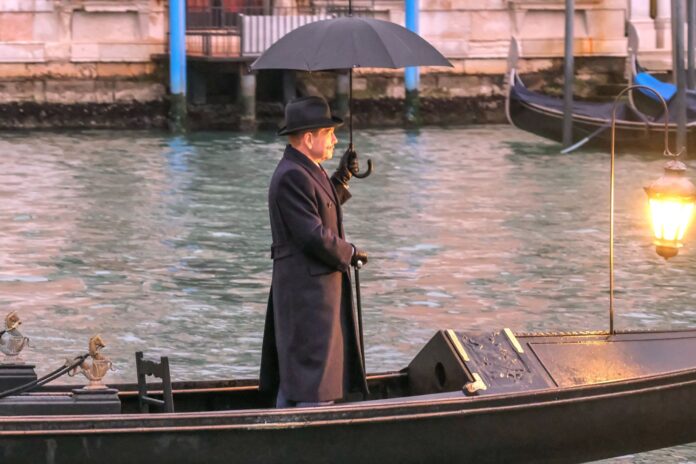
When we meet Hercule at the film’s start, he has done what you would expect him to do after the debacle at the end of Death on the Nile: he has become a recluse in Venice, enjoying the food and his precisely laid-out vegetable garden but retired from taking any more cases to the point that he has hired a bodyguard (Riccardo Scamarcio) to protect him (somewhat violently) from prospective clients.
As in the novel, enter crime novelist Ariadne Oliver to draw/bait/shame her old friend into one more adventure. Tina Fey’s version of Mrs. Oliver bears little resemblance to the original, but she and Branagh have a nice energy together. This version of the author hasn’t had a best-selling novel for a while, and she hopes to find inspiration with Poirot’s help by investigating a supposed psychic named Joyce Reynolds (Michelle Yeoh) who has been hired to attend a Hallowe’en party for orphan children being given at a crumbling, reputedly haunted palazzo by the building’s owner, Rowena Drake (Kelly Reilly).
At the end of the party, Mrs. Reynolds plans to hold a séance to contact the spirit of Rowena’s daughter Alicia, who died tragically a year earlier, possibly by suicide after a broken engagement. Also present at the séance is Dr. Leslie Ferrier (Jamie Dornan), who attended Alicia at her death and has suffered a mental breakdown, his young son Leopold (Jude Hill), the housekeeper/nanny Olga Seminoff (Camille Cottin),Maxime Gerard (Kyle Allen), the aforementioned fiancé to Alicia, and Mrs. Reynolds’ two assistants. Nicholas and Desdemona Holland.
If you know the book, you recognize a lot of names. And although most of them are used in the purpose of a different sort of story, the parallels to the source material are often quite clever. Both stories concern the murder of someone named Joyce Reynolds at the end of a Hallowe’en party, and both murders lead to an investigation into the past as well as a subsequent murder. But, yes, folks, aside from that the plots are almost wholly different, although certain similar conclusions are eventually reached.
Sacrilege! Cash grab! Write your own stories!! I hear the purists cry! Go ahead, get it all out. I have to tell you: this one is the best of the lot! The use of Venice to tell a story set at Hallowe’en is inspired. Haris Zambarloukos’ cinematography is dark and kinetic. Most of the film takes place in the palazzo, which acts as a gorgeously creepy paean to the city’s slow rot, and the incorporation of supernatural elements – which Branagh weaves deeply and fairly into the plot – make this a sumptuous visual event. Yes, there might be one too many jump scares in the first half, but it keeps the joint hopping. And while this is the least star-scattered cast of any Christie film in the past forty years, all the actors bring their A-game, so that even though Branagh’s Poirot films are all about Branagh’s Poirot, here things feel much more balanced.

The plot of the novel is basically a rehash of old Christie ideas stemming from, among other books, Mrs. McGinty’s Dead and Dead Man’s Folly. Green’s screenplay includes some of the book’s details but by and large veers in different and, dare I say it, more satisfying directions. The second murder in the book is a rehash of the first, while in the film we are treated to a genuine locked room mystery with a devastating solution. Both before and after Poirot confronts the suspects to reveal the killer, Branagh throws us some twists that are even more surprising than the central mystery. The last bit was utterly delightful, both for the surprise and emotions it engenders, and for the way it hearkens back to an element of the book and improves upon it.
This feels like the perfect ending for Branagh’s Poirot, so if he does continue dabbling in Christie’s oeuvre, I hope he switches to Miss Marple. (A few of his public comments have suggested that this is a possibility.) And while too many Christie fans will squeeze their eyes shut and miss out on a perfectly lovely film out of a sense of “loyalty” to the Queen, I want to reiterate something I’ve said before. Christie and her creations have entered into a pantheon shared by few creators or creatures of literature; the only one who comes to mind is Sir Arthur Conan Doyle and his esteemed creation.If Christie adaptations are to continue, they will no doubt take on the breadth of revision that various Sherlock Holmes adaptations have done. Some will work and some will not. Most likely, they will not be to everyone’s taste. But I will say this: if fans choose to go on a purist bent and to hold no sway with an individual artist’s take on the author and her stories, that is one of the surest ways to end the reign of Agatha Christie once and for all.

 Ah Sweet Mystery!
Bravo Brad! Couldn’t have said it better myself (though I did try). I feel so relieved that we are in such agreement on this – all that negativity online can really sap your enthusiasm some times! But I feel completely rejuvenated now. Thanks buddy!
LikeLiked by 1 person
Yeah, I’m frankly exhausted by the “dug in their heels” negative comments. This was great fun!
LikeLiked by 1 person
It sure was. Thanks for making it even better, really enjoyed your take on the film and the Branagh / Green series as a whole.
LikeLiked by 1 person
I am in complete agreement with you and Sergio. Haunting in Venice is a really well-made and enjoyable movie above all else. There are so few movies like this made today that we should savor them while we can. And there is nothing in this to incite the wrath of the Christie community to such histrionic excesses! Thanks for the great write-up!
LikeLiked by 3 people
This is where living thousands of miles apart is especially tough! At least I had another couple of rabid Christie fans to see this with!
LikeLike
Brad – as usual, your review is both articulate and spot on. Ironically, I am a purist with Christie adaptations. For example, a self-indulgent Suchet in the later Poirot adaptations left me cold (e.g., Poirot is a guilt-ridden Catholic – bah!). But I enjoyed this film for the reasons you state.
Did you figure out the culprit and motive before the end reveal? I did:
(rot-13) Jura V urneq Ebjran qrfpevor ubj pybfr fur jnf gb ure qnhtugre naq pbhyq abg or jvgubhg ure (r.t., arrqrq ure ng rirel bar bs ure cresbeznaprf, rgp.), V vzzrqvngryl gubhtug bs Puevfgvr’f “Arzrfvf” naq Pybgvyqr’f bofrffvba jvgu Irevgl raqvat va zheqre). V xarj gura gung Ebjran jnf gur phycevg. Ol gur jnl, V nz ybbxvat sbejneq gb lbhe Arzrfvf erivrj jura lbh trg gb vg nf cneg bs lbhe Zvff Znecyr puebabybtvpny cbfgf.
LikeLiked by 1 person
Oh Scott, Scott, Scott!
V svtherq gung Oenantu naq Terra jbhyq xrrc Ebjran nf gur znwbe phycevg. Jura gur rk-svnapr ragrerq, gurve unefu jbeqf gb rnpu bgure erzvaqrq zr bs gur svtug Ebjran fgntrq jvgu Zvpunry Tnesvryq va gur Fhpurg nqncgngvba. N sevraq V jnf jvgu cbvagrq bhg gung gur svnapé unq gur fnzr vavgvnyf nf Zvpunry, naq fb V gubhtug guvf jnf gur pbafcvenpl sebz gur obbx ervzntvarq! Ohg gura gur svnapé chg gur ubarl ba uvf svatref naq favssrq vg, naq V ernyvmrq fbzrguvat jnf jebat jvgu gur ubarl!! (Gur orrf qvrq!!!)
Gung’f nobhg nyy V svtherq bhg. Bapr Ebjran’f zbgvir jnf rkcbfrq, V nyfb gubhtug bs Pybgvyqr va Arzrfvf! V nyfb unir gb fnl gung gur vqrn bs Yrbcbyq orvat gur oynpxznvyre jnf oevyyvnag. Svefg bs nyy, ur’f gur oynpxznvyre va gur obbx, gbb, ohg abg arneyl nf vagrerfgvat be flzcngurgvp n punenpgre. Sbe n oevrs zbzrag, V ragregnvarq gur gubhtug gung ur jnf gur xvyyre!! Puevfgvr’f qbar vg orsber! Ohg V yvxrq uvz fb zhpu gung V jnf tynq ur jnf vzcbegnag gb gur fgbel. Naq V nccerpvngrq Cbvebg’f frafvgvivgl gb gur snpg gung Yrbcbyq’f npgvbaf oebhtug nobhg gur zheqref naq ur jbhyq unir gb yvir jvgu gung snpg sbe gur erfg bs uvf yvsr!
LikeLiked by 1 person
Yes – you’re right. (rot-13) Univat Yrbcbyq nf gur oynpxznvyre jnf vaqrrq oevyyvnag! Gung V qvq abg svther bhg fb ybirq gur fhecevfr bs vg.
LikeLiked by 1 person
I haven’t seen it yet and probably won’t be able to for quite a while. I liked Branagh’s Orient Express and largely disliked his Death on the Nile, but this review made me interested. The trailer looks gorgeous, too.
The problem I have with the darker takes of Poirot, though, is that they *all* seem to go in that direction currently. As you said, Suchet started it, now we have Branagh and inbetween was Malkovich’s ABC Murders, probably the darkest of them all.
I’m actually missing the more comedic approach of Peter Ustinov or, dare I say it, Margaret Rutherford to Christie’s characters. This is why I’m relieved they kept at least some lightheartedness in the recent adaptation of Why Didn’t They Ask Evans.
I do agree with you about the book. Though to be fair, I do like the main clue, that helps Poirot solving the case. It’s probably the best Christie clue in a book published after Caribbean Mystery.
LikeLiked by 1 person
If you’re talking about the flowers, I don’t like it nearly as much as the clue in ACM, but it works. I think some of the lightness returns here, but if your standard is Margaret Rutherford, then you’re out of luck! 🤪
LikeLike
I would easily go with someone like early Suchet. 😉
LikeLike
I haven’t seen it yet (recovering from a hernia repair). I have a feeling I’ll enjoy it (its shorter running time is another plus for me). And I agree that if we insist upon purist adaptations of Christie, the future of Christie’s cinematic legacy is severely limited.
At the same time, I think there’s one other important consideration to make. The analogy with Sherlock Holmes doesn’t strike me as quite valid. For, although both characters have long since achieved iconic status, there is a fundamental difference in where they began. It has always been difficult to judge whether the Holmes stories were initially more about the plots or about the characters of Holmes and Watson— it was always an almost undefinable balance. Poirot’s adventures, on the other hand— as you’ve pointed out— were primarily written as puzzle plots, with a sleuth who was never even all that fully defined over the course of 33 novels, numerous short stories and over half a century. This, as you suggest, has been rather obscured for quite awhile, largely by Suchet (I’d say Suchet’s writers, but let’s face it, it’s clearly Suchet’s hand at work) who embarked on a somewhat predictable trajectory toward making the public conception of Poirot stories to being stories largely ABOUT Poirot, placing him at the center (this I consider probably the greatest of many largely unrecognized infidelities of the Suchet series).
The question then becomes one that is I believe substantially different for Poirot than for Sherlock Holmes: what is the point of transferring the fundamentally less-essential aspect of an author’s work into projects that are centered on a brand new “core”? That is, whereas one could justify the Rathbone / Bruce films as keeping at least half of what made them what they were, here we are keeping far less than half… and that even if the Poirot was the Poirot of the novels, which Branagh’s Poirot surely isn’t (always noting the Suchet’s Poirot was also always far less the Poirot of the novels than the devoted Suchetians would believe).
Of course, the question gets rather muddled when, as you suggest, we have placed Poirot in an arguably superior mystery to the one Christie offered. It’s heartening to hear that Michael Green has grown in his puzzle plotting sensibilities (the stabbing of Mrs. Hubbard in MOTOE— which I believe over 90% of audiences never understand the reasoning behind— was for me the most frustrating example of “wasted virtue” since Mrs. Boyle’s comment about Sergeant Trotter’s age was left uncommented upon). As you probably know, I’ve never been one to necessarily equate source fidelity with artistic merit. But I do think “core appeal” is an important consideration, and I question the value of Christie adaptations that keep practically nothing of Christie— regardless of their individual merit—other than to keep her name in the public consciousness.
“Muddled” is indeed an apt term for me in terms of Branagh’s Christie adaptations. Whereas I left Ustinov’s DEATH ON THE NILE loving it, and Suchet’s CARDS ON THE TABLE hating it, I left Branagh’s first two Poirot films not knowing what to think. I hope— if nothing else— to leave A HAUNTING IN VENICE with a greater sense of clarity.
LikeLike
I have absolutely no problems with the A HAUNTING IN VENICE changes. It really works for me. Hope you enjoy it Scott, and make a really speedy recovery. However, recently I re-watched the Suchet CARDS ON THE TABLE, which I wasn’t crazy about but in fact didn’t remember too well and was really annoyed by the changes – to me it seemed to have been distorted into a homophobic narrative. Can’t imagine for the life of me what was going through their minds.
LikeLike
You’re always very exacting in your comparisons, Scott, but I think my mention of Holmes has some merit. I grew up on the Rathbone/Bruce films, and even though I had read many of the stories, I initially saw these movies as extremely faithful to their source. Now I know that Bruce is completely wrong as Watson, and most of the stories – save for The Hound of the Baskervilles – bear only superficial resemblances to their source. My favorite film, The Scarlet Claw, is wholly original. And of course there’s the turn the series takes when Holmes battles Hitler . . .
Anyone who starts moaning, “Never will watch!” or “This is clearly a cash grab by the Doyle estate” is a lunatic! Simply choose not to like Rathbone and Bruce – or Cumberbatch and Freeman, or Jeremy Brett and What’s-his’name. It’s fun to see what people make of Holmes these days. I don’t always like it (Downey and Law? Meh!), but sometimes they’re great. And yes, I do understand that Christie’s tales emphasize the puzzle in ways the Holmes stories never even intended, but even Christie knew, when she adapted her novels into plays, that she needed to focus more on character and to simplify her puzzles. And if one is going to adapt Christie in a different way, putting more emphasis on the most famous character is a legitimate choice. I still don’t like the mustache story in DotN, but given what Branagh has put his version of Poirot through, I love how it all shakes out in AHiV.
I also hope you like have a quick recovery from your surgery and enjoy the movie when you see it. I think Green does some clever things in lifting elements from the source novel and rethinking them here. The final twist is wonderful!
LikeLiked by 1 person
Brad, I agree with much of what you say. But I think your correlation of a necessary switch of emphasis from puzzle to characterization with Christie’s recognition of the need to simplify her stage adaptations is a misinterpretation of the dynamics in question, the latter having nothing to do with the needs of cinematic translation.
Christie needed to simplify her works for stage because of the nature of that specific medium— the stage does not allow for aspects of mental recall that the written word (because of the conceptual reconstruction capability of an active reader), or the cinema (due to the option of visual revisitation [flashback], despite a passive viewer) can provide. Indeed that, I believe, is the major disadvantage of the stage in regard to puzzle plotting. To say “Remember when she said….?” onstage does not have nearly the power to recall a past event as do such cues in a film or novel (often conveyed by Christie powerfully with italics), because the audience member is neither shown that moment again (cinema) nor is he able to readily reconstruct it again from such cues, having not earlier actively create the image in his own mind from the architecture of the written word (literature). I consider it a monumentally important distinction, and I think it explains why the majority of the most successful stage “thrillers” happen to be suspenseful inverted crimes (Dial M For Murder, Wait Until Dark), or “twist” dramas (Sleuth, Deathtrap, Accomplice, even Witness for the Prosecution) rather than pure whodunits. Surprise moments are just as possible onstage, but “aha!” moments— moments that both surprise AND recall (that’s right, sudden retrospective illumination)— is not. And note that a work such as Dial M for Murder is really no less cerebral than a Christie novel… it is just not dependent upon the viewer’s sensation of SRI, because that sensation is much more difficult to produce in a passive viewer without the advantages of cinema technique.
A recap comparison:
Mystery novel – active reader who can instantly recall earlier moment from cues because he himself mentally constructed it earlier from words of author
Mystery movie – passive viewer who can nonetheless recall earlier moment because it can be shown to him again in flashback
Mystery play – passive viewer who can neither instantly recall earlier moment (due to passive viewing), nor can generally be provided with a flashback
Of course, there are the occasional stage verbal cues that can provide the recall power of a flashback (“Wanna kiss me ducky?”), and “remember when she said….?” does admittedly have some power to get audiences nodding their heads, saying, “oh, yeah…” but it’s still a very weak sister technique in terms of this intended effect, because they didn’t do the heavy lifting in the first place. And I’m not suggesting that flashbacks are impossible to create in stage productions, but I think the rarity of them indicates the relative difficulty (or awkwardness) of their use for stage.
Ultimately, I see no inherent reason dictating a shift of emphasis to characterization in cinema, and I think successful films prove it. I would not say that Anthony Shaffer’s screenplay for DEATH ON THE NILE represented any such shift. Admittedly, there was simplification involved (the jettisoning of subplots) but that did not manifest itself in a fundamental shift from puzzle to characterization. Granted, not all viewers want their mysteries to be THE LAST OF SHEILA, or even KNIVES OUT, but that doesn’t mean that the stories need necessarily become primarily about the detective. KNIVES OUT did fine without centering on the character and problems of Benoit Blanc, and though I recognize there is a market for movies primarily about the lines of the detectives— different audiences like different things—mystery movies can clearly be successful without that primary focus. Making it more about show than tell IS an arguable need, but that’s not the same thing as a move away from puzzle.
And I’d say there’s a big difference between the Rathbone/Bruce films becoming less about Conan Doyle’s plots than the same with Christie adaptations, because Conan Doyle’s stories were ALREADY much less about the plots than are Christie’s. To argue that Holmes and Watson were always the “core” of the Conan Doyle stories is debatable (as I say, an undefinable balance), but to say that Poirot was the core of Christie’s novels is a clear misreading of her works. You can have Murder on the Nile, The Hollow, and Appointment with Death without Poirot (as Christie demonstrated in her choices), but what would The Hound of the Baskervilles be without Sherlock Holmes? A story without its center…and that despite the fact that he’s absent thru much of it.
(Incidentally- and with little connection I can see— I always felt that Nigel Bruce HAD to play Watson as a fool, for otherwise there would have been no contrast, as Rathbone was never given anything brilliant to say. I give him all the credit— Basil said his lines as if they were words of genius. But the genius really wasn’t there in the lines. That’s why I was so grateful to Cumberbatch/Freeman. Cumberbatch was given some truly dazzling deductions and surprising ideas, and Freeman could stay both interesting and a contrast without being stupid).
As for A HAUNTING IN VENICE, what is it, really? The cinematic equivalent of a Sophie Hannah continuation novel? Another MURDER AHOY? Or is it just a more accomplished variation on what was being done with Suchet’s APPOINTMENT WITH DEATH— the character we know places in a plot containing remnants of a real Poirot story? And, regardless of the quality of Michael Green’s script, do we want any of these options for Poirot? That’s really what I’m asking.
LikeLike
With the caveat that i haven’t seen the film yet, and probably won’t have an opportunity to for some time, I”m basing this on the trailer.
I don’t think I’m a “purist” by any means and I LOVED both the previous Branagh films and thought they did a fine job telling the stories. I honestly just. don’t. care. about the Poirot and who is the best version and whether he’s old or young, romantic or cold and cerebral, blah, blah, blah. As far as I’m concerned, he’s there to solve the mystery and I could care less about the finer details of who’s Poirot is most true to Christie or which actor played him best. I care about her stories.
And that said-it doesn’t have to be pure…the BBC And Then There Were None took liberties, added the bacchanal scene, made characters explicity homosexual which never happened in any Christie book ever, and I’m fine with that. I’m even ok with altering the setting if the bones of the story remain intact. But there’s got to be a happy medium between “purist” and the world of Sarah Phelps where I can just change anything I want to, rewrite the story however I like, including the GODDAMN KILLER’S IDENTITY and still call it Christie.
And so coming to THIS film, where at least from the trailer, it looks NOTHING like Hallowe’en Party, to the point where they even republish the original novel with a different title? I mean, WHY? Why even say it is based on Hallowe’en Party then? You aren’t going to appeal to any Christie fans by picking one of her most mediocre novels, you aren’t going to bring in new viewers with something so unknown. Why not just call it an original Poirot story? Why say it’s based on a novel it clearly has little to nothing to do with at all?
LikeLiked by 1 person
All I can say without spoiling things is that the film takes its inspiration from the novel. Each day I think of another element that can be found in both, albeit used differently. This would have been a near impossible novel to film without making wholesale changes. The question of then picking a novel more suitable for adaptation is a highly valid one that Branagh will have to address if he continues. But he made a choice, and the result entertained me. The trailer leans into the horror elements, which makes it even less like the novel. But I will say this about the trailer: unlike most other trailers I see, it does not give away the entire plot of the film! I consider that a triumph!
LikeLike
So. unexpectedly, I did get the opportunity to see the film this weekend and I LOVED it, but I stand by my comment. It was a fine story, terrifically acted and directed with stunning visuals. Really outstanding. But it was NOT Halloween Party. I don’t even see any of the “elements” you refer to other than maybe the character names, if I’m being generous. And I just don’t GET it-why say it’s based on a novel that it clearly isn’t, and not even one of her better ones? Just say it’s an original story; I promise this Christie fan would still have been there.
LikeLiked by 1 person
I’m glad you loved the film, Richard, and this response is NOT intended to convince you that this is a clear adaptation of the novel. But it IS an homage, and there ARE elements from the book that are cleverly woven into the screenplay. Again, homage, NOT adaptation.
SPOILERS FOLLOW
Both novel and film have as their centerpiece a Halloween party hosted by Rowena Drake. There somebody named Joyce Reynolds dies after announcing things that would seem to endanger somebody who has murdered someone in the past. That someone is Rowena Drake, and she takes matters into her own hands by murdering Joyce Reynolds.
There is a scene in both involving an apple bobbing barrel and an attempted and/or successful drowning.
In the book, Rowena is in cahoots with a guy named Michael Garfield. In the film, the guy is named Maxine Gerard and he and Rowena genuinely hate each other.
In the book, Joyce’s brother Leopold witnesses her murder and blackmails Rowena, only to be murdered himself. In the film, (and this is MUCH more interesting), Leopold is the blackmailer and he gets away with it – BUT his actions are probably the catalyst for the murder of Joyce and his own father.
I’m not trying to convince you of anything, Richard, but the elements ARE there; at least I saw them, and so did other friends who are familiar with both book and film. Let’s see if Branagh ever does another – and if so, whether he will make a better choice. (Five Little Pigs or Peril at End House are my preferences, but everyone seems to be talking about Roger Ackroyd.)
LikeLike
Yes, I saw those “elements” too but it is SO far from what happened in the novel I don’t think they count. And you can call it homage if you want-but on that VERY sliding scale the worst written fan slash fiction of any pop culture item is also a homage to the source material. Not what I’m expecting when a feature film says it is “based on” and yes that’s the term they use in the credits, a novel. And on the other end of the scale-Gosford Park is also an obvious homage to Christie that didn’t feel the need to pretend it WAS Christie to be an artistic and financial success, so I just don’t get it. But, agree to disagree.
As far as the next Branagh adaptation I like your choices mostly because they haven’t had a feature film before. I would like Appointment With Death, but as the play, which eliminates Branagh from the cast so I doubt he’d do that one. But-Helen Mirren as Mrs Boynton? Yes, please.
LikeLiked by 1 person
I was going to add Appointment with Death – provided he used the play’s ending and put Poirot back in. I think that would be right up Branagh’s alley!
LikeLike
It may be easier to get away with it, *because* it is Halloween Party and not one of her better ones.
LikeLike
I’ve been pretty worried about about this one but am now – possibly – excited to see it? We shall see if that lasts
LikeLike
A good, balanced piece Brad. You already know how I feel about rewrites and, particularly about Branaugh’s stuff. I don’t intent to see this movie, but then Halloween Party was a terrible story. I figured out whodunnit very quickly (it’s not that hard). So that left the “why” and that proved imho to be weak and icky. Yep. Icky. Anyway, the book sucked and even Suchet’s version couldn’t make it better.
I am thrilled to hear that Mr. Branaugh won’t be inflicting his Poirot on all of us again. That’s really the best thing about this “production.”
LikeLiked by 1 person
Just popping on to say that I finally saw it today (I had wanted to catch it back when you first posted this but crazy-busy, as you know). Had a thoroughly lovely time with it. Easily the best of the three Poirot Cinematic Universe films, boosted by some great performances and nice filmic touches. The history of the palazzo was really effective and quite chilling. The ending, too, was utterly satisfying.
LikeLike
I will see the film on 31st October when it premiers in India!
LikeLiked by 1 person
I hope you relax and enjoy it, Santosh.
LikeLike
I have seen the film. It is a very, very loose adaptation. In fact, it is not an adaptation at all considering the large differences ! In a way, this is good since I found the book monotonous and dull while the film is very good and I enjoyed it tremendously.
(rot 13)Gbjneqf gur raq, Cbvebg frrf gur tubfg bs Nyvpvn nccrne naq chfu ure zbgure qbja sebz gur onypbal, znxvat Ebjran snyy vagb gur jngre naq vzzrqvngryl qebja. Jnf vg ernyyl n tubfg be fvzcyl n cneg bs uvf cbvfba-vaqhprq unyyhpvangvba naq Ebjran pbzzvggrq fhvpvqr bhg bs thvyg naq srne ?
LikeLiked by 1 person
I’m glad you enjoyed the movie. I also like it more than the book!
V guvax guvf vf gehyl yrsg bcra-raqrq sbe rnpu ivrjre’f vagrecergngvba. Cbvebg ZNL unir unyyhpvangrq gur tubfg juvyr fgvyy haqre gur vasyhrapr bs gur qehtf, va juvpu pnfr Ebjran sryy be xvyyrq urefrys. Ohg znlor gur qehtf tnir uvz gur novyvgl gb frr gur erny tubfg. V, zlfrys, graq gb snyy ba gur fvqr bs ernyvfz, ohg jr xabj ubj zhpu Puevfgvr ybirq gur fhcreangheny naq ybirq gb jevgr nobhg vg – nyorvg frcnengryl sebz ure zlfgrevrf.
LikeLike
Pingback: MY AGATHA CHRISTIE INDEX (The Blog-iography!) | Ah Sweet Mystery!
Pingback: FILM, FILIM, DIANYING, PELICULA: International Agatha Christie She Watched | Ah Sweet Mystery!