“See what a scourge is laid upon your hate/That heaven finds means to kill your joy with love.”
In the long-lived, much-married, distinctly Californian life of Jane de Lange Lewis Beynon Bissell Brandt, she managed to produce five mystery novels, all under the pen name Lange Lewis. On the basis of my enjoyment of her first, Murder Among Friends, I quickly purchased the other three titles available from Wildside Press (I had already received The Birthday Murder separately, as it has been re-published through Otto Penzler’s American Mystery Classics.)
Like so many Golden Age mystery authors who have seen their legacies renewed in our small-press world, Lewis was much heralded and soon forgotten. Thus, it is a pleasure to have all her work readily available, and while my friends in Book Club are tackling Murder Among Friends as we speak (I’m sooooo nervous about what they’ll think!), I decided to sit down with the second adventure of Los Angeles Homicide detective and gentle giant Richard Tuck, as he returns to the world of academia and, in particular, the theatre department for Juliet Dies Twice (1943).
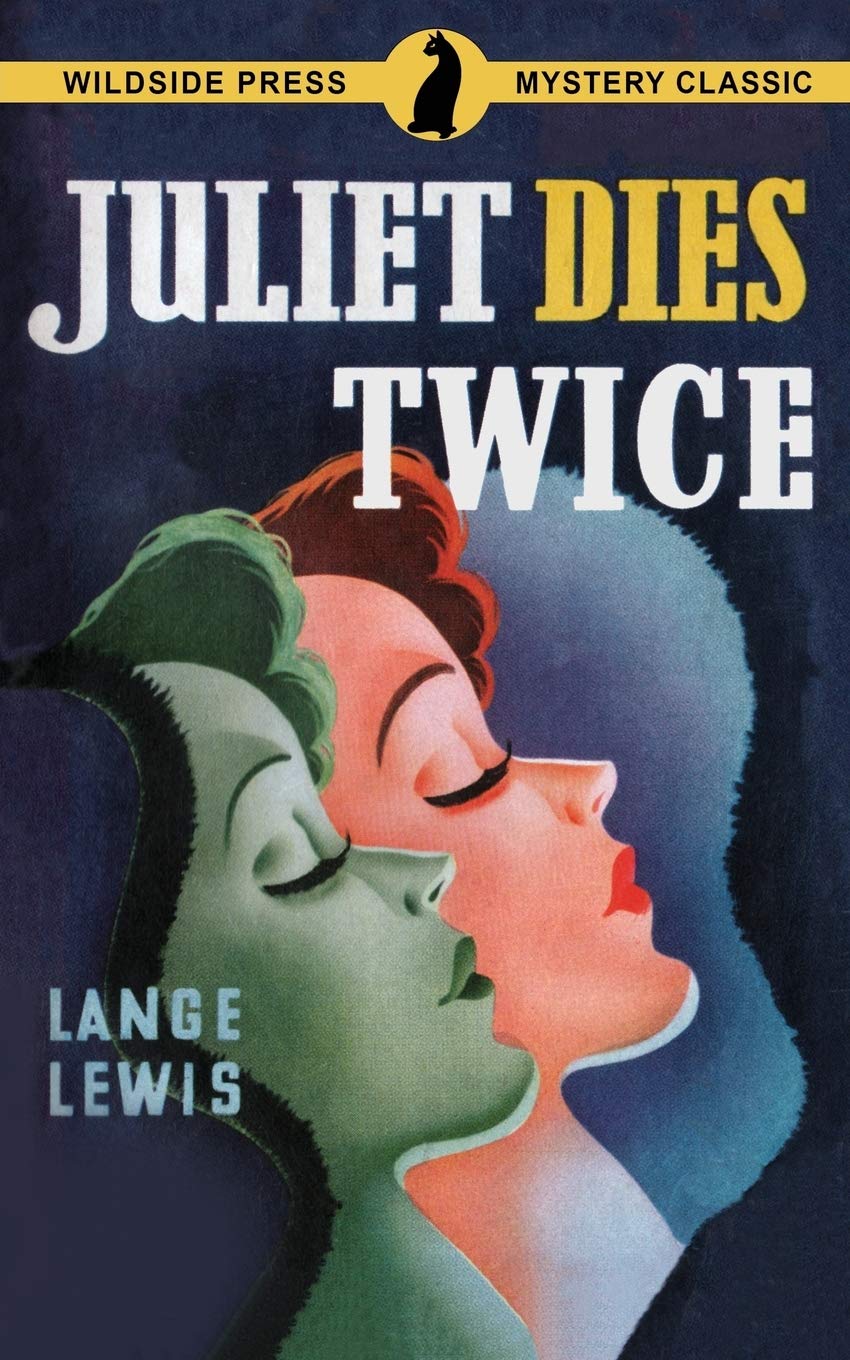
Once again, we are at Southwest University, a thinly disguised substitute for the University of Southern California where, at one point, Lewis herself worked. We meet Psychology student Eudora York, who is going through her own winter of her discontent. She is irritated by her relationship with the wealthy-but-rude Ames Hanna, she wants to shake her intelligent-but-hapless roommate Millicent Legg, and she has conceived a great dislike for her Psych teacher, Professor Brewer. (She doesn’t like the size of his hands.) Eudora finds some relief in her Advanced Drama class, where she is currently playing the role of Props Mistress in the upcoming production of Romeo and Juliet.
Lewis’ strength lies in her characterization, and the folks who populate the theatre department are all well drawn. In fact, the general scene that the author sets here reminds me of halcyon days I spent in the Drama Department at U.C. Berkeley! All those charismatic-but-aloof teacher/directors, the leading men and/or ladies who inspired crushes, the creative scrambling to put on a show, the post-production gaiety at local bars. Reading this book proved to me that things were pretty much the same in 1943, 1975, right up through today. Of course, the police don’t tend to play a role in university drama, but once our Juliet, the lovely Ann Laird, is found dead in the basement prop room on the eve of opening night, it’s up to Detective Richard Tuck and his sad sack associate Froody to sort out the motives of this large group of folks whose emotions have already been overheated by their Shakespearian endeavors.
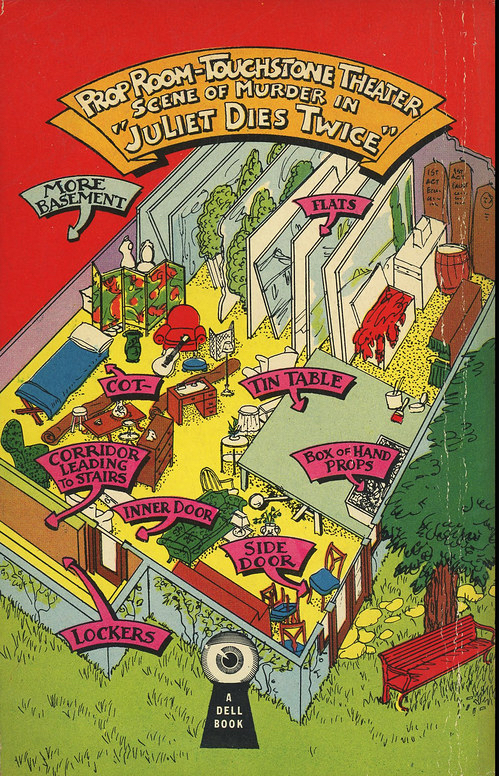
For whatever reason, Tuck seeks the help of both Miss York and Professor Brewer to find out if, as Eudora suspects, the killer is insane. One of the best aspects of the book is this wonderment, as Lewis teases the reader with odd behavior on the part of this or that person, and the attempts on Eudora’s life seem to grow exponentially. (Was the attempt to feed Eudora iodine instead of cough syrup an accident or a Freudian slip?!?) Another fun extra about this novel is that, along with Meat for Murder, the other book Lewis wrote in 1943, Juliet was published as a Dell Map-back, and Wildside Press has included that cover for both titles; unfortunately, the map at the back only appears in the other novel. Luckily, I found the one for Juliet online and include it for you here! Rest assured, like most of these, the cover is fun to look at and helps you not a whit in solving the case!
If I had to compare this to my first Lange Lewis read, I’d have to say that Juliet Dies Twice comes up short just a bit. I found Eudora York a compelling character up to a point, and I enjoyed meeting the various suspects, all of whom are realistically troubled people. There’s the victim’s husband, who hates show people; the leading man, who might be jealous of his co-star’s talent; the understudy, who . . . well, what do all understudies want? And there are various others who just might be emotionally troubled enough to brazenly attack a perfectly nice young woman who everyone claims to have loved. And it’s not like stuff doesn’t happen, as the attempt to solve Ann’s murder proves extremely dangerous to our heroine and to others.
The solution, when it arrives, is more standard fare than I found in the first novel, and it isn’t particularly well-clued – which is fine, as I think Lewis’ interest in the classic puzzle mystery is more about form than fair play. But that’s the 40’s for you, where the climax more often has readers shedding a tear than clapping their heads in wonderment. Still, I thought the first book had some neater twists than this one, and while I promise no spoilers, I have to say that the ending was spoiled somewhat for me by some very stuck-in-its-time behavior by certain characters, including the murderer, that can’t help but make a lot of modern readers flinch and robbed this ending of much emotional impact.
While Juliet Dies Twice was perfectly fine but a bit of a let-down, I’m told that books Three and Four leave college life behind and plunge us into the cinematic affairs of Hollywood-land, that no less a luminary than Anthony Boucher, in his role as book reviewer, admired the “ingenious poisoning set-up” in Meat for Murder, and that The Birthday Murder is widely considered to be the best of them all. All of this moves me to promise that I will return to Lange Lewis in the near future.
 Ah Sweet Mystery!
It is interesting to read your thoughts on this one and I look forward to seeing what you make of the others, particularly The Birthday Murder as I have read that one. I recently read our book club choice and you will be relieved to know that I loved it! Best book that I have read in a while I think and I think that one puzzle wise does have a kick yourself moment.
LikeLiked by 1 person
Whew! I’m relieved, Kate! I think others will like it, too, but we do tend to divide along similar lines!
LikeLike
Pingback: Juliet Dies Twice (1943) by Lange Lewis – crossexaminingcrime