“On Monday afternoon, my beautiful baby boy, Teddy, went missing from my father’s yard. I urge anyone with any information as to where he is to please call the police. Anything, even the smallest bit of information, could help find him. So, please, no matter how trivial you think it might be, please call.
“If there is somebody out there who is holding Teddy, they need to give him back to me. Please. They can drop him off at a safe place – a hospital, a church, somewhere he’d be found . . .
“He is a very happy, lovely boy. Please . . . please somebody bring him home to me . . .”
Let’s face it: in kids’ mysteries of old, the stakes were pretty low. Smuggler’s Cove might be invaded by actual smugglers. Hidden treasure might be discovered in the Old Tower . . . or the Hidden Clock . . . or the sandbar in back of Great-Aunt May’s summer beach house. Invariably, the culprit would be named “Stinky” Rattigan or Ladislav Malinkokoski. Krime for Kids used to, well, stink! But modern- day young people have never had it so good: in the crime fiction being written for them, the stakes are high, both in terms of the crimes characters have to solve and the “real-life” troubles young protagonists face.
I happened to attend our local library’s monthly book sale last weekend and came across a fine example of this from an author about whom I knew nothing. The Goldfish Boy is the 2017 debut novel by British author Lisa Thompson. According to her website, Thompson now has a dozen novels out, and they span a wide variety of genres. What they all seem to have in common is a focus on marginalized children who, put in extreme situations, find their way to a more promising future.
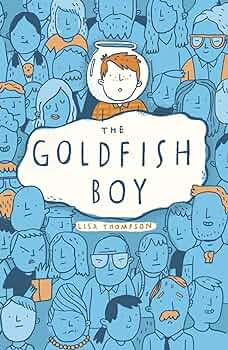
And when The Goldfish Boy begins, 12-year-old Matthew Corbin is saddled with a huge problem that is definitely holding him back. For reasons that become more and more clear as the book goes on, Matthew is suffering from a serious case of Obsessive-Compulsive Disorder. The condition began at the age of seven, and for five years he has struggled in secret. Yet at the start of our story, Mattie’s condition has worsened for some reason, resulting in his having missed school for weeks and confining himself to certain rooms in his home. He spends most of his time cleaning these rooms and, savagely and painfully, himself. The rest of the time he stares out the window of either his bedroom or the family office in order to watch his neighbors in the street below.
There are only seven houses on Matthew’s cul-de-sac, and everyone seems perfectly normal. Kindly old Mr. Clarke next door is obsessed with his garden; Penny and Gordon are the charming older couple who act as surrogate parents to Matthew’s mother; and Mr. Jenkins, Matthew’s health-nut of a P.E. teacher, whose wife is expecting a baby and never stops smiling about it. There are even other kids Mattie’s age: Jake, a boy who used to be Mattie’s best friend and is now his tormentor, and Melody, an oddball girl from Mattie’s class who makes mysterious trips to the local graveyard.
There’s even a haunted house, in a manner of speaking, for while the other six houses all look identical, the Rectory, home to Old Nina, the reclusive widow of the late Vicar, has a very different appearance:
“Built from blood red bricks, the Rectory looked like a guest at a Halloween party where no one else had bothered to dress up. Its front door was black, with two triangular windows at the top that were covered from the inside with some old cardboard. Whether it had been put there to stop the drafts, or just stop anyone from peering in, who knew? . . . It dug its hundred-year-old foundations in and somehow managed to stay, like a rotten old tooth.”
One day, Mr. Clarke’s daughter shows up with her two small children and leaves them in her dad’s care while she takes a month-long job in New York. Stuck in his house, Matthew watches this exchange, and over the coming days he notices a lot of other things, too – like how out-of-control little Casey and Teddy seem to be, and how much Casey seems to loathe her baby brother, and how angry the children’s behavior makes kindly old Mr. Clarke. One morning, Mattie notices Teddy playing alone in his grandfather’s front yard, ripping the petals off Mr. Clarke’s beloved roses. At some point Mattie looks away – and Teddy disappears.
The book’s cover certainly trumpets the mysterious aspects of the novel therein. The tag line on the front is “The perfect crime has an imperfect witness,” while the description on the back describes the book as “a fresh, contemporary spin on the classic whodunnit (that) will keep readers guessing until the end.” The spin on Amazon is “Rear Window meets The Curious Incident of the Dog in the Nighttime.” To some extent, all of this is perfectly fair. Matthew’s OCD keeps him in self-imposed exile and makes it impossible for him to think straight. And once he decides that it is up to him to solve the case of who took Teddy, he begins to run afoul of the police, who find both his condition and his theories less than credible.
Thompson does a fine job of bringing the characters to life and giving them dimension. A few of the “nice” people we meet turn out to be genuinely disturbing characters, while some reveal hidden depths of goodness and strength as the neighborhood comes together to deal with the crisis. This, of course, includes Matthew, and again Thompson strikes an effective balance between crime story and the coming-of-age of a boy in desperate need of help. Some of the plot turns are predictable: you just know that, sooner or later, Melody and/or Jake will switch from foe to friend and help Matthew, both with his sleuthing and his malady. But as the kids consider each of their neighbors in the role of kidnapper, Thompson simultaneously builds a case against and casts doubt on the guilt of every resident.
Perhaps I found this an especially compelling read because of my own childhood struggles with OCD. For me, the trigger was my family moving to a new city and my attendance at a school that proved to be a hostile environment. (Seriously, folks, tell your kids to be kind and welcoming to every new student they meet!) In Mattie, I recognized a kindred spirit: although his condition manifested itself much more severely than mine did, I really felt for the kid as his compulsive behavior wreaked havoc with his daily life and happiness.
In the end he is no Sherlock Holmes, but Mattie’s concern for Teddy unleashes an inner strength that helps him solve the case and moves both our hero, his family, and his community closer to self-healing. In the process, a great many secrets are unearthed, and the mystery of what happened to Teddy reveals to its readers some of the complex mysteries of human behavior.
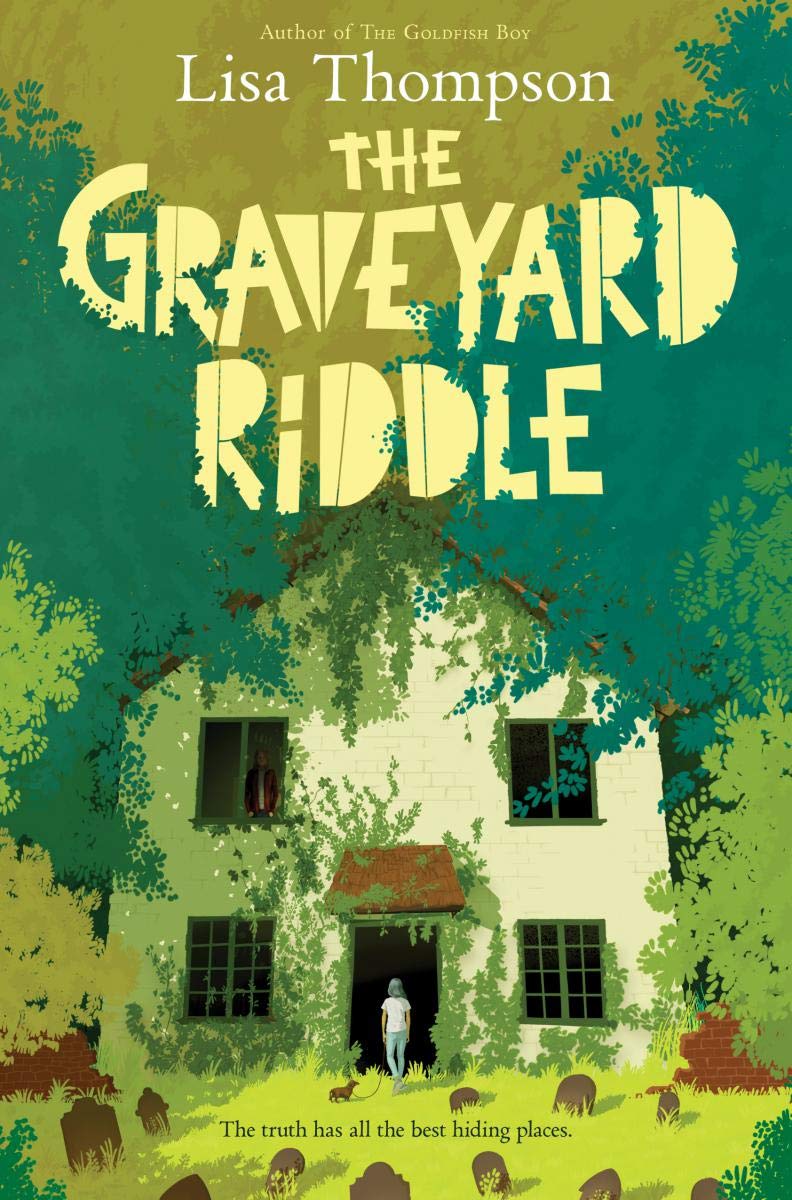
Thompson returned to the cul-de-sac a few years later for a sequel called The Graveyard Riddle. That book features Matthew and Jake, but its focus is on Melody. And while it doesn’t sound exactly like a crime novel, I have a feeling that readers of The Goldfish Boy (myself included) might have to pick it up to check and make sure Mattie’s doing okay. These days, it’s nice to read a book that not only moves you but gives you hope.
 Ah Sweet Mystery!