It’s Leap Day, everyone! Every four years, we gather together 1440 minutes and set them before the people. It’s a gift of time! It’s an acknowledgement of our limitations at monitoring the whirl of planets and the time flow of the cosmos. To me, it’s more unnerving than Halloween and more deserving of celebration.
When I’m unnerved these days, I turn to Erle Stanley Gardner. Oh, but I promised that I would give a pause to all the Perry Mason I’ve been reading. No problem – there’s always the hilarity of Cool and Lam, whom I have visited only once before and to whom far more attention must be paid. But today, since it’s Leap Day and everything is a bit bizarre, I’m going to return to Gardner’s own Bizarro World (Remember, Superman fans? “Us hate beauty! Us love ugliness!”) where everything from the Perry Mason-Verse is flipped! Instead of the big city, we’re in rural Los Angeles County (think Ventura), and instead of a canny criminal defense attorney for a hero, battling the thick-headed legal system on behalf of his innocent clients, we have an earnest handsome District Attorney, sticking by the law in order to put the criminals in jail and keep them there.
Doug Selby, the new D.A. of Madison City, appeared in nine novels between 1937 and 1949, and so far I have enjoyed the first two without being particularly wowed by either. In The D.A. Calls It Murder (1937), Selby wins election over a rival whom it is hinted is part of a corrupt political machine, along with the police chief and the editors of The Blade, one of the town’s two newspapers. Selby immediately lands in hot water, but with the help of fellow electee, Sheriff Rex Brandon, (think Paul Drake if he was played by Lorne Greene) and crusading reporter Sylvia Martin from The Clarion(the honest paper), Selby tries to clean up the town, case by case. Then followed The D.A. Lights a Candle (1938), where Selby goes up against the most powerful family in town . . . not a good way to garner support for re-election.
The Selby books are Westerns couched in mystery terms. Perry Mason reminds you of a P.I. from a Hammett tale or a film noir, Doug is the epitome of a Frank Capra hero: earnest, honest, and committed to the people. That’s not to say Selby is anybody’s sap! Along with that open face and broad shoulders, there’s a keen brain at work, and with the police department, some of the press, and (so far) a shadowy network working hard to bring him down, Selby has to stay ahead of the game at every moment. Having the Sheriff and Sylvia on his side helps – although Sylvia Martin, potential love interest, is no Della Street. She’s like the girl reporters in those same Frank Capra movies, the ones played by Jean Arthur or Barbara Stanwyck, who start out all cynical and then melt before the nobility of Mr. Deeds or Smith. Sylvia also strikes me as the prototype for another girl reporter, one Lois Lane of the Daily Planet, who debuted a year after Sylvia did in Action Comics #1, also the first appearance of one Kal-El of Krypton, alias Clark Kent of Smallville, a.k.a. Superman.
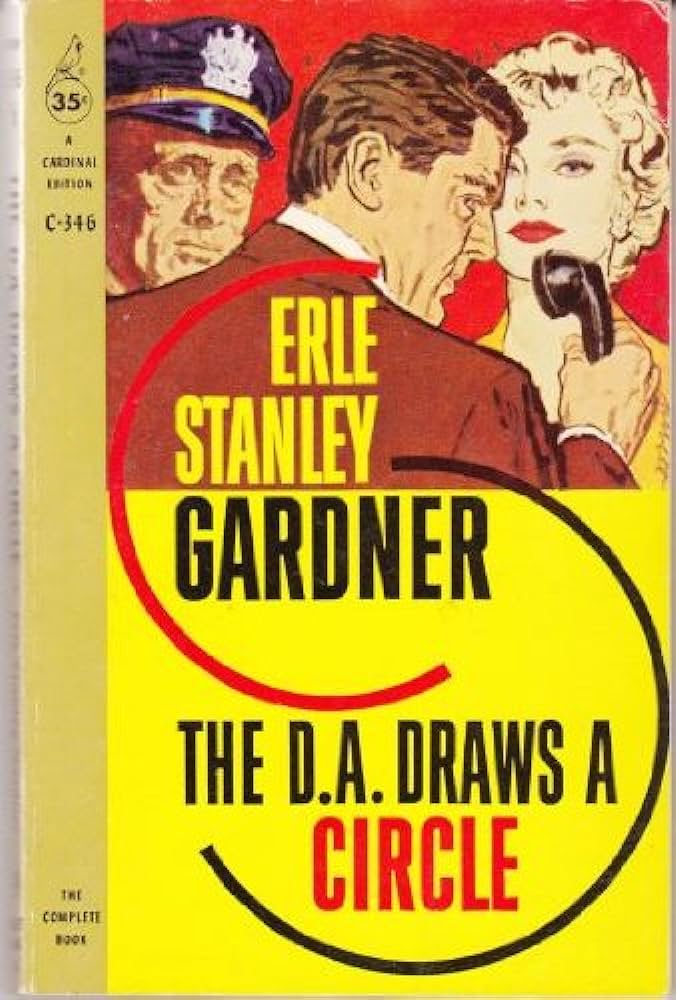
The trio of Selby, Martin, and Brandon form a rather pale parallel to the Dynamic Trio of Mason, Street, and Drake. But in Book Three of the D.A.’s adventures, 1939’s The D.A. Draws a Circle, things get much more interesting with the introduction of Selby’s most interesting adversary yet: Alphonse Baker Carr, or “Old ABC” as he is affectionately known by the gangsters and murderers in need of the world’s greatest defense attorney.
If Doug Selby is Perry Mason if Mason were working for the city and devoid of cynicism and trickery, A.B. Carr is Dark Mason, a man who cares nothing about the innocence or guilt of his clients (the guilty pay more), who is on the make for wealth and prestige, suing for damages anyone who gets in his way, and taking the law in his own hands to get his clients off. Of course, Perry Mason does the same thing all the time – but we’re always rooting for him and laughing at the sputtering D.A. who curses the criminal attorney for making a mockery of the law!
In The D.A. Draws a Circle, Carr does all the things Mason would do, but now they are the actions of a villain, and we are meant to root for Selby, the Man of the People, as he attempts to maneuver around Carr’s tricks in order to bring several reprehensible people to justice. It’s an intriguing flip, even if the results are never quite as much fun as in a Perry Mason mystery.
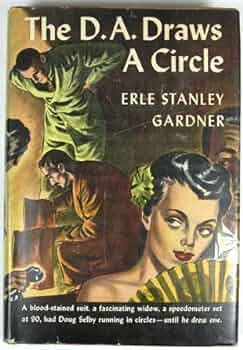
The bulk of the mystery, such as it is, takes place in Orange Heights, the wealthy neighborhood in Madison County. A barranca, or deep gully, divides a space between two grand houses, and one morning some boys find the nude body of a man who has been shot to death. The coroner finds two bullets in the corpse, either of which would have proven fatal; the trick is that one of the bullets was fired through clothing and the other through naked flesh. The question of which bullet was fired first will haunt the case that unfolds.
One bullet was certainly fired by A.B. Carr’s client, Pete Ribber, a lowlife criminal who had fallen out with the victim. And it just so happens that Carr has recently moved from Los Angeles to one of the grand houses next to the barranca and that he is just the sort of big city trickster attorney who would conceive the idea of firing a second bullet into the dead man to create reasonable doubt in the minds of a jury. (Sound like anyone we know?)
The other grand house is occupied by Rita Artrim, who starts the novel rolling with a visit to Selby’s office, begging him to prevent A.B. Carr from moving to Madison City. The description of Rita (“dark eyes, flashing with emotion, long-lashed and subtly emphasized by skillful make-up . . . mobile lips, a vivid red . . .”) should clue you in to the fact that something’s up with Rita. Perhaps the words femme fatale played lightly on your lips as they did mine.
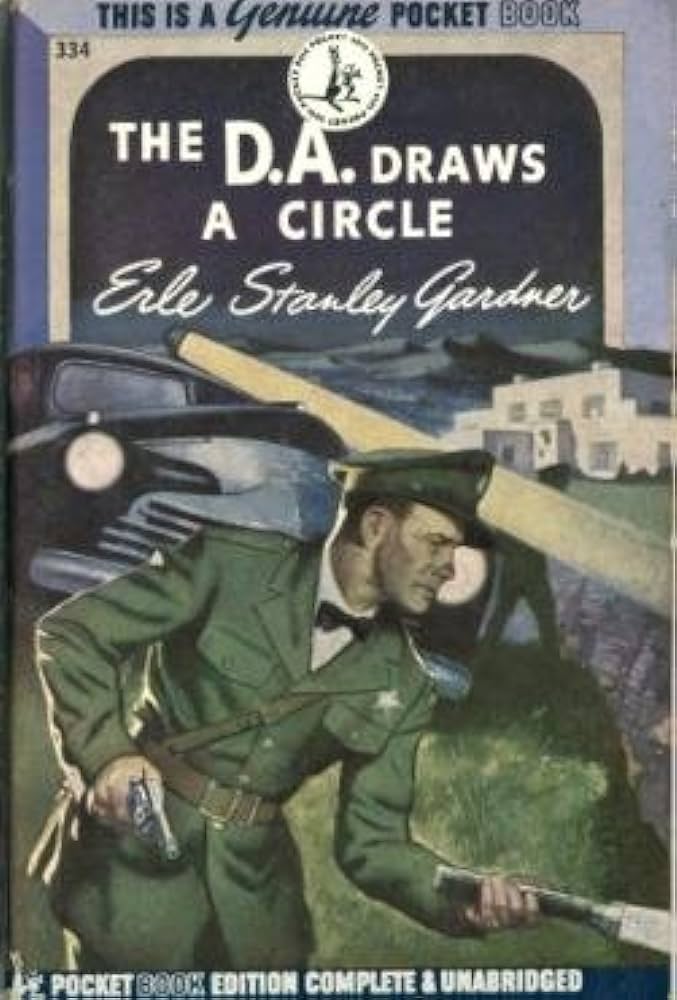
Maybe Rita seems afraid of Carr because her late husband, a gambler who died in a car crash that left his father an invalid living with his resentful daughter-in-law, might have been an associate or client of the attorney’s. But after the father-in-law disappears and bloodstains are found in the house, Rita might find herself in need of her next-door-neighbor’s assistance before she knows it. Did old Mr. Artrim remember something about that fatal auto accident that would have proved inconvenient to the wealthy widow?
A nude corpse, a past crime, a not-so-grieving beauty, a legal shark on the opposing side in court, and a growing conspiracy to destroy Doug Selby’s career once and for all . . . it should make for a complex and delightful situation. The novel moves quickly enough, and Carr is a far more colorful nemesis to the D.A. than Hamilton Burger ever was to Perry Mason. But something is a bit off here: the machinations of the plot feel too by-the-numbers. All the villains sneer and snarl and give off a Snidely Whiplash vibe. Selby’s back is pushed to the wall just where it ought to be to allow for a convincing bounce back. The case isn’t as complicated as it wants you to think it is, and the actions of some of the local characters are so loony that it makes us side more than we should with the oozing urban superiority of Carr.
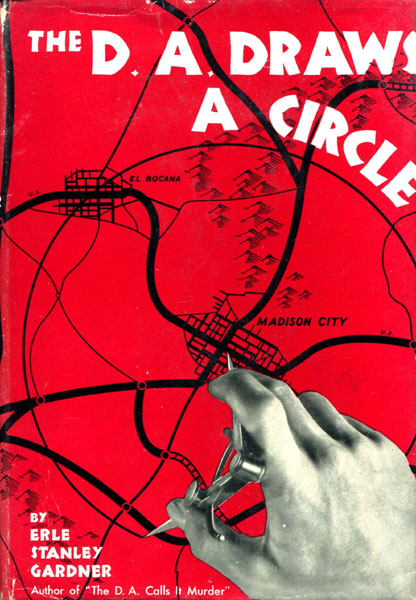
And of course, since we’re looking at a criminal case from the point of view of the District Attorney here, there’s less chance for any whodunnit element to enter into the proceedings. Nobody’s going to break down on the stand and say, “Yes! Yes! I killed him and framed the defendant! And I’m glad, do you hear me? Glad! Mwwwahh haaah haah!!!!” in order to make the D.A. look like a fool. The suspense here comes from how Selby can circumvent and/or survive Carr’s trickery. In a Mason novel, the D.A. never succeeds at that, but here he must, or our hero is political toast.
What really shines is the taut rivalry between the D.A. and the defense attorney, more front and center here than in any Mason novel. Selby may have the morals of a Boy Scout, but he is no naïve kid. And Carr may be a dog, but he is also an excellent judge of character and he learns quickly not to underestimate his adversary. He is also a colorful “Bizarro World” portrait of a villainous Perry Mason, and Gardner has a great deal of fun with the character. Halfway during the preliminary trial, when Sheriff Brandon complains that Carr’s tricks will be eaten up by a jury, Selby sums up his impressions of all devious defense attorneys:
“’That’s the way those big-shot criminal lawyers work, Rex. They inject their own personalities into the case, put on a free show for the courtroom audience. Pretty quick, the jury loses sight of the fact that it’s called on to try a case and considers it’s witnessing a show – and the verdict of not guilty is simply the jury’s way of showing applause for the actor it likes.’ Sylvia Martin said, ‘Isn’t there some way you can beat that, Doug?’ Selby said, ‘It’s a touch combination to beat. they have to contend with it in the big cities all the time.‘”
So they do, Doug, so they do.
* * * * *
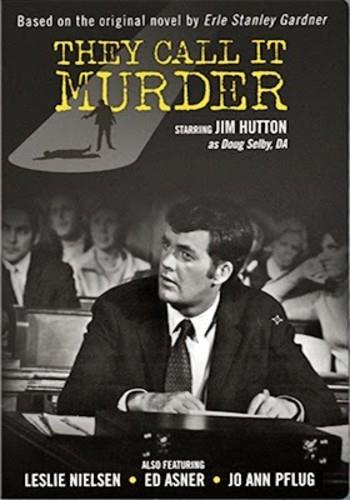
While Perry Mason was at the top of the TV ratings heap, the producers at Paisano Productions thought long and hard about creating new series about Doug Selby and Cool and Lam. Erle Stanley Gardner was all for it, but the pilot for the Cool and Lam series was not picked up, and nothing related to Doug Selby materialized until 1969, three years after Perry Mason had been cancelled. That’s when a two-hour film loosely based on The D.A. Draws a Circle went into production. The script was written by Sam Rolfe, who had helped create Have Gun, Will Travel and The Man from UNCLE, and was edited by Gardner himself. ESG died in March 1970, a month after production wrapped on the movie. The film itself did not appear on TV until December 1971, and any previous interest in turning it into a series evaporated.
Jim Hutton (Ellery Queen) plays Selby, and Leslie Nielsen is a kick as Frank Artrim. Ed Asner makes the perfect Otto Larkin, but Jessica Walter plays Rita (here renamed Jane) in much more muted tones than the book. It’s interesting how closely the script hews to the novel and still manages to completely miss the mark. Part of that stems from moving the story to 1971, where the nagging musical score, reminiscent of mediocre Burt Bacharach, saps the 1930’s tale of its power. All the city politics from the book is cut to give room for a much larger conspiracy surrounding the murders. Lloyd Bochner is horribly miscast or misdirected as A.B. Carr, and the character is much more secondary to the plot, probably to give Nielsen a lot more to do. A romance of sorts is manufactured between Selby and Rita to try and give the whole shebang a bit of a Maltese Falcon flair. But the end result is a bore, and I can’t imagine that Doug Selby will be sourced out to screenwriters again anytime soon.
What do I care – I have six more books to read!!
 Ah Sweet Mystery!
Great piece as always, I have little to add, I love the entire Doug Selby and although not as strong an entry as Cool and Lam, liked the insight into small town politics and corruption. I think you will enjoy reading the rest of the series if you haven’t already.
I also think you would enjoy Gramps Wiggins (The Case of the Turning Tide and the Case of the Smoking Chimney.) Gramps “helps” his granddaughter Mildred’s husband, D.A. Frank Duryea, solve mysteries. Gramps’ bathing suit scene is worth the price of admission. Sadly there are only two entries in the series.
LikeLiked by 1 person
All my D.A. reads are first time reads! I own them all and and making my way slowly through the series since there are only nine of them. And I also own both Gramps Wiggins novels, so I will get to them at some point. Plus, I have a ton of Cool and Lams. I don’t think I’m going to read those in order, but based on a couple of Jim’s recent reviews, I plan on tackling the World War II novels!
There’s sooooo much Gardner to read that I could seriously skip all other authors for a long time!!
LikeLiked by 1 person
Pingback: EVE OF POSSIBILITIES: Looking Back on ’24 and Forward to ’25 | Ah Sweet Mystery!
Pingback: THE ERLE STANLEY GARDNER INDEX | Ah Sweet Mystery!