It’s always sad when a marriage ends in divorce. And it makes me feel no better when the series of marital titles I’ve been covering in the Perry Mason series ends as ignominiously as The Case of the Daring Divorcee.
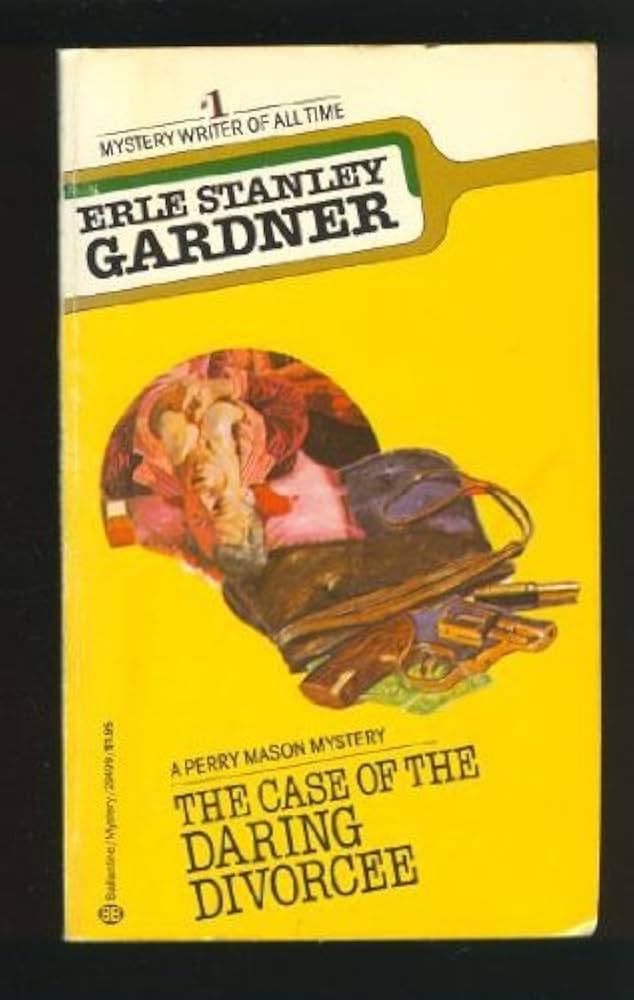
It’s 1964: Erle Stanley Gardner is 75 years old and has more than seventy Mason mysteries, six movies, a radio show and a hit TV series behind him. But there are still ten more novels to go (two of them published posthumously), and the show Perry Mason is several years away from cancellation. The old boy is still driving the bus and apparently has got some steam left in him. Still, while I haven’t read the titles that came after Daring Divorcee, this one feels like someone has let the air out of the tires.
Perry Mason is well known as the greatest criminal defense attorney who ever lived. He does not take divorce cases, and here is no exception. While he is at lunch one day, a beautiful woman wearing dark glasses enters Mason’s office and tells Gertie, the receptionist, that she desperately needs Mason’s protection. She waits a few minutes, tells Gertie she has to leave for just a moment, and vanishes, leaving behind her purse. And in her purse is a gun that has been fired twice . . .
There’s nothing wrong with that set-up or, in principle, with anything that follows. But something is off here from the start, and it took me a few chapters to figure out the problems I have with this book. First, the narrative is pretty much all talk and no action. Mason comes back from lunch and talks to Della about the vanishing client. He talks some more to Paul Drake. He talks on the phone. Perry and Della fly to Las Vegas to find their client. They talk on the plane. They talk to the client. Then they go back to the office and talk and talk and talk.
Most of the characters in the book make only the briefest of appearances, including the murderer, who first appears over halfway through the novel, occupies about a page of space, and whose motive isn’t unveiled until page 190. This isn’t necessarily a bad thing, as Gardner always liked to focus on the team of Mason, Street, and Drake and tell the story through their investigation. But Della and Paul don’t do much more than follow orders in this one, and Mason . . . well, he talks and talks and talks without saying much of interest. (By this point in a review of early Mason novels, I would have quoted the attorney at least twice!)
The defendant in this case isn’t a bad character, and she has a boyfriend who helps Mason out with some slick testimony. The rest of the cast feels like shadows of previous, better suspect lists – especially the vixens! Gardner specialized in vixens, but the ones found here are poor specimens.
The worst thing is that it feels like Gardner is going through the motions of a typical Perry Mason novel. The attorney takes on a client, he battles corrupt individuals, he puts his career in jeopardy and in doing so tangles with both D.A. Hamilton Burger and Lieutenant Tragg. The whole affair winds up in court with fifty pages of text to spare, and Mason uses his legal legerdemain to figuratively “pants” an overweening assistant D.A., to the point that Burger himself takes over and is also put in his place. Oh, Hamilton, will you never learn?
But nothing sings like it should. The stakes are never high enough, the tension feels tepid, and Mason’s legerdemain is clumsy – so clumsy that the reader will find himself ahead of Mason as to where it all is leading. It’s a given that the counselor will show up the prosecution, but half the fun is in finding out how he’s going to do it! Here both the district attorneys are so profoundly stupid, falling into one boring courtroom trap after another with far too much ease, that we can see the end result a mile away.
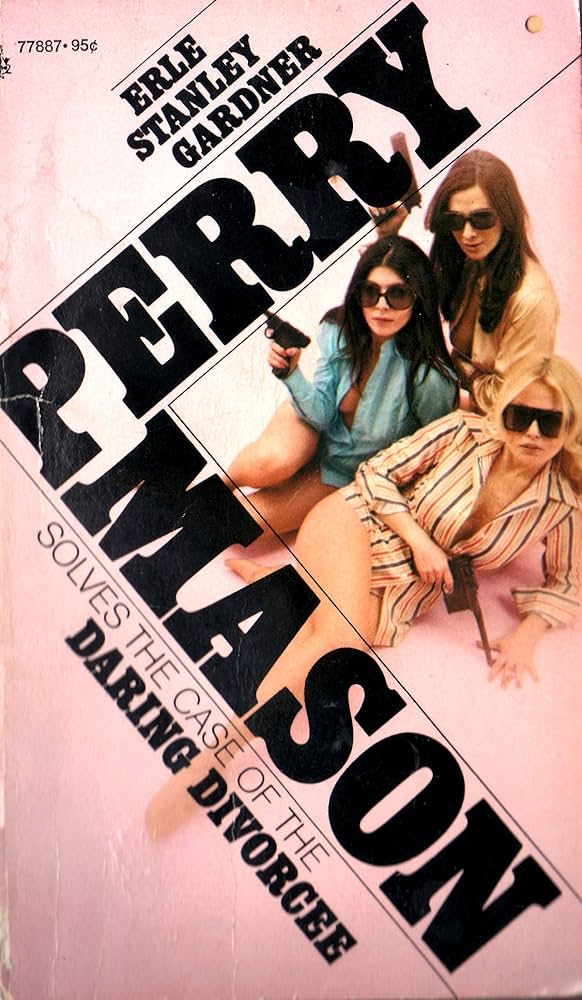
As Gardner’s writing career advanced, his take on women felt more dated and chauvinistic. There’s an awful scene in the middle of the novel where Perry conceives a plan that involves forcing Paul Drake to run up and down and all around the office building in search of young pretty women who will put on a pair of dark glasses and mill about the attorney’s reception office for an hour. (Frankly, Paul is reduced to an errand boy in this novel, and I for one resent it!) Mason’s purpose for this tactic seems awfully minor, but it turns out to have great and unforeseen rewards. Meanwhile, the lawyer is incredulous at the difficulty in finding women who will put aside their own jobs or pleasures in order to serve his needs when a twenty or fifty-dollar bill is dangled before their eyes.
You’ve changed, Perry. You’re not the man I fell in love with in 1933. I want a divorce!
The novel, like the rest of the final decade of books, was not adapted for the TV series. In a way, it’s too bad because it could have easily been fitted into the format of the show, and the suspect list could have been appropriately expanded to fit that format. I feel bad that the marital titles took a qualitative nose dive at the end, but I suspect that’s going to happen when you look at the Mason oeuvre chronologically.
This brings the marital series to an end, but there is sooooo much more Perry Mason to explore. I already have a plan in the works for the next series: it encompasses a baker’s dozen of titles, traverses Gardner’s career from the very start but stops with dignity at 1960, and has a theme that’ll make you feel all warm and furry, er, feathery, er, fuzzy!!
Don’t worry, we’ll get there.
 Ah Sweet Mystery!
Pingback: THE ERLE STANLEY GARDNER INDEX | Ah Sweet Mystery!