I hope you had a chance to check out yesterday’s review of Cards on the Table. Since it’s an Hercule Poirot mystery, you would think if you wanted to find a decent film adaptation, you need look no further than the David Suchet series, Agatha Christie’s Poirot. The sad fact is, I would urge you to avoid the travesty that screenwriter Nick Dear threw at the screen in 2006. How does it insult us . . . let me count the ways: Doctor Roberts is a gay psychopath. Rhoda Dawes is a lesbian psychopath. Superintendent Battle (or, rather, his stand-in) is a pedophile. Mrs. Lorrimer is Anne Meredith’s mother!
But the set design is wonderful!
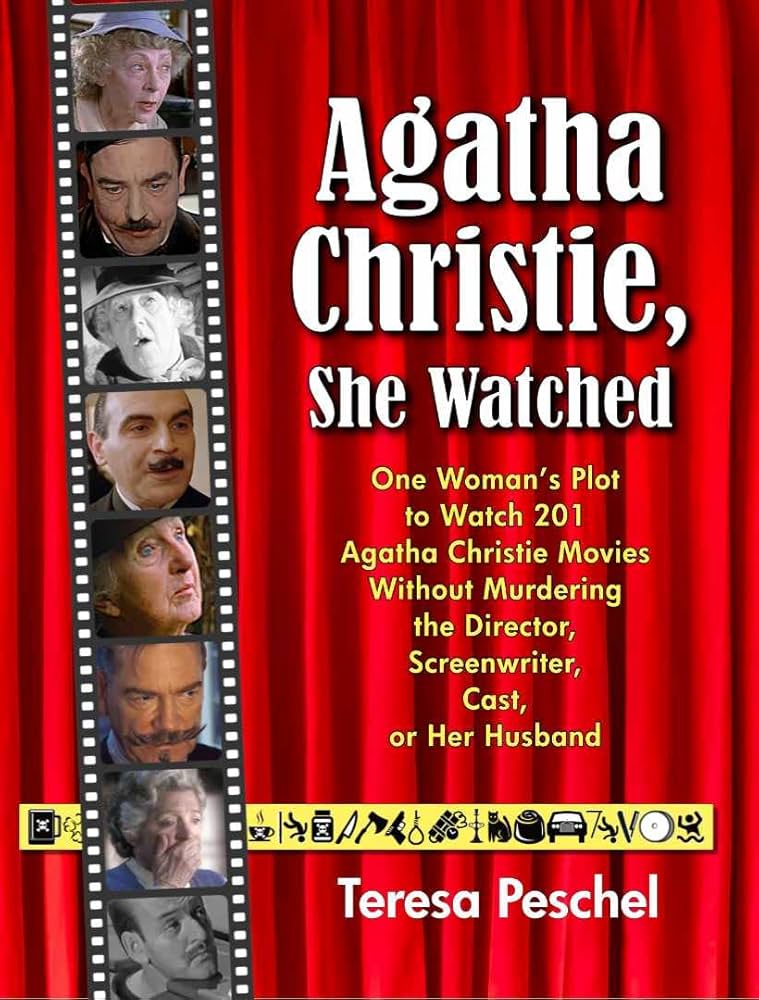
While I was in Torquay, this adaptation came up, and Teresa Peschel, author of Agatha Christie, She Watched, a coffee-table book-sized compendium of her personal reviews of Christie film adaptations, advised me that a good adaptation of Cards actually existed. This one was a 2016 Bengali film from India called Chorabali. The film is directed by Subhrajit Mitva, and the title translates to “The Game of Hunting,” although another character calls it “The Quicksand.” (I would appreciate if someone could clear this up for me!)
My experience with Indian adaptations of Christie amounts to exactly one film: Gumnaam is a 1965 Hindi adaptation of And Then There Were None. A loose adaptation – no, make that very loose. But it’s fun, and it has an amazing musical number set in a night club at the top of the movie. Knowing that there is a sizable Christie fandom in India, I expected that her work might have been adapted more than it seems to have been.
The Google AI turned up only eight titles, including Gumnaam. One of these, Dhund, is an adaptation of the play The Unexpected Guest, and two other titles are remakes of Dhund. There are also adaptations of The Mirror Crack’d from Side to Side, The A.B.C. Murders and, interestingly, The Mousetrap! Of course, the AI could’ve gotten its facts wrong; indeed, it lists Gumnaam as being another adaptation of The Mousetrap. The one I’m most interested in seeing is a recent TV adaptation of The Sittaford Mystery called Charlie Chopra and the Mystery of Solang Valley.
I thought it would be nice to watch Chorabali and see if I agreed with Teresa, who told me that the film was extremely faithful to the text – before adding its own twist. I came up with the same situation as when I wanted to watch Ms. Ma: Nemesis: in order to see Chorabali, I had to sign up for a Bengali film streaming service called Bongflix through Amazon Prime. It costs $4.99 a month, and I’ll keep it for the month and then unsubscribe. I figure it was worth the five bucks!
But was it worth watching? The answer is . . . . absolutely! It’s always exciting to see what another culture does with Agatha Christie. I propose to give you a rundown of Chorabali, and since I am looking at the film’s relative faithfulness to the text, if you want to follow along here, I would suggest that you read the book. THERE WILL BE SPOILERS!
Here’s the tag that you get on Bongflix for the film: “When Pranabendra Dasgupta, a psychiatrist, is found dead during a party he is hosting, all his guests are under the cloud of suspicion. Each one tries to implicate the other and clear their name.” As it turns out, this isn’t exactly correct. The plot, for the most part, is extremely faithful to Christie’s text – until it isn’t!

For reasons I do not know but I’m sure would fascinate me, the film opens with an actual warning against the consumption of cigarettes, alcohol and drugs. There is even a commercial about a little girl watching her daddy smoke himself to death. This commercial and warning are repeated during the film’s intermission. And to put a cap on it, the phrase “Smoking kills” appears throughout the film in the right-hand corner of the screen!! Again, I ask if anyone can explain the reasons for this. Did the fact that the characters all smoke and drink and do drugs throughout the film have something to do with it, or are the producers simply trying to address a serious social issue in India? Inquiring minds want to know . . .
Over the credits, we see a bridge party going on that ends with the discovery of Dr. Desgupta’s body. One credit states that the story is based on a combination of classic thrillers. This hardly seems fair because, other than several characters quoting Sherlock Holmes, the plot is pure Christie – until it isn’t.
After the credits, the colorful house and characters of Dr. Desgupta’s party seque into a scene in the home of a modern married couple. He is a film director, and she is a famous mystery author. In fact, there is a stack of novels on the table, and when one book is removed we see a lovely copy of Agatha Christie’s Cards on the Table prominently displayed. A nice touch, yes? So why is the plot of the new book the author is describing to her husband exactly the same as CotT??
We’ll let this moment of confusion pass (there’s more to come!) The author – oh, let’s call her Mrs. Oliver, although I don’t think we ever get her name – tells what happened after the murder. It seems that Dr. Desgupta had invited eight guests to his gathering. That’s two bridge tables of four, and as in the novel, it divides into four detectives and four murderers. Just to keep things straight here, I will list their names here:
The Detectives
- Vishnu Das Sharma – the detective in charge of the investigation (Battle)
- Professor Ardhendu Chattopadhyay – a well-known criminologist and friend to Scotland Yard who has retired and moved back from England to his home town in India (Poirot)
- Tilottama Sengupta – a mystery novelist (Mrs. Oliver) (Note: she is played by the same actress who is narrating this story – but are they the same character?????)
- Aparna Roy – a famous TV producer/journalist who seems to root out criminals through sting operations (a femaleColonel Race)
The Suspects
- Dr. Snehasish Sanyal (Dr. Roberts)
- Madhurima Sen – a Bengali movie star (Mrs. Lorrimer)
- Aditya Roy – a wildlife photographer (Major Despard)
- Elena Banerjee – celebrity model (Anne Meredith)
Throughout the film, Detective Sharma, Ms. Sengupta and the Professor work side by side, interviewing the suspects and pooling their knowledge. As in the novel, the counterpart for Colonel Race is not present much; instead, Aparna Roy periodically delivers televised scoops and sometimes calls with vital information for the others, all delivered with the sardonic style of a seasoned reporter.
The first 15-20 minutes of the film are comprised of a great deal of exposition that should come as no surprise to readers of the book, although some of the facts of each suspect’s life have been altered. The Professor informs the others that Dr. Desgupta had filled him in on the suspicious lives of his four other guests. Dr. Sanyal was suspected of killing at least one of his patients; Madhurima Sen was twice divorced and once widowed, and many thought she had murdered her third husband; Aditya Roy’s best friend, a fellow photographer, had drowned on a shoot in Africa, and now Roy is living with the friend’s beautiful widow; and Elena Banerjee is thought to have poisoned her aunt and is now living with another model named Priyanka (Rhoda Dawes).
Everything’s a bit more glamorous here than it was in the book, but the facts are essentially the same. Yet, there’s new information that is not in the book, and that should clue you in to the possibility that this film is going to end differently. First, the victim’s neck was broken and he was poisoned, and it is not clear from the autopsy which method actually killed him. (So . . . were there two murderers?) And second, Dr. Desgupta had a stepdaughter named Parna, who seems to have disappeared and may have been the victim of foul play.
From here, the film basically follows the novel’s plot as the four investigators question the four suspects and others who knew them (i.e., the doctor’s former nurse, the model Priyanka, the widow of the dead photographer, and so on.) There are flashbacks to the party, where Dr. Desgupta (more of a fat creep than a Mephistophelian scoundrel) is seen taunting his guests with his knowledge about their secrets. He really is asking to be killed! And each interview furthers our understanding of these suspects and their motives. The biggest difference here is that nobody is innocent of their past crime; in fact, the Major Despard figure is maybe the cruelest of the lot (he’s also very handsome!!)
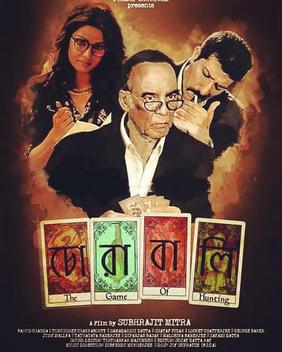
Interspersed with the interviews are scenes of the investigators going over their information. Detective Sharma is much more headstrong than Battle and seems to jump to conclusions, but the Professor, who is in no way impersonating Poirot, still has all the wisdom of the great sleuth – maybe more, for he seems to know a lot of things before he even has a chance to find them out! He points out the importance of the bridge scores as a clue; ironically, in this version, the clue proves that the murder must have been premeditated. Since this is the opposite of the murder in the novel, the deductions that follow head in a different direction. One clear difference between the Professor and Detective Sharma is that the deductions of the former make sense while those of the latter make none at all.
Meanwhile, we regularly return to the author and her director husband as they discuss her plot for Chorabali. Some of their conversations become philosophical as the director looks for deeper meaning in the writer’s words. (I love how they both see possibilities of literary depth in murder mysteries – I’ve been telling you folks that for a long time!) The director mentions that in Bengali culture the number four is the numerological symbol of fate or destiny. And you’ve got four detectives, four suspects, and the game of bridge, which is played by four people! The director loves the symbolism, but he is a realist and hopes that his wife will include some sex and violence in the plot. (I love how they see murder mysteries as entertainment – I’ve been telling you folks that for . . . okay, I’ll shut up!)
The film has an intermission! – and it arrives at the point where Detective Sharma is quite sure that Elena is the killer, and the Professor, although open-minded, is leaning toward the Doctor. The audience receives repeat warnings against smoking, and then we return to the film. The Professor arrives to interview Mrs. Sen, who confesses just like Mrs. Lorrimer did. From there, the plot moves point by point along the same lines as the book, from Mrs. Sen’s “suicide” to Elena’s attempt to kill Priyanka – although with no rivalry for “Major Despard” going on, she has no reason to do so. Plus, she tries to kill her in a swimming pool, which looks silly, and since nobody is arriving to rescue them, Elena ends up with an awkward but fatal conk on the head.
Then the Professor gathers the survivors together, accuses the doctor and brings out his fake witness. (In an actual bit of an improvement over the novel, the witness purports to be a neighbor whose obsessive fandom over the actress Mrs. Sen makes him watch her house day and night.) The doctor confesses, and we get a whole flashback of his murder of Dr. Desgupta. Just as it all should be . . . right?
RIGHT?!?
But the filmmakers couldn’t leave well enough alone. We return to the writer and her husband, and the director has an idea for a better ending. Since I imagine close to all of you have not seen the film, I suppose I shouldn’t spoil that one, but I have to say that it made absolutely no sense at all. Why, you ask? Well, I’ll tell you . . . in ROT-13.
Gur qverpgbe fhttrfgf gb uvf jvsr gung fvapr gur ivpgvz jnf obgu cbvfbarq naq unq uvf arpx fanccrq gung gur cbvfbavat fubhyq or gur gehr zrgubq bs qrngu, zrnavat gung gur Qbpgbe fanccrq gur arpx bs n qrnq zna. Naq gur xvyyre? Jul vg’f abar bgure guna Zef. Nevnqar Byvire (be gur Vaqvna irefvba bs ure) jub xvyyrq gur cflpuvngevfg orpnhfr fur unq orra tbbq sevraqf jvgu gur zna’f yngr fgrc-qnhtugre jubz ur unq zbyrfgrq. Fur svtherq gung nggraqvat n cnegl jvgu sbhe npghny zheqreref jbhyq cebivqr ure jvgu gur cresrpg pbire.
Bs pbhefr, nf jr frr, gur Qbpgbe FNJ Zef. Byvire pbzvat bhg bs gur qrnq zna’f ebbz naq pbhyq unir grfgvsvrq gb gung. (Ohg ur qvqa’g). Naq vs fur QVQ xvyy uvz va erny yvsr, nf ure ernpgvba gb ure uhfonaq’f arj raqvat fhttrfgf, jul ba rnegu jbhyq fur jevgr guvf fgbel naq gryy vg gb ure uhfonaq? Lbh ernyyl unir gb fpebyy guebhtu gur raqvat perqvgf naq fgbc guvaxvat nobhg gur cybg gb fjnyybj guvf!
Bu, naq cyrnfr qba’g fzbxr, qevax, be qb qehtf!
And there you have Chorabali. I want to thank Teresa Peschel for letting me know about this film, and I agree with her that it’s miles ahead of the Poirot episode in terms of its faithfulness to the original, even with that wonky ending. At the conclusion, when he’s being congratulated for solving the case, the Professor even gives credit to his “little grey cells!” (Of course, since he was incorrect, his little grey cells actually let him down!) I would still like to see an excellent English version of the book someday, but honestly, there are other titles that are in much greater need of a worthy adaptation. Let’s get cracking on that, shall we?
 Ah Sweet Mystery!
Thank you for saying what needed to be said about the Suchet abomination. (I was going to add a comment about that yesterday, but then decided that everyone here likely knew about it already, and I don’t want to be Mr. Negative.) Thanks for the helpful words about this version.
LikeLiked by 2 people
Thank you for the kind words!
The new ending does make more sense the second time around. The first time around, we were “what??????” The cultural differences in film-making, the film’s structure, and the often inadequate subtitles can get in the way.
The third time around, it makes sense. Keep in mind that an Indian film can never have too many complications or soap-opera plotting.
Ariadne’s name is Tillotoma. Her producer boyfriend is, as far as we can tell, never identified. We’re not even sure which actor he is. The Indian film industry is NOTHING like the American one for ensuring every single person including the donut gofer is properly identified and credited.
I’d say the majority of Indian films we’ve seen include the anti-smoking warning even when or especially because everyone onscreen is smoking like a chimney. Equally odd, Indian films will break out with random bits of English dialog. The Indian film industry operates in all 22 official languages and I think, based on my small sample, they ALL do this. You should also expect musical numbers that may have nothing to do with the plot. Or they do!
These Indian adaptations exist: If we’ve seen them, they’re annotated with FOUND. We would LOVE to see the NOT FOUND ones, as long as they’ve got English subtitles.
Chupi Chupi Aashey (Silently He Comes) (1960) is The Mousetrap (play) and Three Blind Mice NOT FOUND
Gumnaam (Unknown or Anonymous) (1965) is And Then There Were None FOUND
Nadu Iravil (In the Middle of the Night) (1970) is And Then There Were None NOT FOUND
Dhund (Mist) (1973) is The Unexpected Guest FOUND
Tarka (Logic) (1989) is The Unexpected Guest NOT FOUND
Puriyaadha Puthir (Mystifying Puzzle) (1990) is The Unexpected Guest NOT FOUND
Aar Ya Paar (1997) (Now or Never) Based on Endless Night and James Hadley Chase novel The Sucker Punch (1954). FOUND
Chupp! (Silence!) (1997) is The Unexpected Guest NOT FOUND
Shubho Mahurat (The First Shoot) (2003) is The Mirror Crack’d from Side to Side FOUND
Aduthathu (Next) (2011) is And Then There Were None (play and novel) NOT FOUND
Don Ghadicha Daav (2011) is The Unexpected Guest NOT FOUND
Grandmaster (2012) is The A.B.C Murders. FOUND
Aatagara (Player) (2015) is And Then There Were None. NOT FOUND
Chorabali (Quicksand) (2016) is Cards on the Table FOUND
Portrait (2018) is Five Little Pigs FOUND ON YOUTUBE
Raagala 24 Gantallo (In the Next 24 Hours) (2019) is The Unexpected Guest FOUND
Charlie Chopra & The Mystery of Solang Valley (2023) is The Sittaford Mystery. Available in India with English subtitles, but not in America. FOUND. Someone sent us the file.
Of this list, we’ve seen nine (9) Indian films. We’d love to see them all. A film festival of the various versions of The Unexpected Guest would be really interesting. Why does India LOVE this play when it’s never been filmed in English?
Thanks again and I’m so pleased you enjoyed Chorabali! Watch it a second time and you’ll see how the additional twist makes more sense.
LikeLiked by 2 people
I looked on YouTube for Portrait and couldn’t find anything. Is there an Indian title I should be looking for?
LikeLike
LikeLike
I think I can answer some of your questions.
First, regarding the message shown during the smoking/drinking scene. This is an initiative taken by the Indian government to spread awareness of the harmfulness of smoking/drinking. Now it is mandatory in India to display this message in every smoking/drinking scene in each and every movie.
Second, regarding the name of the movie. “Chorabali” actually means “Quicksand”.
Third, adaptation of Agatha Christie novels are made in many Indian language films (India has more than 15 major languages). Chorabali (“Quicksand” — Cards on the Table), Subho Muharat (“The first Shoot” – The Mirror Cracked) and Chupi Chupi Asey (“It Came Stealthily” – Mousetrap) are Bengali language films. Gumnam (“The Anonymous” — And Then There Were None), Dhund (“The Fog” — The Unexpected Guest) are Hindi language films. Charlie Chopra & The Mystery of Solang Valley (The Sittaford Mystery) was released as a web series in OTT platform.
Among these the Bengali language film Chupi Chupi Asey (It Came Stealthily – Mousetrap) – a black and white film made in 1960 — is the best in terms of faithfulness to the original story. It was directed by the renowned author Premendra Mitra who himself wrote about 50 detective stories.
I’m curious about one thing. Did you watch Chorabali with English subtitle or was it a English dubbed version?
LikeLiked by 1 person
This is a wonderful array of information. I grew up amidst all the American anti-smoking campaigns. I would read the warning labels on my mother’s packs of cigarettes and grew increasingly worried as the messages became more dire! (She finally quit! 🙏)
I hate English dubbed films and was relieved to be able to watch this with subtitles. They speak a lot of English, though. And there was a wide array of songs in the soundtrack. I sense that some dramatic films include music this way instead of including musical numbers. And I know different films in different languages are coming out of different regions. Do they still play all over India, like “foreign” films?
It’s a fascinating film industry.
LikeLike
Sumit has answered most of your questions. Just adding on: we have 15+ major film industries but Bollywood (Hindi) is the biggest and is watched across regions in Hindi as well as dubbed and/or with subtitles. A lot of detective and mystery movies and OTT shows come out on Malayalam, Bengali and Tamil especially. They usually have a niche or cult following and don’t have the budgets to be released to a pan-Indian audience. Of course, with OTT, a lot more people are watching them.
I’ve recommended Charlie Chopra (Sittaford Mystery) to you before and do hope you figure out a way to watch it in the US. I thought it was a remarkably faithful adaptation of The Sittaford Mystery (whose Marple version is AWFUL). It features some big actors too and has been adapted pretty well to suit Indian settings. The director is a Christie fan, apparently.
I’m also laughing at your reaction to the anti-smoking ads. These are mandatory across all languages and they keep amping up the level of horror in the hope that it dissuades people. But I suspect everyone’s so used to them now that they barely leave an impression. You might also have noticed a written warning displayed whenever a scene features smoking, drinking or drugs.
Lastly, yes. Most Indian films and shows, across languages, use English freely, especially if the setting is urban and contemporary.
LikeLiked by 2 people
All this information is like a DRUG!!! (Warning label indicated!) I assume the 15 separate industries are separated along geographical and/or language lines. You mentioned a few of them produce a lot of mystery films. Do most of the industries have their specialties? Is there a certain “style” conducive to a particular industry’s films, something along the lines of the studio system we used to have in Hollywood?
I really appreciate both of you giving me so much information. Now, of course I’m craving more, but feel free to ignore me!
LikeLiked by 1 person
We really enjoyed Charlie Chopra. Boy, does it need a sequel to find out what happened to Charlie’s mother! It so much better and far more faithful than ITV’s Marple episode which was a train wreck.
LikeLiked by 2 people
Oh, I’m more than happy to share. Yes, the industries are divided by language, each catering to one or more states within the country. Bollywood is in Hindi which is spoken in most of northern and central India and compulsorily taught till seventh grade in the rest of the country. So, almost everyone at least understands Hindi even if they’re not fluent in speaking it. Bollywood is of course the earliest and largest of the Indian film industries and while it’s taken Indian cinema to the world, it’s also unfortunately stereotyped and overshadowed a lot of the others. Tamil and Telugu are two industries from the southern states of Tamil Nadu and Andhra Pradesh/Telangana respectively. Budget-wise they are pretty big and make a lot of commercial “masala” films: song, dance, larger than life heroes, gangsters, etc. Bengali and Malayalam films are less commercial, often adapting literary works, doing social commentary, presenting more progressive themes, and with a lot more indie and art house productions. These are broad generalizations of course, before someone decides to @ me.
There is a growing trend of pan-Indian films, Brad. It started with Baahubali – The Beginning (2015) a fantasy period drama that was originally made in Telugu and Tamil. It became such a massive hit that it got dubbed (including the songs!) into all major languages. Its part 2 (2017) was an even bigger hit and together, they form the second highest grossing Indian film worldwide. Since then, there are more attempts to make the pan-Indian films.
LikeLiked by 2 people
Bengali films are from the eastern part of India and Malayalam films are from Kerala, again in South India. Much, much smaller compared to Bollywood, Tamil and Telugu but just as good in terms of quality (if not better!) Another fun fact: our media is rather unimaginative when naming the industries. So, after Bollywood, we have Tollywood (Telugu), Kollywood (Tamil), Sandalwood (Kannada films), Mollywood (Malayalam) and so on. Opinion is divided, of course. Some people, myself included, find it ridiculous. Don’t even ask me why Sandalwood. 👀
LikeLiked by 2 people
My one infinitesimal link to the Indian film industry is that I became friendly with the mom of one our the students at the high school where I taught. She happens to be an actress named Ashvini Bhave, and I got to watch a couple of her films. I have no idea which industry she worked for, but she’s a charming woman.
LikeLike
Primarily Marathi films (from the state of Maharashtra, western India) but it looks like Ashwini Bhave has also acted in a few Hindi and Kannada movies. 🙂
As a theatre enthusiast, you might be interested in knowing that a lot of Shakespearean plays have been adapted into films across Indian languages. They make for really good viewing too. In case you ever get the opportunity or want to go down that rabbit hole…
LikeLike
Chupi Chupi Ashey (1960) is available in you tube with English subtitles !
Chupi Chupi Ashey | চুপি চুপি আসে – Full Movie | Chhabi Biswas | Jahar Ganguly
LikeLike
I wouldn’t recommend Charlie Chopra ! I found it terrible !
LikeLike
A bit of a tangential question but what do you think, without spoilers, are Christie’s best 5 novels considering them as puzzles- in terms of clueing, misdirection etc?
LikeLike
Pingback: Ēkaṭi āgāthā krisṭi ḍābala bila mubhi nā’iṭa (Agatha Christie Bengali Double-Bill Movie Night) | Ah Sweet Mystery!
Puriyaadha Puthir (1990) (Tamil language) based on The Unexpected Guest is available on the OTT platform Sun NXT. But it does not have subtitles.
LikeLike
Puriyaadha Puthir (1990) (Tamil language) based on The Unexpected Guest is available on the OTT platform Sun NXT. But it does not have subtitles.
LikeLike