My recent viewing of Chorabali, the Indian adaptation of Cards on the Table, had the added bonus of my getting to speak with a number of folks possessed of great knowledge about the sprawling Indian film industry. Turns out that, while we have all heard of “Bollywood,” there are actually over fifteen major film “industries” spread throughout the country, delivering a wide variety of films primarily to niche audiences largely based on geographical region and language. There also seem to be a whole lot more Agatha Christie adaptations than the handful of titles that came up in my initial search. (Take that, Google AI!)
Two of the commenters were even kind enough to send a link each to two more films: 1960’s Chupi Chupi Aashey, an adaptation of The Mousetrap, and Portrait (2018), a short film based on Five Little Pigs. These days, I’m basically roleplaying as Miss Marple: recovering from pneumonia, I am in desperate need of a fresh mystery. And so I took advantage of my newfound information and watched both these films.

Written, co-produced and directed by Mayurakshi Sen, Portrait comes in at just under twenty-nine minutes and is billed as “a fiery cocktail of LOVE, LUST and FATAL BETRAYAL for your viewing pleasure.” It is also a bit of a rush job, although God knows how one can cram Five Little Pigs into a half hour. Sen’s solution to this problem is to reduce the number of little pigs to three (goodbye, Meredith Blake and Miss Williams) and to reduce or eliminate most of the clues.
We’re still treated to a modern-day rendition of most of the story. Manani (Caroline Crale) has died in prison after spending seven years there for the self-confessed murder of her artist husband, Aveek (Amyas). Before she died, she sent a letter to her sister Bipasha (Angela Warren) saying that while they both know she’s innocent, she’s at peace with her confession. Feeling confused, I would imagine, Bipasha hires a detective, Pracheto, to investigate the long-solved murder, and he invites Shantanu (Philip Blake) and Ramyani (Elsa Greer) to sit in Aveek’s living room and reminisce about the case. Through a series of flashbacks, Pracheto arrives at the true solution, which essentially follows that of the book, including Caroline’s motivation for confessing.
I think most fans acknowledge that Five Little Pigs is maybe the richest of Christie’s novels in terms of emotional resonance. What some people may forget is that it is also an extremely well-made puzzle – maybe one of Christie’s best – in that the clues spring out of character traits and motivations, and the machinations of seven people on that fateful day operated successfully both from the point of mechanics and drama. By reducing and/or eliminating clues, Sen signals that she is focusing on the dramatic aspects of the story to the mystery’s expense. Yes, Pracheto interviews the three suspects, considers each one as the possible culprit, and then reveals which of them dunnit. But his proof is really an amalgam of the clues that are uncovered and the clues from the book that are missing. Where Hercule Poirot could solve the case by studying the timeline and the psychology of the characters, Pracheto basically has to guess.
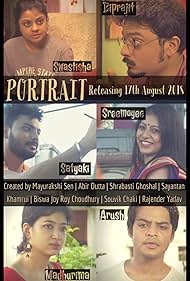
As for the emotional impact . . . well, it suffers from the limitations of both the budget and the performances. This was an independent film that looks like it was made in someone’s apartment with a bunch of friends. Changing the time span between the crime and the reopened investigation from sixteen years to seven means that the actors can look and dress the same in both time periods. The women all scream at each other, while the men chat calmly about artistic muses and sexual hanky-panky. The film seems slow because the shots are static throughout: people don’t enter or exit scenes, they rise and sit and talk. All the same, because the film is so short, we have no time to get to know these people and feel something for them.
It was interesting to watch this once as a Christie fan interested in other interpretations of her work. Had I not been into Christie, I’m not sure if this film would have interested me much. As much as there’s a victim, suspects and a hidden killer, the film never feels much like a whodunnit mystery, let along one of Christie’s greatest.
Let’s call Portrait the palate cleanser for the main event. One commenter called 1960’s Chupi Chupi Aashey (“It Came Stealthily”) the best in terms of faithfulness to the original story. It can be assumed that the director, Premendra Mitra had a feel for this kind of material as he himself wrote about fifty detective stories, some of them featuring the poet-sleuth Parashor Barma.

Here Mitra helms one of the few cinematic renderings of Christie’s The Mousetrap, a story that has been through the adaptation mill a lot over the past 77 years. It started as a short radio play, a birthday present for Queen Mary. The following year, it became a 30 minute-long television program on the BBC, while in America it was adapted into a short story for Cosmopolitan Magazine’s May issue. U.S. television saw a 60-minute adaptation in 1950, and another adaptation of the short story was seen on Brazilian TV in 1956. Meanwhile, Christie had expanded the original into a full-length play, which premiered in London in 1952. I have to check Wikipedia to see how long that run lasted . . .
As many of you probably know, an English-language film of The Mousetrap cannot be made until the London stage production has closed. So it’s nice to report that Chupi Chupi Aashey is incredibly faithful as a sort of hybrid of the short story and the play. It includes the prologue from the story depicting the killer stalking and murdering Mrs. Lyon (I’m just going to give the English character names, but the murder occurs in Kolkata). Witnesses find the slip of paper leading to Monkswell Manor (here it’s the Kalyaneshwari Health Resort), and the rest of the film takes place as the suspects gather at the resort amidst torrential rains that lead to the party being stranded by a massive flood. Then young Inspector Ghoshal arrives with the terrifying news that a serial killer may be in their midst.
The film characters conform to the play’s Mollie and Giles Ralston (except this pair isn’t married, they’re just “in business” together), Christopher Wren, Mrs. Boyle, Major Metcalf (here a retired doctor), and Mr. Paravicini. The screenplay ejects the play’s Miss Casewell (always an underwritten character) but adds an eighth person to the party in the form of Mr. Beni Babu, a querulous invalid who lives in the room upstairs and complains that the manor is haunted by ghosts. He is actually an interesting addition to the action, with secrets of his own; of the rest, the actors playing Wren, Paravicini and Mrs. Boyle could easily fit into an touring Indian production of Christie’s play.
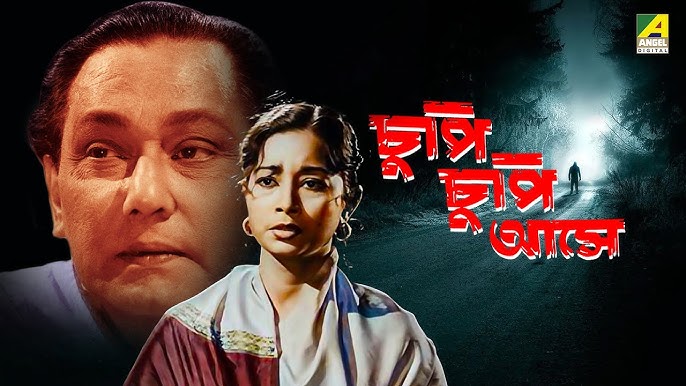
That’s not to say the movie’s perfect. Perhaps its fidelity to the source material is an indicator of The Mousetrap‘s weaknesses. I’ve directed it twice: there are some wonderfully suspenseful moments and a bit of good comedy, but mostly Mousetrap is a lot of talk. The film tries to counteract that by including the London death, and he opening sequence of Chupi Chupi is well done; so, too, are other corresponding moments from the play (the death of Mrs. Boyle, the final confrontation with the killer). There is also an extended sequence not found in the play that begins after everyone says goes off to bed and turns into a dark night of the soul. For some reason, the killer brings a costume with him – or is it someone impersonating the killer?? – and those moments of X stalking the guests, accompanied by a truly horrifying yowling sound, are among the film’s best.
In the end, I can’t deny that there are some tedious passages in the movie, and that the Mollie figure in particular left me cold, but it’s wonderful to have this available film (it’s right there on YouTube) that hews so closely to the original that whole swaths of dialogue seem lifted from the play. And it’s nice to add another pair of international film adaptations to my watch history. Thank you to Marcel Versteeg and Santosh Iyer for providing the links, which you can find in the comments to my Chorabali review.
Please let me know if you have chased down any more adaptations out there – from any country! (They only need to have English subtitles and be stream-able.)
 Ah Sweet Mystery!
Here us a link to an Italian TV production of SPYDER’S WEB – The subs are auto generated. The lead actress, Monica Guerritore, is a big name Italy (deservedly).
LikeLike
“https://youtu.be/hobumk0JWTo?feature=shared”
Hope the link comes through …
LikeLike
And this is GO BACK FOR MURDER, from 5 Little Pigs, also from Italy (,they did s series of adaptations of her plays):
“https://youtu.be/sJdxZ-DxuTk?feature=shared”
LikeLike
Plus one of my favourite TV Movie whodunits, KILL JOY (aka WHO KILLED JOY MORGAN):
“https://m.my.mail.ru/bk/next_door/video/_myvideo/1.html?origin=serp_auto”
LikeLike
I have the Hindi film Dhund (1973) with English subtitles which is adapted from The Unexpected Guest.
If you are interested , I can send you a copy to your email.
It is available on you tube but without subtitles.
LikeLike
Yes, just send it to my email – ahsweetmysteryblog@gmail.com. Thanks, Santosh!
LikeLiked by 1 person
The Bengali film Shubho Muharat (2003) with English subtitles adapted from The Mirror Cracked is available in you tube.
Subho Muharat – Full Movie | Sharmila Tagore | Rakhee Gulzar | Nandita Das
LikeLike
I’ve seen this one. Margo Bence gets gender-swapped and it’s Miss Marple’s first murder! It’s a very different take from the other seven versions we’ve watched.
LikeLike
Thank you for the links to the two Italian films! We’ll watch them and review them for International Agatha Christie, She Watched.
These films come and go on YouTube and DailyMotion. They’re easy to miss when they appear!
LikeLike