A week or so ago, I was texting back and forth with my friends (and fellow Christie fanatics) Jeff and Chris. It was just after the dinner hour, and Jeff informed us that he was settling down to watch The Body in the Library – not the crazy one with the mad lesbian killers, but the good one – the one with Joan Hickson. His purpose was two-fold: to enjoy a great program once again, naturally, and to calm the $#@% down for a few hours from the craziness that has enveloped America since You-Know-Who became the You-Know-What for the second time.
Folks, I promise I’m not going to get political here – let’s just say that a LOT of Americans are turning for solace to Miss Marple. It sounded like a good idea to me! I had not watched the series for a very long time, and the thought of slipping into the comfortable surroundings of St. Mary Mead sounded like heaven. The BBC series was one of the very first DVD sets I owned, and I was about to head upstairs to grab it when I remembered that the whole thing is on Britbox. And since I’m still paying for that service and, to my embarrassment, have never figured out how to connect a DVD player to my Smart TV, I thought I might as well stream it.
This turned out to be a brilliant idea. My DVD set is the first iteration, and the visual quality is, frankly, rotten. Britbox is showing the remastered episodes, and they look fantastic. I watched The Body in the Library, and from there I couldn’t stop – Joan Hickson had hooked me all over again!

The brilliance of her performance is no surprise. As most of you know, the apocryphal story is that Christie herself thought Hickson would make a grand Aunt Jane, based on her performance as Miss Price in the original 1944 stage production of Appointment with Death – and told her so. Hickson began playing Miss Marple in 1986, when she was 78, and starred in adaptations of all twelve novels through 1992. Even though some may say she grew tired toward the end, she was the perfect age to play Miss Marple.
(Margaret Rutherford was 69 when she played Marple, but those bloodhound jowls made her look older; I loved Margaret Rutherford, despite how wrong those films got Christie and her spinster sleuth most of the time. Angela Lansbury was only 55 when she played Miss Marple in the film The Mirror Crack’d and had to wear awful age make-up. She is one of my favorite actors of all time, but even I must concede that her Marple was far from the best – not terrible, mind you, but not quite right. Geraldine McEwan, whose Marple I happened to enjoy very much, played the character from the age of 72 to 78. When a broken hip helped decide her retirement from the role, she was replaced by Julia McKenzie, who was 67 at the time and who is a fine actress but not the Marple for me. This might also have to do with the general horrible-ness of the adaptations in which she appeared.)
Purists can complain all they want about changes a screenwriter makes to adapt a novel, but sometimes they’re necessary and, on rare occasions, they can even improve upon the author’s work. That turns out to have actually happened in the BBC Marple. While some of my favorite novels are less well represented, mostly due to pacing or financial issues, a few that proved more problematic to me in my ranking of the twelve Miss Marple novels are more enjoyable than I had remembered from my first watch these oh so many years ago!
All sorts of factors played into my reaction, from plot choices and character portrayals to the ratio of the leisurely pace of an 80’s British series to the running times of each story, which vary wildly. Two novels were adapted into three-part mini-series, totalling approximately 150 minutes. Five more were spread across two episodes each, and the remaining five were single episode “TV-movies” averaging an hour and 45 minutes in length. I can’t give you a surefire comment here, like “long was too long and short was too short” because even here my reactions vary. One of the three-part adaptations worked better for me than the other, and the two-parters were all over the place – sometimes in surprising ways.
Rather than try and rank these films, I thought I would just pass on my comments about each one in the order in which they were shown. For those of you who don’t know the series well (or at all), I warn you that there can’t help but be spoilers of plot points from the novels on which they’re based, although I have tried not to outright name the murderer. For those of you who have watched the series many times, I hope this isn’t tiresome for you but rather a nice wallow through a favorite program.
The Body in the Library (1984)
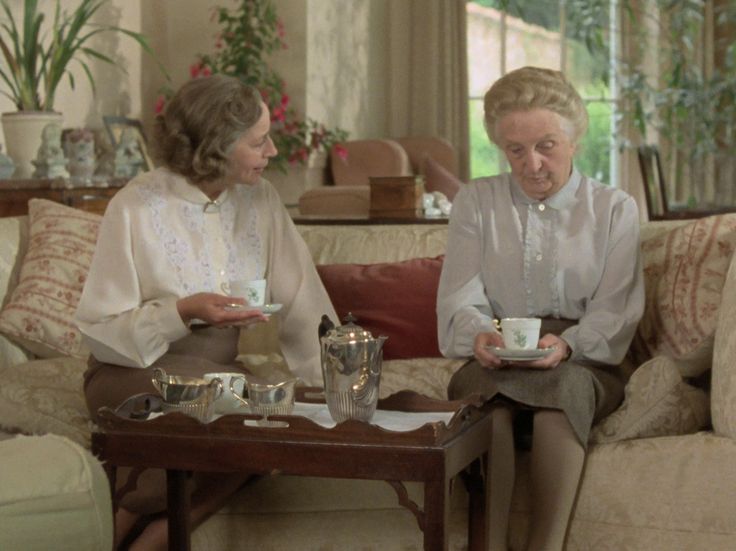
This is the first of two three-part adaptations, and even though it wasn’t the first Miss Marple, it would have made a marvelous literary debut of the character and thus deserves its place of honor as Joan Hickson’s debut. You can tell the creators thought this as well, for screenwriter T.R. Bowen (who also was one of two actors to portray Miss Marple’s nephew Raymond West in the series) keeps us in St. Mary Mead for the first episode, allowing us to get to know the place as much as the characters. This allows us to gain great first impressions of not only Miss Marple, but of the Bantrys (Gwen Watford and Moray Watson) and Colonel Melchett (Frederick Jaeger) and the apparently odious Basil Blake (Anthony Smee).
Watford will show up again as Dolly Bantry in the final episode of the series, but the best decision was to beef up the role of Detective Inspector Slack, whom readers mostly remember from The Murder at the Vicarage. The antagonism between a private or amateur sleuth and the official police is a tried-and-true trope of the TV crime story, but it is often played for laughs. Here, David Horovitch is perfection as Slack, never overplaying his frustration with everyone who interferes with his conducting investigations his way, but indicating it with a brief stillness and a look. The banter between Horovitch and Hickson that begins here and appears in several more episodes is a highlight, although of course, this is TV, so here Miss Marple gives as good as she gets. If Slack gets a dig in, this Marple digs right back – and enjoys doing so.
The more leisurely pace also allows the gravity of the situation for Colonel Bantry to sink in, as neighbors begin to gossip about the presence of a beautiful and quite dead young blonde in his library. This gives a nice dramatic push for Dolly to grab hold of her friend Miss Marple and hie to the Majestic Hotel in Danemouth. And while things do slow down a bit over the next two episodes, it gives Bowen a chance to develop the romantic entanglements of Adelaide Jefferson between her nice proper beau Hugo McLean and the attractive (and more dangerous) Raymond Starr. (I would have chosen Raymond in a second flat!) We also get to see the way Miss Marple works, mostly by placing herself in strategic areas to knit and overhear exactly what she needs to hear.
This episode makes extensive use of flashbacks, which allows interviews to be less static, but I’m not sure how much they added to the viewing experience in total. The other thing that some viewers might find problematic was the addition of a new character, a sort of village idiot in St. Mary Mead named Malcolm (Colin Higgins) whose discovery of the burnt car containing a second dead girl is milked over two episodes for good dramatic effect – except village idiots are always a bit problematical.
The climax matches the novel’s, and it’s nice to see Slack (who does not fulfill this role in the book) finally on the same wavelength as Miss Marple, who wisely waits out the capture of the killer in her room playing patience but shows up to explain the whole thing. All in all, it’s a fine debut for the series.

The Moving Finger (1985)
In my novel rankings, Finger placed fourth, right after (and one point shy of) The Body in the Library. I really love this book, the village of Lymstock (changed here unaccountably to Lymston) and those fish out of water, narrator/hero Jerry Burton and his glamorous sister Joanna. For a lot of people, the biggest fault of the book is that Miss Marple appears so late; I have never had a problem with this as the Burtons are such charming company, and once she arrives, Miss Marple deftly usurps Jerry’s position as lead sleuth and turns him into a leg man and clumsy Pygmalion (as far as Megan Hunt is concerned).
Since this is Joan Hickson’s series, screenwriter Julia Jones made perhaps the only possible choice of getting Miss Marple over to Lymston as quickly as possible, sent for by the Vicar’s wife, Maud Calthrop (Dilys Hamlett) to investigate the anonymous letters plaguing the town. (By the time she arrives in the novel, there have already been two deaths.) This creates the first problem for me: the story is no longer told from the point of view ofJerry Burton, who now becomes just another character, and not a particularly interesting one at that. Most of the beats of his story are still present, but his romance with Megan is less important – possibly because Megan is far less present here, and possibly because Deborah Appleby’s portrayal is too ordinary.
The second problem is that this adaptation is missing most of Christie’s warmth and humor that made this such a favorite for me. This is particularly true for Maud Calthrop and the maid Partridge and Aimee Griffith, the doctor’s sister. These are three characters whom Jerry viewed with some alarm, always to good effect; Miss Griffith in particular undergoes a complete metamorphosis that might be understanding (the character in the novel is very much a literary type) but eliminates a wealth of delicious moments of confrontation that we found in the book. The film is more successful in its treatment of Mr. Pye and the Symmington family, who take even more prominent positions in the story.
Finally, the story goes that the series was running short of money and had to make cuts, which led to a sense of rushing through the ending, most prominent in the depiction of Jerry and Megan’s sojourn to London as a series of still shots that, in tone, is inconsistent with the rest of the series. So . . . tonal mistakes, lack of humor and – dare I say it? – TOO MUCH Miss Marple!?! This episode didn’t really stand a chance.
A Murder Is Announced (1985)
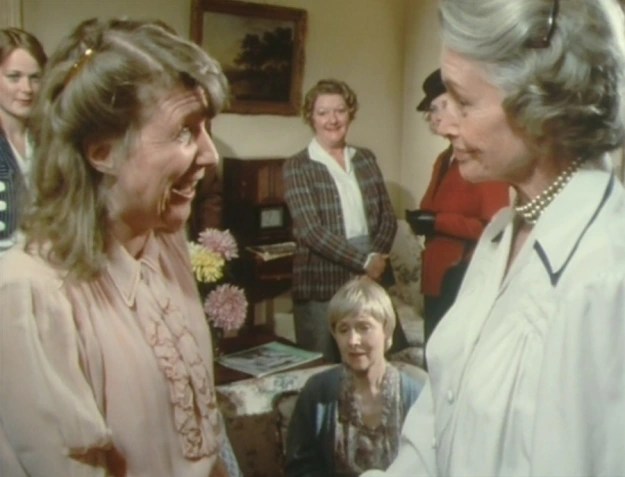
This was, and always will be, my favorite Miss Marple novel. (I have a feeling that holds true for a lot of fans.) And while I think three episodes is ultimately too long for an adaptation, this one almost proves me wrong. Yes, David Giles’ direction of Alan Plater’s script seems a little “pace-y,” like soap operas used to feel, as if everyone is holding for a reaction before they say their next line. But the refusal to rush allows us to really get to know this circle of folks (it helps that casting is superb), and it helps to examine all of them because the biggest flaw of this plot is that the murderer can seem very obvious if you know where to look. (That’s definitely the problem with the Geraldine McEwan version and the play by Leslie Darbon, both of which cut suspects down.)
Ursula Howells and Renee Asherson are wonderful as Miss Blackwell and Dora Bunner, respectfully. The same holds true for Ralph Michael and Silvia Syms as the Easterbrooks, and for Paola Dionisotti and Joan Sims as Hinchcliffe and Murgatroyd. The deaths of Dora and Murgatroyd are heartbreaking. The subplot concerning the tumultuous life of Phillipa Haymes (Nicola King) is given its full due. It’s nice to see a young Samantha Bond here as Julia Simmons and a Keven Whateley auditioning so well for his ultimate role as Sergeant Lewis by playing another Sergeant here. My only minor qualm is with the portrayal of Dermot Craddock, my favorite inspector d’histoire: John Castle is handsome and intense, but for some reason he lacks warmth and energy.
Hickson’s presence again insures that the role of Miss Marple will be built up, but somehow it plays true to and then enhances her presence in the novel. Despite feeling a trifle too long, this is a faithful and beautifully rendered tribute to this fine Miss Marple tale.

A Pocket Full of Rye (1985)
Here is an interesting problem in that the role Miss Marple plays is a fascinating display of the avenging angel – and yet she doesn’t appear until Chapter Thirteen. I can imagine the challenges that faced screenwriter T.R. Bowen to get Joan Hickson into the story more quickly, and he seems to solve it by relating the first episode (which covers those first twelve chapters) by adding scenes of Miss Marple slowly receiving information about Gladys Martin’s situation while in St. Mary Mead, to the point of view of Detective-Inspector Neele, beautifully played by Tom Wilkinson, and the various perspectives of the Fortescue family and their servants. We begin with Rex Fortescue’s death (a lovely cameo by Timothy West) and end with the nicely staged discover of Adele’s murder, omitting the most horrible moment, Gladys’ death, until the start of the second episode. All of this ramps up the suspense and makes for a gripping hour of television. And we get some great performances, including Fabia Drake as the crazy aunt, Annette Badland and Rachel Bell, both equally poignant, respectively, as Gladys and Jennifer, and a young Peter Davison charmingly rakish as Lance.
The problem is that the final two thirds of the novel, from Miss Marple’s entrance at Yewtree Lodge to a badly misjudged climax, is jammed into the final forty-five minutes. The plot points are ticked off, one after another, with hardly time to take a breath; the all-important subplot/red herring/motivation of the Blackbird Mine is horribly truncated, and Bowen makes the weird decision to have the killer himself killed at the end of a car chase. Thank goodness we still get Miss Marple’s receipt of Gladys’ letter at the end to mitigate some of these mistakes with Hickson’s fine performance of this early incarnation of Nemesis.
What made me enjoy this more was that I met Annette Badland at the Christie Festival last September. She came up to me at breakfast in the hotel and asked where I had found my teacup. This led to a really lovely chat for about ten minutes about all sorts of things, like how she might herself have made an excellent Miss Marple, and how when she played Gladys, the director Guy Slater kept her outside in the cold with a clothes pin on her nose for an inordinate amount of shooting time. Sheer torture it was! Poor Gladys!
The Murder at the Vicarage (1986)
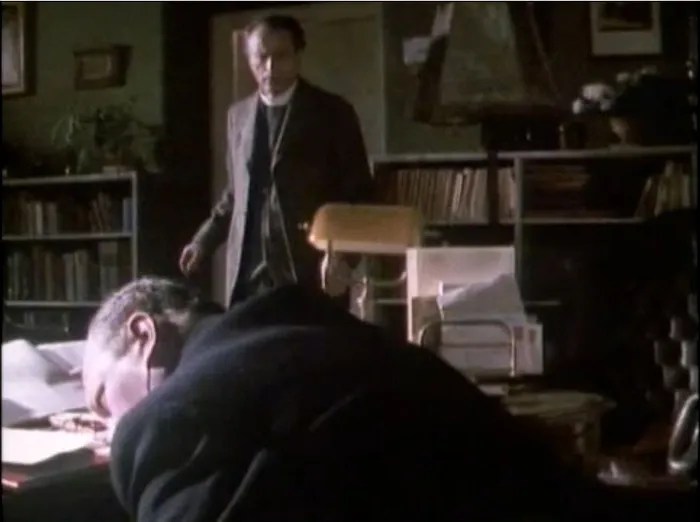
This adaptation opened the second series of Miss Marple and was the first novel to be turned into a 102 minute-long TV-movie. This necessitated trimming some of the “fat” from the longest Miss Marple novel, but this probably wouldn’t have bothered Christie, who herself insisted that “it has, I think, far too many characters, and too many subplots.” And so writer T.R. Bowen excised a pair of suspects (the archaeologist Dr. Stone and his assistant, Miss Cram), and two nephews: the Vicar’s nephew Dennis (I’m sorry about that one) and Miss Marple’s nephew, Raymond West, who enters the book midway through and rather overstays his welcome.
What’s left is a solid adaptation of the novel, with more hits than misses. St. Mary Mead is certainly a star figure, and it contains all the beloved characters, particularly the circle of gossips who hang out with Miss Marple. The plot points are all pretty intact, although a new method of faking a gunshot replaces the highly unlikely one Christie included in the book (exploding rocks?!?). David Horovitch shines as Inspector Slack here, and his reactions to Miss Marple’s lingering presence are the comic highpoint of the show.
Which is a bit of a shame because I love the Leonard and Griselda Clement of the novel, and while Paul Eddington and Cheryl Campbell are perfectly fine, they can’t match the chemistry of the book characters. Part of this might have to do with the fact that other comic characters who feed off them, like Dennis, or Mary the Perfectly Awful maid/cook, or Miss Cram, the archaeologist’s assistant, or Archer the poacher are either missing or stripped of much of their humor in order to make them more viable suspects. The roles of Mary and Archer, in particular, are beefed up considerably.
Mostly, however, I suspect the vicar’s connection to the investigation is lessened here to make more room (and screen time) for Miss Marple. This gives us some great scenes between her and Slack, who, of course, is a series semi-regular, but I miss the charming humor and perspectives on both the village and the case of Clement’s narration.
It’s a perfectly lovely adaptation, though, and I enjoyed myself. Tara MacGowan’s Lettice Protheroe is a far less annoying figure than in the novel, and both Polly Adams and Norma West cut rather noble figures as Anne Protheroe and Mrs. Lestrange. Oddly, Lawrence Redding seems almost like a minor figure, disappearing for a long stretch in the middle. I suppose he did that in the novel, too; maybe I just didn’t find the actor as sexually appealing as everyone suggests the artist to be.

Sleeping Murder (1987)
The next two episodes, both two-parters, ranked as my 11th and 12th favorite Miss Marple novels, and the adaptation of Sleeping Murder does nothing to change my mind. I didn’t recognize Geraldine Alexander as the Bridgerton’s housekeeper, but then it has been over thirty years since she starred as Gwenda Reed here. She’s perfectly fine and can’t help it if Gwenda is one of my least favorite Christie heroines.
The script by Ken Taylor is extremely faithful to the novel. The only real change is that here Giles Reed arrives in England with his wife and witnesses all the things that happen to her at their new “haunted” house and in London. The scene at the theatre is well-staged, as it should be, since it’s the best moment in the whole story. And here, for once, Miss Marple plays very much the same role she did in the book, hovering on the outskirts of the investigation and allowing Gwenda and Giles to take the focus for much of the film.
My qualms with Sleeping Murder lie not in how the plot is presented but in the plot itself. The killer is terribly obvious from the start, even if you are not familiar with the play The Duchess of Malfi. The “three suspects” barely appear, (two of them in the second hour only), and the second, present-day, murder, the cleverest bit of misdirection in the book, loses a lot in its filmic translation. Frederick Treves is fine as Dr. Kennedy, and the actor playing Giles, John Moulder-Brown, is terribly good looking. I looked him up and discovered that he had played some very twisted film roles throughout his career. In contrast, all he has to do in Sleeping Murder is stand, sit and lie around, looking supportive. But dull as this may have been, Moulder-Brown said it was fun to be on set, where he flirted shamelessly with Joan Hickson. The bawdy old wench!!
I’ll be back next week with my thoughts on the second half of the series.
 Ah Sweet Mystery!
Glad you are enjoying Miss M…
LikeLiked by 1 person
Hard to disagree here Brad, you are spot-on. I agree, Trevor Bowen did some great script work but … Alan Plater was a master and his MURDER US ANNOUNCED adaptation is night on perfect (though yes, 150 minutes is perhaps a tad long).
LikeLiked by 2 people
I enjoyed your brief discussion of different Miss Marples but wonder what you think of Helen Hayes’ Miss Marple?
LikeLiked by 1 person
Chalk it up to my lack of attention span as a 20-something, but I have never gotten on all that well with the Joan Hickson series. I understand it is probably the definitive version of the Marple stories and the actors and locations selected with care, but I rarely watch them and feel that they represent the books as I picture them in my head. (The same could arguably be said for the Suchet Poirot series but I suppose I was introduced to those an early-enough an age that they have become part of my appreciation of Christie by osmosis.)
As Sergio noted above, the pedigree of the writers was really second-to-none and there was considerable overlap with the writing team adapting the Jeremy Brett Sherlock Holmes series. (Another fun Holmesian connection while I’m here: Clive Merrison who plays Percival Fortescue in Pocket Full of Rye was the voice of BBC radio’s Holmes from 1989-1998 and remains one of the very best actors to take on the part.)
LikeLiked by 1 person
Morrison was a superb Holmes (hecdid all 60 as I recall) – and am a big fan of the new adventures by Bert Coules too.
LikeLiked by 1 person
“Merrison” without auto correct… sigh
LikeLiked by 1 person
They’re slower by far than the later series. That was the style back then. In the 70’s – 80’s, I devoured Masterpiece Theatre, but when I tried to rewatch The Duchess of Duke Street a couple of years ago, I quickly gave up. The Marple series isn’t nearly as slow, and while I don’t always agree with the changes it sometimes makes to the plots, they tend to be for understandable reasons.
LikeLike
We originally watched the first DVDs of Miss Marple from our library. Seeing some of them a second time with the remastering and subtitles was a revelation. I missed so much the first time around!
I’m so glad the BBC (or whoever) remastered the episodes. They deserve it because they, despite some flaws, are worth watching several times over.
LikeLiked by 1 person
And since EVERYTHING is subtitled on Britbox, I’m in heaven. (Although I watched a Scottish series where even the subtitles couldn’t figure out what the folks were saying: “Ayyy, yeh wee bairn, ye’re . . . Illegible!”
LikeLike
I think one reason that the Hickson adaptations work so well is that they don’t stray greatly from the source material. When I am invested in a book that I enjoy, I have little tolerance for adaptations that re-invent what is to me already excellent. To that end, A Murder is Announced and The Moving Finger are two favorites from your Part 1 review. Both stay reasonably close to Christie’s original works.
When I don’t get on with a given Christie novel (e.g., Halloween Party) than I don’t mind an adaptation that differs significantly from the book (e.g., Branagh’s A Haunting in Venice).
LikeLiked by 1 person
I agree with you, and I happen to like Branagh’s‘s version of the novel more than the Suchet version. Sacrilege indeed! One of my favorite episodes from the series at large, which I will discuss next week, doesn’t change things so much as consolidate the plot of what I consider a weak novel into something quite riveting. I was surprised at how much I loved this adaptation and how it made me appreciate the book more.
LikeLike
I watched Nemesis on TV last night,I enjoy it but feel the murderer is rather obvious,some of the dialogue about love points to 1 peron and it is that person who ends up the murderer,they are always on BBC TV here in the UK and found the full Murder is Announced my ultimate favourite on YouTube,it contains the best cast for a Christie adaptation apart from the Hercule films from 74 – 82.
Joan Sims is marvellous Ursula Howells keeps her motivations hidden and Renee Asheron a great beauty in her day is very real and touching and no-one will ever better Joan Hickson’s portrayal.
I like these as they remind me of happier times,Murder is Announced got me into murder mysteries when I was jut 10 and everytime the theme begins I have a warm feeling.
LikeLike
Brad, I love that you are re-watching the John Hickson series. It can never be tiresome to read more about Miss Marple if you are a fan!
A Murder is Announced: This 1985 film is one of my favourite Christie adaptations of all time, and one that I have rewatched at least thrice. I think the casting is excellent, as you pointed out, especially the sensitive and nuanced portrayals of Bunny, Hinch, and Murgatroyd. The film has humour and heart. It takes it sweet time and I am grateful for the opportunity to spend more time in St.Mary Mead with these wonderful people. The version with Zoe Wanamaker just doesn’t do it for me because the murderer feels painfully obvious from the start.
Sleeping Murder: When I first read this book as a teenager, I had no idea about ‘The Duchess of Malfi’. Therefore, I was thrilled by the reveal. Re-reading the book as an adult, I realise that the problem isn’t so much this aspect of the plot as the fact that there are far too few credible suspects. Three men are built up as possible murderers, but none of them felt like a truly plausible candidate with motive, means and opportunity.
I think the book’s strongest point is how it draws the terrifying psychology of “loving” control. These days, we hear so much about toxic relationships on social media, and I think about how well it’s portrayed in the book. I think Frederick Treves as Dr.Kennedy truly does justice to his role.
The Body in the Library: I enjoy the first half of this book a lot more than the second half. The trouble that Colonel Bantry finds himself in, the involvement of Basil Blake, the frustrations of inspector Slack are all interesting for me, but the entire set of characters at the hotel and the Jefferson family were eminently forgettable.
I think the same holds true for the Hickson film as well, although Josie Turner and Slack were particularly well-portrayed. I don’t remember the actress playing Dolly Bantry in this film, but I do know that I hate Joanna Lumley’s version. While she is a good actress, her interpretation of Mrs. Bantry was all wrong. Mrs.Bantry was charming and batty, but God, not like this!
A Pocketful of Rye: Reading the book for the first time, I remember feeling a sense of vague irritation at one more adenoidal and foolish maid named Gladys. But watching this film, I could actually see what such a person might look like and feel and think and behave. All credits to Annette Badland for this. She is great fun in Midsomer Murders too.
What did not work for me in this film was the actress playing Patricia Fortescue. She looked too old and dull to be this character who was described as having a certain innocent charm. Because the motive is so entwined with this character, I think they should have cast somebody much better.
The Moving Finger: One of my favourite Marple books even though she appears quite late into the story. I thoroughly enjoyed all the characters, but especially the motive and how simply a murder was carried out. I think the relationship between Megan and Jerry gets a lot of attention. But my favourite is the budding relationship between Joanna and Dr Owen Griffith. This is not a bad adaptation and contrary to general sentiment. I quite liked Deborah Appleby’s portrayal of Megan, she had a certain unassuming innocence.
The Murder at the Vicarage: This is one book where I don’t remember the Hickson version at all because the 2004 adaptation is excellent and I enjoyed it tremendously. I know that a lot of people have issues with the flashback because it is out of character. I think this story is indeed out of character for Hickson’s version of Jane Marple, but I think it works really well for the more rougish version played by Geraldine McEwan.
Dare I say it? While Joan Hickson plays Miss Marple excellently in almost all the films, I think she’s a bit grim and doesn’t twinkle as much as Miss Marple does in the books. 🫣 Geraldine McEwan does a very good job of humanising Miss Marple, although she is often let down by the screenplays. As for Julia McKenzie, she looks altogether too earnest and anxious to make a credible Miss Marple!
LikeLiked by 1 person
The actor playing Dolly Bantry is Gwen Watford, and she’s wonderful. Lumley was stunt casting and leaned too hard into Dolly’s eccentricities.
I actually liked McEwan’s performance, too, although I prefer Hickson’s way of “playing the role” of woolly-headed old lady. Listen, if someone wants to give Miss Marple a romantic backstory, be my guest. I have a hard time believing she would pin her hopes on a married man, but in the McEwan universe it gives an explanation for her spinsterhood.
But I had forgotten how funny Hickson could be as Miss Marple. Her looks of disapproval at red sports cars and skyscrapers, her attempt to keep her cool after Brian drives her from Her home to Rutherford Hall, the glint in her eye when she stares down a waiter and asks, “Is it REAL seed cake?” It just makes me want to watch the whole thing all over again.
LikeLike
Pingback: MY AGATHA CHRISTIE INDEX (The Blog-iography!) | Ah Sweet Mystery!