Last week, I explained how circumstances led me to revisit Agatha Christie’s Miss Marple, the series that starred Joan Hickson and which aired on the BBC from 1986 to 1992. I shared my thoughts about the first six adaptations, and today we’ll cover the rest of the series.

At Bertram’s Hotel (1987)
Returning to this was the biggest surprise for me. Bertram’s is my lowest ranked Marple, and I don’t remember enjoying this when I first saw it. But the adaptation is absolutely wonderful, somehow distilling the best bits of the novel into a coherent and entertaining two-parter, and not having to resort to wanton plot butchering, a crime that the later Marple series committed in spades. It scored scenically by recreating a fine old British hotel just like the one I stayed in last fall – not too big, not ostentatious, just fabulous.
The novel is not really a whodunit at all: rather, it is a merging of two crime stories: a massive organized crime syndicate and something much more personal. Screenwriter Jill Hyem strikes the perfect balance between the two, focusing more on the lives of Bess Sedgwick, her daughter Elvira and their hangers-on than even the novel did. I’m not as big a fan of Bess as other readers are, but Carolyn Blakiston has a lot of fun playing her. I was more taken with Helena Michell as Elvira, a difficult character to pull off because she is cold as ice in the novel. Michell warms us up to her and allows us to sympathize – before pulling the rug out from under us, exactly as Christie planned it.
Inspector Fred Davy is hanging around undercover, eating one afternoon tea after another as he observes the goings-on at Bertram’s. He is played by George Baker, whom I remember well as Tiberius in the glorious I, Claudius. Baker is excellent here, and it’s marvelous how in the first episode we get to watch both he and Miss Marple basically sit and observe, and then in Part Two they pool their talents together, consulting far more than they do in the book. Then it becomes quite funny watching Hickson plant herself and her knitting in one chair after another in order to report her findings to “Father” Davy.
Everyone is good here: all the employees at Bertram’s (especially Brian McGrath, who makes you sad when Mickey Gorman is killed); the helpless old men, Canon Pennyfather and Colonel Luscombe; and especially the fabulous Joan Greenwood as Lady Selina Hazy (“Oh, look, isn’t that Lady Teasdale over there?”). She steals the shot every time she appears in it; even Joan Hickson is wise and kind enough to meekly defer to her performance.
The climax is suitably climactic, and while it feels more conventional, I can’t help being happy that the script added a final confrontation between Miss Marple and the killer. (Except that confessional diary is waaaay too convenient: “Today I killed Mickey?”) Seriously, this almost shifts my feelings about the book upwards – but even if Bertram’s remains on the bottom of my list, it’s nice to know that there is a version of it out there that offers a most pleasing experience at Bertram’s Hotel!
P.S. Be sure and get your adaptations straight: avoid the execrable mess that ITV made of this in the later Marple series.

Nemesis (1987)
Continuity was an iffy thing in Christie, but there are a few steadfast rules for reading her books in any sort of order. One of them is that you must read A Caribbean Mystery before you read Nemesis. Miss Marple’s first meeting with millionaire Jason Rafiel occurs in the Caribbean, and the development of their relationship during that holiday (well, a busman’s holiday for our Jane) is what leads us right into Nemesis.
Thus, adapting them for TV in the opposite order strikes me as a mistake and a missed opportunity. But this is small potatoes compared to the bigger challenge of adapting this final, significant chapter in the career of Miss Marple. (Don’t talk to me of Sleeping Murder – I will always believe that Nemesis was the lady’s swan song!) Nemesis is hardly a traditional whodunit at all; rather, it is a deeply introspective and emotional piece centered around the complex ramifications of love. A great deal of the novel occurs in Miss Marple’s mind, while most of the rest consists of long conversations mostly dealing with memories. There is a death, but like most of Christie’s novels about murder in retrospect, any present-day shenanigans act mostly as pointers to the past.
So how to make this largely elegiac piece of literature into a movie? Writer T.R. Bowen comes up with a few significant changes that manage not to alter the plot much but to assist his goal of retelling Nemesis in a way more conducive to the needs of the series.
First, in the novel we learn about Mr. Rafiel’s “commission” to Miss Marple through a series of letters. Here, we actually meet the man, who is at death’s door on his private island paradise, frantically making final arrangements with his secretary. Next, Bowen bestows upon Miss Marple a godson! Lionel Peel has just been thrown out by his wife, and he seeks out his favorite old relation for commiseration. I’m not crazy about new characters being manufactured in a Christie novel (take those miserable children of Rowena Drake in Hallowe’en Party – please!), but Lionel is more a device than a person, a means of giving voice to Miss Marple’s reactions Mr. Rafiel’s request.
The other major change is that in the novel, Michael Rafiel is rotting in prison, convicted of the murder of Verity Hunt. But here Michael was never indicted for that crime. Instead, he has dropped out of society and is living on the streets, working as an advocate for other homeless people who are more helpless than him. He knows about his father’s death and gradually becomes aware of the investigation going on in his behalf.
Other smaller changes speed the story along – and it was a book that tended to sag in the middle. Miss Marple begins her quest on a much less vague note: she is informed about Verity’s death and makes the obvious assumption that Mr. Rafiel wants her to look into it. Since A Caribbean Mystery hasn’t been seen yet, Bowen cuts out the visit to Esther Walters, which I enjoyed reading but must admit added no significant information to benefit Miss Marple. Several minor characters in the book who supplied minor subplots – like the romance between Joanna Crawford and Emlyn Price – are dropped. So is the initial stakeout in St. Mary Mead by Miss Cooke, who along with her partner Miss Barrow is milked for all she’s worth as a red herring.
The central story remains intact, and it is beautifully performed by the cast. The Bradbury-Scott sisters are the focal point, and Margaret Tyzack gives a tremendous performance as Clothilde. The satellite of assistant commissioners sent to help Miss Marple – Elizabeth Temple, Professor Wanstead, Archdeacon Brabazon – are all excellent as well. Miss Temple’s murder is brought indoors and restaged for the series, and it makes for a wonderfully shocking cliffhanger between episodes.
Here, though, is a case where Joan Hickson steals the show. She perfectly embodies the thoughtful reflection that occurs, albeit in a more literary fashion, in the book. But while she spends most of At Bertram’s Hotel sitting and observing, here she is all over the place, and each new visitation brings new thoughts and reflections. Hickson is helped along by a haunting score (I believe, by series composer Ken Howard) and by the thoughtful direction of David Tucker. The only slightly false note occurs at the very end when Miss Marple finally meets Michael, now all cleaned up and positively courtly. It’s too falsely happy a note on which to end such a dark, sad story.
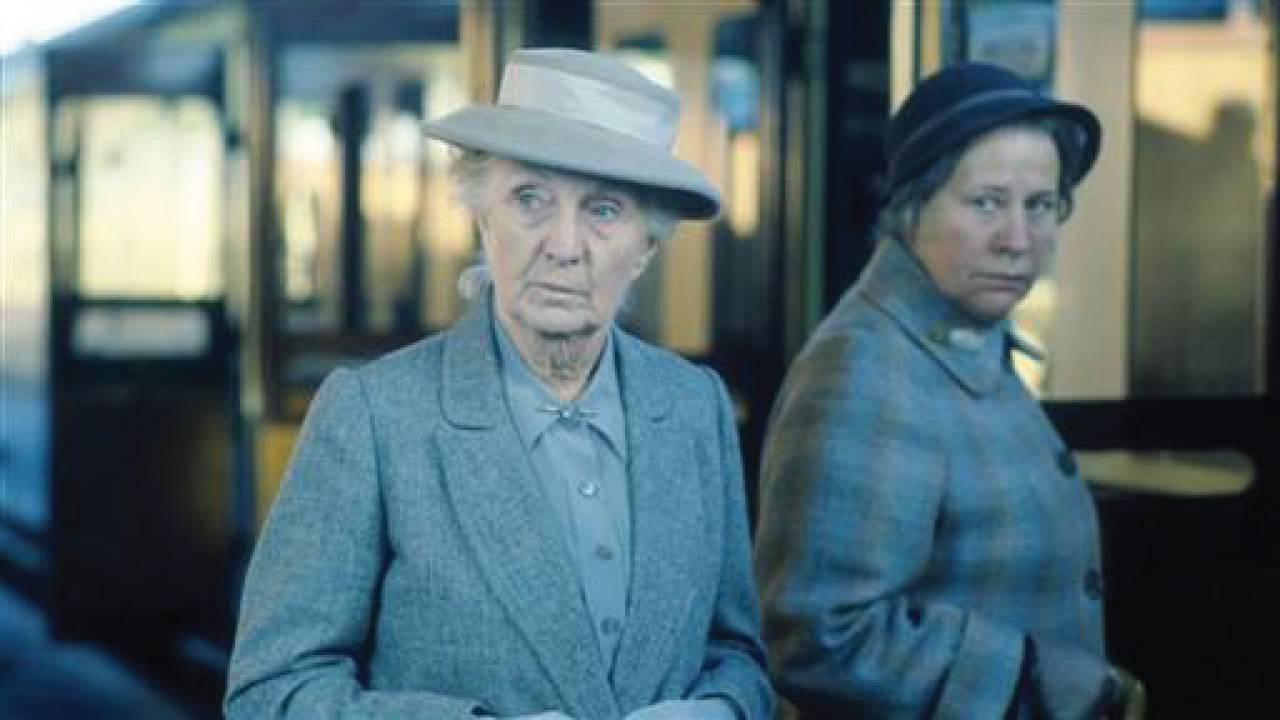
4:50 from Paddington (1987)
The third and final season of Miss Marple was comprised of feature-length episodes, all written by T.R. Bowen, adapting the four remaining novels. Evidently there had been some doubt as to whether Joan Hickson would complete the Marple canon, and so in Season Two decisions were made as to which novels to adapt. This would account for Nemesis appearing before A Caribbean Mystery, as foreign travel would have added a new wrinkle to production. I suppose most people wouldn’t consider these four last titles “Grade A” Marple. Indeed, in my own rankings, they all placed in the middle – two of them at 5 and 6, and the other two at 9 and 10.
Paddington was one the the higher-placed titles. I’ve always enjoyed it for its hook, its humor, and the romantic mystery surrounding Lucy Eyelesbarrow. I’ve been fairly flexible with changes wrought to the original text, but this time, I think Bowen goes a little too far. Not that the basic mystery is changed all that much, but a lot of what I enjoyed in the book goes missing – as the following chart will show:
| Things I Like about the novel 4:50 from Paddington | How the BBC adaptation differs from the novel |
| 1. The opening is told from the point of view of Mrs. McGillicuddy as she witnesses the murder of a strange woman in a passing train | 1. The opening point of view is split between Mrs. M. and the victim, allowing the adaptor, T.R. Bowen, to spill the beans early that she was a devout Catholic |
| 2. Once Mrs. M. tells her old friend Miss Marple about the murder, our sleuth uses a variety of resources, including the Vicar’s son, to trace the probable location of the body to the area near Rutherford Hall. And that’s ALL Miss Marple knows; the rest must be deduced following onsite investigation. | 2. Once Mrs. M. tells her old friend Miss Marple about the murder, our sleuth deduces that the body must be hidden at Rutherford Hall, which has now been moved into Miss Marple’s neighborhood for TWO reasons: first, Miss Marple already knows a lot about the Crackenthorpes, eliminating the novel’s exposition, and second . . . |
| 3. Miss Marple hires Lucy Eyelesbarrow, who manages to locate the body in a sarcophagus in the old barn, prompting the arrival of my favorite policeman, Dermot Craddock. | 3. . . . since this now takes place near St. Mary Mead, the services of series regular David Horovitch as Inspector Slack can be used. This provides comic merriment as we witness the rivalry between Slack and Miss Marple. Scotland Yard does get called in, but it’s a new character who joins the investigation. |
| 4. Much of the novel’s mystery is in figuring out the identity of the victim. An underlying possibility is that it’s Martine, the war bride of the late Edmund Crackenthorpe. | 4. The body is identified almost immediately. Miss Marple is told that the victim appeared athletic and deduces she was a dancer. In a twinkling, the police locate the workplace of Anna Stavisky, and the dance director identifies her. Oddly, the police learn that Anna’s real name was Martine, which is a ridiculous coincidence meant to link one woman to another. |
| 5. In a dramatic turn midway through the novel, the family is poisoned by doctored curry, causing the death of Alfred. Although Harold recovers, someone purporting to be Dr. Quimpe sends him poisoned medication and he, too, dies. | 6. There is no poisoning incident. Harold is murdered on the grounds while out hunting. It turns out that he was a ballet fan and might (but it’s not clear) have known and been able to identify Anna Staviska. (So why didn’t he?) Meanwhile, Aflred is not murdered – except it turns out that Dr. Quimper diagnosed his cancer too late for him to be treated for it. |
| 6. Late in the game, the family is visited by Mrs. Stoddart-West, mother of Alexander Eastley’s best friend. She reveals herself to be Martine, thus ending that red herring and helping to confirm that the victim was Anna. | 6. No Mrs. Stoddart-West, no wrap-up to the Martine story. Perhaps it was a bit pat for Christie to include it, but I have great fondness for that twist. |
| 7. An even better mystery than the killing of the lady in the train is: who will end up with Lucy Eyelesbarrow’s hand in marriage. I always plumped for Dermot Craaddock, but I guess Christie has confirmed in print or interviews that the lucky man was Cedric Crackenthorpe, the artist. Christie smartly leaves it open, however, allowing all of us romantics to imagine our own happy ending for Lucy! | 8. Writer Bowen ignores the wishes of both the author and this fan and spends a great deal of time setting up an open rivalry between Cedric and war hero Bryan Eastley. There’s no ambivalence about the ending: Cedric reveals himself to be a lecherous cad, and Bryan gets to fly onto the grounds in a plane and knock out the killer with his fists, despite having a gun drawn on him. I guess to satisfy Christie fans, Miss Marple offers the consolation to Cedric that Lucy was attracted to him. |
Wrap-up: clearly, there are elements of the novel that Bowen saw as “weaknesses” and tried to “fix.” As 4:50 from Paddington ranked sixth out of twelve on my list, I have no problem with them, aside from the fact that Miss Marple pulls the solution out of thin air. Since Bowen thought he could fix things, perhaps he could have tried tackling that little problem as well!
A Caribbean Mystery (1989)
This has always been a favorite of mine, perhaps because it was the first Miss Marple novel I ever read. Had I known how many seemingly charming husbands kill their wives in Christie (and had I not been 12 at the time), I might have seen through the ruse and solved the case. As it is, I think the central clue concerning Major Palgrave that Christie places right before our eyes, as it were, is extremely clever. Perhaps the story is a little simplistic and the characters a bit undeveloped, which is why it earned a ranking of 5th place on my list.
Rather than change things up, however, T.R. Bowen (who makes a cameo appearance as Raymond West here) decided to take advantage of the simple plot and expand upon the characters and their relationships to each other. Director Christopher Petit took full advantage of the exotic location shoot in Barbados and created an atmospheric tale of betrayal and murder. A lot more time is spent than in the novel setting up the complex relationships between the Dysons and the Hillingdons. Sophie Ward is an affecting Molly Kendal, and she plays the woman’s disintegration into forced madness perfectly.
But the show is definitely stolen by Donald Pleasance, who creates a wonderful Jason Rafiel. His interactions with Miss Marple are a joy to behold, and Joan Hickson is clearly having fun with him. I wondered if she was feeling her age during this filming, as the ending feels a bit truncated. Rather than sit down and explain the solution to everyone, Petit chooses to have Miss Marple deliver her monologue in voiceover while the camera shows her returning to England. There’s no goodbye to Jason Rafiel at all, which, in the context of “Nemesis,” doesn’t make sense.
Bowen adds a couple of plot points into the mix that is not in the book, but since they boost the presence of the island characters, I approved heartily. He builds up the character of the maid, Victoria Jackson, and turns her from a scheming blackmailer into an observant employee who notices too much. Early on, Miss Marple befriends Victoria, who invites the detective to her own village to meet her aunt. After the maid’s death, Miss Marple attends her funeral, and when the killer is caught, the aunt is given a moment to confront him, which is powerful. Another twist, perhaps unnecessary but fun nevertheless, is that Weston, the native policeman put in charge of investigating Victoria’s death, did his training in England where he met Sir Henry Clithering, who told him all about Miss Marple. This gives the new relationship between professional and amateur a whole new shading here.
Perhaps the film as a whole could have been tightened up a little, but all in all it was a fine adaptation that mined the story for all its emotional impact, from the pathos of poor Major Palgrave to the final tragic ending of Molly’s “happy” marriage. No wonder Miss Marple was happy to get home to England!
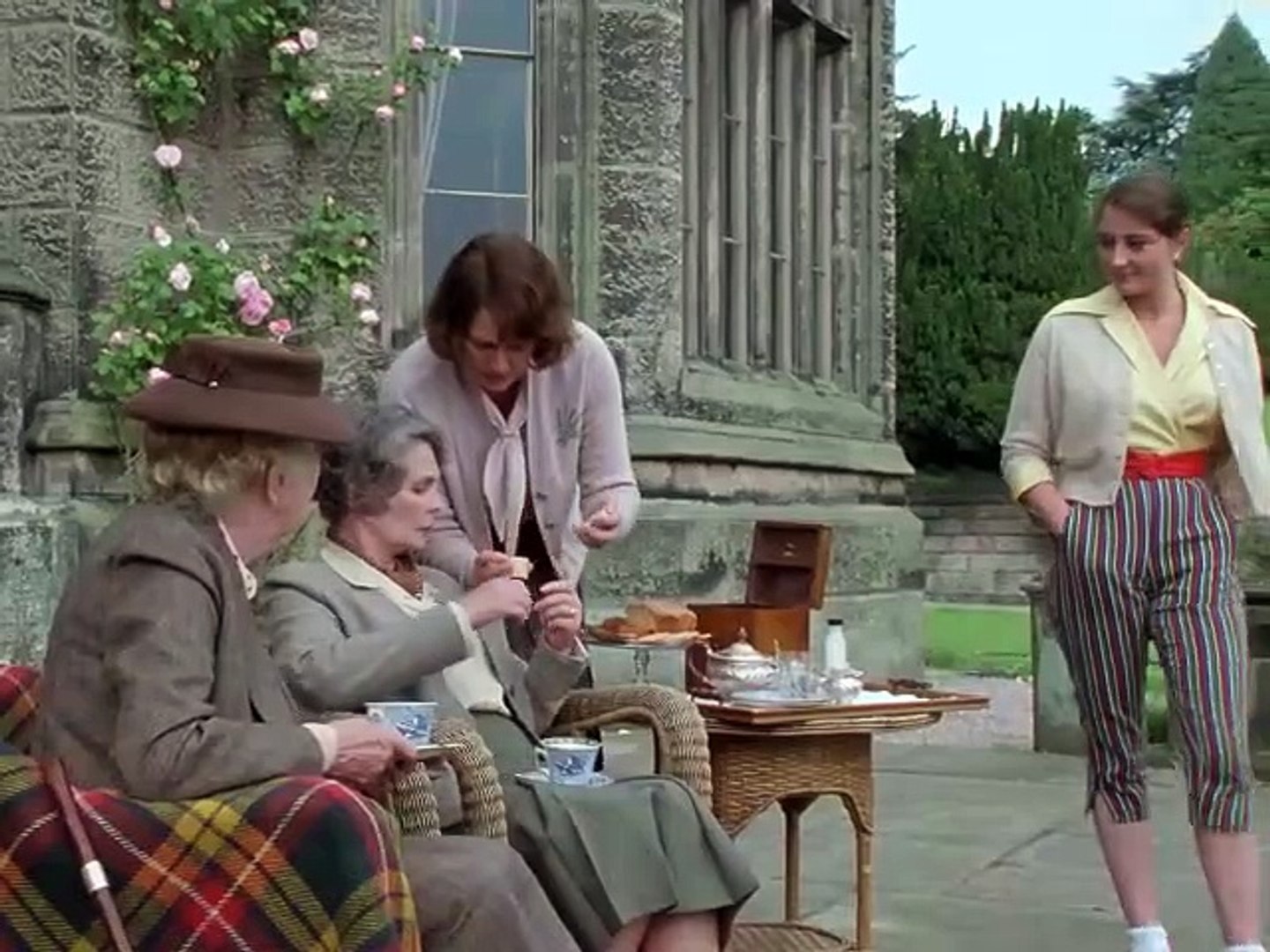
They Do It with Mirrors (1991)
From the start, T.R. Bowen’s script tries to inject some fun into this, perhaps the dourest of Miss Marple novels. Bowen expands the role of Ruth Van Rydock, Miss Marple’s childhood friend, who summons her to the Savoy in London to ask a favor: would she please check in on Ruth’s sister Carrie-Louise, because Ruth has a gut feeling that something is wrong.
But first! The ladies make a day of it, something we never see in the novel. They have lunch and attend a matinee of a new modern ballet by Carrie-Louise’s stepson Alex Restarick. The ballet is pseudo-pretentious crap, and it’s fun watching Miss Marple and all the other elderly matinee ladies try and hold themselves together.
Once Miss Marple arrives at Stoneygates, the mansion that used to belong to Carrie-Louise’s first husband and has now been transformed by her third husband, Lewis Serrocold, into a rehabilitation home for delinquent boys, the story pretty much follows the original plot. The exceptions are fairly minor: Ruth arrives at the house in time to be included in the suspect list; the role of Alex Restarick is expanded, while the role of pathetic daughter Mildred Strete is reduced to comic relief; and when the double attack occurs against Alex and Ernie Gregg, Alex survives.
The basic murder plot, however, remains the same. The problem is with the investigation. First of all, it is run by Inspector Slack, which must mean that Carrie-Louise lives in the same county as Miss Marple. So why haven’t they seen each other in forty+ years? For some bizarre reason, Slack has been given the hobby of practicing magic tricks, which is what cues Miss Marple into how the killer managed to get away with murder before everyone’s ears! Slack pulls people in for questioning, but very little regard is given to anyone as a potential murderer.
What makes this so watchable is a terrific cast, led by Jean Simmons as Carrie-Louise and Joss Acklund as Lewis. A nice touch (also not in the book) is that Ruth has some connection with the film industry and manages to have an old reel from her childhood restored. At the end of Mirrors, everyone sits down to watch this glimpse of a very young and pretty Miss Jane Marple escorting her charges, Ruth and Carrie-Louise, all around Europe. It can’t help but put a lump in your throat.

The Mirror Crack’d from Side to Side (1992)
If Nemesis is no longer available to end the series, then a good argument could be made for this being a fine swan song for Joan Hickson’s Miss Marple. The best aspects of the book have to do with settling the old lady’s domestic affairs and finding that solution almost surprisingly residents of St. Mary Mead’s new development. The book is full of Miss Marple’s reflections on her community and these are dropped, but the whole Miss Knight vs. Cherry Baker subplot is beautifully presented.
Adding to the nostalgia here is the return of Gwen Watford as Dolly Bantry. We met her and her husband in the first episode, The Body in the Library. Now Colonel Bantry is dead, and Dolly has sold Gossington Hall to movie star Marina Gregg. Watford makes a perfect Dolly (I always thought the stunt casting of Joanna Lumley in the later series was just weird), and her friendship with Jane Marple forms the crux of the episode. It’s also nice to see John Castle return from A Murder Is Announced as Inspector Craddock, although all sorts of strangeness is attached to his presence here. For one thing, he is oddly transformed into Miss Marple’s nephew; for another, he shows up and is answerable to the chief of the community – Inspector Slack! No matter: the trio of Marple, Craddock and Bantry are a formidable team.
As for the mystery, the book always had a weak middle section that almost fails to support the strong central idea. Here, I hope I don’t offend when I say that writer T.R. Bowen (who makes his second cameo at the end as Raymond West) has improved upon Christie’s barely sketched in suspect list. Ardwyck Fenn, Lola Brewster, and Margot Bence are much better developed as suspects (although the actor playing Fenn is bizarrely cartoonish). The dysfunctional household at Gossington is better delineated, with Elizabeth Garvie excellent as Ella Zeilinsky and Norman Rodway equally good in the expanded role of Dr. Gilchrist. The character of Hayley Preston is cut; so are the pointless plot points of the butler being murdered and Arthur Badcock turning out to be Marina’s first husband. (Good riddance to both!)
Leading the guest cast are Claire Bloom and Barry Newman, who create a really lovely and sad romance between Marina Gregg and Jason Rudd. Bloom’s Marina is more realistically depicted than Elizabeth Taylor’s earlier portrayal, and more complex. Dr. Gilchrist suggests she is manic-depressive, and that helps explain a lot without trying to excuse the terrible choices she has made in her life.
Not even the excellent writing and acting here can fully hide that Mirror works better as a domestic drama than a whodunnit. The concept of German measles comes to Miss Marple in way that’s different from the book but no less awkward and out of the blue. The climax follows the book’s ending, but the episode adds a coda that fans of Joan Hickson and of this marvelous series will enjoy: a garden tea where the three investigators are joined by Raymond West and the Vicar (it’s Hawes from The Murder at the Vicarage, now promoted!). They speak their final piece about the case, and then Miss Marple is caught in an everlasting final shot as she offers the vicar more tea.
This return to a beloved old series has been such a pleasure. I found it even more engaging this time around. The question that arises is – do I dare rewatch Suchet’s Poirot or the later Marple series? I’ve seen none of the short story episodes of Poirot, and while I very much enjoyed Suchet’s performance, I do not hold with the idea that the series gave us uniformly excellent adaptations. And I gave up on Marple soon after Juliz Mackenzie started appearing in books outside the Marple canon. One has to ask if, due to the choices made here, we will ever see a good and proper adaptation of The Sittaford Mystery. Time will tell.
 Ah Sweet Mystery!
As you may know, I am not a wholehearted fan of the Hickson Marple series. I do love Hickson in the role—though I feel the very notion of a definitive portrayal suggests intolerance of other viewpoints. But the pace of the series often strikes me as leisurely to the point of somnolence, and I don’t feel the general thinness of clueing in the Marple stories is helped any by eschewing denoument flashbacks (we’ve often seen that they needn’t be jarring, “flashy”devices— they can be presented in a gentle way that fits in with the style of these type of stories).
However, I am dazzled by the Hickson Nemesis adaptation. Here, I feel the leisurely pace actually enhances the gentle, contemplative mood of the story. Whether it is a function of the screen writing or the direction, the frequent use of unfinished sentences by many of the characters adds to the subtlety of the performances, for either dramatic or comic effect. And besides those excellent performances you’ve already named, I’d add those of the two solicitors, Madge the tour guide (hilarious), and above all the tour de force dramatic performance of Liz Frazier as Mrs. Brent, who is given a monologue I feel almost rivals that of Ingrid Bergman’s in Murder on the Orient Express.
Even the lack of denouement flashbacks don’t bother me here. Miss Marple’s speech to the culprit provides all the key points in a manner that I for once consider sufficient without them (perhaps because the emotional power is so strong, and even Hickson’s performance here is uncharacteristically dramatic). I see your point about the ending, but I’m not at all bothered by it… I’m not big on the “restoration of the social order” concept of the genre, but I feel there’s an emotionally satisfying aspect to Mrs. Marple bringing about the justice that Mr. Rafael was wise enough to entrust her with. Yes, I’ll end with that preposition.
LikeLiked by 2 people
Ending with a preposition doesn’t bother me. Calling her “Mrs.” Marple is either a grand faux pas or wishful thinking.
I concur with all your plaudits for the named characters’ performances. I also call attention to the quiet remorselessness of Miss Marple’s tone with the murderer and how it got under the killer’s skin.
LikeLiked by 1 person
File it under grand faux pas.
LikeLike
I can’t disagree with you on any of this Brad, I think you are absolutely right about the later adaptations in the Hickson series. Overall they certainly remain my favourite screen versions of those books, love though I do the 1980 film of THE MIRROR CRACK’D.
LikeLike
Agree with you on all of these, Brad. I love this version of Nemesis, especially the casting and how chilling the portrayal of Clotilde was. And the Hickson version has my favourite Marina Gregg. Just the right level of drama and pathos.
LikeLiked by 1 person
Pingback: MY AGATHA CHRISTIE INDEX (The Blog-iography!) | Ah Sweet Mystery!