I have to tell you that, health-wise, for me February has been a bust. There was no glamor to it: this wasn’t COVID or the flu or la grippe. This bug was out to prove that you can feel just as rotten with a generic cold as with one of those celebrity illnesses floating about. It skipped the sniffles and went right to my chest, and no amount of cough medicine, homemade chicken soup, or episodes of The Traitor could stop this thing from wracking my lungs and making sleep impossible. By first week’s end, I was sore of body, woolly of head, and utterly depressed.
It was, in short, the perfect time to read Cornell Woolrich.

It is said (by Francis M. Nevins, Woolrich’s biographer) that Woolrich had the most wretched life of any American writer since Edgar Allan Poe. According to film noir scholar Eddie Muller, in his introduction to the American Mystery Classics reprint of The Bride Wore Black, Woolrich’s first existential crisis occurred at age eleven; later, when asked about his hugely successful writing career, he was heard to say: “I was only trying to cheat death.” Writing brought wealth and fame, which was spent in a series of seedy hotel rooms, one of which Woolrich shared with his mother. He spent his final days after her death as an alcoholic cripple, a lonely, self-loathing homosexual staring out the window of the crappy lobby of his crappy hotel at life literally passing him by.
Woolrich’s genius lay in how he poured the bleakness he felt into his work, how the loathing and fear and despair oozed through his fingertips across the surface of his Remington NC69411 and created dozens of books and short stories that epitomized the best of the pulps just as well or better than his more acclaimed contemporaries Cain and Chandler and Hammett. Woolrich took the landscape of roofs and alleys and fire escapes that permeated the view outside his hotel window and made it the stuff of nightmares. His heroes searched for the truth with the intensity of Oedipus, and like that tragic Greek king, to say that they were dismayed by the end of their journey would be an understatement.
Hollywood became obsessed with Woolrich (although it denied him any success as a screenwriter.) The studios adapted dozens of films from his work, and noir critics will often tell you that most of the time they got the man wrong. I would hazard a guess that the most frequent mistake had to do with the film industry’s unwillingness to go far enough to suit the writer’s original intent (and in that case a strong argument can be made that Hollywood also got Cain and Highsmith and Goodis and Thompson wrong.) That said, plenty of good movies got made: Phantom Lady, The Leopard Man, Night Has a Thousand Eyes, – and my favorite film of all time, Alfred Hitchcock’s Rear Window (1954).
Not that Hitchcock got Woolrich right either, but any author adapted by Hitchcock had to expect that his work would be transformed into An Alfred Hitchcock Picture. The director took for his inspiration a short story Woolrich had published under his most popular pseudonym, “William Irish” called “It Had to Be Murder.” Up till this moment, it’s the only thing by the author I have read, and compared to most of Woolrich, it’s positively light-hearted. Hitchcock took this little tale of a man in a wheelchair who thinks he sees a murder outside his apartment window, warmed it up, expanded the character list, turned the man’s male attendant into the scene-stealing Thelma Ritter, and put Grace Kelly in about fifty Edith Head creations. It’s sheer heaven – but ultimately it doesn’t replicate The Woolrich Experience.
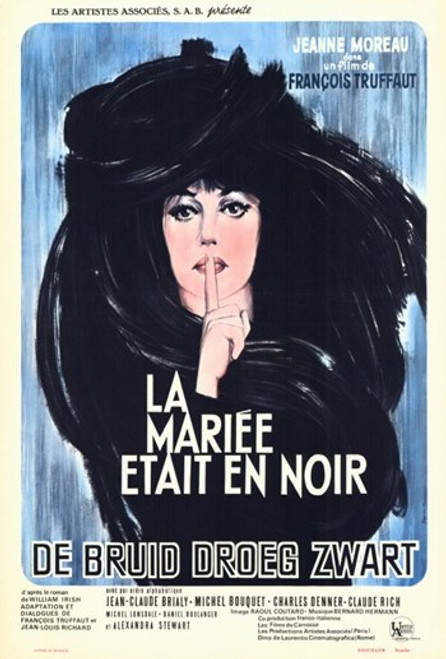
In 1968, French filmmaker Francois Truffaut adapted The Bride Wore Black – not because he understood Woolrich any better than anyone else but because he adored Hitchcock and wanted to make An Alfred Hitchcock Picture. I watched it a couple of years ago, and, to be frank, it put me off reading the book. There was something sterile about it that made me wonder how well Truffaut, for all his adoration, had even understood Hitchcock.
Ultimately, it was my friends in Book Club who set the stage for me to read this one, and this dratted cold sealed the deal. Not that Book Club is reading the book together – we have yet to pick a Woolrich to share, but I have a feeling it will happen one of these days. No, we have a project coming up in March that necessitated my picking up The Bride Wore Black, first published in 1940 after Woolrich’s career as a Jazz Age novelist had sputtered out (he might have looked out that window and noticed that the Jazz Age was long dead.) And while I can’t speak for the rest of his canon – not yet – I have a feeling that Bride will go down as one of the most stunning debuts ever. Not of a writer, since Woolrich had published several before this, but of a style so evocative that all you have to do is say the author’s name to summon up the images of men and women wandering the alleys of the city like rats in a maze.
The book is divided into five sections. The first, deliciously called “Bliss,” introduces us to our main character Julie Killeen, a beautiful young woman in the throes of grief and some other, darker, emotion, and establishes the pattern of her present life. At the start, Julie bids her life in New York goodbye and allows a friend to escort her to Grand Central Station where she buys a one-way ticket to Chicago in search of a fresh start. Except – she’s not going to Chicago, and this “fresh start” might surprise her friend. Once alone, Julie throws away the ticket and takes a cab to a seedy rooming house where her subsequent actions indicate that there is a plan forming in her fevered brain. I love the details here, like the rusty razor blade she finds atop the rust-brushed medicine cabinet that she uses to rip her initials off of her suitcase.
And then we meet the object of Julie’s feverish obsession: a businessman named Bliss, who has traded in his life as a ladies’ man for the respectability of matrimony. We get the sense that Bliss is on a path to reform himself as befits a successful man of means, especially in his conversation with best pal Corey who disapproves of xi respectable interaction with women. Their dialogue together is refreshingly frank:
- Corey: Well, tonight you get hooked! Tonight you get branded! Feel like running out yet? You bet you do! You’re all white around the gills –
- Bliss: Think I’m like you?
- Corey: You should be like me. This is one guy they don’t pin down to a formal promise.
- Bliss: If you’d bathed oftener, maybe you’d get more offers.
- Corey: And make them have a hard time finding me when the lights go out? That wouldn’t be fair.

Meanwhile, Bliss becomes aware that he is being stalked by a mysterious woman. Woolrich dangles this before us, and it is just as interesting the way he presents the ways men respond when beauty pursues them as it is to feel the noose of suspense tightening around Bliss until it culminates in a shocking climax at his engagement party. At this point, Woolrich introduces Wanger, a homicide detective who is destined to become Julie’s long-term antagonist. While others are eager to dismiss the businessman’s death as a horrible accident, Wanger can’t help but consider the odd behavior of the woman who found herself alone with Bliss on the rooftop – and who then disappeared.
Each section of the book deals with a different man and his fateful relationship with Julie. It has every possibility of becoming repetitive, but the devil – and the delight – is in the details. Woolrich produces one imaginative scenario after another and ratchets up the suspense in a variety of ways. In one sequence, the question becomes how Julie will commit murder, particularly with her victim’s young son running about; in another, we chew our nails wondering if this sympathetic villain can escape the impending scene of her next crime when an impromptu party descends upon the place. We know how each situation is going to resolve itself, but Woolrich keeps surprising us with clever little twists.
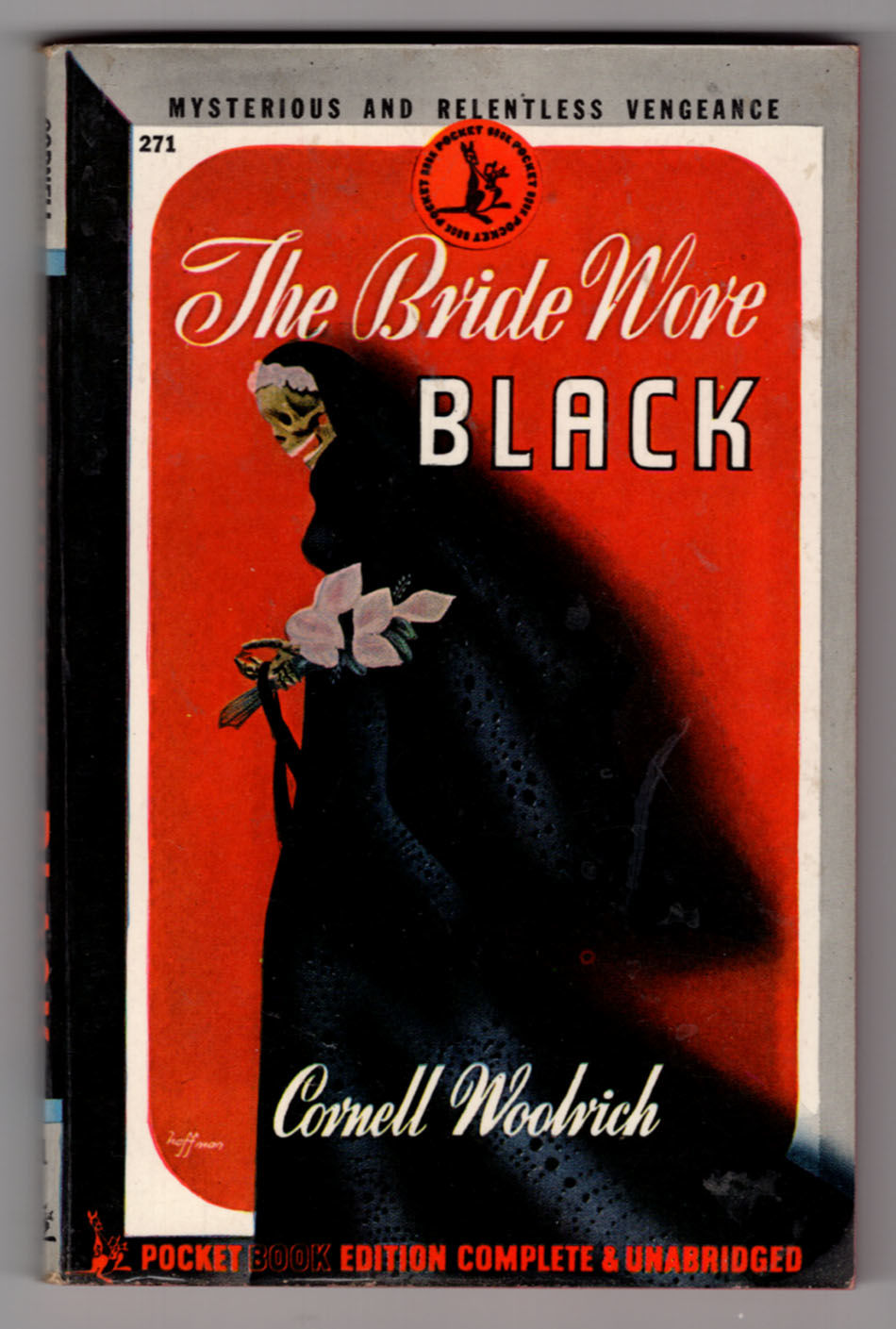
In his introduction, Eddie Muller talks about the general critical response to Woolrich’s work:
“Literary critics, of course, we’re always disdainful of Woolrich. His stories are not conducive to analysis or interpretation. He was not an elegant writer. You don’t reread him for the beauty of the prose. His work should not be intellectualized – it should be consumed in a feverish rush. That’s how you feel the undertow, surrendering to the rush of words, carried away on the relentless black tide.”
I totally get this: as I read, I was consumed by a feeling of being pulled toward something dark and inevitable. And yet, I enjoyed Woolrich’s prose just fine, too. I found it rich and evocative and sometimes quite funny, as in a scene where we follow a pair of obnoxious art “intellectuals” through a gallery as they put down the displaying artist’s work.
As Wanger slowly closes in on Julie, we can’t help but look forward to their climactic confrontation and predict how this will go down: will Wanger feel any sympathy for Julie? Will the bride feel any remorse for the chain of death she has wrought upon a group of men that we suspect might be deserving of their fates? But this is Cornell Woolrich we’re talking about, and he has a nasty twist up his sleeve that pulls the rug out from all our understanding of the world as we believed it to be.
I may have a bit of a quibble as to how firmly Woolrich establishes the foundation for this final twist. But my minor concerns can’t rob the book of its power. And this was just the beginning of Woolrich’s career as a suspense writer. I can’t wait to see where he went from here. I have a feeling I’m at the start of a beautifully nasty habit!
 Ah Sweet Mystery!
We all owe a debt to Muller – the Czar of Noir – but like you, I think Woolrich’s prose style is worthy of attention (Julian Symons is another fine critic, one I mostly agree with, who was tough on the author’s style). BRIDE and PHANTOM LADY, the first “William Irish” novel, are usually wherein begins and I certainly did – that was 40 years ago and I have never looked back. Really look forward to reading what you make of his other books, once you’ve shaken off that nasty cold though! I MARRIED A DEAD MAN was his last great novel – and has been filmed multiple times.
LikeLiked by 1 person
Fortunately, it’s a pretty manageable canon and still accessible. I can’t wait!
LikeLiked by 1 person
So glad to hear you enjoyed this one, I loved it too when I read it. Sorry to hear you’re still feeling poorly though. I hope you start feeling better soon. Another Woolrich I would recommend is Deadline at Dawn (also an AMC reprint).
LikeLiked by 2 people
I’ll put it on the list! And thanks, I am feeling better, which is why I’m moving on to Rufus King and maybe another YA mystery!
LikeLiked by 1 person
No one rights desperate characters driven to ever more extreme actions better than Woolrich. The despair at times drips of the pages.
In addition to the titles that Kate and Sergio highlight, I also recommend “Waltz into Darkness” and “Fright”. Coincidentally, today I will get “The Black Curtain” delivered. As you say, many of Woolrich’s novels and short stories thankfully are available.
LikeLiked by 2 people
I happen to have old copies of The Black Curtain and Waltz into Darkness on my shelves, so I’m all set!
LikeLiked by 1 person
Cornell Woolrich wrote some amazing stuff. Three O’clock is my favorite.
LikeLiked by 1 person
Thanks for the suggestion!
LikeLiked by 1 person
If you get the chance, after you read it, listen to the Old Radio Show of it on Suspense. It starred Van Heflin. Its on YouTube I think
LikeLike
I picked up the AMC reprint on my last trip to the Mysterious Bookshop over the summer and I really can’t wait to read it. Your positive review has pushed it a few rungs higher on the TBR pile!
LikeLike
Sorry you have been through a tough mnth, but so glad you read this book! This is how I discovered Woolrich just a few years ago. Wow! What a writer. Loved it!
https://wordsandpeace.com/2022/06/20/book-review-the-bride-wore-black/
LikeLike
Here’s a short blog piece on the homophobia in the Nevins’ Woolrich bio, which is what Muller relies in in his intro. Straight men writing about CW has been a bit problematic. https://thepassingtramp.blogspot.com/2024/09/show-me-happy-homosexual-and-ill-show.html
You might want to check out my long take on Wollrich and Nevins’ Black Legend in crimereads. I’ll link it but it’s one of the top Google search hits on Woolrich, it’s not hard to find.
https://thepassingtramp.blogspot.com/2024/09/show-me-happy-homosexual-and-ill-show.html
LikeLiked by 1 person
This is one of those books that made it clear to me that I love Woolrich as a writer but am just not a noir person- I thought this was great til the twist ending, which felt very noir but which to me let the air out of the tires a bit. Woolrich was a brilliant writer and I’ve read way more of his stuff than I probably would any other noir writer just because he makes me forget that I don’t usually like noir.
(One of my favorite things of his, actually, is pretty light-hearted and has a female main character, unusually for his usual depressed-noir-writer tendencies. It’s a mystery/thriller short story called The Book That Squealed and it feels much more like Christie than Woolrich. It was made into a radio play starring the always wonderful Myrna Loy which changes some details but is also delightful.)
LikeLiked by 1 person
I guess I didn’t pass much judgment on the final twist, but as much as I DO like noir, this felt nasty and kinda misogynistic. I’ll keep a lookout for that story you mentioned!!
LikeLike
So actually, my writing about it made me want to look it up and I have the book it’s in bookmarked, if you’re bored! The Mignon G Eberhart story right before it isn’t half bad either- I have a bit of a weakness for Susan Dare. https://archive.org/details/womensleuths00gree/page/112/mode/2up
LikeLiked by 1 person
Thanks for the link, Hannah! I’m on my phone atm, but when I can access this link on my computer, I’ll give the story a read!
LikeLike
Pingback: “I’ve got (another) little list . . . ” Ten Favorite Mysteries of the 1940’s | Ah Sweet Mystery!
Pingback: Oh #$%&! Not Another Blogger’s Tenth Anniversary!! | Ah Sweet Mystery!
Pingback: BECAUSE YOU LIKE THE LISTS . . . Brad’s Top Ten Reads of 2025 | Ah Sweet Mystery!