Is there any fictional character who has been showered with parodies, pastiches, homages and adaptations as much as Sherlock Holmes? Has anyone even tried to keep track of all the stories, novels, plays, movies, and games that have gotten their inspiration from the most famous detective of all time?
I am no Holmesian scholar. In my lifetime, I read all of the stories and two of the novels – and that’s it. Oh, at university I played a couple of small roles in William Gillette’s melodrama about the detective – that was fun. But I haven’t sought out a deeper intellectual relationship with Holmes and Watson because neither of them has a brilliantined mustache or egg-shaped head.
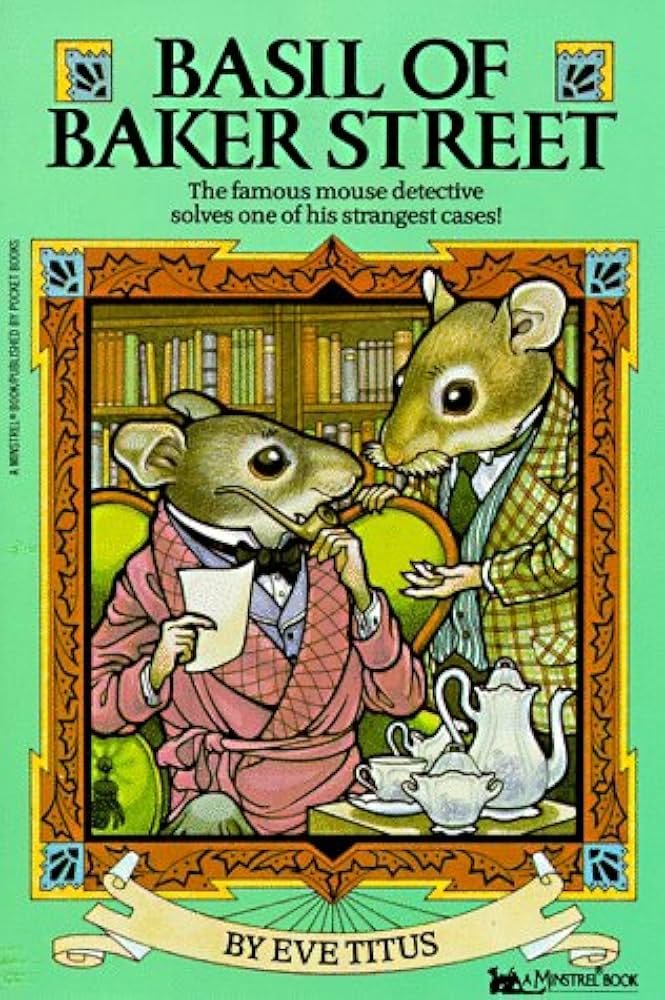
Even without looking, however, I have come upon and been entertained by many a pastiche, parody, homage or adaptation starring the denizens of 221B Baker Street. This started as a child, with Eve Titus’ Basil of Baker Street, which spawned several sequels and a Disney cartoon (The Great Mouse Detective). Subscribing to Ellery Queen’s Mystery Magazine as a teenager, I remember a series of comic adventures by Robert L. Fish featuring Schlock Homes of Bagel Street. I have a special fondness for Ellery Queen’s A Study in Terror, although the bulk of that novel (the Holmes section) was written by Paul W. Fairman, with Fred Dannay adding the framing device of Ellery “teaming up” with Sherlock to solve the mystery of Jack the Ripper. I like the novel’s solution better than the one in the film adaptation, but that might be because Ellery is completely dropped from the movie.
I happened to see the children’s novel, The Improbable Tales of Baskerville Hall by Ali Standish in a local bookstore and bought it because my buddy JJ over at The Invisible Event, who is a far better-read Holmesian than me, has been spotlighting various PPHA about the detective, including those written specifically for kids. This is the first in a trilogy that was approved by the Conan Doyle Estate itself: the second book (The Sign of the Five) was published in 2024 and the third (The Valley of Lies) comes out this year.
These purport to tell the story not of young Sherlock Holmes but of his creator, young Arthur Conan Doyle. A brief biography of the author can be found at the end of the novel: born into poverty in Edinburgh in 1859, he was sent to boarding school at the age of nine, eventually studied medicine and gave it all up to be a prolific best-selling author. Case closed.

Baskerville Hall is in no way a straightforward biography of Doyle, and since I’m not sure you can write a parody or pastiche of a real person’s life, I suppose this book falls under the category of either homage or adaptation. If so, I call your attention to the word “Improbable” in the title and ask you to underline it – several times! What I think disappointed me – and this is not the author’s fault – is that, given the name of the book’s hero, the name of the school he attends (Baskerville Hall) and the fact that the front cover shows kids holding magnifying glasses, I thought I was going to read a mystery. And because the people young Arthur Doyle meets at this school have names like John Watson, James Moriarty, Sebastian Moran – and, yes, Sherlock Holmes!!! – I felt pretty certain of my belief.
It turns out – and this is the responsibility of the author – that The Improbable Tales of Baskerville Hall most certainly is a pastiche – of the Harry Potter books. And, in that sense, it’s a pretty anemic one.
I haven’t read Harry Potter and the Philosopher’s/Sorcerer’s Stone in over twenty-five years, but I can remember it as if it were yesterday. Say what you like about J.K. Rowling today, I won’t stop you – but that woman could put together a story. It’s not just the larger strokes of the seven-book Potter epic that I remember; in fact, I’ve probably forgotten a great deal of the permutations of Voldemort and his legions vs. the powers of good. It’s the small moments throughout the saga that resonate: how Harry, Ron and Hermione bonded for life over Chocolate Frogs on the Hogwarts Express; the steamy meetings with Moaning Myrtle in the boy’s bathroom; the rather brilliant mystery that unfolded during Prisoner of Azhaban. Sure, the books started getting too long around #4, and the whole saga threatened to cave in under the weight of all those horcruxes. But Harry Potter was an Event for a lot of us in the early days of the new millennium, and I confess to being one of the many slightly shamefaced adults standing in line with the kids at Borders Books waiting for the clock to strike midnight before the release of several Potter books!
Baskerville Hall can’t help but make you think about Harry Potter, although it’s too bland to compete with that series. Although they were ostensibly written for the same ages, Rowling knew how to appeal to adults through humor and an attention to detail. Standish’s book feels very much an adventure just for kids. The most realized character, no surprise, is young Arthur, although with his own powers of observation and deduction, he rather confusedly comes across as another Sherlock Holmes, albeit a more loveable version.
None of the many great many professors and fellow students that Arthur meets in rapid succession at Baskerville Hall stands out particularly. Dr. Watson is a teacher there, wheelchair-bound for some reason, and far more sardonic than the Watson of the books. But he at least is interesting. The head of the school uses an air balloon to pick up new students and keeps a pet dodo bird named Didi. The first is an tribute to The Lost World (Doyle wrote lots of stuff besides the Holmes stories, and was glad of it!); the second is just kids’ stuff. And there are, of course, staff members with various agendas – but none of them comes to life like Professors Snape, McGonagall, or other members of the Hogwarts staff.
There is a mystery of sorts that takes much longer than the air balloon to get off the ground, but it devolves into fantasy around about the time that the dinosaur egg hatches in the magic clock. And while young Sebastian Moran is a suitably creepy bully, very much in the Draco Malfoy vein, and girl friend (not girlfriend) Irene Eagle is lively and athletic and deeply loyal to Arthur (so why eventually name Irene Adler after her?), other friends, like Pocket (a girl who sews lots of pockets onto her dress) and Grover (obsessed with dead people) are pretty forgettable. The worst is Jimmie Moriarty, who is neither a lively friend in the Weasley vein nor a secret criminal like . . . well, you-know-who.
I have no doubt that The Improbable Tales of Baskerville Hall could entertain young children thirsty for more adventures in the Potter mold. I just can’t help feeling a sense of missed opportunity here that, with the approval of Doyle’s estate behind her, Ali Standish couldn’t have come up with something that resonates far better with the many fans – past, present and future – of Arthur Conan Doyle and his greatest creation.
 Ah Sweet Mystery!
I get the impression that Holmes and Co. are difficult characters to transform into personalities that are likely to grasp the attention of younger readers. There was a series of Young Sherlock Holmes adventures written by Andy Lane, the first of which I read, and was disappointed to find was more of an adventure story with a deadly swarm of bees than anything else. Despite the fact that Holmes was “The Original Caped Crusader,” deductive reasoning and problem-solving lack the whizz-bang quality that I think a lot of publishing companies demand of their young adult fiction today. There’s a reason that the Alex Ryder books and the adventures of a young James Bond were so successful in comparison.
That being said, I remember Sherlock Holmes and the Baker Street Irregulars: The Fall of the Amazing Zalindas by Tracy Mack and Michael Citrin being great fun when I was a young Sherlockian.
LikeLiked by 1 person
Arthur is definitely the hero here in a Holmesian way: he uses his powers of observation constantly to do a wide variety of things, like win a boxing match and cross a rickety bridge in the dark. The other characters are representatives of their Doyle counterparts pretty much in name only. And, as I said, once it dives into an all too generic fantasy, it takes us away from Holmes – who then turns up at the very end to confuse us further.
LikeLike