Amidst the array of masterpieces that constitute the Christies of the 1930’s, Death in the Clouds (American title: Death in the Air) suffers by comparison. Hercule Poirot spent a large part of this decade “en route” to one place or another, but despite a chapter or two spent in Paris, Clouds is firmly set in London and nearby suburbs. It’s the weakest of the “trains, boats, and planes” trilogy, lacking the epic emotional heft of Murder on the Orient Express and Death on the Nile.

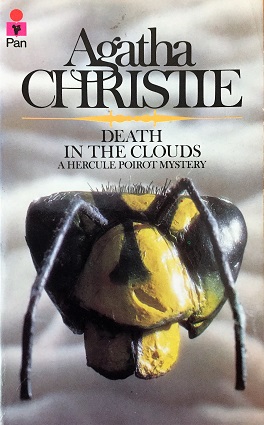
There’s also the weird issue of proximity: Clouds is positioned right in the middle of the decade, sandwiched between Three-Act Tragedy (1934/5) and The A.B.C. Murders (1936). The three books share a startling amount of plot devices and trickery, but Clouds does it with less fanfare, or hoopla, or whatever word you want to use that constitutes a sense of specialness. Arguably, the biggest standout factor of the book is the iconic Tom Adams cover, the one with the wasp devouring a Hengist passenger plane (and, by extension, the fascinating episode of Dr. Who that this cover inspired.)
Yet the book is lighter in tone than all the others I’ve mentioned, and if it doesn’t soar to greatness, it achieves a pleasant altitude or provides us with a smooth, enjoyable ride. It also contains one of Christie’s cleverest clues, one that most readers will never decipher because Christie does such a good job of diverting our suspicions. Both the over-the-top murder plot and surprise ending may be marred for bearing a distinct likeness to the immediately preceding title, but Christie sets up the twist differently and is clearly in her element as she does so.
To my mind, Death in the Clouds is a transitional book in the Christie canon, a sign that after fifteen years and sixteen mystery novels, she was about to change up her style. Her enjoyment writing the Westmacotts and her burgeoning interest in playwrighting gave her work a new emphasis on characterization – not at the expense of the puzzle, not yet, but certainly in the way she presented her stories. She started to experiment with varying points of view – even offering, for the first time since Roger Ackroyd, cleverly veiled glimpses into the mind of her killer. If the success of this technique varies throughout the book, and the scope seems small compared to the masterpieces that came before, I still see Death in the Clouds as a harbinger for the stunning books that will follow with increasing regularity, providing readers with a whole new set of tricks.
* * * * *
The Hook
“Right at the end of the car, in Seat No. 2, Madame Giselle‘s head lolled forward a little. One might have taken her to be asleep. But she was not asleep. She neither spoke nor thought. Madame Giselle was dead . . .”
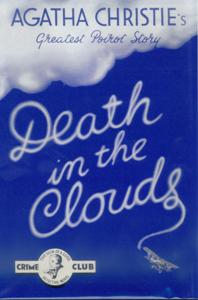
This might be the most economical opening hook of all the Christies I have ranked. In one short chapter, we get a glimpse into the mindset of the ten suspects sitting in the rear car of the air liner “Prometheus,” taking off from Paris bound for Croydon. We even get inside the head of our sleuth who, despite a bout of mal de l’air, manages to notice the incipient love affair brewing across the aisle. In hindsight, this is the cleverest aspect of the chapter, as the detective’s alternate identity of “Papa Poirot” will play a major role in both amusing and deceiving the reader.
Christie also manages to flood us with details that seem minor but will eventually emerge as clues – although most of these will be red herrings. Dr. Bryant caressing his flute, the Countess of Horbury and Venetia Kerr giving away an entire subplot with their thoughts (sometimes Christie is too economical here), the Countess loading a cigarette holder, Armand Dupont pulling a Kurdish pipe out of his case, and that dratted wasp flying around Mr. Clancy’s head . . .
As part of a puzzle plot, then, the opening sets the stage and ends with a murder more quickly than any Poirot that has come before. Part of me can’t help thinking, “This is a novel, Agatha – what’s your hurry?” But the pace has been set, and the question arises whether Christie can maintain it throughout.
Oh – an extra point for the floor plan of the rear cabin. I’m in a generous mood.
Score: 8/10
The Closed Circle: Who, What, When, Where, Why?
Who?
I don’t mean to belabor the comparison, but as far as who and what and where goes, if we set Death in the Clouds side by side with Three-Act Tragedy, we can observe things that Clouds accomplishes well and places where it falters.
The three most important characters in a mystery are the victim, the murderer, and the detective. In 3AT, the three victims are actually not that well delineated, functioning almost purely as plot devices. We never even meet the third victim, who has nothing to do with the case and functions as a smokescreen. Personally, I always feel disappointed when I don’t get to meet the victim. Even in his few scenes, a character like Mr. Ratchett comes to life on the page, and the animosity of the other characters towards him is richer for us for having seen him in action. Poirot himself can’t stand the guy and refuses his commission for that reason.

We never meet Mary Morisot, alias Madame Giselle, except as a corpse, but her back story is fascinating. I would even call it “Dickensian,” since it brings me to mind of Dickens’ Bleak House, a favorite novel of Agatha’s. The young and pretty Mary finds herself with child and gives the baby away (just like Lady Dedlock). Then she contracts smallpox (like the illegitimate Esther Summerson), loses her looks and dives into the business of moneylending. Giselle isn’t wicked, just hardened by life, embittered toward Englishmen (one of whom impregnated her), and focused completely on making money. She collects information against her clients for collateral (like the lawyer Mr. Tulkinghorn).
As far as the detective goes, we’ll deal with Poirot later, but he is sadly absent for most of Three-Act Tragedy. This paves the way for Christie’s central trick of bonding us to the murderer as he “plays” detective. Our illusions about Sir Charles are reinforced by the opinions of Egg Lytton-Gore, who adores him, and the trusted Mr. Satterthwaite. And yet, Christie fairly sets us up for the final reversal by emphasizing Charles’ capacity for role-playing and by providing Egg with an alternate (if initially unsatisfactory) beau.
In Death in the Clouds, we get plenty of Poirot, so we don’t need Mr. Satterthwaite or any other Watson figure. Norman Gale is recruited, along with Jane Grey, to assist Poirot in his investigations. The reason for this seems practical: Jane and Norman start detecting because their lives as suspects in a murder case have become genuinely untenable. Christie very cleverly puts us on their side by showing them at work: while Jane has become a cause celebre by regaling her hairdressing clients with details of the murder (and maneuvering a raise to boot), Norman is shedding dental clients by the hour! “Nasty helpless feeling you have in the dentist’s chair. If the dentist were to run amuck . . . “
Jane and Norman are both working-class Londoners, good-looking and charming. They meet cute at the roulette tables in Le Pinet, and Christie lets us into their heads on board the Prometheus where, by total chance, they find themselves sitting opposite each other. Jane’s thoughts are adorable (“Absurd to feel – so – so – excited. I might be seventeen.”) and Norman’s – well, here Christie is extra clever by making him sound like “Normal Norman”: “She’s so attractive when she smiles – no pyorrhea there – healthy gums and sound teeth . . . Damn it, I feel quite excited. Steady, my boy . . . “

As they bond over their shared involvement as “innocent” bystanders in the case, Norman’s feelings for Jane genuinely grow. In a lovely scene, they’re sharing what they witnessed on the plane, and Jane blushes as she remembers not noticing much but the good-looking guy sitting across from her. Again, Christie shares Norman’s thoughts with us, and again she is very clever:
“I wonder what makes her blush like that . . . She’s wonderful . . . I’m going to marry her . . . Yes, I am . . . But it’s no good looking too far ahead. I’ve got to have some good excuse for seeing her often. This murder business will do as well as anything else . . . Besides, I really think it would be as well to do something – that whipper-snapper of a reporter and his publicity . . .”
This reads as the thoughts of a sympathetic young man making the most out of a difficult situation; most of us will not see the cunning murderer seeking to control the narrative because Norman’s feelings for Jane are real. (Yes, folks, even murderers can love!)
Just like Three-Act Tragedy, Christie provides an “unsuitable” third for this romantic triangle. Jean Dupont is French rather than Jewish. “You’ve got to look out with the French, they always say so,” thinks Jane, when she meets Jean by chance at a restaurant. But here, Christie is even more clever. Jane’s first date with Norman is an exercise in comic romantic immaturity:
“It was one of those enchanting evenings when every word and confidence exchanged seemed to reveal a bond of sympathy and shared tastes. They liked dogs and disliked cats. They both hated oysters and loved smoked salmon. They liked Greta Garbo and disliked Katharine Hepburn. They didn’t like fat women and admired really jet-black hair. They disliked very red nails . . . They preferred buses to tubes. It seemed almost miraculous that two people should have so many points of agreement.”
Every other discussion we see between Jane and Norman has to do with the case. Meanwhile, Jean, who appears sparingly, engages with Jane in a manner that suggests two adults having an adult conversation. He talks to her frankly about his love of beautiful women and his disdain for the English habit of putting work before romance. He challenges Jane, and while she is initially unprepared to embrace him, she is definitely intrigued by him.
Let me belabor one more fact: Norman is incredibly good-looking. Too good-looking, in fact, for this never bodes well in Agatha’s world. He is – dare I say it? – Archie Christie. And Jean, whose face is “attractive more by reason of its extreme mobility than because of any actual claim to good looks,” is an archaeologist, for God’s sake! He’s Max Mallowan!
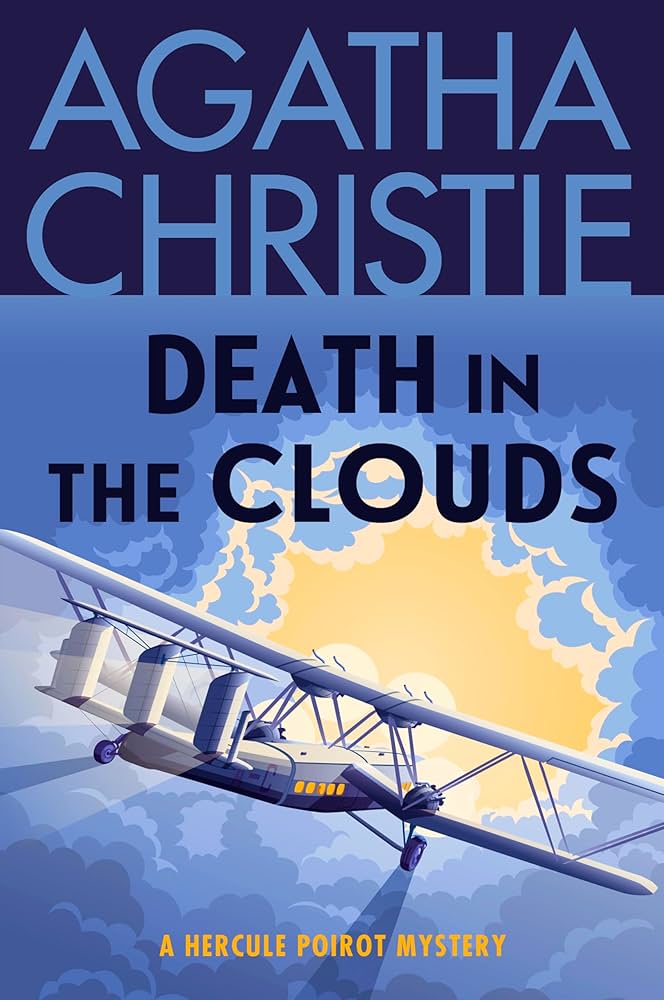
Where Three-Act Tragedy really falters, in my opinion, is in its circle of suspects. There are quite a lot of them, and we barely scratch the surface of who they are, or even why they are suspects. Death in the Clouds may not have the most riveting closed circle in the canon, but there are some genuinely attractive and/or interesting characters. I think they are made more so because we meet them in a variety of ways, not merely through police interviews but also from scenes set apart from the investigation. This is especially true of the secondary triangle between Cecily Horbury, her husband Stephen, and her former rival Venetia Kerr. While they are not particularly original characters, their melodramatic story is economically told through thoughts and actions, not police interviews.
I had honestly forgotten how fun a portrait Christie provides here of the mystery writer Daniel Clancy. Yes, he may be a dress-rehearsal for the reemergence of Ariadne Oliver as a major character the following year, but he is a delight. His “great detective,” Wilbraham Rice is a mass of tics and habits, biting his nails and scarfing down bananas (rather than apples). The books Clancy writes, like The Clue of the Scarlet Petal, are no doubt as outlandish as the theories he presents to Poirot and Jane of the murder on board the Prometheus, and one of the funniest passages in Christie comes when Clancy explains how he will fictionalize the case (as The Air Mail Mystery) and avoid possible charges of libel by creating his own solution:
“Disguised as the pilot, a girl gets into the plane at Le Bourget and successfully stows herself away under Madame Giselle’s seat. She has with her an ampoule of the newest gas. She releases this – everybody becomes unconscious for three minutes – she squirms out – fires the poisoned dart, and makes a parachute descent from the rear door of the car.”
Watching Clancy then expertly squirm out of every practical objection his listeners have to this theory is pure gold!
What?
“’Miracle or no miracle, there it is,’ said Japp. ‘We’ve got the medical evidence, we’ve got the weapon; and if anyone had told me a week ago, that I should be investigating a crime where a woman was killed with a poison dart with snake venom on it – well, I’d have laughed in his face! It’s an insult – that’s what this murder is – an insult.’”
Let’s divide the twelve Poirot titles from the 1930’s into two categories: the Epic/International include all the foreign foreign travel books and one title that encompasses all of England; the Malice Domestic books take place in London and its suburbs:
| EPIC/INTERNATIONAL | MALICE DOMESTIC |
| Murder on the Orient Express | Peril at End House |
| Death in the Clouds | Lord Edgware Dies |
| The A.B.C. Murders | Three-Act Tragedy |
| Murder in Mesopotamia | Cards on the Table |
| Death on the Nile | Dumb Witness |
| Appointment with Death | Hercule Poirot’s Christmas |
One issue with Death in the Clouds is that it tends to straddle both categories: despite a strong opening that utilizes transport and straddles two countries, as well as an extended sequence where Poirot returns to France to question witnesses, most of the novel takes place either in London or at Horbury Chase in the countryside. One could argue that Three-Act Tragedy does the same thing; in fact, its European sequence might be even briefer. But that novel encompasses more time and space, a more dynamic cast of characters, and three dramatically arranged murders.
I suggested that most of the characters in Clouds are better developed, but they are “ordinary” folk, and the situations they find themselves in are more down to earth. One of the strengths of the novel is how it reveals the debilitating effect murder can have on regular lives. (The suspects in Three-Act Tragedy seem much more blasé about murder, in spite of having witnessed two real ones and a staged third attempt.) Still, the general plot here is more basic than almost any of the others listed above. Even Dumb Witness, which I don’t enjoy as much as Clouds, has a fine opening hook and some interesting features, including a small, well-developed circle of suspects and a dash of the supernatural.
The case we’re dealing with here turns out to be pretty grubby: a French moneylender is murdered, and it looks like the killer must be one of her more desperate customers. Madame Giselle is not evil, but she does have a system of “fair play” with the first rule being: “Pay me back on time or I’ll destroy you.” The number of people on board the Prometheus who are connected to Madame Giselle is ludicrous in the typical fashion of Golden Age mysteries. But then the killer turns out to have a different motive entirely . . .
The most bizarre feature is the murder itself. I find it puzzling that neither Robert Adey nor Brian Skupin list it in their bibliographies of impossible crimes. How was Madame Giselle killed? As M. Fournier demonstrates on a later flight, the idea of someone standing up in a plane cabin and using a blow pipe against another person without being noticed is ridiculous. And Poirot quickly determines that the wasp acted as a distraction. No, the question of how Madame Giselle was dispatched must be determined in order to unmask the identity of her assassin.
This explains why Poirot cannot say anything when, as early as Chapter Eight, he announces that he could name the killer based on the contents of the passenger’s luggage. This is another excellent feature of the book, and it hangs over our heads to determine which of these two hundred or so perfectly ordinary items is the correct one. I’m sure many people wondered if Dr. Bryant’s flute or any one of the cigarette holders or pens people were carrying could have, in actuality, been a murder weapon, and it does Christie proud that the solution to this problem is so brilliantly simple.

Christie enlivens this pretty standard plot with a great deal of humor and romance. And because she’s brilliant, Christie’s use of these two non-criminal elements become integral to the puzzle plot. While the charm of Jane and Norman’s budding romance deflects us from considering either of them to be the guilty party, it also reveals elements of Norman’s character that will take on a different meaning once he is exposed.
One other delightful scene is the inquest into Giselle’s death, much of which is seen through the eyes of the reporters giving their journalistic “spin” to the procedure, with the women’s magazines focusing on the women’s fashions. It ends, to our great pleasure, when it is revealed that the supposed weapon was discovered jammed under Hercule Poirot’s seat, and the jury returns a quick verdict – to which the coroner responds: “’What’s all this?’ Nonsense. I can’t accept this verdict.’”
How close did Hercule Poirot come to standing on the dock?!?
When and where?
From Agatha Christie’s Notebooks:
“The notes for (the book) feature diagrams illustrating the disposition of the passengers in the plane seats. Both from these and the novel as a whole, it can be seen that the interior of a plane cabin in the 1930s was very different to that of a modern plane. There are only 18 seats and a mere 11 passengers, and of the possible nine aisle seats, only two are occupied.”
The opening scene gives a nice sense of how people traveled in the day. The rest of the novel bounces from place to place, much like Three-Act Tragedy did, without resorting to a wealth of detail. Horbury Chase, for example, could be Styles Court or any number of generic estates found in the canon. As usual, Christie’s strength lies in her depiction of shops and businesses. Antoine’s, the hairdressing establishment at which Jane works, is a comic highlight, as is Daniel Clancy’s apartment, where he does his writing:

“Poirot realized at once the force of Mr. Clancy’s announcement at Croydon to the effect that he was not a tidy man. The room, a long one, with three windows along its length and shelves and bookcases on the other walls, was in a state of chaos. There were papers strewn about, cardboard files, bananas, bottles of beer, open books, sofa cushions, a trombone, miscellaneous china, etchings, and a bewildering assortment of fountain pens.”
I love the image of Clancy spending weeks drifting about the room, his fingers stained with ink, tossing back beer, peeling bananas, and having a go at the trombone as, bit by bit, he writes The Affair of the Scarlet Petal. I wouldn’t be surprised if the author did some of his writing in the bathtub!! All that’s missing is a wild wallpaper covered with birds of paradise – but have no fear! Christie has that all set for another chaotic mystery writer!
Score: 7/10
The Solution and How He Gets There (10 points)
“’Well, let’s hear your ideas of the clues in the case’ said Japp.
“Poirot smiled. ‘I will give them titles – like the names of Mr. Clancy’s stories: The Clue of the Wasp. The Clue in the Passengers’ Luggage. The Clue of the Extra Coffee Spoon.”
There’s no doubt that the reversal of our expectations regarding Norman Gale makes for a nice surprise, and I would argue that Christie grounds this reveal in a solid way. Poirot’s incorporation of actual solid clues to reach this conclusion makes the journey there feel quite smart. My problem is that the full solution is over-complicated bordering on ridiculous, and reaching it depends on several coincidences and some huge jumps in logic on Poirot’s part.
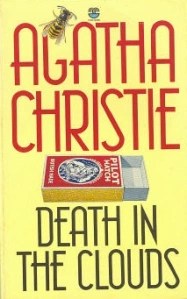
Let’s look at the positives: the Three Clues, plus a fourth which I will call The Clue of the Dentist’s Talent. Poirot argues that the appearance of a wasp in the plane where a woman is “stung” to death is too extraordinary to be a coincidence. Therefore, he looks in the passenger’s luggage for some item that might hold a living wasp and finds only one possibility: the empty matchbox in Norman’s possession. This is a terrific combination of clues that justifies Poirot’s early suspicions towards Mr. Gale. A second item in Norman’s luggage, the dentist’s white coat that he had no reason to take with him on holiday, becomes a further nail in the coffin as Poirot deduces its purpose. The extra coffee spoon acts as confirmation (but maybe not proof) that Norman was in disguise as a steward and used the spoon as a cover to approach Madame Giselle.
The Clue of the Dentist’s Talent refers to a charming sequence where Poirot asks Norman to disguise himself as a blackmailer in order to get the goods on Lady Horbury. Norman’s first attempts are so outrageously obvious that Poirot assumes the dentist made a bad show on purpose. Again, this is an assumption and not proof, but it helps point Poirot in the right direction. I find it odd that after Poirot insults Norman’s attempts, the young man’s rejoinder is to reveal that he used to engage in amateur theatrics, but this can be explained away as an American’s underlying contempt for foreigners.
Our solution, with its attendant surprise ending, is reminiscent of the one we just got in Three-Act Tragedy, albeit with suitable rearrangements. Both murderers use disguise and the convenient mental derangement among murder mystery characters that servants go unnoticed. Both fall in love with a beautiful girl. Sir Charles kills to avoid exposure so that he can marry the girl. His crimes are highly theatrical, and the fact that this suits his personality is beautifully clued throughout.

Norman kills for money, and his attraction to Jane is probably his undoing. He is also a dentist and outwardly seems like the kind of charming, slightly dimwitted British boy who would not conceive such a complicated plan. His unmasking is perhaps a greater surprise, but it doesn’t feel organic. All the clues I’ve mentioned pave the way nicely for his being the murderer – but something feels off. I think the problem is the dumping of massive amounts of information that we receive only a couple of chapters before the end.
Anne Morisot, Giselle’s daughter, has been mentioned but appears very late in the proceedings. She’s married to an American or Canadian (why the uncertainty?). She turns out to be Lady Horbury’s maid. She shouldn’t have been on the plane, but the problems inherent in her presence are revealed only at the very end. I ask myself if this young woman, head over heels in love with Norman, could have passed through that section of the plane where her man was eying the beautiful girl sitting across from him, and nobody notices a reaction from either Anne or Norman.
Of course, it never pays to over-dissect a classic murder plot, and this one works pretty well. However, it lacks the elegance of the great solutions that surround it in the canon.
Score: 7/10
The Poirot Factor
“There are more important things than finding the murderer. And justice is a fine word, but it is sometimes difficult to see exactly what one means by it. In my opinion, the important thing is to clear the innocent.”
If there is a little something lacking in the novel as a whole – in the details of the drama or the excitement of the chase – at least Poirot does not fail us in the least. His first appearance is told from the point of view of the English: Jane sees him as “a little elderly man with large moustaches and an egg-shaped head,” and Dr. Bryant is surprised at the interference by “a small muffled-up foreigner” near the dead woman’s seat. Poirot quickly dashes their initial expectations.

With Japp, he is the patient superior detective. Japp is unusually thick-headed here, suspecting Daniel Clancy because he is obsessed with murder. (A mystery writer yet!) He wonders how it’s possible for the Duponts to have noticed nothing going on around Madame Giselle’s seat. “You are not, perhaps, acquainted with many archaeologists?” Poirot asks him. The great detective knows when to speak, when to prod a witness or suspect, and when to withhold knowledge – although he does the latter as much for the sake of the reader as the investigation, non?
The best thing here is the way Christie utilizes the detective’s alternate identity as “Papa” Poirot. Throughout his career, the sleuth has enjoyed playing matchmaker with the innocent as much as he has reveled in tracking down the guilty. In this novel, Christie perfectly merges this dual purpose. In fact, I think Poirot’s focus on romance here strikes me as one of the strongest and subtlest clues toward Norman’s guilt.
When he comes upon Jane and Norman stalking Mr. Clancy, Poirot is all twinkling eyes and good humor – and yet he separates them and keeps Jane in his company. He does this a lot in the latter half of the novel, once he has decided that Norman must be the killer. He also throws Jane in together with Jean Dupont and sets up her eventual position as the archaeologist’s secretary (and probable wife). This is what Poirot predicts, even as he also takes dubious credit for the probable marriage of Stephen Horbury to Venetia Kerr. That’s ego talking – but it goes down as smoothly as a shot of sirop de cassis.
Score: 10/10
The Wow Factor
In the end, Death in the Clouds is a perfectly enjoyable mystery, well put together, with a handful of engaging characters and a Christie-like twist at the end. Any ambitious young mystery writer would give their eye teeth to have written a book as good as this one. What it lacks, however is a wow factor – and for the first time I almost regret having created this category! Sometimes judging the “wow” means pitting Agatha against herself. And in a decade as fertile as this one was for the author, being a simply well-made mystery novel won’t cut it.
Score: 3/10
FINAL SCORE FOR DEATH IN THE CLOUDS: 35/50
THE POIROT PROJECT RANKINGS SO FAR . . .
- The A.B.C. Murders (46 points)
- Three-Act Tragedy (42 points)
- Cards on the Table (36 points)
- Death in the Clouds (35 points)
- One, Two, Buckle My Shoe (34 points)
- Dead Man’s Folly (28 points)
- The Mystery of the Blue Train (26 points)
Next time . . .
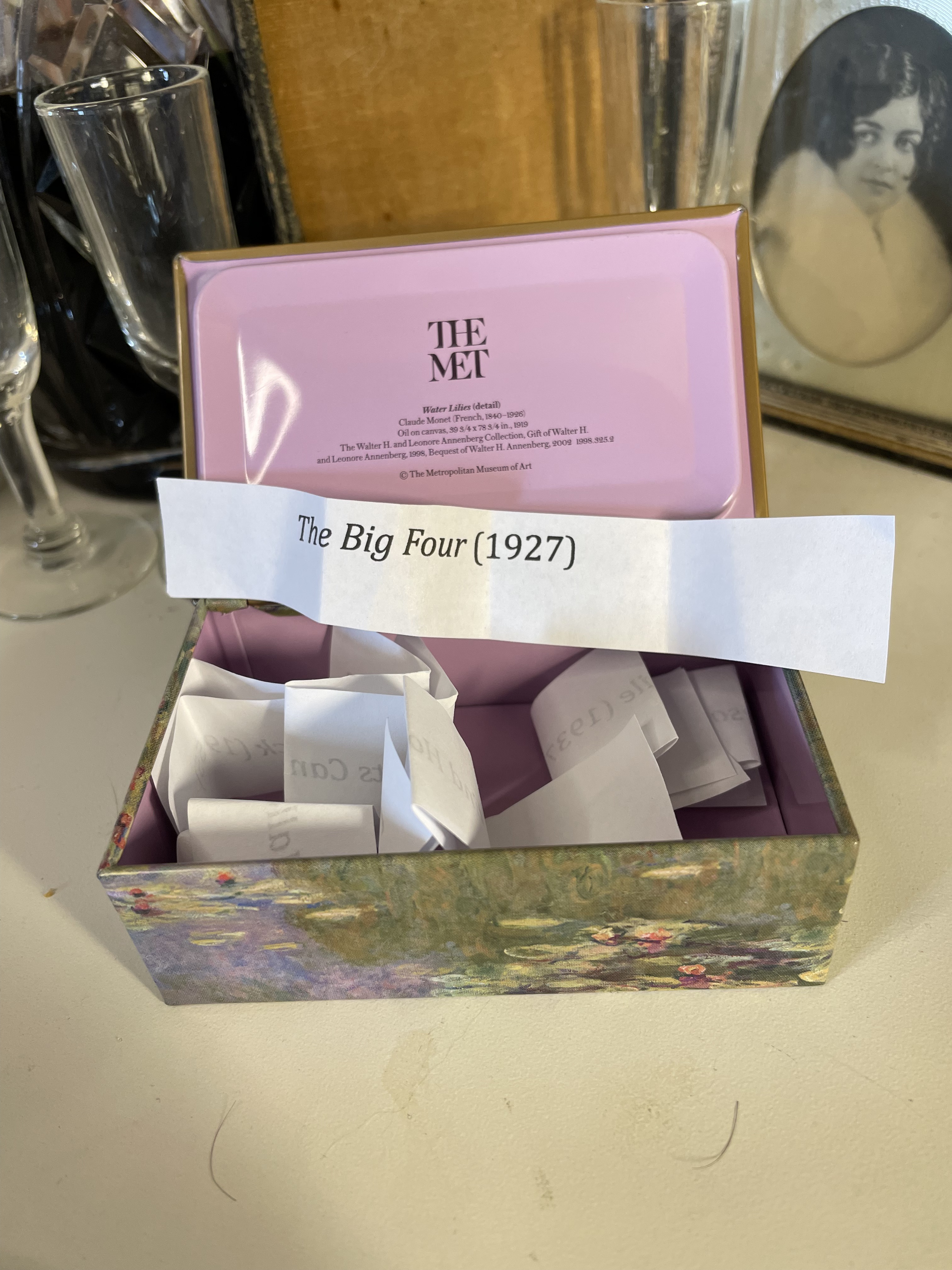
What are the chances this next read will be my #1 Poirot? I’ll bet you an American millionaire, a Fu Manchu knockoff, a beautiful French scientist, and a master of disguise that it’s never gonna happen!
 Ah Sweet Mystery!
I think you enjoyed this one more than me, but I nevertheless enjoyed reading your thoughts. I am curious to see what you make of The Big Four as I got a lot out of re-reading this one a few years ago. Christie is quite playful in her use of tropes and there is an interesting battle between detective and thriller modes of telling a story.
LikeLike
Pingback: MY AGATHA CHRISTIE INDEX | Ah Sweet Mystery!
The first Poirot novel I ever read, so CLOUDS definitely has a special place in my secret Christie heart, flawed as it may be. It still has my favorite Poirot murderer reveal (“I never stopped…you are the murderer”) and the marvelous mixture of shock and satisfaction was a feeling I chased forever after.
LikeLiked by 1 person
Oh, yes, that’s line is incredible – and as the book fooled me completely the first time around, I remember the line giving me goose bumps!
My technical “first” was And Then There Were None, but I already knew the plot by heart. So my REAL first was Murder on the Orient Express. That reveal prompted the same glorious reaction!!
LikeLike
Excellent review as usual. I have read DitC only once as a teenager years ago although I have seen the Suchet adaptation a couple times.
I enjoyed the comparison to MiTA as both suffer the same problem for me (i.e., I cannot believe the passengers on the plane or the guests/servants during the second murder respectively would not have noticed the culprits’ deception – that irritated me both times).
That said, you make me want to re-read DitC as well as MiTA from your recent review to see if I have misjudged either or both.
LikeLiked by 1 person
I think is very fair. And I think the Lis and minuses helped make it very entertaining when filmed for the Suchet series.
LikeLike
Oh Christ, my stupid autocorrect … This should read:
I think this is very fair. And I think the plus and minuses helped make it very entertaining … etc. 🙄
LikeLike
Pingback: THE POIROT PROJECT #8: The Big Four | Ah Sweet Mystery!
Pingback: THE POIROT PROJECT #9: The Murder of Roger Ackroyd | Ah Sweet Mystery!
Pingback: THE POIROT PROJECT #10: Murder in Mesopotamia | Ah Sweet Mystery!
Pingback: THE POIROT PROJECT #11: Hickory Dickory Dock | Ah Sweet Mystery!
Pingback: THE POIROT PROJECT #12: Elephants Can Remember | Ah Sweet Mystery!
Pingback: THE POIROT PROJECT #13: Hallowe’en Party | Ah Sweet Mystery!
Pingback: THE POIROT PROJECT #14: Death on the Nile | Ah Sweet Mystery!
Pingback: THE POIROT PROJECT #15: Peril at End House | Ah Sweet Mystery!