In our year-long visit through the Perry Mason Menagerie, we have been wandering through the Hall of Birds for an awfully long time. Canaries in 1937! Parrots in 1939! Time moves along, it is now 1942, and we find ourselves still stuck in the avian section – only now the birds go “quack” and float on the water.
Well – they do most of the time.

The Case of the Drowning Duck finds Perry and Della Street on vacation together in Palm Springs. Even on his downtime, Mason likes to vent about the fact that he doesn’t accept routine cases, that he craves mystery and excitement, that he’s bound to “cut a corner and get in hot water” if it will benefit his client – and remember, in the world of Erle Stanley Gardner, the client is always innocent! This time, Perry is waxing philosophical to a prospective client, John L. Witherspoon. The millionaire wants Mason to look into Lois’ fiancé, Marvin Adams, who may not be the “right” sort of fellow for the child of a man as obsessed with lineage and good breeding as Witherspoon is. Marvin recently had a shock when he learned from his dying mother that she was not, in fact, his mother, that she and her husband had kidnapped the lad at the age of three from a wealthy and powerful East Coast family.
But the truth is more sordid than that, as Witherspoon explains to Mason when the kids have gone: it seems that the late Mrs. Adams was indeed Marvin’s mom, and that Marvin’s dad was convicted and executed for murdering his business partner eighteen years earlier. Unfortunately, Witherspoon subscribes to the genetic theories of that ancient Greek, Agathos Christinos, whereby the child of a murderer is certain to inherit his dad’s “killer genes!” Witherspoon is giving Marvin one chance before he blows the engagement up by asking Perry to dig into this cold, dead case and try to prove that the late Mr. Adams is not a killer, or get out of Witherspoon’s way so he can destroy his daughter’s romantic happiness.

Mason takes the case, both because the challenge intrigues him and because he has a soft spot for this new generation of young people. In a stirring speech, he differentiates the youth of the pre-Crash 1920’s, who had everything and squandered it, those of the 30’s,who had nothing, (watch William Wellman’s marvelous 1933 pre-Code film Wild Boys of the Road if you don’t believe me), and the young men of the 40’s like Marvin, who stands a good chance of being drafted after he returns from his honeymoon:
“The modern youngsters are coming into a different scheme of things. There’ll be heartaches. There’ll be fighting and hardships – and death – but those who survive will have been tempered in a crucible of fire. They won’t put up with makeshifts. Make no mistake about it . . . when this war is over . . . it’s going to be different because of the young men who have suffered, and fought – and learned.”
Mason’s determination to help Marvin and Lois is only ramped up as the novel continues, both by his growing antipathy towards his snobbish client and by the fact that, while it is proving next to impossible to prove whether or not Marvin’s dad was innocent, it is clear from the transcripts that the defense attorney botched the case by not believing his client’s story about the victim running off with another woman.
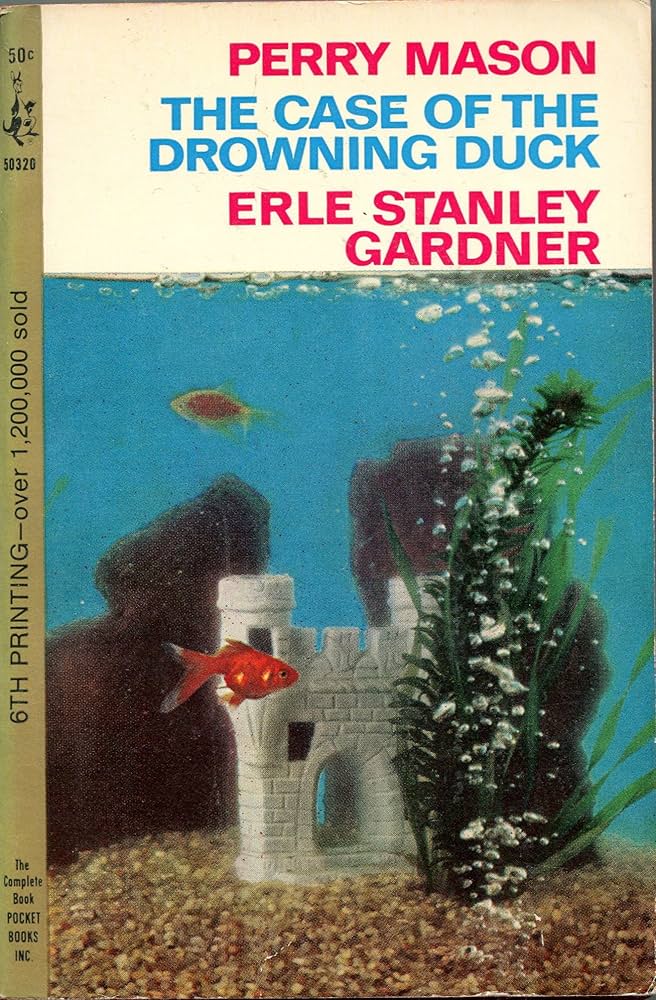
Soon enough, the preoccupations with the past give way to worries about the present as first one then another character succumb to the same insidious murder method. And at the first scene of the crime is an aquarium where Mason witnesses the bizarre sight of a duck drowning. (Don’t worry: he saves the duck!) Frankly, this H2O-challenged waterfowl is not as well integrated into the plot as the parrots or even the canaries were in the past two cases we’ve examined, but, as in those stories, Mason plays fast and loose with multiple birds and lands in a heap of trouble because of it.
For once, Mason’s client may be the best developed character in the bunch. At first, he might seem like the typical bombastic tycoon we find so often in these novels, but word has it that Gardner based the character on various aspects of himself: despite possessing millions and a crack head at business, Witherspoon shuns society, living on fifteen hundred “mighty nice” acres in the neighboring Red River Valley and spending his days hunting and fishing and sheltering his lovely daughter Lois from the vicissitudes of life. From first to last, Gardner never lets us feel much sympathy for Witherspoon; most of the fixes he gets into are of his own making, and Mason doesn’t even try to hide his dislike for the guy, which leads to some interesting fissures in their relationship.
Aside from the man and his daughter, most of the other characters are just passing through. The two murder victims are not seen alive within these pages. (One of them doesn’t even appear in the Cast of Characters in my edition.) But a few minor characters stand out, including a venal member of Paul Drake’s profession and a couple of aging vixens. As usual, Mason relies on Della’s fine abilities at reading character and asks her this time around to explain the wiles of a femme fatale who is past her prime:
“‘Tell me something about women, Della. Could she have let herself go to seed, and then brought herself back this way?’
“’Definitely not,’ Della Street said. ‘Not at the age of fifty-odd. She’s a woman who has taken care of herself all her life. She has eyes, and legs and hips, and she knows it – and uses them.’
“’Interesting,’ Mason said. ‘Let’s have a look at her.’”

On the plus side, we get several chapters in court, with the added frisson that through much of the trial, Mason has been sidelined to the role of spectator. I hope you will indulge me on this longer quote because Gardner clearly has fun with his hero’s frustration at this moment:
“It was a new experience for Perry Mason to sit in a courtroom as a spectator – and it was a trying experience.
“The expert bronco-buster who sits in the grandstand at a rodeo instinctively sways his body as he watches another rider trying to stay on a bucking horse. The expert pinball machine player, standing as a spectator, watching another send the metal balls rolling down the inclined plane, will instinctively push with his own body as the balls hit the cushioned bumper.
“Perry Mason, sitting in the front row of the spectators’ chairs in the crowded courtroom . . . would lean forward in his chair, as though about to ask a question. When some objection was made, he would grip the arms of the chair as if he were about to get up and argue the matter.”
Of course, Perry is allowed to take charge just in time to save his client – although I must say there seems a whole lot more guessing going on here than usual about what happened in murders past and present. In the end, the cold case doesn’t have any of the emotional resonance of Five Little Pigs or The Murderer Is a Fox, but the solution to one murder in the present is . . . fine, and the solution to the second death is quite clever.
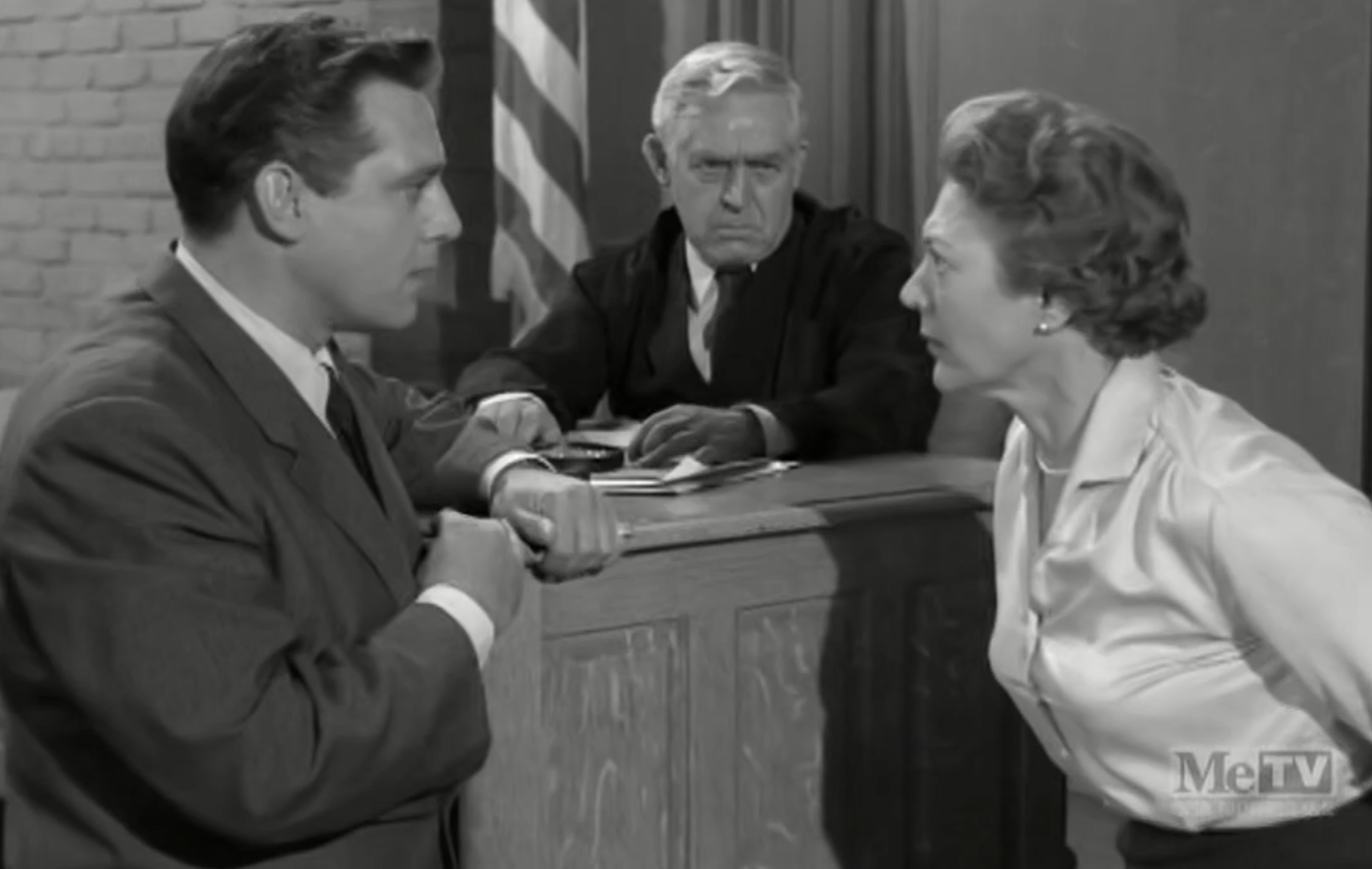
Any cleverness about the novel was nowhere in evidence on October 12, 1957, when “The Case of the Drowning Duck” premiered as the fourth episode of the first season of Perry Mason. I suppose the basic premise of the episode is kinda sorta similar to the book, but whole subplots and the characters contained therein are excised, the Witherspoons are but shadows of their book characters, the defendant is switched, the second and more clever death is edited out, and the solution is literally sawn in half.

At least Raymond Burr looks quite handsome here. After he had auditioned, he was being considered for the role of D.A. Hamilton Burger. But producer Gale Patrick Jackson (herself a fine actress in the 30’s and 40’s, remembered how well Burr had played an attorney in the film A Place in the Sun. The problem was the actor’s excessive weight, and Burr went on a crash diet, lost over sixty pounds in a month, and got the title role in the series. The weight would come creeping back over nine seasons and a plethora of TV movies, but watching Burr in the first season, it’s easy to understand both what Jackson saw in him and how hard he worked to earn the role.
One month from today, we’re going to change things up with a revisit to my favorite domestic animal, and it leads to a most perilous situation for the lovely Della Street! But the squawking isn’t over just yet: before we leave the Hall of Birds forever, we’re going to make one brief unscheduled stop. So I’ll see you fellow Mason fans sooner than you might expect!
 Ah Sweet Mystery!
Pingback: #1327: “There’s a plain, logical solution to the whole business…” – The Case of the Substitute Face (1938) by Erle Stanley Gardner | The Invisible Event
Pingback: THE ERLE STANLEY GARDNER INDEX | Ah Sweet Mystery!