Back in January, I promised you a year-long journey through a bountiful bestiary beset with blonde bombshells and redolent red-heads, all connected to the creatures of the air, land, and sea, all created by Erle Stanley Gardner, and all of them starring that peerless legal eagle for the ages, Perry Mason. I promised you twelve cases – my previous encounter with the Howling Dog preventing me from giving you a Baker’s Dozen. And now that we’re halfway through our tour of the Mason Menagerie, it gives me some pleasure to say . . .
Surprise!
It turns out that there is a thirteenth case – if you include the novelettes.

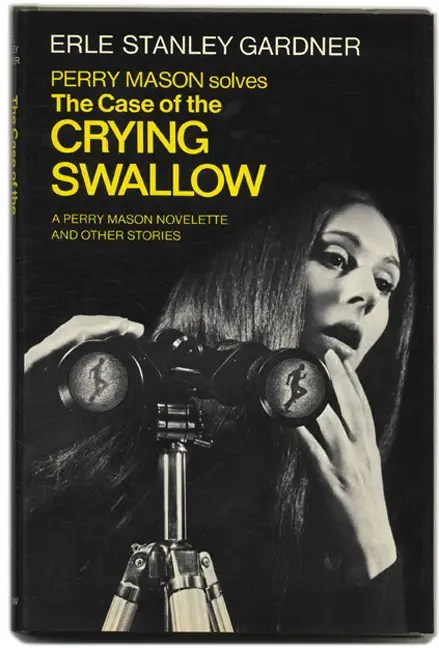
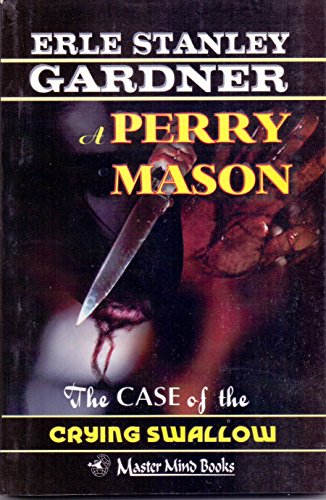
I say “if” and I say “some pleasure” because, after reading the first of perhaps four Perry Mason novellas that Gardner wrote, I’m not sure if this shortened form serves the author or his hero particularly well. And I say “perhaps four novelettes” because there seems to be some controversy as to whether “The Case of the Suspect Sweethearts,” was even penned by the author. All four of these cases received their premieres in magazines: “Swallow” debuted in The American Magazine in August 1947, two months after The Case of the Fan-Dancer’s Horse (which we’ll be reviewing in August) and two months before The Case of the Lazy Lover. The same publication debuted “The Case of the Crimson Kiss” the following year; “Sweethearts” appeared in Radio and Television Mirror in 1950, and “The Case of the Irate Witness” showed up in Collier’s in 1953.
With the exception of “Sweethearts,” which you can easily find online, the other tales were published in book form after Gardner’s death, each title headlining a different collection of Gardner short stories. I came across a first edition of “Swallow” in my local used bookstore: it also includes three other stories, headlined respectively by Lester Leith, Sidney Zoom, and Jerry Bane. I plan on focusing on these minor icons in Gardner’s bibliography as soon as I finish all the Masons, all the Cools and Lams, and all the D.A. books . . . . somewhere around 2175!!
“Della Street said, ‘A client sends his card.’ Mason straightened in the swivel chair and for the first time caught sight of the money which Della Street has so neatly spread out. ‘He said his name was Mr. Cash,’ Della Street explained. ‘Then he handed me ten one-hundred-dollar-bills and said these were his cards.’”
In case you share my interest in these things, one thousand dollars in 1947 would be the equivalent of a tad over $14, 000 today. Thus, we have a client with money to burn and a sense of whimsy – not a bad way to start a Perry Mason story, no matter what the length.
Unfortunately, the humor stops there. Della has seen the man’s face in the papers: he’s Major Claude L. Winnett, “polo player, yachtsman, millionaire playboy” – and war hero. Winnett has brought his new bride Marcia to live in his mother’s grand estate, and Mrs. Winnett, aptly named Victoria, heartily disapproves of her daughter-in-law’s uncertain pedigree. And now Marcia has disappeared, only a few nights after the couple’s bedroom was burgled as they slept and all of Marcia’s jewels were stolen. Oddly, this happened exactly one day after Marcia inexplicably cancelled her insurance policy on the jewels. What signaled the troubles that night was the squawking of a flight of swallows who had nested in the eaves of the Winnett’s bedroom balcony.
That nest does have mild significance to the case of what happened to Marcia Winnett. I suppose the most surprising thing is that Mason decides that in order to solve it he must move himself, Della Street and private detective Paul Drake into the mansion, posing as people associated with the Major’s mining interests. (Yes, even in the novellas, the plot wheel keeps getting stuck on “mining interests.”) This gives us a chance to meet the indomitable Victoria, her private nurse, Helen Custer, and Daphne Rexford, the woman that Mrs. Winnett wishes her son had married.
There’s an observatory at the top of the house where the residents like to go to check out birds and spy on the comings and goings of people in the public camping trailer park that lies just beyond the vast grounds of the estate. In one of those trailers, Mason will eventually discover a dead man who is, of course, tied into this whole funny business.
Except, as I said, it’s not so funny, and the business we encounter is a fairly standard series of complications without a great deal of interesting tissue to connect them. Mason does stuff, but he’s hardly the Perry Mason we love to follow around in the longer works. The characters in the mansion are mildly unpleasant. The widow of the victim is your standard glossy, not-to-be-trusted brunette, and the couple residing next door to the fatal trailer are further proof that some of Gardner’s best characters are the minor ones.
All in all, the mystery presented here is so-so, hampered further by its reliance on a set of numbers that require Mason, his cohorts and the reader to – gasp! – do math! When I made mysteries my favorite genre, I did not sign up to do math!! It’s a quick read, but it’s one I can only recommend to Perry Mason Completists.
And so, like Gardner does here, we’ll keep this short. Join us on the seventeenth of the month when Mason comes to the rescue of a Careless Kitten!
 Ah Sweet Mystery!
Pingback: THE ERLE STANLEY GARDNER INDEX | Ah Sweet Mystery!