Can you blame me if, at the halfway point in our yearlong exploration of the Perry Mason Menagerie, I have decided to return to the Hall of Cats? I happen to have a pair of feline monsters of my own, which might be why I enjoyed the earlier adventure where a family caretaker was found murdered in his bed and his cat’s pawprints were found all over the body. I guess that made the cat a prime suspect in the case, and since he was not the defendant, it’s certainly possible that the cat dunnit! (I can’t tell you how often I wake up at 3am to find my Sonny looming over me, flexing his claws!!!!)

Seven years later, another feline raises its back and hisses at Mason in 1942’s The Case of the Careless Kitten. This time, it’s an adorable little guy named Amber Eyes, and here the cat is a victim rather than a menace. Someone has poisoned the beloved pet of pretty and spunky Helen Kendal, and it’s clear the fiend is someone close to her. Is it her mean-spirited aunt, Matilda Shore, who holds the purse strings and has little affection to spare for her niece? Is it Gerald Shore, Helen’s uncle and Matilda’s brother-in-law, a lovable attorney bitten by the gambling bug? Perhaps it’s one of the servants: the irascible gardener Thomas Lunk, or the inscrutable manservant Komo, who swears he’s Korean but is probably Japanese (and is definitely a “stuck in his time” sore point here!)
There are also two young men in Helen’s life. Five will get you ten that the guilty party is not Jerry Templar, the brave young soldier who, on the verge of shipping out, refuses to propose to his upper-class girlfriend until he has the means to support her. But I’m not so sure about her other suitor, George Alber, whose movie star looks and professions of love cannot mask the covetous gleam in his eyes.
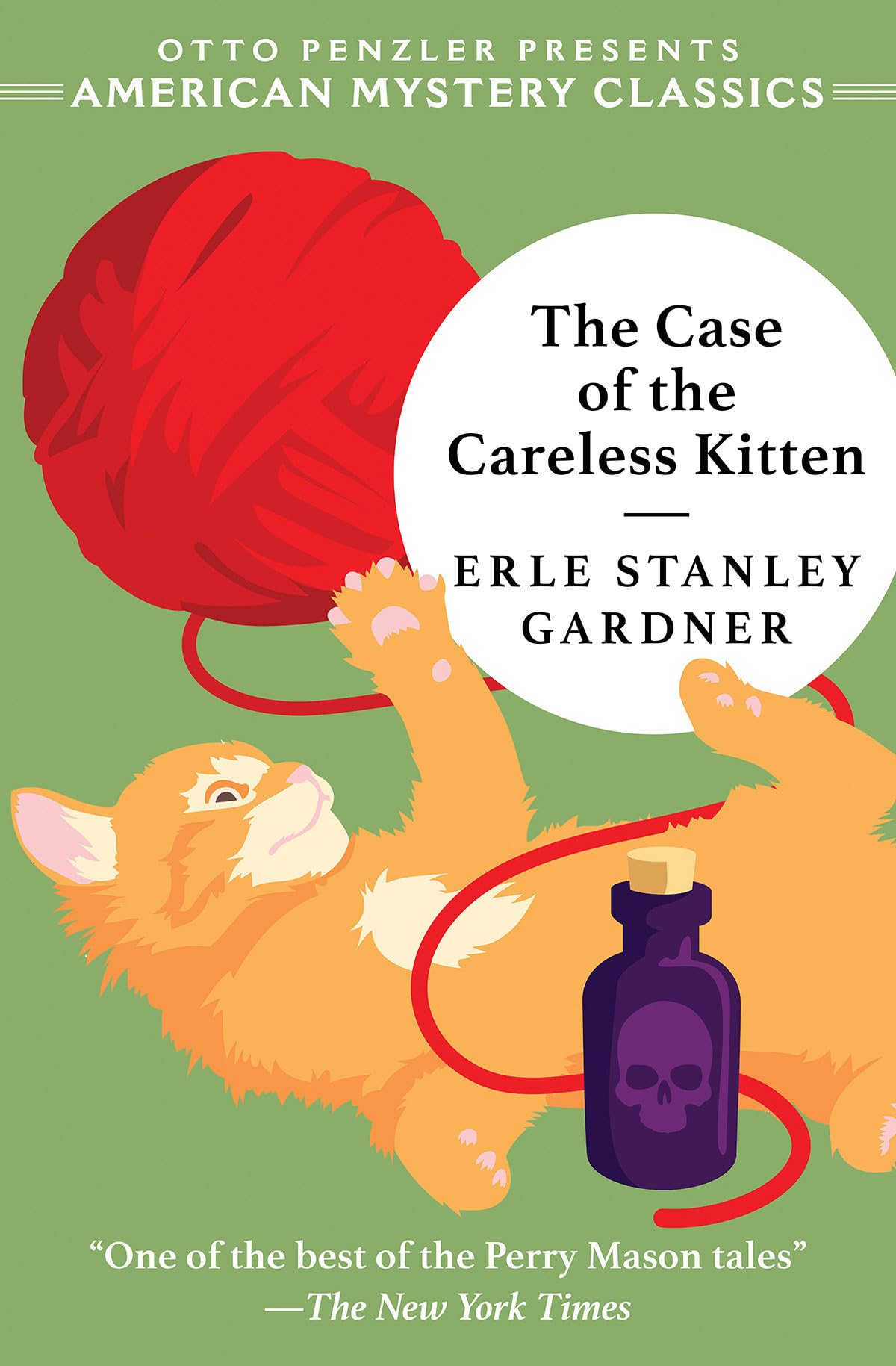
The one person who most likely did not poison the kitten is Helen’s beloved uncle Franklin Shore, and that’s because ten years earlier, the prestigious banker ran away from his wife Matilda with another woman, disappeared and is now presumed dead. Except . . . only moments before Amber Eyes is poisoned, Helen receives a phone call from a man who claims to be Uncle Franklin, asking her to meet him at a seedy Los Angeles hotel that evening and to bring only one person – attorney Perry Mason!
(SCENE: The straightforward, no-frills law office of PERRY MASON. It is late afternoon, and the great man is behind his desk, his long legs elevated, the ankles crossed on a corner of the desk. Enter DELLA STREET, the perfect secretary, who glances at her boss and proceeds to hang up her hat and coat.)
DELLA: Well, here I am.
MASON: Della, virtue has been rewarded. I told you this morning that we shouldn’t clutter up our minds with that equity case, even if there was money in it. Eight hours later we get this.
DELLA: (Frostily) There was a ten-thousand dollar fee in that equity case. What’s in this?
PERRY: It’s an adventure that will make you feel ten years younger.
DELLA: Most of your adventures make me feel ten years older!
PERRY: (Ignoring her) This has none of the dull, routine angles that drive me to drink. It sparkles with bizarre mystery, adventure, romance. To put it another way, it’s cockeyed crazy and doesn’t make any sense at all – one hell of a swell case.

The task is simple: Mason will accompany Helen to meet her uncle, Franklin will work out some magic with the lawyer to save his fortune from vengeance-seeking Matilda, and Helen will be taken care of and be able to marry sweet soldier Jerry and live happily ever after. Fortunately, everything goes wrong! Uncle Gerald butts into the situation for secret reasons of his own, another poisoning takes place, this time of a human being, a man is found shot to death in his car, and another person is shot right in front of Helen at her home.
It’s another wonderfully convoluted situation, and it’s made even more wonderful by the presence early on of Homicide Detective-Lieutenant Tragg, who is in fine form here, even demonstrating his innate humanity at one point by playing matchmaker, and by District Attorney Hamilton Burger, who appears way too late in the novel but who is in fine form as well, as for the dozenth time he attempts to have Mason disbarred once and for all. It almost makes up for the lack of Paul Drake, who doesn’t show up till halfway through and whose appearance mounts to scarcely more than a cameo.
The best thing of all is that, when we finally get into court on page 188, Mason is on fire because the careless kitten who is his defendant this time is none other than . . . Della Street!
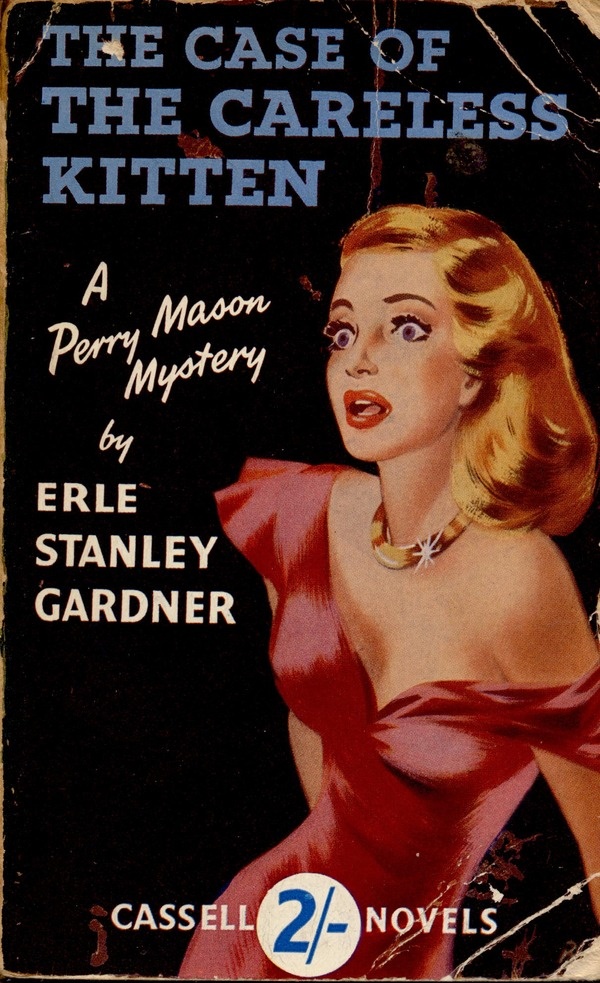
It has been well established over the past twenty cases that Della is head over heels in love with her boss and is totally loyal to him. We get a lovely moment early on where Perry is waxing excitedly over this new potential case, but Gardner lets us see where Della’s head is at:
“Perry was staring at her and automatically Della looked at herself through his eyes. Her brown suede pumps were good. Her legs were perfect. If the beige tailored suit didn’t fit, it was not because she hadn’t been to a good tailor. Her face was all right, and she had a new shade of lipstick. Her hat was outrageous. She hoped he was satisfied.”
Della has always been a willing assistant, even partner, to Mason’s most outrageous schemes – and many of them are quite outrageous – but this time she is getting a bum rap from the D.A. as part of Burger’s scheme to drum Mason out of the legal profession. As Perry’s behavior in court demonstrates, however, nobody tries to walk all over Della Street.
Mason: “The defendant has pleaded not guilty, and asked for a trial by jury. And to prove our good faith in the matter, we will accept, without examination, the first twelve names which are called to the jury box as jurymen to try this case.”

That’s how certain Mason is that he can get Della off, and while we all share that certainty, the trial is still a high point in showcasing the defense attorney’s legerdemain. As a bonus, Mason shares the reason for his constant courtroom antics with none other than the D.A. himself:
“It’s high time for citizens to wake up to the fact that it isn’t a question of whether a man is guilty or innocent, but whether his guilt or innocence can be proved under a procedure which leaves in the citizen the legal rights to which he is entitled under a constitutional government. You object to spectacular, dramatic methods of defense. You overlook the fact that for the past twenty-five years, you have beguiled the public into releasing its constitutional rights, so that the only effective methods of defense which are left are the spectacular and dramatic.”
Mason protects Della’s legal rights and more, and then he sums up the solution to the case – which he only does for Della, since the D.A. and Tragg have made him so mad, Mason decides they’re on their own in search of answers. I’m hampered from full enjoyment of the ending by having figured out a good part of it. This is one of those times when Gardner dips into the traditional mystery well and comes up with a trope with which most of us will find all too familiar. At least the careless kitten turns out to supply several major clues, so that’s all right.
“The Case of the Careless Kitten” was a late entry in the Perry Mason TV series, premiering on March 25, 1965 as the 24th episode of the 8th season. Since, as often happened with the novels of the 20’s and 30’s, the plot fails to adhere to the series’ strict formula, one might predict that writer Jackson Gillis would make wholesale changes to the original plot. But one would be wrong: the basic puzzle is intact, right down to the clues from the novel that send Mason in the right direction. Thus, we have a rare episode lacking a murder trial or even a defendant. One extraneous suspect is cut, and the Japanese servant Komo is, perhaps wisely, transformed into the British butler Cosmo.
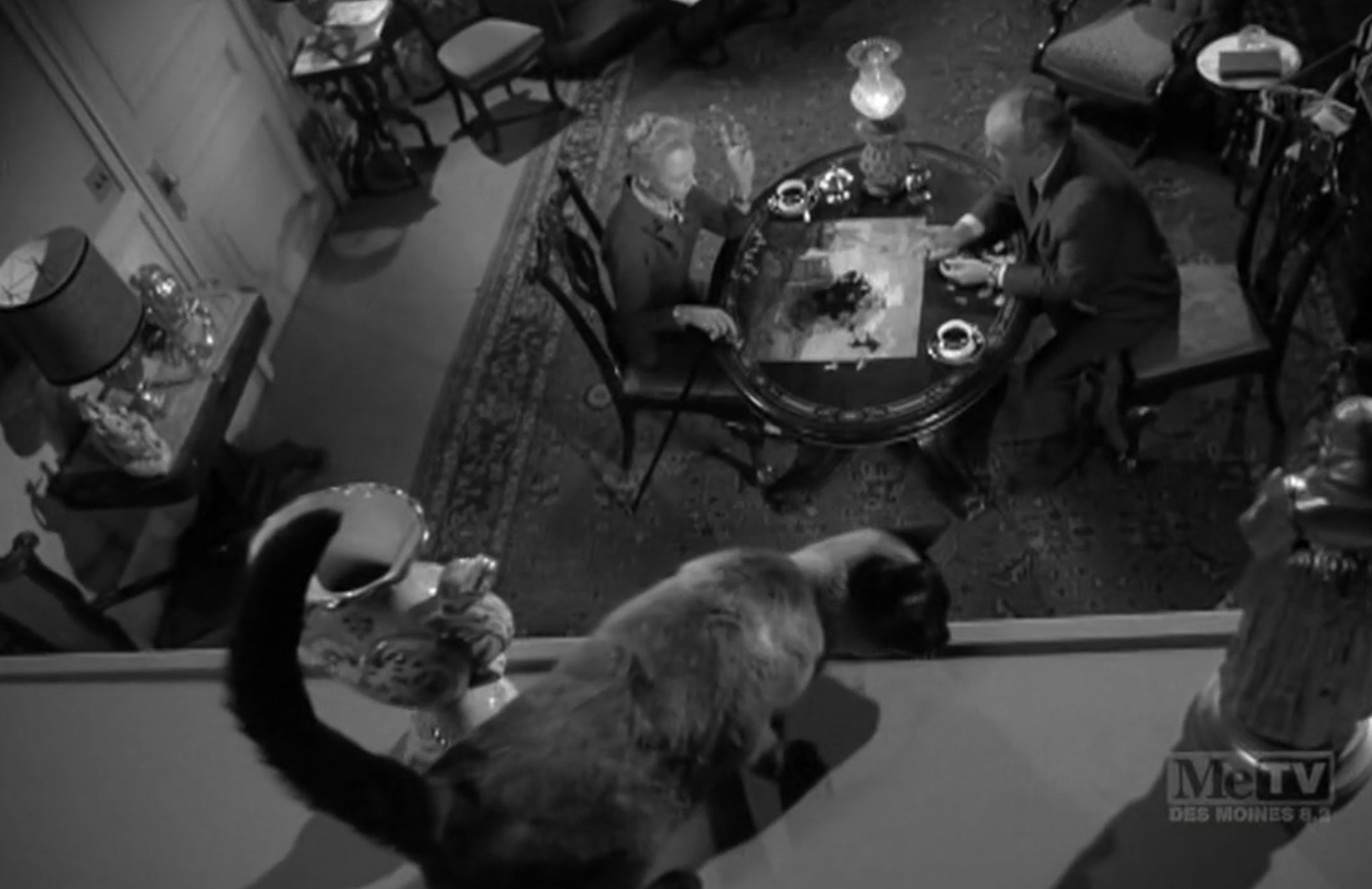
Sadly, Raymond Burr and William (Paul Drake) Hopper look old and portly here – Burr’s energy is muted the whole way through, and for the final scenes his arm is inexplicably bound in a sling – and the great Ray Collins, a much older Lieutenant Tragg than in the books but no less sardonic, was out of the series by now and would pass away four months later. The lowest blow is that the best part of the book, the whole trial of Della Street, has been excised. Understandable, perhaps, but all poor Barbara Hale gets to do here is take dictation and make coffee.
Next time, we return to flying creatures, but instead of a cute canary or a daffy duck, we find ourselves tangling with one of nature’s most odious insects in a stellar title that puts Perry and Della in mortal danger. See you next month!
 Ah Sweet Mystery!
the book was published in 1942, you say.
at the time, the US forcefully stuffed people of Japanese descent living in the US, including children and people born in the US, into concentration camps.
hence, I would not pooh-pooh a 1942 book containing a character of (possibly) Japanese descent swearing they are Korean for being stuck in its time. Rather I would applaud it for being sensitive to victims of the shameful behavior of the US at the time.
LikeLiked by 1 person
I appreciate the perspective. Gardner included a number of Asian characters in his work. While his descriptors were occasionally cringeworthy, I always got a sense of deep respect on the author’s part for these people. It would make for an interesting discussion as to whether 1) this was Gardner’s intention, and 2) whether his readers discerned this, agreed with it, or even cared about it. Gardner seemed pretty apolitical in his work, but I may not be a knowledgeable enough reader to get all his meanings. Sorry about that.
LikeLike
Pingback: THE ERLE STANLEY GARDNER INDEX | Ah Sweet Mystery!
Pingback: Oh #$%&! Not Another Blogger’s Tenth Anniversary!! | Ah Sweet Mystery!