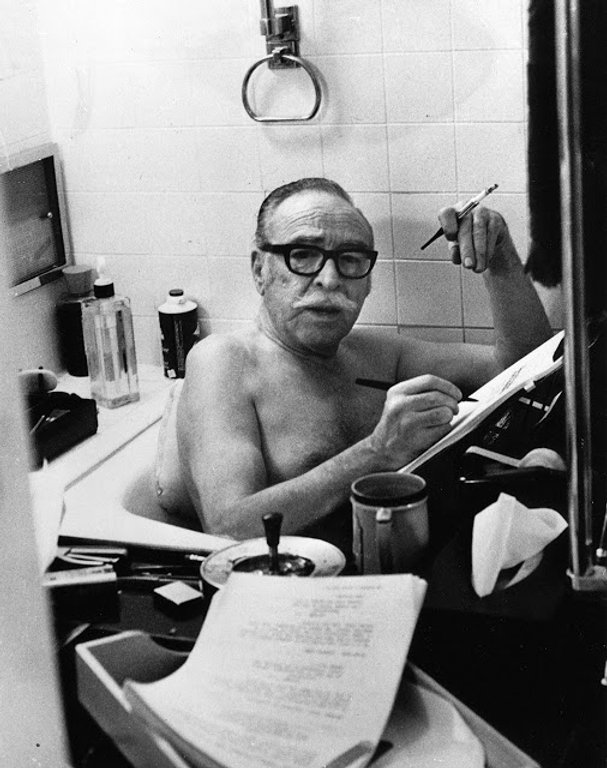
Since 2018, when James Scott Byrnside’s Goodnight Irene debuted in all its self-published glory, I’ve had an image of the author sitting in his bathtub in the luxury penthouse he owns atop one of Las Vegas’ swanky off-the-Strip hotels – maybe around City Center? – with classic Sinatra piped in through the sound system. His typewriter on a tray before him, a Scotch in one hand, the butt of a cigar in his mouth, and lots and lots of lavender-scented bubbles all around, the author hunts and pecks until the job is done.
Seven years later, Byrnside’s got five impossible crime novels to his credit – plus, I would imagine, ten very pruney fingers! His books are insanely clever, clearly derived from the Golden Age authors he loves, along with a strong dash of classic pulp fiction. Byrnside likes to dazzle you with baffling puzzles and shock you with sudden bursts of gross violence. He can write an action scene that viscerally places you on the scene – I’m thinking of the flood in Irene and the “buried alive” section of The Strange Case of the Barrington Hills Vampire. And I can’t forget the moment in The Five False Suicides when a person’s face melts off in a forest fire. (I try to forget, but I can’t.)
If I could ask Byrnside for two things, it would be to hire a proofreader and a marketing assistant. I had no idea that a new book was in the offing until I happened upon a review at my friend John Harrison’s blog. But now that book, It’s About Impossible Crime, is in my hands. It’s a long-promised collection of short fiction featuring Byrnside’s series detective Rowan “The Fat Man” Manory and his handsome assistant, Walter “Hey Good Lookin’” Williams. Manory set his shingle in Chicago during the Roaring Twenties and Dirty Thirties, and brilliant though he may be at solving impossible crimes, his best action was to hire Walter to be his sidekick. Together they’re hilarious! (Byrnside once made the terrible mistake of splitting this pair up. He has since rectified that error, all while serving notice that in a James Scott Byrnside story, anything can happen!)

It’s About Impossible Crime contains five cases, all taking place in the space of a year: 1928, to be exact. To begin, he gives us “Silent Steps of Murder,” Byrnside’s take on the old “footsteps in the snow” gimmick. It’s New Year’s Eve, and Manory and Williams are in a shabby part of town to finish up a case before they celebrate at their favorite bar. Thoughts of “Auld Lang Syne” will have to wait, however, when cries of “murder!” fill the street. The team meets rookie beat cop Jimmy Quinn, who tells them he has discovered the badly mangled body of a woman in her apartment. Veronica Hart, a burlesque dancer, has been shot in the chest, her beauty marred by several stab wounds in the face (lots of tomato sauce!).
The only footprints visible are Quinn’s, going in and coming out of Veronica’s building. (Byrnside provides us with a nice map here.) Before readers can come up with the obvious theory, Manory assures us we are wrong and then proceeds to give us the truth, based upon logical deductions from the footprints, the body, and a variety of clues found in Veronica’s place.
This has all the makings of a short-short story: set the scene and explain it away, and do it all through the hilarious rat-a-tat interactions between Manory and Williams. And yet Byrnside does something a little different with the ending of this one that may divide classic mystery readers. I myself really liked that final scene, which gives a clever little puzzle some emotional weight.
Byrnside’s playfully violent nature rears its head next with “Where There’s Smoke, There’s Pazuzu.” It’s a brisk spring morning, and Manory picks up the phone at work to hear a sinister voice warn him with ghoulish glee that a man is about to be “murdered in the most horrible way imaginable. His body will be torn apart. Then, it will be set on fire. His head will be cut off and his entrails spilled onto the floor. It’s going to be a bloody mess.” (Sometimes I think Byrnside should put more lavender in his bath!!) The caller insists Manory must investigate, even though he will not solve the case because the truth involves the supernatural.
Naturally, the supernatural is never really involved; rather, some clever killer has come up with a complicated way to make the impossible appear possible. Byrnside throws a lot of information our way about visitors and strange noises and packages and burn patterns . . . and I’m sure it should all come together for people who didn’t hate chemistry, which I did, or who have a Rube Goldberg kind of mind – which I don’t. Honestly, folks, I rarely try to solve “howdunnits.” For me, it’s all about the people, and I’m happy to say that, in that regard, this story does not disappoint. In fact, the high point for me here is when one of the leads takes Williams off to visit an old war buddy and his wife. It’s a beautifully written scene that manages to be both witness interview and social commentary, revealing much about the dark side of fighting for your country and the ravages of poverty and illness.
In the end, the solution is clever; in fact, with great economy Byrnside gives us a requisite false solution before Manory unveils the real one. And for a puzzle that makes comical hay about the demon Pazuzu, the worst demon there is (just ask Regan MacNeil), this ending packs a real emotional punch.

“Instrument of Death” begins on a rainy summer night: a desperate woman named Violet Reynolds wanders into the shop of Madame Dunkel, Clairvoyant, and receives a three-dollar prophecy of doom:
“’I saw a man standing over your corpse. He was leaning over you and watching you take your last breath and he was smiling.’
“Violet felt her throat tighten. She placed a hand at its base, massaging the skin as if to soothe herself. ‘What . . . what does he look like?’
“’He is large,’ Dunkel said, holding her arms wide. ‘Large . . . and ugly.”
For the life of me, I can’t figure how what follows can be categorized as “an impossible crime” – or series of crimes, rather. I was pretty certain all along who the villain was – but no matter. For what the author has created is no less than a film noir in fifty-two pages. There are certainly trappings of the murder mystery present here, especially a nifty dying message. But mostly, the atmosphere is thick with fatalism, a sense of impending doom that surrounds these characters and forces Rowan – who works here not with Williams but with one of the few decent cops in Chicago – to bear witness to one of the bleakest cases of his career.
Bleak, but not depressing, thanks to the thread of wit that runs throughout – in the dialogue, and in succinctly colorful descriptions of characters and places:
“A forgotten corner of the precinct, where the walls had yellowed from years of cigarette smoke and the single overhead bulb cast a sickly glow. The wooden table bore the deep scratches of restless hands, and the chair across from it was deliberately uncomfortable – a design meant to break a man down just that much faster. It was the kind of room reserved for a man like Al Grimm. Small with thin hair and no muscle, Al looked like his parents hated him.”
Back in the 1930’s, a certain type of horror/mystery film proliferated the movie theatre. Films like The Old Dark House, The Bat Whispers, The Cat and the Canary, The Ghoul, etc. were indeed set in old dark houses and followed a group of people as they wandered through the night, bumping into each other as, one by one, they fell victim to a maniacal killer. Ultimately, some amiable coot, who seemed far too silly to solve a mystery, would unmask another perfectly nice person, revealing them to be a deranged maniac.
And that is exactly what the autumnal story, “The Preminger Curse,” is. Rowan Manory is informed that he has been named in the will of the late Dolph and Sophie Preminger, but in order to collect he must spend the night in their decaying old mansion secluded in the swamps of Southern Illinois. Rowan has no idea why he would be named an heir to a couple for whom he long ago did a small job, but he can’t help but thinking, “Late changes to a will. That’s never a good sign . . . I wonder how they died.”
Accompanied by Walter, Rowan heads to the Preminger estate for the reading of the will and learns about the titular curse. Byrnside comes up with an interesting variation on the old tontine will trope and throws in that old stand-by, genetic insanity. There’s nothing left to do but settle in for fifty pages of slaughter, and true to form by the end less than half the original cast list is left standing. The story contains a neat little locked room puzzle at the center with a good solution. But frankly, there’s an awful lot going on here for a long short story – or a short novella, take your pick. I count nine deaths and at least two false solutions before we reach the end!
Perhaps there aren’t enough distinctive features here to merit expanding the tale to novel length – yet! But Byrnside has a fiendish imagination, and I can’t help thinking that he should have turned this into a longer work.
Our final tale brings us full circle to New Year’s Eve. It’s called “Cue, Murder,” which should cue readers that it’s steeped in theatrical personalities and dramatic tricks. But Byrnside eschews the typical regional theatre set-up, complete with over-the-top actors and stage knives that suddenly turn lethal for something much more sordid and interesting. The five men in this story have a most complex history together, both professional and personal, how it all relates to the case at hand is part of the fun.
Failed stage director and drama teacher Atlee Burroughs has invited lonely student Paul Chase to celebrate New Year’s Eve with him. Their opening scene is like something out of Tennessee Williams: just who is taking advantage of who here? As their relationship is about to head into deeper waters, both men hear voices coming from the pipes. It appears that an argument is taking place in the downstairs apartment of Jonathan Keltner, a former student of Atlee who is on the verge of stardom. Keltner’s guest appears to pull a knife and threaten murder, and then – silence.
Of course, Jonathan’s apartment door is locked on the inside. And there are two other acquaintances – a third acting student and an embittered theatre critic – hanging about. And of course, Jonathan is dead, his body rolled up in a rug as if for transportation to parts unknown.
Manory and Williams have another New Year’s Eve celebration interrupted by the police, who know this case is right up their alley. And, frankly, I appreciate Rowan’s sensitivity in his handling of five men of the theatre, their sexualities spread across the spectrum. A half hour after reading the story, I couldn’t explain the method of murder to you if you painted a series of pictures showing me how it was done. I’ll have to accept that it’s a clever ruse. But there were other aspects of the crime that I did get which were just as clever. And the relationships between the characters, while as sordid as sordid can get, made for gripping drama.

It’s About Impossible Crime can be ordered on Amazon. It chronicles a delightfully clever year in the life of my favorite modern detective duo. Next time though, Byrnside, call me when you’ve got a new book coming out. Or, better yet, set me up in an adjoining suite where this retired English teacher will be happy to proofread your final draft for you. I’ll bring my own bath salts!
 Ah Sweet Mystery!
Pingback: July 24, 2025 Update – James Scott Byrnside