I sure hope some of you are watching along with me as I take a crash course in 1955 film noir in preparation for the second annual Noirvember Draft I’ll be having with my buddies Sergio and Nick. So far, the views have ranged from terrific to terrible, which is exactly how the genre is supposed to be! Here come films 7 – 9 on the list – a list that you can find right here!
Crashout
The story isn’t new: a massive prison break occurs at the start, and the guards manage to round up or slaughter all but six men. The guys form a band to help their leader, who has been seriously wounded while escaping, reach a far-off mountaintop where he has stashed the loot from his last big hold-up; in return, he promises to split the pot evenly amongst them. Along the way, they cross paths with a variety of ordinary citizens, as well as some cops hungry for their capture.
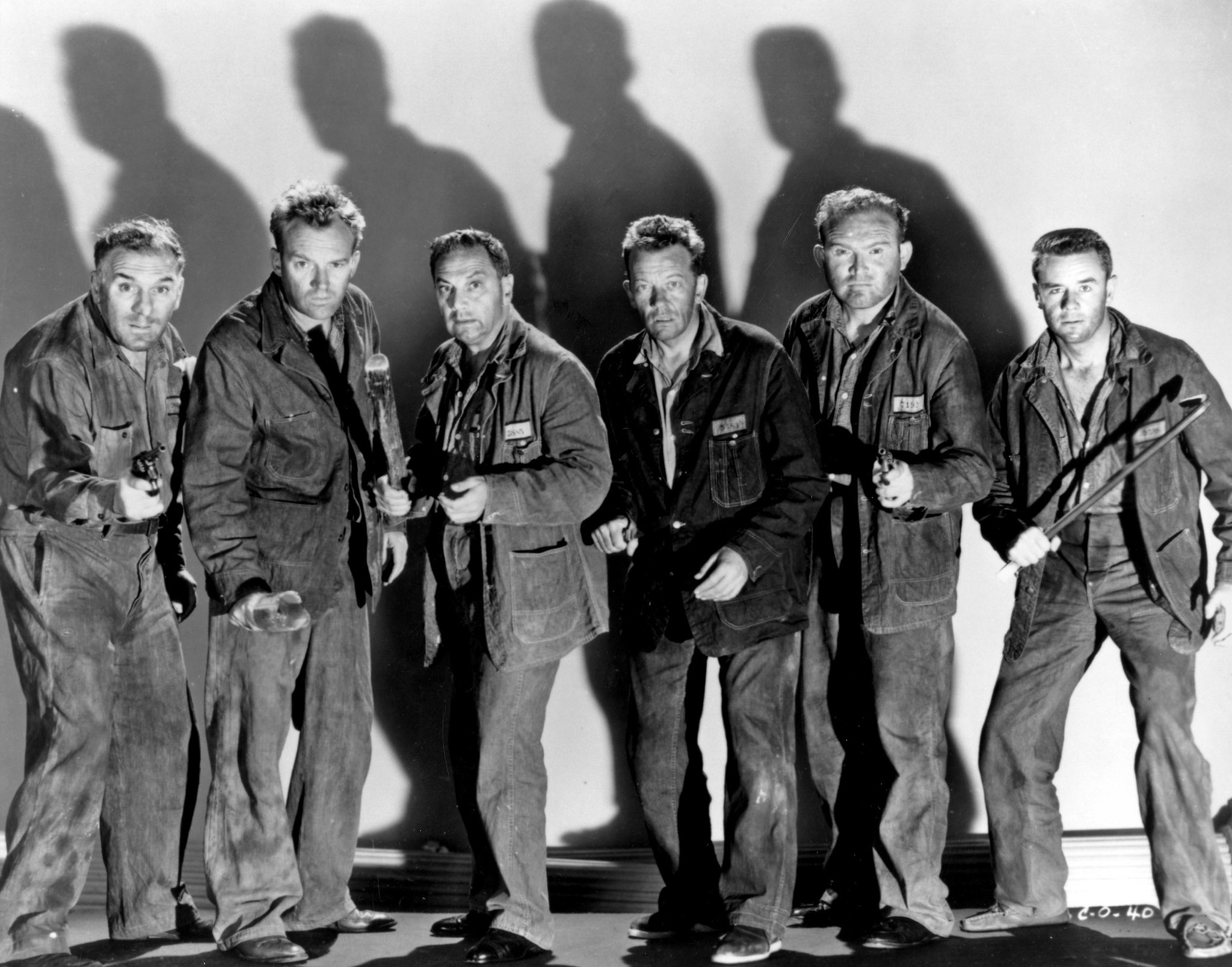
Now, take the quiz: Is there honor among thieves? Will they succeed in their quest? Or will they all get the final destiny they deserve, thanks in large part to the Production Code? If you answered “no” “no” and “yes,” then you are a noir whiz. Still, the script makes up for its lack of originality with some really good things. It comes in at a tight 89 minutes, which manages to be packed with action and still provide rich portraits of a dozen characters.
Let’s start with the cast: in order of morality from most to least evil they are William Bendix, William Tallman, Luther Adler, Gene Raymond, Marshall Thompson, and Arthur Kennedy (whose name will feature prominently twice today!). Each is a standout as a character. Bendix can play good or bad as needed; here, he is as bad as they come. Adler manages to do bad things in a way that make him the comic relief. William Tallman, so chilling two years earlier as The Hitchhiker, plays a more complex figure here, a man who, as his crimes mount while on the run, is driven to madness by religious guilt. And Kennedy is the best of this bad bunch, embittered by his experience, very self-aware of his own rotten decisions, and yet someone you know is capable of being so much better.
Along the way, they run into two women, and these segments are highpoints of the film. One (Gloria Talbott) is a girl on a train with her own troubled past, who sparks something in the heart of Billy Lang, the young killer played by Thompson. The other is a farmer and single mother (Beverly Michaels) who is forced to take the escapees in to protect her family. Again, the script takes time to fill in her past, and while she definitely fulfills the role of the good woman who has the capacity to reform a bad guy (here it’s Kennedy), the script manages to avoid most of the cliches.
As the story progresses, we find ourselves in an And Then There Were None sort of scenario. The question comes down to whether or not any of these men will survive. It makes for a stirring finish to an exciting film that combines a manhunt with a tale of moral reckoning.
* * * * *
The Crooked Web
For its first twenty-two minutes, this looks like it’s shaping up to be a choice piece of noir. That’s largely due to the presence of Frank Lovejoy in the role of Stan Fabian, owner of a drive-in restaurant who is in love with one of his employees, the beautiful Joanie Daniel (Mari Blanchard), and longs to give her the good life she expects if she’s going to be his wife. The opportunity arises when Joanie’s handsome but no-good brother Frankie (Richard Denning) turns up and offers Stan a one-third cut in a plan Frank has to recover a stash of gold he hid in Germany while fighting during the war.
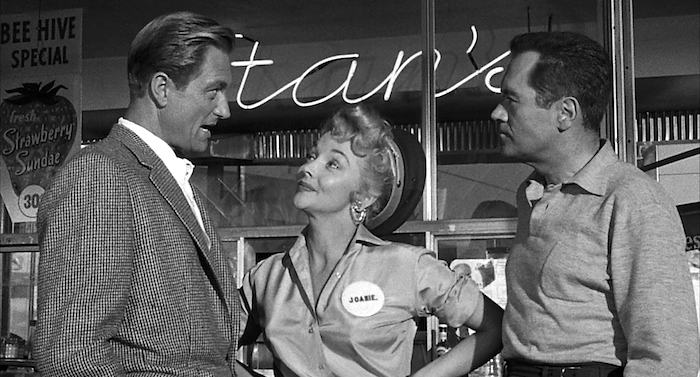
Stan agrees but quickly learns how ruthless Frank can be when he witnesses the guy gun down their third partner. Still, he loves Joanie so much that he’s willing to embark on this dangerous scheme. What Stan doesn’t know – but we find out in a nice reveal – is that Joanie and Frank aren’t sister and brother but lovers, and they are about to entangle Stan in their crooked web!
What a great set-up that is! I can’t wait to see that movie! Because, at the twenty-two minute mark, the “great twist” is revealed that changes our perspective on everything that has happened and that is to follow. Normally, I love big twists, but this one ruins the show, turning the film from a nifty little noir into a tepid progenitor for Mission: Impossible. Every obstacle our heroes run into is quickly resolved. Every action scene is brief and poorly filmed. The best moment in the rest of the film is a well-deserved slap at the final moment; I hope it stung.
What kept me watching was Lovejoy, an actor who died far too young (he was doing a Broadway play when he succumbed to a heart attack at the age of 50.) Lovejoy might never have achieved A status precisely because he embodied the everyman so perfectly. That made him a great soldier in war movies and a great protagonist in films noirs. Fortunately, he made two other noir pictures in 1955, so we will see him again!
* * * * *
The Desperate Hours
It’s rare that a film noir comes across as a prestige picture, but this one’s got class up and down the line. It’s directed by A-lister William Wyler and features a sterling cast. Cinematographer Lee Garmes worked with the best directors, from von Sternberg to Hitchcock, and the first rate score is by Gail Kubik, a classically trained musician and Pulitzer Prize-winning composer.

Based on a novel and play by Joseph Hayes, who also wrote the screenplay (and won an Edgar Award for it), The Desperate Hours is about the Hilliards, a typical suburban family whose lives are upended when three escaped convicts invade their home. Their leader, Glenn Griffin (Humphrey Bogart) is mean and, yes, desperate, his younger brother Hal (Dewey Martin) is essentially kind and sensitive, and Samuel Kobish (Robert Middleton) is a huge, childlike psychopath. Griffin’s plan is to hold the family as their prisoners until his girlfriend can show up with money to affect their escape. Of course, the plan goes wrong, and a single day stretches out into many. Meanwhile, the FBI and the police, led by Deputy Sheriff Jesse Bard (Arthur Kennedy) are racing to locate and capture the prisoners before anyone gets hurt or killed. Too late!
This is a highly enjoyable thriller, but if I have one caveat, it’s Bogart. The part of Glenn was played onstage by Paul Newman, who was considered too small potatoes to take on the role here. Newman was thirty; Bogie was fifty-five, fifteen months shy of his death. He’s not bad at all, but this feels almost rote to him. In fact, he had described the role as “Duke Mantee (from The Petrified Forest) grown up.” Bogie is better as Duke Mantee. But, never mind, everyone else in the film is terrific. The Hilliards – Fredric March and Martha Scott at the parents, Mary Murphy and Richard Eyer as the kids – are all sensational, as is Kennedy as the man trying to save them. Gig Young plays Cindy Hilliard’s boyfriend: he was forty-two to her twenty-four, and it shows. Ray Collins appears at the end as a self-serving sheriff, two years before he would debut as Lt. Tragg on Perry Mason.
The film is full of suspenseful set pieces and comes to a gripping climax, largely played in silence. Yes, I would have loved to see Paul Newman play Glenn, but this is a film I highly recommend.
* * * * *
The rankings?
All three films were fun to watch, and two of them were top-notch noir. If I had to give you a ranking here, I would say:
- 1st place – Crashout, the tightest of the three, it provides thrills and great characters on a low budget
- 2nd place – The Desperate Hours, also terrific, but it comes in a tad lower because it’s much slicker and hampered by a tired Bogart
- 3rd place – The Crooked Web – one quarter of a fantastic film noir, ruined by a “clever” twist that turns it into a different sort of movie and asks you to root against the most interesting character.
We all need a little break! I’ll be back in August with the next nine films on our list! Keep watching – preferably over your shoulder!!!
 Ah Sweet Mystery!