What is the world coming to?
It used to be that if one announced a new film based on a hugely popular novel and starring Oscar, Tony and Olivier winner Helen Mirren, Oscar and Grammy winner Sir Ben Kingsley, Tony and Olivier winner Sir Jonathan Pryce, and 72-year-old-but-he’s-still-got-it former Bondsman Pierce Brosnan, you would reach for the newspaper, pick out the time at your local theatre, and swing your partner toward a movie date. Today, you microwave some popcorn, settle in your sofa, and make sure your Netflix subscription is up to date.
The Thursday Murder Club, an adaptation of Richard Osman’s crime novel, the first in a popular series, dropped yesterday on the streaming service and stars all the big names mentioned above, plus David Tennant (plenty of BAFTAs and Emmys) and Celia Imrie (Olivier winner). It is directed by Chris Columbus, whom I actually had the pleasure of meeting and interviewing when I directed RENT at my high school. He was a real gent, and his films – like the first two in the Harry Potter series – are always extremely faithful to the source material, if maybe a bit dull for that.
I read the book and enjoyed it well enough – but not well enough to offer a review or read any more of them. I lent it to my mother, and she was frankly a bit offended at the way elderly people were portrayed. I thought the mystery aspect was just okay – the ending was nice – while the real joy was in getting to know these characters and watching their interplay with others. All of that stuff is sharply abbreviated to fit the mystery plot into a two-hour slot. I suppose we are compensated for that with the BIG CASTING of our central quartet.

Honestly, though, it felt a little bit like drafting Olivier, Guilgud and Richardson to play the Three Stooges. I couldn’t help thinking that Mirren especially looked a bit bored – but that might be part of her character choices playing Elizabeth Best, who used to belong to M16 and is not just another resident in an ultra-posh senior home where she, Brosnan’s former union leader Ron Ritchie, and retired psychiatrist Ibrahim Arif (Kingsley) meet every Thursday to tackle various unsolved cold cases. When their latest file requires some medical expertise, they seek out former nurse Joyce Meadowcroft (Imrie) and their trio becomes a foursome.
Osman’s premise is not original: it smacks of the set-up for The Thirteen Problems, my favorite Christie collection, where the (mostly elderly) members of the Tuesday Night Club met each week to tackle various true crime mysteries – the difference being that these cases were old but not cold, the teller of each tale possessing the solution.

The other major difference with Osman’s tale is that the Tuesday Night Club never found themselves with a present-day crime to solve, while our modern quartet discovers just that when Tony Curran, the co-owner of the senior home, is found brutally murdered in his home. Curran had been in a heated dispute with his business partner, Ian Ventham who wanted to sell his property on which the home rests, dig up the graves of late residents and displace the living. Tennant is delightfully odious as Ventham, each of his moments onscreen bringing a much-needed energy to the proceedings.
What’s not to enjoy about these remarkable actors cavorting in a luxurious setting and solving murders to boot?!? I particularly enjoyed Imrie’s Joyce and Jonathan Pryce’s too-small but heart-rending role as Mirren’s Alzheimer’s-addled husband. I also thought Naomi Ackie was charming as the PC who befriends the club members and sees her life and career changed because of it. As far as I can remember, the book’s plot was faithfully rendered onscreen, for better or for worse. And yet, despite its best-seller status, the novel always seemed like just another cozy to me, perhaps dressed up in more impressive wrappings, and Columbus leans into this atmosphere, whipping it up into a souffle that looks perfectly delicious but leaves you wanting more.
If the film does well and Netflix decides to make sequels of all of Osman’s other books, I won’t complain. They’ll go down easy, I’m sure, and make me feel even more pleased about my decision not to read the rest of the books. A similar thing happened to me with Robert Thorogood’s Marlowe Murder Club series, a suspiciously similar idea to Osman’s work – except I couldn’t even get through the first novel, and I found the five-part adaptations too long and not gripping enough to keep me coming back. If you enjoyed Osman’s series more than I did, you very well might like this film a lot.
* * * * *
I have one more TV crime show to mention, although I’m oh so late coming to this picnic. Last year, Fox debuted a new series, Murder in a Small Town, based on the crime novels of Canadian author L. R. Wright. It stars Rossif Sutherland, Donald’s son, as Karl Alberg, a tortured police detective who has left his job in Minneapolis and has come to the small British Columbia town of Gibsons to serve as their Chief of Police. While on a case, he meets Marian the Librarian – except this one is named Cassandra, and she isn’t uptight in the least. She is played by Kristin Kreuk, who I remember from way back in Smallville as Lana Lang.
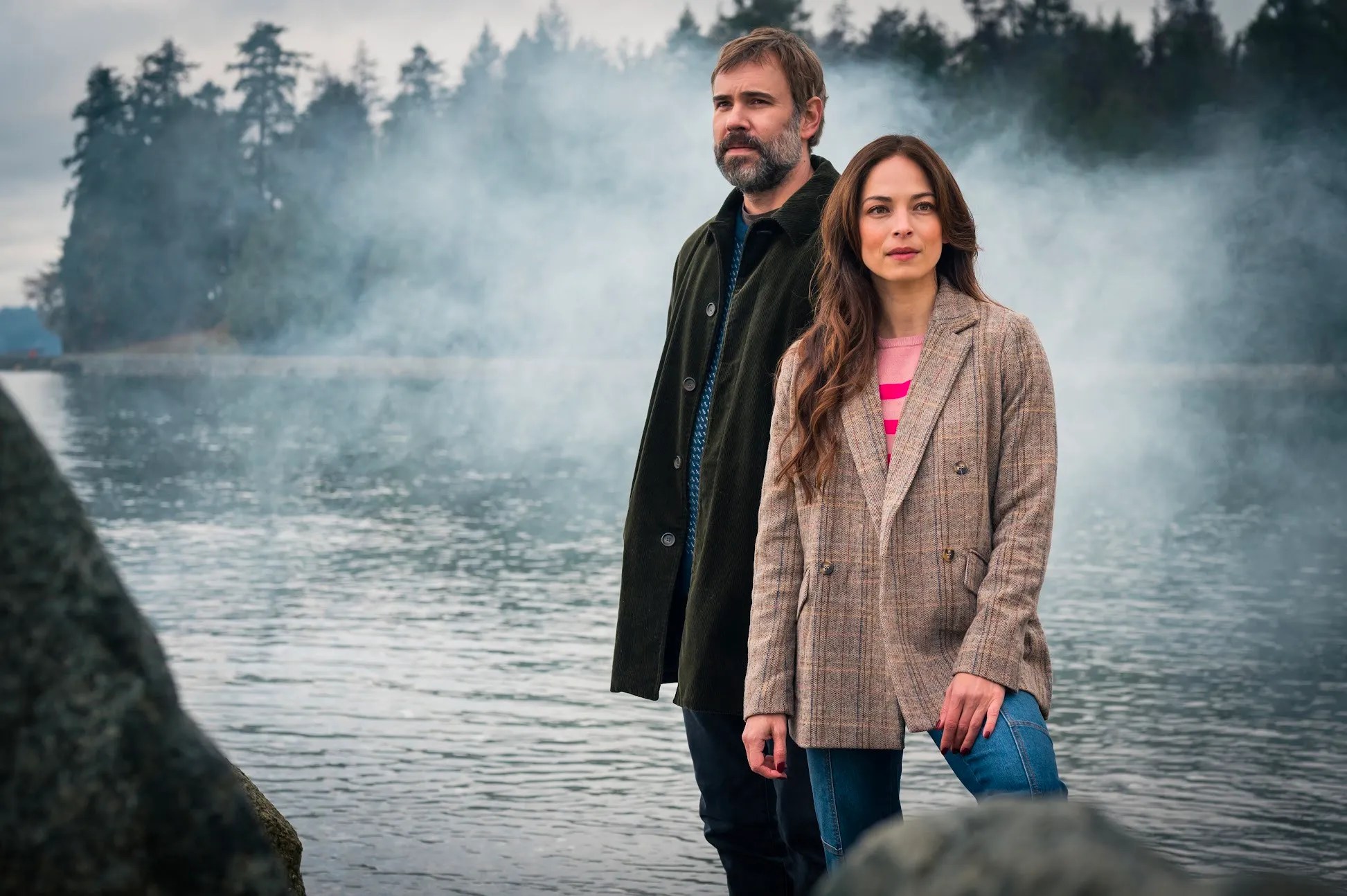
The first, expanded episode of this series is based on Wright’s novel The Suspect and features James Cromwell as the neighbor of a murdered man who becomes the titular main suspect in his death. It was a really good hour of television, not a whodunit at all but a great character study of three quirky, interesting people. Unfortunately, as it goes along, the series feels more and more like . . . just another TV crime drama series. At least, Cassandra doesn’t become Tuppence to Karl’s Tommy. Their story seems to be more about how a bright but cautious woman and a dedicated-to-the-point-of-obsession crime fighter navigate some sort of personal relationship. I liked both their performances, especially Sutherland’s.
Cromwell was such a gift to the pilot – perhaps too much of a gift – for now that the series has become a regular procedural, none of the criminals of the week have come close to being as gripping as the character Cromwell played. And the other regulars – the folks who surround our couple, Karl’s fellow cops, Cassandra’s friends – are all perfectly pleasant and perfectly forgettable. The weekly storylines seem to be based on other books in Wright’s series, which I haven’t read and, frankly, don’t feel inclined to read now. The show has been renewed for a second season with a lot of new cast members in the works. I’m watching it on Hulu, and it’s a perfectly pleasant way to pass the time.
Watching both these shows brings up a whole conversation about adaptation. There are those who will always prefer the book to the movie. If you love the book, this makes perfect sense: reading gives you ownership on what the characters and scenery look like and how the best scenes play out in your head. If you didn’t like the book or haven’t even read it, however, the adaptation is all you’ve got. And we all are at the mercy of producers as to which books get adapted and how those adaptations play out.
Of course, the latest best-sellers are more likely to receive this treatment – makes sense to me. And when producers decide to reach back into the classic world and pull out, say, another Agatha Christie title – say, the Tommy and Tuppence series of novels – those producers are nowadays more than likely to give these old books a modern-day spin. (That potential fiasco is coming down the pike!) And if an adaptation isn’t good, aren’t people going to be less likely to pick up the far better books? Meanwhile, those of us who keep wondering why there can’t be a TV series, or even a movie, based on the work of John Dickson Carr – who proved how dramatically viable he was on the radio many years ago – seemingly have to keep wondering in vain.
What can we do about that?
 Ah Sweet Mystery!
Not read the original book by Osman (whose wife, Doctor Who alumnus Ingrid Oliver, plays Imrie’s daughter by the way) but to me this feels like it would have worked much better as a series than a movie. It’s OK but apart from the cast it’s all a bit too bland to be memorable.
LikeLike
Oh, I don’t think this book has enough plot for a full series. As a film, it was light and frothy and forgettable (true to the book!)
LikeLiked by 1 person
I feel like the book wouldn’t have gotten so much attention if the author wasn’t already famous, and I guess they were trying for the same effect with this casting. David Tennant as Ian Ventham is a brilliant casting choice, but that’s the only thing making me even consider watching this.
LikeLiked by 1 person
Another problem with “liberal” adaptations is that if film-goers decide to read the books because of what they liked in the movie, they could be in for some disillusionment. (Imagine my shock when I read a Miss Marple book after seeing the Margaret Rutherford films! I was lucky, I liked the real Miss Marple too.) Modern audiences might think classic authors are a little tame after seeing the “improvements” added by the movie to “bring the story up to date”!
LikeLiked by 1 person
I have often been able to spot those who have never actually picked up a Christie by the way they describe those “improvements” they enjoyed – or when they get the killer wrong!!
LikeLike
Brad, I share your feelings about both the Thursday Murder Club and the Marlowe Murder Club series. I remember liking book #2 in the TMC series a little more than #1 but not enough to continue reading.
How I wish they’d give us a really good adaptation of Roger Ackroyd or the Miss Marple short stories.
LikeLiked by 1 person
I feel there’s a way to adapt The Thirteen Problems to allow for flashbacks to the cases, with each storyteller taking turns being spotlighted. I also think someone should turn to John Dickson Carr and Christianna Brand for material! A series based on Carr could last for decades!!
LikeLiked by 1 person
In a recent discussion about underrated vintage mystery writers in the GAD Facebook group, somebody mentioned why John Dickson Carr doesn’t get his due and that’s because of how challenging it might be to adapt his locked room mysteries for TV in a way that is interesting.
Personally, my favourite Carr novels are the ones without the whole supernatural theorizing. The Mystery of the Wire Cage, for instance. If you can think of any of his more prosaic mysteries, please let me know. I have read only about 20% of his works. 😀
LikeLike