We have given a lot of space here to the Queens of Crime. More and more, however I’ve been turning my attentions to the Duchesses of Domestic Suspense! To my great shame, I haven’t yet read anything by Patricia Highsmith, a troubled woman whose books focused on the abnormal and most frightening members of the human race. But this year, thanks to Book Club, I have dipped my toe in the murky waters of Margaret Millar, who populates her books with lonely people driven to paranoia and acts of desperation, and Charlotte Armstrong, who centers her horrors amongst a rarefied, elegant society.

And now, we have turned our attentions to Celia Fremlin, thanks largely to fellow blogger and Book Club member Kate Jackson, who has shone a spotlight on Fremlin’s work over at Cross-Examining Crime. Fremlin’s characters dwell in ordinary homes in English cities and suburbs. They are mothers and their children, husbands and wives, friends and neighbors, whose relationships have been damaged in ways we recognize, and whose struggles to put things right are deeply human, even if the results of their actions are monstrous.
When we found out that Kate had not yet read The Jealous One (1965), we slotted it as our September book. I almost didn’t get to read it – my life has been a bit of a whirlwind as I am simultaneously directing both a play and a musical at two separate venues – but I decided to at least start the book before our Book Club meeting. Wouldn’t you know it? Slow reader that I am, I devoured The Jealous One in less than 24 hours! Warning: this is more than genre fiction; it is a work of modern literature and social satire. To this, I can only add – you must read this book.
The plot is very simple: Rosamund and Geoffrey are married and living a pretty good life in a London suburb. They have a circle of friends and neighbors, a son admittedly stuck in the stickiest phase of adolescence, and a whole handbook full of “things” – those secret bonds that long-term couples share together. They both love cats and guitars, and they hate cars and Pekingese dogs. They love to gaze out their bedroom window together, commenting in a gently superior fashion as the world goes by. And then one day they watch a woman named Lindy as she moves into the house next door. All too quickly, their new neighbor transforms Rosamund’s tranquil inner life into a maelstrom of jealousy.
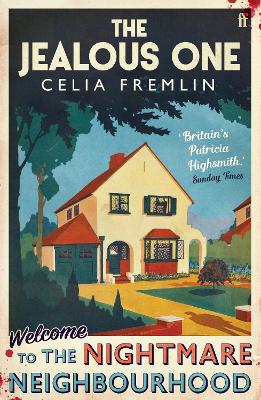
Geoffrey and Lindy immediately form a strong bond, and as he spends an increasing amount of time with her, we see just how fragile the marriage is. At least, we see it from Rosamund’s perspective: the book sets up residence in her mind and never leaves it. As her thoughts get uglier, the character veers toward the unsympathetic. And yet, even through a veil of bias and hate, Rosamund is a great conduit to our understanding of the workings of her family and her neighbors.
Thankfully, Fremlin leavens this dark journey with great swaths of humor that satirizes marriage, parenthood, and suburban living – and humanizes Rosamund. Some of my favorite passages focus on suburban child-rearing. Peter, the son, is introduced as a pain in the neck, lacking empathy or responsibility to his family, but always ready with a critical gibe against his parents, their friends, or the world at large. Rosamund frets, “Why can’t I have one of those secretive teenagers who never tell their parents anything?” The truth is that she and Geoffrey are at a complete loss as to how to parent their child. Rosamund’s most fervent prayer is that her son’s personality will sort itself out: “The thought that everything was probably just a phase had sustained Rosamund through the sixteen years of Peter‘s upbringing just as religious principles had once sustained her grandmother.”
Meanwhile, Rosamund struggles to defeat Lindy, whom she believes has designs not just on her husband but on her whole life. The plan is to kill her rival with kindness and inclusion, and thus give Geoffrey no recourse to complain about her true feelings. But even as the couple become a “happy” threesome, the weight of Rosamund’s rage against Lindy grows explosive and dark thoughts of another sort of “killing” enter unbidden.
And then . . . Lindy disappears.

That event causes new rifts and new feelings, made all the more suspenseful because Rosamund, whose mind has become strangely clouded, finds potential evidence that she herself might have killed Lindy. This is a question that does get answered at the end. I hesitate to call it a “solution” because, as I said, this book is barely a mystery, but I was satisfied with, if not surprised by, the reveal.
The thing is Fremlin is going for something more all-encompassing than a criminous tale woven around a domestic love triangle. Just who is the jealous one here? A case can be made for quite a few characters in the book, and all of them, significantly, are women. Oh sure, the novel delves into the disintegration of a marriage, but all the marriages depicted here are troubled. Rosamund’s neighbors Norah and William are being torn apart by their own son, who is ten times worse than Peter. A telling moment comes when Norah shows up at Rosamund’s house and pours her heart out after her son goes missing. Her words are chilling:
“All I’m frightened of now is that in three days he’ll be back – right there in the house again, still bored, still with nothing he wants to do. He’ll lounge about the place again, all day long, asking for money, being rude to his father, making us quarrel about him all the time. William and I can never be happy again, never! That boy’s round our necks like a load of lead, we are chained to him for the rest of our lives, it’s a life sentence! He’ll never go away, I know he won’t, he’ll never find anything he wants to do. He’ll stay at home, making us miserable for the rest of our lives . . .”
The men who populate the book are pompous and selfish, like William, thoughtless and selfish, like Peter, or attractive and selfish, like Geoffrey. They all want to be lord of the manor. But Fremlin saves her most pointed savagery for the women, who all compete to be the best friend, the most long-suffering mom, or a loving wife who still tries to scrape together a little life of her own. Granted, some of this is hilarious, like the mother of four who boasts of having had the easiest childbirths (and the fewest stitches!) or the fortnightly meetings of a woman’s club that devolve into a contest over who can provide the most impressive snacks. I read a comment somewhere that complained The Jealous One feels a bit stuck in its time. These women are stuck in a housewife-ly rut; their husbands act like children, and their children act like strangers. They turn to each other for support, but just as often they can turn on each other. And then someone like Lindy appears, espousing the philosophy that women must put their own needs and worries aside and cater to their men. It’s mid-century philosophy straight out of early sitcoms – but it also smacks of The Stepford Wives and The Handmaid’s Tale. And it’s made all the more chilling – and prescient – when we look at the rising movement in America to return us to these “halcyon” days of male supremacy and female devotion.
Which brings us back to the central mystery: what is going on between Rosamund and Lindy. Did Rosamund crack under the weight of Lindy’s criticisms and her devotion to Geoffrey? Did a murder even take place here? And why can’t Rosamund remember? Her foggy mental state, like everything else, is delineated in gorgeous prose, but Fremlin is always willing to inject humor, as when Lindy’s sister asks Rosamund to try and understand the missing woman’s state of mind, and Rosamund thinks:

“I don’t want to understand her, ever; and if I haven’t murdered her already, then I damn well will, the very next time I lay eyes on her! And there will be nothing subconscious about it, either: I mean to enjoy it this time!”
I wish The Jealous One could be placed immediately on the English curriculum lists of midwestern and southern colleges. Meanwhile, I urge you to read it because it’s terrific.
Here is Kate’s take on the book.
 Ah Sweet Mystery!
Pingback: The Jealous One by Celia Fremlin – Mysteries Ahoy!
I’m glad you enjoyed this one as much as I did. While I can understand the “of their time” reaction of some readers, there is more than enough subversion going on for me not to find it a problem.
In the UK, the reprints over the last couple of years have been a pleasure. I started with Uncle Paul, as the stylish cover caught my eye and reading one every six months or so has been enjoyable. As a general aside, the skill of choosing distinctive covers can be easily underestimated. The initial success of the British Library Crime Classics was surely in part down to their covers.
LikeLiked by 1 person
I have the Dover cover for The Jealous One, but those Faber covers are exquisite. I am looking forward to getting more Fremlin under my belt over time!
LikeLike
Pingback: BECAUSE YOU LIKE THE LISTS . . . Brad’s Top Ten Reads of 2025 | Ah Sweet Mystery!