Della to Perry: “Well, you certainly took a button and sewed a vest on it!”
On my journey through the Perry Mason Menagerie, I approached the Hall of Monkeys with some trepidation. Part of this had to do with a personal experience that I’ll share with you next month, but mostly it was all about timing. You see, in the lengthy canon that is Perry Mason, we reached the 1950’s last month, where author Erle Stanley Gardner is more likely to have gone awry in his plotting. The Case of the Moth-Eaten Mink seemed to prove that, and since The Case of the Grinning Gorilla immediately followed after that title, I had some misgivings.

At least the novel begins well. The best openings of a Perry Mason mystery quickly establish his status as a maverick attorney and then incites him with an out-of-the-ordinary client or incident that balloons into a full-fledged murder case. Maverick status? Check! Normally this has to do with Mason’s refusal to answer his mail or take on a run-of-the-mill case. This time out, status is achieved through a bust of Sir William Blackstone, the eminent English judge whose commentaries became the foundation of American law back when our nation was founded. Evidently, a lot of lawyers have a bust of Blackstone sitting in their office as proof of their respect for his legal scholarship. But Perry Mason? He uses his bust for target practice! And on this day, he manages to land his hat right on top of Blackstone’s head – and at a rakish angle!
The inciting incident to this case is a small act of human kindness on Mason’s part. On his way to work, he stops by the courthouse and attends an auction of personal property that has been collected during various investigations and never retrieved. People attend these auctions hoping to grab somebody’s jewelry, silverware, or other valuables. As Mason is walking by, however, the item up for bid is a collection of the personal belongings of Helen Cadmus, a secretary who had committed suicide on the yacht of her eccentric millionaire boss. Nobody wants to bid, so as a favor to his friend the public administrator, Mason starts the bidding off at five dollars – and finds himself the unwitting owner of the envelope.
What Perry and his perfect secretary Della Street find in the package is highly intriguing. There’s a photograph album containing some hot pictures of Miss Cadmus in a revealing swimsuit (“three squares of cloth skillfully knotted about the curves of a very nice figure . . .”), along with a collection of snapshots of the simian variety. It seems that Helen’s boss, Benjamin Addicks, collect various monkeys and apes, upon whom he conducts various “psychological experiments.” Also in the package are four volumes that appear to be Helen’s personal diaries. Della reads one entry that has a disturbing note, suggesting that Helen is concerned about a particular ape named Pete, whom she is ready to take into her own custody to protect from any further attempts to “break down Pete’s mind and undermine his nervous system.”

So far, so good – and it gets better when an agent of Addicks, a smarmy man named Nathan Fallon, arrives and attempts to buy the diaries back from Mason, who begins to suspect that something is up! Is Helen, whose body was never recovered at sea, truly dead? If so, was her death an accident, a suicide, or murder? What can the diaries tell us about any of this? As you may expect, Mason refuses to part with them and sets his team poring over the diaries to see what sort of monkey business is going on.
Erle Stanley Gardner’s infamous plot wheel is clearly at work here. Already I’m suspicious about Helen’s “death,” having read The Case of the Half-Wakened Wife. And I’m snorting with derision that Addicks has made his fortune through “mining interests.” Surely, Gardner was aware of other forms of business!?! Still, if this plot plans to delve into the dark side of animal experimentation, I’m braced for something new and potentially unpleasant.
Things don’t start going downhill until after the murder. As usual, the plot wheel has landed on “Perry finds the body,” but at least Gardner makes some hay out of it this time. The scene is genuinely suspenseful and makes full use of the simian characters running about Addicks’ estate when they should be locked in their cages. And then we get a touch of humor as Mason and his client, escaping with their lives, run into the police who insist on driving both of them down to the station.
“‘Good Lord!’ Mason said. ‘You don’t mean they’re going to impound (my car) for evidence, too.’
“‘The boys are going over it,’ the officer told him. ‘Maybe they’ll be done by the time you get out of here. Maybe they won’t.’
“Mason said angrily, ‘That’s what I get for instructing my secretary to call the police.’
“‘No,’ the officer said, ‘that’s what you get for finding so damn many bodies.’”

There should be more fun in the barrel of twists that follows, but this is Mason’s 42nd case, and Gardner seems – not tired, but uninspired. Interestingly, I thought several of the plot mechanics seemed derived from certain Agatha Christie novels. One in particular made me question why the American publishers of Three-Act Tragedy felt the need to rewrite that ending. The others – well, I won’t give away all of this novel’s secrets.
And maybe I’m just being sensitive, but a few moments pop up here that make me highly uncomfortable. Most of them have to do with male attitudes toward, and treatment of women. There’s an ugly side trip to interview a potential witness, a woman whose ex-husband, a professional hypnotist, appears to have used his skill to dominate his wife in every aspect of their marriage. We also get an uncomfortable sequence in a Chinese restaurant that reminds us that Gardner published this book over seventy years ago. Finally, we all know that Perry and Della love each other. More evidence of this pops up here, but it’s a bit icky and it does not show the attorney off in a good light.
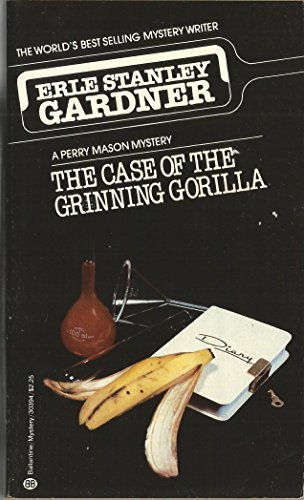
At least Della is around from start to finish to help out, for the book is stingy with all-too-brief appearances by Paul Drake, Lieutenant Tragg, and even the nasty Sergeant Holcomb. District Attorney Hamilton Burger shows up in the last fifty pages when Mason goes to court. There is a particularly lovely cross-examination of a cop who insists that Mason and his client were “fleeing” the scene of the crime. Perry makes semantic mincemeat out of this witness and proceeds to do the same with a forensics expert.
All that’s left then is for Mason to make sense of this ape show, and I’m sorry to say that the solution is truly bananas. After the many wonderful books I’ve read, this ending struck me as so ridiculous that I was embarrassed for the author and for the hero he created, who deserves better than this. In conclusion, I have to admit that Grinning Gorilla is one for the completists.
* * * * *
“The Case of the Grinning Gorilla” premiered on April 29, 1965. It was the 28th episode of the eighth season. Actress Lurene Tuttle appeared in six episodes of the series: here she appears as the defendant for the fourth time. Victor Buono and Gavin MacLeod are both excellent as major suspects. The episode massively simplifies the book’s plot; I don’t see how it could have done anything else, but it doesn’t make the story any better. And while they managed to reproduce the thrilling discovery of the body from the novel almost word for word, the scene was marred by a gorilla clearly being played by a man in a cheap ape suit.
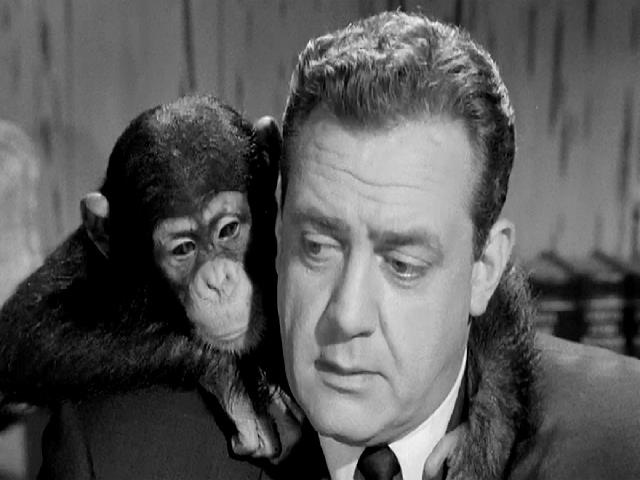
I also have to say something about the depiction of Perry and Della here, and I’m speaking as a man who cherished this series in my youth. The best part of Grinning Gorilla the novel is Mason himself: even after solving case after case for nearly twenty years, he’s still raring to go, still the maverick, still a ball of fire. And Della is both his practical angel and the girl who is in love with him and will follow him to the ends of the earth if that’s what it takes to protect and support her “Chief.” Several moments in the novel clearly underscore this relationship.
Here, Raymond Burr is 48 and looks 60 because he has gained back all the weight and more that he lost to secure the role eight years earlier. Barbara Hale is 42 and looks a matronly 50. In the screenplay, it’s Della who purchases the diaries and Perry who wants to work on briefs in the office, meaning that they are playing polar opposites of the characters in the book. Hale plays Della like a kooky fan of movie magazines and Mason is brutal in response. “Get to work!” he screams at her. This is not the man who would cherish his secretary to the point that he lifts her in his arms and kisses her, or pockets her fortune cookie fortune because of the romantic sentiments it holds. I was incensed about the way Perry was written and portrayed here, and it provided a sour ending to a middling reading experience.
We only have two more stops in the Mason Menagerie. Next month: more monkey business! Can Gardner do better than he’s managed here? We’ll have to wait and see . . .
 Ah Sweet Mystery!
Fascinating. I have a copy of this but I’m miles away from it at the moment. I have never seen the TV series. Not even a part of an episode, although I sympathise with your horror at a blundering screenplay treatment (I feel that way about every Christie mangled in the last 25 years).
LikeLiked by 1 person
If you’re planning on reading them all in order, come back in three years and let’s chat!
LikeLike
Pingback: THE ERLE STANLEY GARDNER INDEX | Ah Sweet Mystery!