It has been months in the making: Sergio Angelini, the Noir Master and host of the noir-centered podcast Tipping My Fedora, reached back seventy years and compiled a list of thirty-six films made in 1955. Our task was to watch (or, in some cases, re-watch) these films and come together in Noirvember to draft a list of the very best – the top thirteen.
In a surprise twist!!!!! – Sergio made a mistake: Hell on Frisco Bay turned out to have been released in 1956, leaving us with only thirty-five films under consideration.
It took me several months to watch and review every film on this list. (Just to remind you of the stakes at hand, here’s that list of films we considered in our draft. In a surprise twist that certainly must have made it less daunting for you to watch along, Sergio made a mistake by including a film made in 1956):
| 5 Against the House | Finger Man | The Phenix City Story |
| The Big Bluff | Illegal | Queen Bee |
| The Big Combo | Killer’s Kiss | Rififi |
| The Big Knife | Kiss Me Deadly | Shack Out on 101 |
| A Bullet for Joey | Las Vegas Shakedown | Sudden Danger |
| Chicago Syndicate | Mr. Arkadin | Tight Spot |
| Crashout | Murder Is My Beat | Women’s Prison |
| The Crooked Web | The Naked Street | |
| The Desperate Hours | New Orleans Uncensored | Hell’s Island |
| Les Diaboliques | New York Confidential | House of Bamboo |
| Female Jungle | The Night Holds Terror | I Died a Thousand Times |
| Female on the Beach | The Night of the Hunter | Violent Saturday |
Our third drafter, Nick Cardillo, ran into a bit of a snag by getting cast in a leading role in a play. This resulted in a highly curtailed watching schedule, and while he watched a great many of the films and made some excellent selections, he wasn’t always able to comment on the films that Sergio or I chose.
Our game follows the rules of Screen Drafts, one of the best podcasts about movies out there. Each episode covers the creation, serpentine-style, of a “best of” list of films made by guest film experts and fans covering a specific topic. We determined the order of drafting randomly:
DRAFTER C (Sergio) selected films 13, 12, 9, 6, and 3.
DRAFTER B (Brad) selected films 11, 8, 5, and 2.
DRAFTER A (Nick) selected films 10, 7, 4, and 1.
All drafters are given a blessing in the form of a VETO. If one player selects a film and an opponent feels that this film should either not be on the list or be placed higher, they can veto that selection and it goes back into the draft ether, where it can be played again by any of the drafters.
Since DRAFTER A, Nick, has fewer picks, he gets an EXTRA VETO.
In longer drafts like this one, Screen Drafts bestows a second blessing called the VETO OVERRIDE. If a player makes a selection and gets vetoed, but the player holding the override agrees that the film has found its proper place, he can nullify that veto, and the film remains in place. Since DRAFTER B, Brad, has fewer picks, he receives the VETO OVERRIDE.
Are the rules clear? Then let’s head down the mean streets of Noirvember ’55 and begin the draft!
* * * * *
THIRTEEN

For his first pick, Sergio selected New York Confidential. His comments: Rather like this one. It is very traditional gangster tale but has a great cast and a super busy script, all of which pays off. Looks ahead to THE GODFATHER in particular and has a great noir ending in which everyone except the boss’ elderly mother gets killed.
Nick: Unfortunately, I did not get around to seeing this one, but a strong cast and its proto-Godfather premise make it sound like a worthy one to watch.
This was Brad’s Number Twelve film. I was pleased at its placement here. Far too many of the movies on this list were about troubled crime bosses, but this was one of the better ones, largely due to a terrific cast (Crawford, Bancroft, Conte and the fantastic character actor Mike Mazurki.)
TWELVE

Sergio had back-to-back picks, and his next selection was Violent Saturday. Director Richard Fleischer makes great use of CinemaScope in this colorful, open air Noir that is made with his customary precision and attention to pace. A good mid-range heist movie that is as much about exploring the stultifying moral and class rigidity of the Eisenhower era as it is about crime and punishment.
Nick: Didn’t catch this one either, but the unique cast and the large scope sound very enticing!
Brad had this one a little higher at #8 but was thrilled to be so copacetic (so far!) with Sergio. Yes, it smacks of soap opera, but I really enjoyed this Peyton Place with a noir twist about a small Arizona town where the citizens live their troubled lives until they are all affected by a trio of bank robbers. Some live, some die, but everyone is changed in some profound way. It has a great cast, both on both the good and bad guy side, with some really interesting twists to every character.
ELEVEN
Brad reluctantly played Mr Arkadin (a.k.a. Confidential Report), wisely figuring that my co-drafters were more fond of it and might play it higher. The visual imagery is stunning and over the top, as are the performances, but I didn’t have much fun watching this. It feels like an echo of Citizen Kane, with a less riveting central figure (played, of course, by the director himself) and a puzzle-box plot that made little sense.

Sergio was much more fond of the film. This quirky and delirious movie by Orson Welles is basically a simple story of an adventurer who tries to squeeze some money from one of the world’s wealthiest men via his daughter. But in the telling this became a globe-trotting fable of fallen heroes, not-so-innocent princesses and sad but dangerous ogres that can be quite hard to follow. But it is very stylish and in its best edit (the “Comprehensive edition”) a truly poetic piece of Noir with a melancholy ending that is a real knockout.
Nick: I admire Orson Welles enough that I’m liable to judge a film that is as objectively messy as Mr. Arkadin with leniency. That messiness is, of course, attributable to the circumstances under which it was filmed, but Welles was able to overcome his stipulations and limitations in this film, the criminal twin of Citizen Kane. Particularly, the final act, with its bacchanal at Christmas, as the pieces of the puzzle start to fall into place, is riveting: a triumph for Welles, his shoestring budget, and what can be done with a little imagination and keen awareness of what can be done with your camera.
All the GMs agreed that your enjoyment of this film depends on which of the eight existing cuts you watch! (Sergio also recommends the radio version.)
TEN
Nick’s first pick on the list was The Desperate Hours. “You don’t have it in ya” “Yes I do. You put it there.” Tense and dark. Love seeing Bogart tough as nails one last time and ruthless (threatening to shoot a kid), and surprisingly psychological. Good as Bogart is, you wish that it was Paul Newman (who played the role on stage) as a younger and more virile crook, but the prestige trappings give this one a unique style and Frederic March is excellent. I expected it to be more of a chamber piece – a little tighter, a little more claustrophobic – but for what it is, it’s quite impressive.

Brad had this one higher on his list. It’s the rare prestige picture directed by an A-lister (William Wyler) and with a sterling cast. Cinematographer Lee Garmes worked with the best directors, from von Sternberg to Hitchcock, and the first-rate score is by Gail Kubik, a classically trained musician and Pulitzer Prize-winning composer. The cast (Fredric March and Martha Scott as the parents, Arthur Kennedy as the cop trying to save them) is mostly excellent, although I think Bogart is too old here (if only Paul Newman could have repeated his stage role.) The film is full of suspenseful set pieces and comes to a gripping climax, largely played in silence.
Sergio had a harder time with this one, although he decided not to veto it: Despite its great cast and crew, to me this has always felt a bit of a drag as a movie – it’s all rather rather sedate for my taste, not trying hard enough to disguise its stage origins. One wishes that March and Bogart had switched roles. Wyler’s movies by this point had got rather slow at times.
NINE
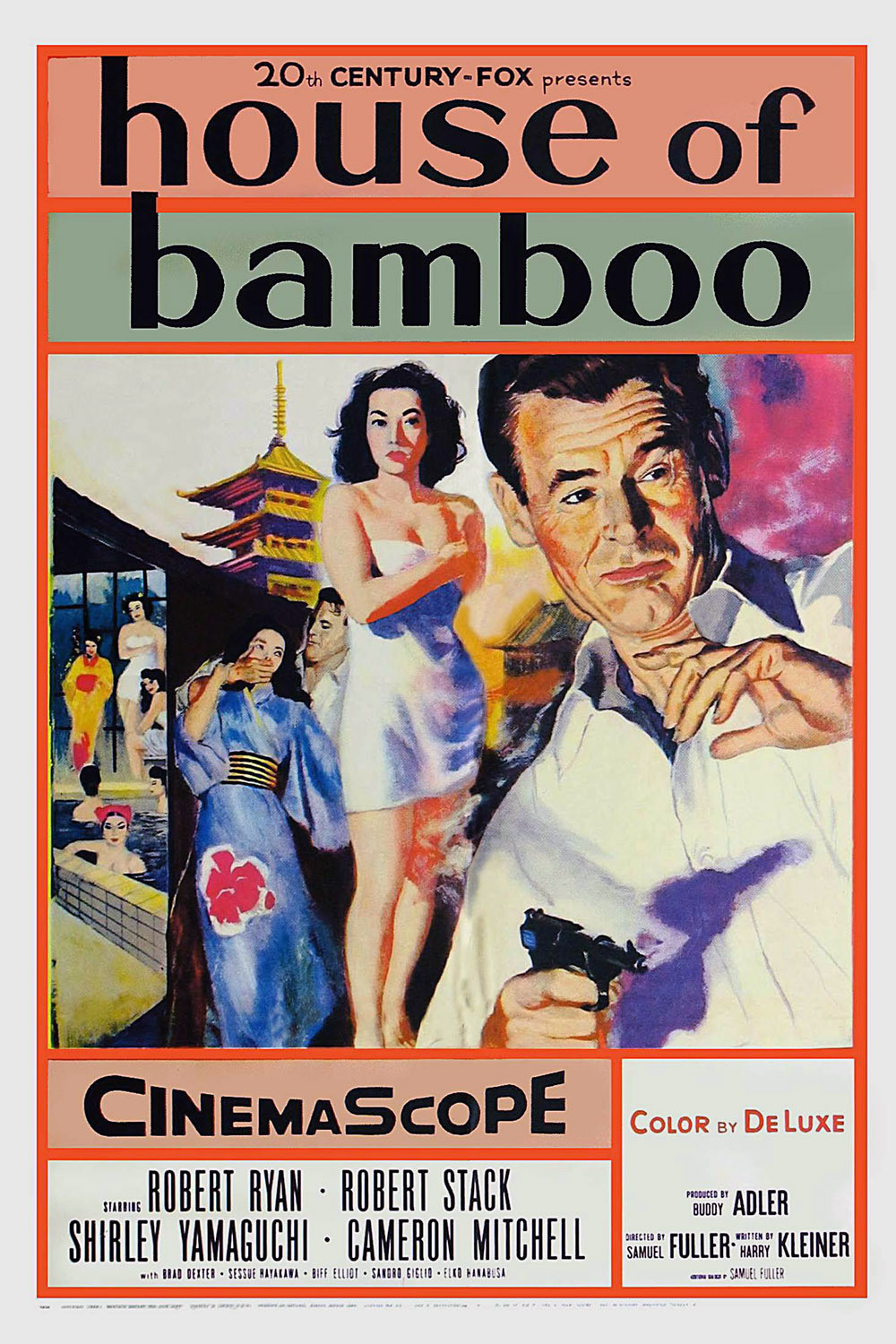
Sergio played House of Bamboo. Sam Fuller is one of the great writer-directors of Noir and American cinema. This is a rather strange movie in some respects but its unusual setting and equivocal characterisation makes for great drama – and it was very ballsy for the time to have the Americans be the villains. The climax is superbly staged in CinemaScope.
Nick: This sounds very enticing and I love the unique use of the locale.Didn’t get time to check it out before the draft, but I will be looking into it after for sure.
Brad likes Sam Fuller just fine, just not here. The earlier Pick-up on South Street is a terrific noir, and the later Forty Guns is a looney-toons Western; I have covered both on this blog. But while House of Bamboo is something to look at, I never found the story involving. Still . . . no veto.
EIGHT
Brad played The Phenix City Story – Based on the real-life attempt to rid Phenix City, Alabama, known as “Sin City,” of the hold that organized crime had on it for many years, this is a tough, thrilling story. Director Phil Karlson wisely brought his cast and crew right to the source, filming in Phenix City and casting locals in smaller roles and as extras. To lend even more credence to the reality of the situation, Karlson filmed a fifteen-minute “prologue” where a journalist interviews real citizens about the hold organized crime has had on the town and offered it as a “pre-show” to cinema distributors before the main film was run.

The plot travels throughout the populace, pinpointing both those who run the rackets. Richard Kiley makes a fine reluctant hero, and Edward Andrews, who we usually think about as a sitcom staple, is a jovially fiendish villain. John McIntire, as Kiley’s father, is the true tragic hero here, hoping against hope that his town is salvageable. It is – but at a terrible price for Kiley’s family.
Sergio had this at #7. It’s one of Karlson’s most important films and an important transitional title in Noir, moving the semi-documentary style of the 1940s spy movies to tackle inner city corruption and gangsterism. It remains a powerful film and is definitely one for the 1955 Film noir top ten. It is brutal and still hard to take, its use of non-professional actors giving it a really edgy feel. A bit of an odd mixture but one that works.
Nick had unfortunately not watched the film, but he commented: Literally ripped from the headlines?!? This soundsreally neat!
SEVEN
Nick played Les Diaboliques. I recalled this being easier to appreciate than actually enjoy, but this viewing surpassed my expectations. From the drawn-out murder scene to the second act’s vignettes, each one ratcheting up the tension and the unease, director Clouzot wrings every ounce of suspense from the script. The strong screenplay could rest on its incredibly clever laurels, but never once does it feel like it’s drawing attention to itself. There have been countless imitators, but few are as successful and Clouzot proves throughout here (and in the even better Wages of Fear) that he’s one of the few who could possibly challenge Hitchcock as the Master of Suspense.

Brad places this film much more in the horror genre. I find it kind of drawn out. But it is visually stunning and beautifully cast, and the central triangle is admittedly noirish in the most French of ways. I also love the elderly detective played by the great Charles Vanel. The film was on my list, just much lower, and I’m happy to keep it here (but no higher.)
This is a favorite for Sergio, who calls it one of the great suspense movies of the 1950s, one that often gets overlooked as a Noir due to its trick ending. And yet as a tale of dark suspense andtwistedromance this isan absolutely stunningpiece of work, beautifully acted and superbly paced.
SIX
Sergio selected 5 Against the House, our second Phil Karlson film, based on a book written by Jack Finney (Invasion of the Body Snatchers). His comments: Psychologically scarred soldier finding it hard to re-adjust to civilian life is an addition by the screenwriters in an otherwise fairly close adaptation of Finney’s quirky first-person narrative. Brian Keith’s vet with PTSD, a violent temper and a huge inferiority complex provides the fulcrum for this slightly off-centre story of a heist planned as a lark by a group of enterprising law students.

After her debut in Pushover, Kim Novak quickly returned to Film Noir though here she is not a femme fatale but just a young woman unsure about committing to Madison’s older and much more experienced boyfriend (in the book she is more integral to the proceedings). Ingenious and sober, albeit with reams of wisecracking banter to contrast with Keith’s darker anguish, it is all handled with Karlson’s customary understated fluidity and intelligence. The climax, featuring a huge automated car parking bay, was added for the film and provided a real novelty at the time. The complex, forbidding and cavernous construction serves as a dynamic representation of the mental and emotional cul-de-sac in which Keith feels himself to be trapped.
This was not on Brad’s list. Perhaps the fact that it was the first film I watched put it at a disadvantage for him as other titles more to my liking kept pushing this one further down on his list. However, Sergio’s arguments about Brian Keith’s performance and the climactic shootout in the high-rise parking lot convinced me not to veto, but I do think, at least, that it should have placed lower than the other, superior, Karlson I drafted, The Phenix City Story.
Nick: Sergio says this has some proto-Ocean’s 11vibes. Brad disagrees.I’llhave to check it out soon to make up my mind.
FIVE
Brad played Crashout – but Sergio vetoed it.
Brad then played The Big Combo. It has terrific direction by Joseph H. Lewis, (Gun Crazy) and brilliant cinematography by John Alton. It’s not about the plot, which is standard, but about the presentation and the performances. Richard Conte is deliciously evil as crime boss Mr. Brown, and his nemesis, Detective Diamond, is played by Cornel Wilde, a multi-dimensional character who is in love with Conte’s girl. The film is graphically violent and sexually frank, even depicting, albeit in subtle terms, a loving gay relationship.
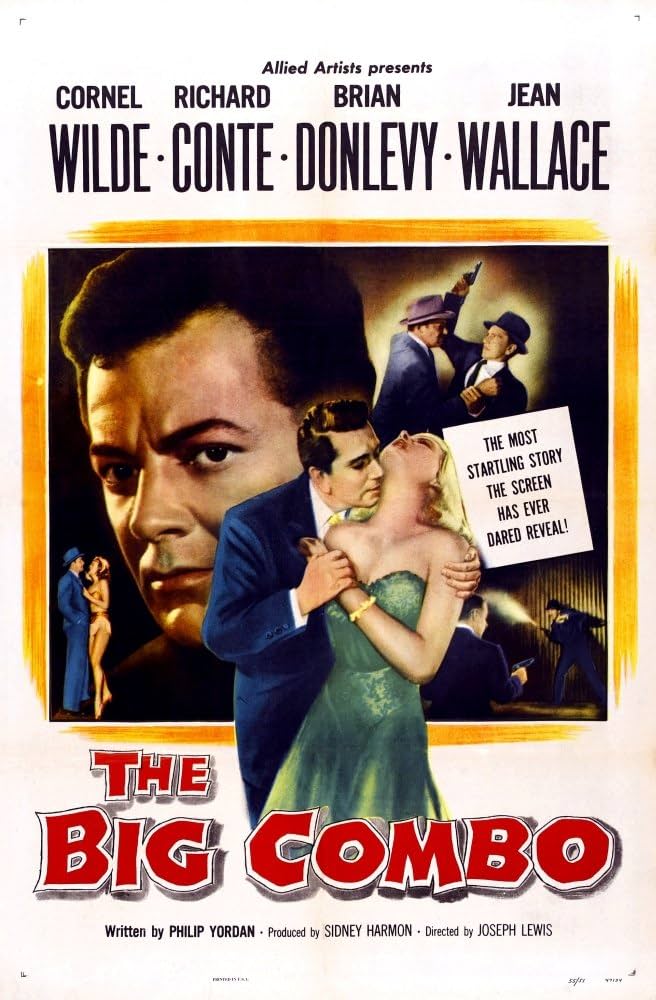
Nick: Of all the drafted titles, this is the one that I kick myself for not checking out. The indelible fog-shrouded image that is synonymous with film noir as a whole originates here, and I would love to see it on screen.
Sergio approved: Artfully shot by John Alton, with a minimal but punchy score by David Raksin, and handled with his usual quirky style by Joseph H Lewis, this is a great gangster noir with an unusually strong sexual undercurrent (triangle between hero, villain and the blonde princess in between; the two henchmen who are clearly coded as gay).Plus that new-fangled violence of the 1950s (torture by hearing aid). Conte is great, Wilde a bit dull to be honest.
FOUR
Nick played The Night of the Hunter, but off the shocked and dismayed looks on his co-GM’s faces, he self-vetoed and substituted Rififi. I was thrilled to revisit this film for this draft and it did not disappoint. When I first watched it, I expected an elegant affair; its placement in heist movie history as one of the first and one of the best predisposed to thinking about it in a certain way. What I got was a tough-as-nails portrait of equally gritty criminals that really packed a punch. I was shocked on that initial watch, but on this go around, the power of the film was little diminished. The central heist is breathtaking in its suspense and execution. I love every taut second of it. But when the film veers into the hardboiled, it does so organically and effortlessly, that the balance of tones is to be applauded. We all agreed that this film deserves to be seen on as big a screen as possible.

Sergio loves this choice: Jules Dassin’s first film after escaping the US witch hunts of the 1950s is a stunning heist film, utterly uncompromising. The director co-stars as the Italian safecracker and holds his own against a great cast. The 30-minute dialogue-free robbery is still an absolute stunner.
Brad had placed this one spot higher. It’s the French heist classic with a tragic aftermath. The depiction of the actual heist was so detailed that real-life crooks actually tried out the plan, leading to several countries banning the film. The score, by Georges Auric, is masterful, and he wrote music for the heist that he insisted be used, until Dassin showed him the rushes and he had to agree that the director was correct. I want to watch this again very soon – but on a big screen amongst a crowd of fans!!!!
THREE
Sergio played Killer’s Kiss, the film that displays in just over an hour the promise of Stanley Kubrick’s directing style. His comments: Kubrick’s proper debut (his early amateur film, Fear and Desire, was never released commercially), this is a powerful and stylistically adventurous film (at one point we have dreams within flashbacks). Frank Silvera as the villain is the only professional actor and it shows but the sheer dynamism of the filmmaking really makes the film stand out.

Nick: I watched this years ago to fill in the gaps in Kubrick’s career and though I did not get to rewatch it in the lead-up to this draft (darn cold!), the images linger long. The mannequins at the climax are an especially creepy, evocative touch.
Brad: This was the film that I was afraid Sergio would play. I would have been happier if it had appeared lower on the list. But I couldn’t veto it for two reasons: despite its weaknesses (variable acting, disjointed editing, horrible sound, tacked-on happy ending), it has some terrific set pieces. Secondly, at this point in the draft, the only film I would have wanted here as a replacement – Crashout – had been vetoed by Sergio. And so it stayed here at #3.
TWO
Brad played The Night of the Hunter. The real tragedy about this movie is that the studio system drove director Charles Laughton crazy with their interference, and he never made another film again! This is gorgeously filmed by Stanley Cortez, who was behind the camera for another classic that was mangled by Hollywood, The Magnificent Ambersons. The script by James Agee is lyrical and beautifully written and performed by a terrific cast, especially Billy Chapin in his second to last film performance before spending the rest of the decade on television and then retiring from show business.

Nick: A pretty astoundingpiece of filmmaking not only for 1955 but for a first-time filmmaker in the form of Charles Laughton. The incredibly eerie and malevolent tone is maintained from the beginning as are the more lyrical sections evocative of a Grimm’s Fairy Tale. And at the center of the fairy tale is the Big Bad Wolf himself, Robert Mitchum, in a performance that is stunningly calibrated that it resonates as one of the purest incarnations of pure evil ever put to film. Of course, any discussion of the performances in this movie would be incomplete without praise reserved for Billy Chapin who feels so utterly real in every scene. But the thing to recommend Night of the Hunter perhaps the most is its cinematography. I don’t think the Expressionistic style has ever been better incorporated into a Hollywood film and with subtle deliberateness.There’s a reason that, as Shelley Winters’ Willa falls under the spell of Harry Powell, her world begins to look more artificial, more detached, and more like the portrait of a nightmare.
Sergio calls it a dark fairytale and a truly remarkable feat of filmmaking in the silent style full of remarkable images, none more haunting than that of the submerged car and its occupant. A classic film – either the best or seconf best Film noir of 1955.
ONE
Nick picked Kiss Me Deadly. I may be alone in my distaste for Ralph Meeker in this film, but I was notalone inpraising it as a powerful, apocalyptic noir that harnessed all the anxieties of the day into its tough-as-nails private eye drama. I think it may remain the ultimate MacGuffin movie and has been atouch-pointfor generations of filmmakers.Pulp Fiction obviously cribs its own glowing central object for itself, but I was also put in mind of David Lynch’s Lost Highway which feels like a surrealist mirror held up to Mickey Spillane’s original.

Brad: It’s the epitome of late 50’s noir. Historically, it’s important: it’s said to have inspired the French New Wave. It certainly taps into our fear of the apocalypse and never lets us off the hook. Stylistically, it’s both beautiful and terrifying, thanks to director Robert Aldrich and the work he got out of cinematographer Ernest Laszlo. Mickey Spillane was known for his cutthroat violence, and you would expect a filmmaker to tone it down, but Aldrich goes all the way, creating an ultra-violent nightmare of paranoia.
Sergio agrees, calling it a truly extraordinary film – the hero is almost as despicable as the villain, the finale utterly wild and outlandish, the violence extreme – and yet, all of it is memorable and the film has been hugely influential down the decades (for example, compare it with David Lynch’s Lost Highway). Easily the best and most important film noir of 1955. Oh, and despite what the director and screenwriter said, it’s a pretty close adaptation of the book, so Spillane does deserve some of the credit even if the filmmakers were so effectively critiquing pretty much everything that he and his book stood for.
* * * * *
And that’s our draft! Each of us had our triumphs and disappointments, but I think we came up with a pretty terrific list! Let me know what you think in the comments below.
We managed to firm up some decisions regarding upcoming drafts for 2026, including an intriguing Noirvember draft, but you’ll have to wait for the start of the year to find out more about them.
You can listen to Nick Cardillo talk about The Hound of the Baskervilles and the influence Sir Arthur Conan Doyle had on Agatha Christie if you can get behind the Patreon wall and listen to the October Patreon episode of All About Agatha.
You can listen to Sergio Angelini on his amazing podcast about all things noir called Tipping My Fedora anywhere you listen to your podcasts.
And you can find me right here, churning out my content for your pleasure.
 Ah Sweet Mystery!
I really am sorry about KILLER’S KISS not being at number 6 and CRASHOUT could easily have sat in for 5 AGAINST THE HOUSE. Not sure you mentioned my small error about the release date of HELL ON FRISCO BAY quite enough times though (for the record, its premiere was 6th of January of ’56). I had a great time – thank you amigos. Can’t wait to do it again.
LikeLike
Always a pleasure to chat with you gentlemen, and some titles that will shoot straight to the top of the to-watch list for me!
LikeLike