“In a way the orange seeds helped. They were the final touch of unreality. No one could feel the actual tragedy of death in a world where people drew dancing men for murder threats and sent dried orange seeds by special messenger.”
The closest Agatha Christie came to writing a Hollywood mystery was 1962’s The Mirror Crack’d from Side to Side, and that required Hollywood to come to England in the person of movie star Marina Gregg and her director husband. Some of the suspects are “Hollywood types,” and there’s even a late scene at a film studio where someone douses Marina’s coffee with poison. But if you want to really get a real taste of Murder in Hollywoodland, you need to look further back to the late 30’s – early 40’s when the industry provided happy fodder for some of my favorite mystery authors.

Fred Dannay and Manny Lee sent Ellery Queen to Hollywood in 1938 on a three-book-long adventure that had plenty of screwball in its DNA. (1938’s The Four of Hearts is probably the best – and certainly the most star-studded – of these.) In 1940 came Carter Dickson’s And So to Murder, which proved that the British film industry was just as nuts as the one in Los Angeles. In 1941, Stuart Palmer made Hildegarde Withers a consultant on a movie in The Puzzle of the Happy Hooligan, while the end of the decade saw Philip Marlowe investigating dark doings within the industry in 1949’s The Little Sister. (This was partly inspired by author Raymond Chandler’s brief but notable experience as a screenwriter.)
The late 1930’s and 1940’s marked the height – followed by the slow decline – of the studio system in Hollywood. All the glamor and scandal and craziness are perfect kindling for a good mystery plot. I had forgotten – because it must be forty years since I first read it – that Anthony Boucher’s The Case of the Baker Street Irregulars (1940) was a Hollywood mystery, complete with the requisite Jewish studio head (F.X. Weinberg, channeling the likes of the Warner Brothers, Louis B. Mayer, Samuel Goldwyn, Carl Laemmle, William Fox, Adolf Zukor, and David O. Selznick), heroic employee (Maureen O’Breen, head of Publicity and the sister of Boucher’s series detective, Fergus O’Breen), and upcoming film project (an adaptation of Sir Arthur Conan Doyle’s “The Adventure of the Speckled Band,” a classic Sherlock Holmes story that Doyle himself thought was ripe for dramatization.)
Mostly, of course, Baker Street Irregulars is an homage to the Master, both Doyle and his creation. The pages here are bursting with references to the canon, nearly every clue has something to do with one of the stories, and the list of suspects consists of five members of that illustrious group mentioned in the book’s title. Of course, I’m not speaking of that band of ragamuffin youths who helped Sherlock Holmes out with some of his cases. By 1940, all of these lads would be a bit long in the tooth!

I’m talking about the club (still existing) of Sherlock Holmes fanatics, who meet annually to drink and pay homage to the world’s greatest detective. (And, apparently, to drink some more.)

About all I could remember of the book is that it was funny and felt like more of a romp than a formal mystery. I was therefore pleased as punch when someone suggested this as a title for our Book Club and eager to see how well my newfound perceptions coincided with those dim memories.
The book is funny – at least much of the time – and firmly set in the film world. Weinberg’s pet project is in trouble because the Baker Street Irregulars object to his choice of screenwriter. Stephen Worth is a writer of hard-boiled mysteries who used to be a private detective himself. He also has little respect for the “cozy” closed circle mysteries written by all the authors I love, and he has special contempt for Sherlock Holmes. In fact, Worth has promised to use the film “to show up that cocky bastard for what he is!” (Interestingly, this attitude pre-dates that shown Raymond Chandler himself, who would lay out a similar contempt for the form in his 944 essay, “The Simple Art of Murder.” It makes me wonder, though, if Worth isn’t at least slightly based on Chandler or, perhaps, Hammett, who worked for Pinkerton and also had a spotty career in Hollywood.)
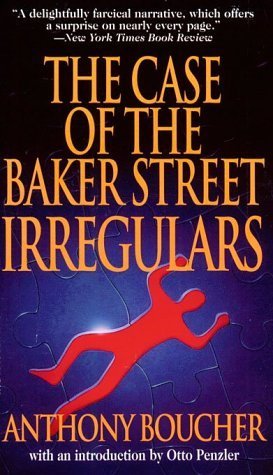
In addition to hating on classic mysteries, Worth is a rampant skirt-chaser and overall odious human being, (Maureen has a bill for a new brassiere to show for it!) And now the Baker Street Irregulars, made up of distinguished famous folk and intellectual others, has demanded that Weinberg fire Stephen Worth before he can turn one of the most beloved stories from the Sacred Writings into a screen travesty. The producer is fine with this idea, as Worth is a pain in the neck, but Worth’s contract is airtight: either he writes the film or it never gets made.
Ever the smart cookie, Maureen comes up with the idea of inviting the Irregulars to Hollywood to serve as expert consultants on the film. Five of these gentlemen answer the call: an author, a doctor, a professor, a newspaper editor, and an Austrian Nazi-hunter. All are seemingly gentle, intelligent men, and yet each of them appears to have a dark spot in their past, some with possible ties to Stephen Worth. They put up in a mansion at 221B Romualdo Drive (not even a studio head is powerful enough to get the street name changed to Baker!) and are even bequeathed a housekeeper named Mrs. Hudson!
A lavish Hollywood party is set up to honor their arrival, but Worth crashes the party, insults everyone – and ends up getting shot in an upstairs room. Maureen witnesses this murder and is knocked out for her troubles. Fortunately, the Los Angeles Police Department is also on hand in the person of Lieutenant Andy Jackson, who has collaborated with Maureen’s brother on earlier recorded cases.
So far, Boucher has presented us with a classic closed circle mystery, complete with colorful suspects, maps and lists of alibis. The relationship of the clues to the Holmesian canon is a nice touch. But then he veers – and your enjoyment of the novel may depend on how much you like the divertissements that follow. On the day following the murder, each of the five Irregulars has an adventure that hews loosely to the casebook of a certain Master Detective. A full quarter of the novel is devoted to these five adventures, and Boucher himself interrupts the proceedings to call attention to the importance of these stories:
“Do not distrust these following narratives simply these because they are told in the first person by the Irregulars rather than in the third by the author. Each adventure forms an integral part of the Worth case; and each took place, the author guarantees, exactly as its protagonist recounts it.”
That may be true, but most of these stories themselves feel rather trifling, and none come close to the richness of the most baseline Holmes story by Conan Doyle. The real fun comes from the multitude of connections between these tales and the Holmes canon, but I was disappointed by both the incomplete nature of the tales and by the obviousness of the clues. One piece of information gave away the very nature of the circumstances that involved the Irregulars, and another seemed to me such an obvious signpost of the killer’s identity – and was underscored as such twice within the narrative – that I could only hope it was a huge trap placed in front of me.

When we return to our regular story, Boucher delivers more classic tropes: an apparent second murder attempt, a dying message, and a seemingly endless series of false solutions that had me tapping my foot impatiently. When we got to the final solution, I must admit that I started muttering “Move along, move along!” – but we didn’t move along, and the denouement resulted in bitter disappointment on my part.
My final thoughts? The Case of the Baker Street Irregulars is more of a traditional mystery than I remembered, but this constitutes probably the weakest aspects of the story. Read this book for the Holmesian whimsy (I love Boucher’s choice as to which character delivers the correct solution) and for the Hollywood stuff. Maureen O’Breen and Andy Jackson are charming characters; I only wish they had gotten a chance to solve one of Boucher’s more clever cases.
 Ah Sweet Mystery!
Pingback: The Case Of The Baker Street Irregulars (1940) by Anthony Boucher – In Search of the Classic Mystery Novel