“He was her man and he did her wrong . . .”
Death on the Nile is my favorite Hercule Poirot novel. I ranked Five Little Pigs higher on my Top Ten Christies list, and it deserves its place there. But it is a different sort of book than Nile, and I enjoy Christie’s 1937 tale more. Pigs is one of her most intimate tales: a man is murdered, and his wife goes to prison for the crime; if she is innocent, then no more or less than five others could have committed the crime. When I think of Nile, the word that comes to mind is “epic” – epic scenery, epic romance, a cast of nineteen majkor figures and seventeen hangers-on. The puzzle plot of Pigs is brilliantly tight; that of Nile twists and turns like the river itself. While both novels have devastating conclusions, Pigs ends quietly while Nile goes out in a blaze of gunfire.

Some have criticized the novel’s length. I compared the sadly few Fontana editions I own and found that most of them averaged 190 pages (The Murder at the Vicarage, Death in the Clouds, Sad Cypress and Why Didn’t They Ask Evans?); the 40’s title The Moving Finger comes in at only 160 pages! Nile is 221 pages long, For me, the novel flies by from beginning to end.
The 1930’s featured a dozen novels starring Hercule Poirot, truly a Golden Age for the sleuth. Four of these novels comprise Poirot’s “travel” mysteries, although Death in the Clouds involves merely plane rides back and forth between Paris and Croydon. It seems that, like his creator, Poirot had a fondness for the Middle East: in Murder on the Orient Express (1934) and Murder in Mesopotamia (1936), he is on assignment for a foreign government. That leaves Death on the Nile and Appointment with Death (1938), two mysteries that find Poirot on holiday. Like all Golden Age detectives, however Poirot was invariably on a busman’s holiday.
He had solved earlier murders while on vacation in two 1936 short stories, and the trajectory of his travels here is odd. February saw the publication of “Problem at Sea,” which has Poirot on a boat bound for Egypt. Then, in May, he journeyed to a Greek island to ponder the “Triangle at Rhodes,” a precursor of sorts to the 1941 novel Evil Under the Sun, where the detective is also on holiday when murder strikes. Nile was published in November 1937, and we must assume that the events chronicled here occurred between the February story and the one in May, which suggests that everywhere he went on this trip, he had to track down murderers.
There are nearly no notes about the book in Christie’s notebooks, but there is a potential cast of characters, some of whom will clearly be reconfigured into other titles. Fascinatingly, Christie first considered putting Miss Marple onboard the Karnac! While I can see Aunt Jane knitting placidly on a boat deck and observing all the matters of the heart revealed in whispered conversations around her, John Curran makes a good argument for this idea probably being no more than a passing fancy on Christie’s part She had only appeared in one novel at the start of the decade; plus, “the 1932 short story collection The Thirteen Problems, set firmly in the parlors of St. Mary Mead, could hardly be seen as a preparation for an exotic Egyptian adventure.” Curran goes on to explain that in 1935-36, when Nile is almost certain to have been completed, it was the rare Englishman who would consider travelling such a distance and to such an exotic locale.
One other problem that Curran fails to mention: Miss Marple would have solved this case in a hot minute.
* * * * *
The Hook
- “’What a lot of enemies you must make, Linnet.’
- “’Enemies?’ Linnet looked surprised . . .
- “ ‘Enemies, my sweet. You’ve so devastatingly efficient. And you’re so frightfully good at doing the right thing.’
- “Linnet laughed. ‘Why, I haven’t got an enemy in the world.’”
Christie’s plan to hook us at the start of this novel may amount to a slow burn to some (my pal Jim Noy argues that the whole first chapter could be cut with no loss) but takes a thoughtful, novelistic approach to setting up the mystery.

At its heart are two women, Linnet Doyle and Jacqueline de Bellefort, who share a for-life friendship between two almost complete opposites. Linnet’s father, Melhuish Ridgeway, a businessman who made a brilliant marriage to a German heiress, (Christie will repeat this to very different effect in One, Two, Buckle My Shoe), successfully compounded her fortune, and transferred his ruthless efficiency to his daughter. Jackie was the daughter of a French count and an American mother, but her father died and her mother lost the family fortune in the stock market crash.
Jackie hits up her friend for a favor: since Linnet has bought herself a huge estate at Malton-under-Wode, she will need a land agent to run it. Jackie has fallen in love with Simon Doyle, who has earned his degree in business and grew up on an estate. If Linnet gives Simon the job, the couple will have the funds they need to get married. Linnet’s decision to help Jackie is the opposite of “ruthless efficiency” and displays a sense of romance and sisterhood that must be commended. It seals the fates of all three of these people.
Quite brilliantly, Christie introduces most of her other characters as satellites around which this central plot unfolds. Joanna Southwood hangs out with Linnet (and admires her pearls) while Linnet is making a date with Jackie. Hercule Poirot is dining at a favorite restaurant when he witnesses Jackie and Simon celebrating his new job and their forthcoming marriage. As various people plan their own trips to the Nile – the Allertons, Miss Van Schuyler and her retinue, “Uncle” Andrew Pennington, Jim Fanthorp, and the Otterbournes – Linnet and Simon’s marriage is revealed, and the seeds for other motives are planted. This is an opening chapter that sets all that will follow in a compelling and entertaining way.
Score: 10/10
The Closed Circle: Who, What, When, Where, Why?.
Who?
“A big scarlet Rolls-Royce had just stopped in front of the local post office. A girl jumped out, a girl without a hat and wearing a frock that looked (but only looked) simple. A girl with golden hair and straight autocratic features – a girl with a lovely shape – a girl such as was seldom seen in Malton-under-Wode.”
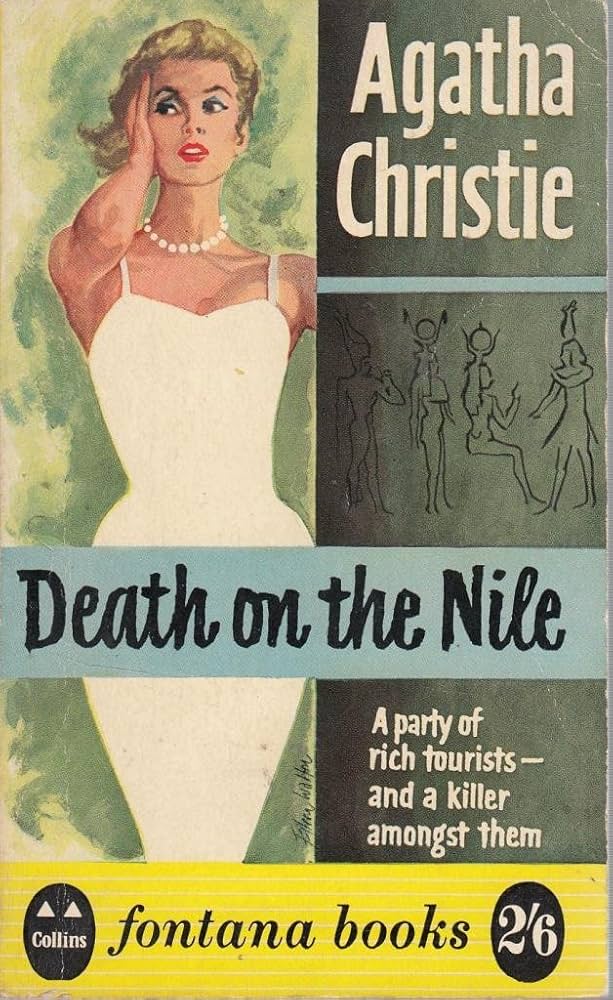
Christie truly shines when she presents us with a good victim. To my mind, no actress has given us the multi-layered portrait of Linnet Doyle that we find in the book. Lois Chiles portrays her as obnoxiously vain and self-serving. Think of poor Jackie coming to her oldest friend for help and having to pay homage to Linnet’s redecorated bathroom! Emily Blunt made her a bitch. Gal Gadot actually gave us more layers, but Kenneth Branagh’s film ultimately didn’t do any of the characters any favors.
In the novel, Linnet is rich and self- assured and certainly enjoys her money, but she also has a gracious side. There’s no “Now, Barnstable!” moment of meanness. She likes her friends, even the odious Joanna Southwood, and she is excited about reuniting with Jacqueline de Bellefort. When she meets Simon, Christie is far more subtle than any of the films about Linnet’s predatory nature: “A warm sweet feeling of intoxication ran through her veins . . . (Linnet) thought: ‘I’m frightfully – frightfully happy. I like Jackie’s young man . . . I like him enormously . . .’ And then with a sudden pang: ‘Lucky Jackie . . . ‘”
We learn all the ugly details through other people: from the Allertons, vacationing in Majorca, who read about Linnet’s upcoming marriage to Simon, from Andrew Pennington and Jim Fanthorp, separately worried about what the marriage means to Linnet’s finances, from Mrs. Otterbourne, who is thrilled to rub shoulders with these scandal-mongers. And we learn a lot from Jackie herself when she admits at the end to feeling no sorrow over Linnet’s death: “She went all out to get Simon away from me . . . I don’t think she hesitated for more than about a minute. I was her friend, but she didn’t care.”
Our most significant observation of the now married Linnet comes when she asks Hercule Poirot to try and convince Jackie to stop her persecution of the couple. Poirot, who refused to take on Mr. Ratchett as a client on the Orient Express because he did not like the man’s face, refuses to act for Linnet’s sake, (although he happens to appreciate her face, figure and clear brain.) Instead, he offers her a moral “out” for her actions:
“I suggest that there was a moment when you hesitated, when you realized that there was a choice – that you could refrain or go on. I suggest that the initiative rested with you – not with Monsieur Doyle. You are beautiful, Madame; you are rich; you are clever, intelligent – and you have charm. You could have exercised that charm, or you could have restrained it. You have everything, Madame, that life can offer. Your friend’s life was bound up in one person. You knew that, but, though you hesitated, you did not hold your hand.”

Poirot is being perspicacious, but he doesn’t have all the facts. Linnet isn’t blameless, but her struggle to avoid facing what Poirot is partly mitigated by Poirot’s belief that she is capable of acting with grace and humility.
“I should say, Madame, that you have had a happy life, that you have been generous and kindly in your attitude towards others . . . And that is why the feeling that you have deliberately caused injury to someone upsets you so much, and why you are so reluctant to admit the fact . . . You have the clear brain. Yes, one cannot go back over the past. One must accept things as they are. And sometimes, Madame, that is all one can do – accept the consequences of one’s past deeds.”
This is Poirot at his most sensitive and spiritual, suggesting to Linnet that the guilt she has endured because of her actions can serve as a form of atonement for whatever bad act she committed. When she again presses him to talk to Jackie, he agrees – but not for Linnet.
“I will do what I can in the interest of humanity. That, yes. There is here a situation that is full of difficulty and danger. I will do what I can to clear it up – but I am not very sanguinous to my chance of success.”
In an ordinary mystery, Poirot might now go to Jackie and say, “Look, Mademoiselle, you have been heard making threats on these people’s lives. But now Poirot is on the scene, hein? So watch yourself, missie, or I’ll sic the law on you.” But Christie gives her sleuth a more elevated purpose. The cornerstone of this novel – and one of its finest attributes – is the relationship that develops between Poirot and Jackie. It began before the Karnac sets sail – back in England, at Chez Ma Tante, when Poirot observed Jackie and Simon together and thought to himself, “She cares too much, that little one . . . It is not safe.”
At this point, there is no thought of murder in Jackie’s heart, nor any designs on Linnet’s fortune. It’s only after Linnet makes her play for Simon and he shares his feelings with Jackie that she begins to conceive her plan. She does it for love, folks, not for the money. I will never believe otherwise. Of course, we can’t let Jackie off the hook any more than we can dismiss Linnet as getting what she deserved. Once committed to murdering her rival, Jackie excels at the planning. She also becomes an excellent actress: she gives vent to her hurt and anger as she stalks the couple through Europe, and as she pours out her heart to Poirot at their first meeting she also plants the false idea that they are being overheard by an unknown person. Finally, she deserves an Oscar for her hysterics and “attempted murder” of Simon on the night of Linnet’s death and for her contrition afterwards.
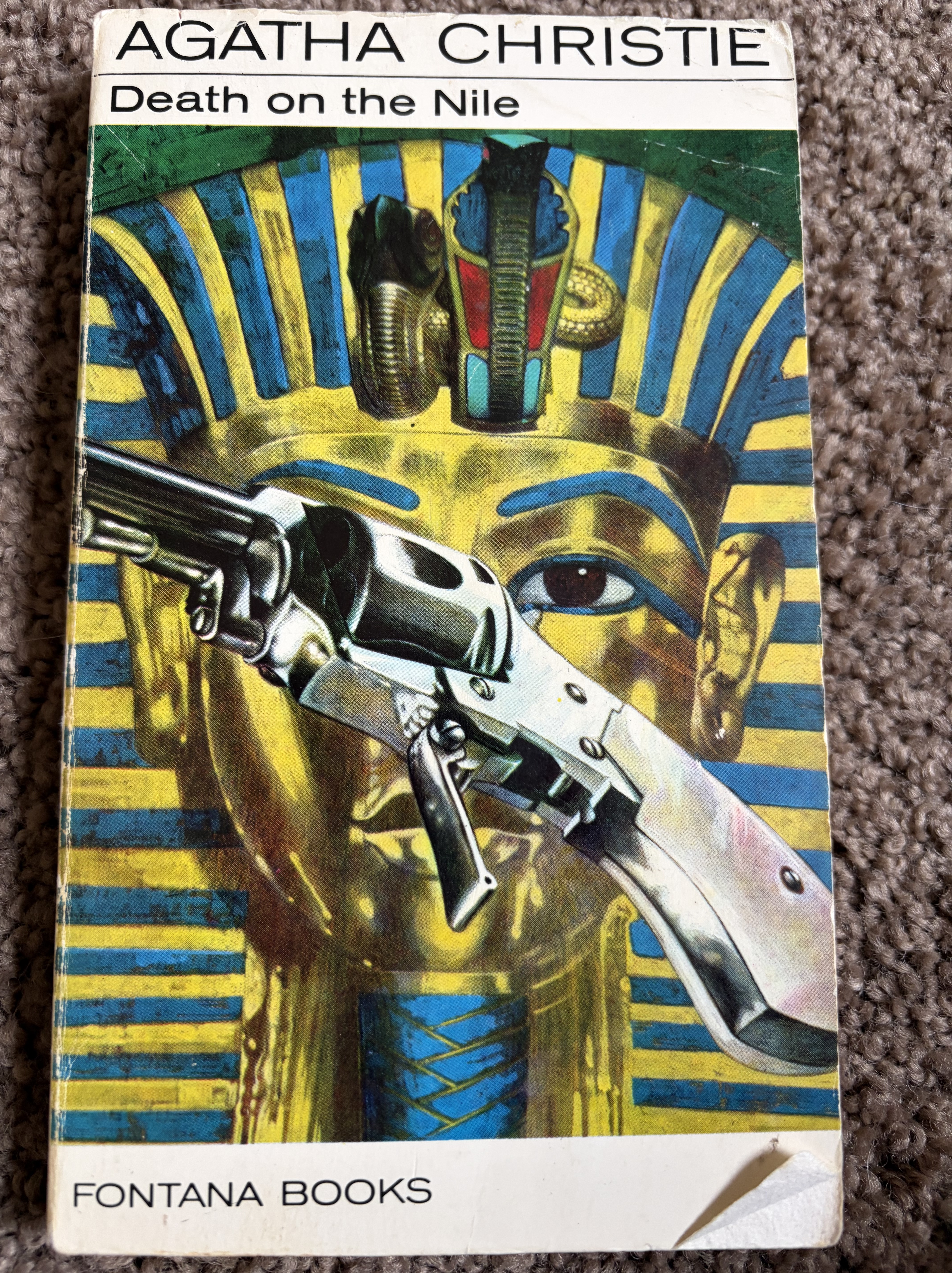
Still, there’s something honest between Jackie and Poirot. He genuinely wants her to give up her vendetta for her own sake: “Mademoiselle, I beseech you, do not do what you are doing . . . Do not open your heart to evil . . . . Because – if you do – evil will come. Yes, very surely evil will come. It will enter in and make its home within you, and after a little while, it will no longer be possible to drive it out.” Jackie truly appreciates the way Poirot feels for her and lets him off the hook for sending her to the gallows, both in deed (suicide) and word:
“Don’t mind so much for me, Monsieur Poirot. After all, I’ve lived hard always, you know. If we had won out, I’d have been very happy and enjoyed things, and probably should never have regretted anything. As it is – well, one goes through with it.”
Simon feels more like a Christie “type,” the charming British cad, the “Simple Simon,” the Archie Christie. He shouldn’t be as good an actor – and he’s not, really: in the end, it’s what Simon says that gives him away, and how he says it. He should have yelled at Louise Bourget, “Make some sense girl, and stop talking in the past subjunctive!” And he should have not yelled at Mrs. Otterbourne when she was about to reveal the identity of Louise’s killer. Ultimately, he’s less good at words than his partner, and so Christie leaves the explanations about his motivation to Jackie, who tells Poirot how put off Simon was by Linnet’s flirtations and her “bossiness,” who rejected Jackie’s offer to stand aside and let him marry Linnet (“I’d be a kind of damned Prince Consort!”), who started to picture what life might be like if her married the girl and she died soon thereafter.
But I keep going back to that delicious scene at Chez Ma Tante where Christie teases us about Simon’s true nature by filtering it through Jackie’s reactions – and then tricks us into misinterpreting what it all means.
- “We’ll see (Egypt) together, Jackie . . . together. Won’t it be marvelous?”
- “I wonder. Will it be as marvelous to you as it is to me? Do you really care – as much as I do?”. . .
- “Don’t be absurd, Jackie.” . . .
- “I wonder.”

The dozen or so passengers who form the suspect list once Linnet is murdered might remind us of the international assortment we find on board the Orient Express. Three years later, though, Christie is more interested in characterization, and she allows herself the space to present these people as people and not just as suspects. If, as a mystery reader, you find this a waste of your time, then you are definitely reading the wrong book. As for me, I love every bit of Chapters Two through Twelve, with all the shipboard conversations that come between one attempted murder after another.
The screenwriters of all three films picked and chose (and, in Branagh’s case, mostly reinterpreted) which passengers would come on board for each particular journey. Christie herself excised nearly everyone from her theatrical adaptation of the book. I won’t belabor this by providing a character sketch of each one; I understand the logic of these decisions; even I am aware of a time crunch at the idea of providing sketches of each character. Suffice it to say that I love most of them, both as suspects and as portraits of a varied band of tourists. The varied parent-child relationships between the Allertons and the Otterbournes, the secondary romantic mystery of who Cornelia Robson will choose to partner with; the presence of the ineffable Colonel Race as Poirot’s partner in crime-solving!
If you want to argue that Colonel Race’s terrorist gang subplot fizzles out (just who is the woman B?) and crewman Fleetwood is perhaps the most forgettable suspect in the canon (I certainly forget about him every time I reread this!), be my guest. Personally, I think it gives an overcrowded “ship of fools” feeling to the proceedings. I love every one of these people, and I won’t be dissuaded.
What?
Contrary to the fact that the novel takes place on a luxury river cruise along the Nile, we should not forget the economic situation into which most people in England and the U.S. found themselves during the mid-1930’s. Both countries were in the throes of economic depression. England in 1935 was in the midst of “The Great Slump,” characterized by economic disparity, a downturn for traditional industries, like coal, steel, and shipbuilding, and high unemployment. A person like Linnet Ridgeway, born into money that kept growing throughout the period, was a rare figure who inspired greed, jealousy, and fear in others.
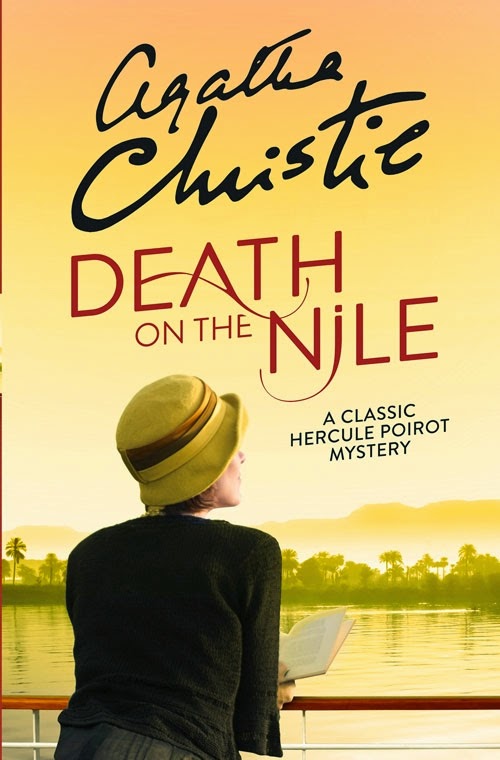
The story that unfolds around Linnet on board the Karnac is almost Dickensian as it presents a panoply of souls struggling to carve out a worthy life for themselves. And, no doubt about it, they are struggling. The wealthier characters, like Miss Van Schuyler, Lord Dawlish/Mr. Ferguson, and the Allertons, are free to travel the world but find little to like about it. Dawlish despises people like himself, while Van Schuyler and Tim Allerton are opportunists. Mrs. Otterbourne’s career is in shambles, and Rosalie is miserable. Most of the others – Pennington, Fanthorp, Fleetwood, Louise, Miss Bowers, and Richetti – are not on board for pleasure. Only Cornelia and Dr. Bessner are truly enjoying themselves, at least before Bessner is put to work examining one corpse after another!
Jackie and Simon both come from evaporated wealth: in the arms of a better man, Jackie would have handled this economic downturn with grace, but Simon has had a rough go of making a living. His risk-taking for the sake of money has gotten him fired from one job and has warped his vision of the next. Sure, he could “afford” marriage to Jackie if he worked for Linnet, but it’s not enough. For men like Simon – and Andrew Pennington and Tim Allerton – life is an insistent search for more, no matter what rules need to be broken.
There are good men, too – Jim Fanthorp is onboard to protect Linnet, Dr. Bessner is a compassionate medical man, and Colonel Race is a hero – but they are outnumbered. The young women have it harder, as they are forced to subsist by taking care of others: Louise Bourget waits on Linnet and turns greedy; Rosalie Otterbourne fronts for her pathetic mother and turns bitter. Only Cornelia Robson, pure of heart, cheerfully endures being a slave to her elderly cousin, and Christie rewards her with the book’s happiest ending.
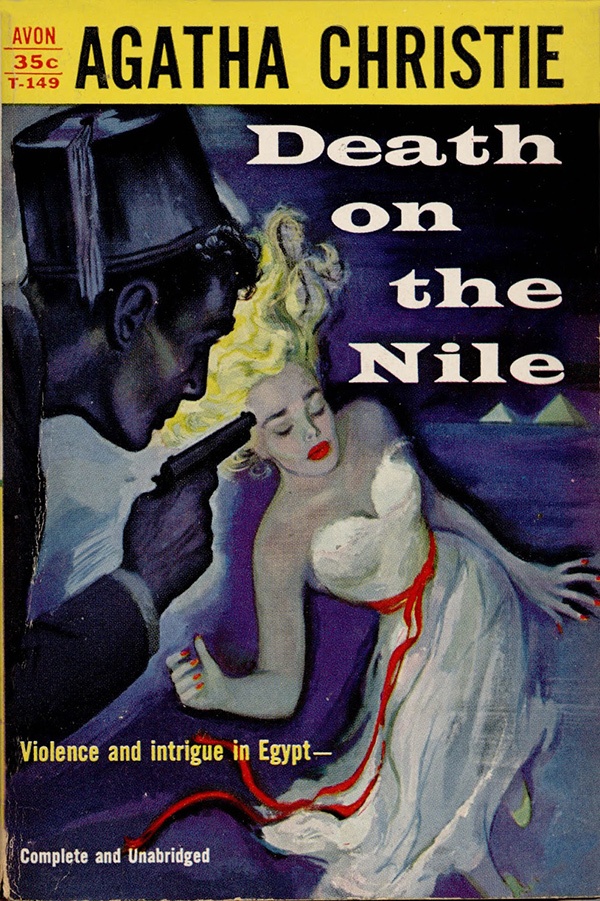
It seems like I’m still talking about character, but the plot of the first third of the book could stand in for any travel novel where the gathering of a disparate set of strangers upends everyone’s lives. Not even half of these folks are in Egypt because of Linnet Doyle, and yet their lives are irrevocably changed for having known her – some for better and some for worse. And all because the murderers’ plot requires witnesses, who can observe the persecution of Simon and his bride by his former fiancée, setting Jackie up to be Linnet’s murderer, and then pull the rug out from under us by giving Jackie a perfect alibi.
Just as brilliant is the attempted murder of Linnet at Abu Simbel: Jackie could not have staged this; nor could Simon (for those who always rightfully suspect the husband!) – so who among her fellow passengers would want Linnet to die? It provides rich punctuation to the presence of Andrew Pennington onboard the ship. His desperation is a stroke of good luck for the killers, but after Linnet’s murder, a series of misfortunes threaten their plan and lead to two more murders. If I wanted to be really picky, it feels slightly repetitive that both Louise Bourget and Mrs. Otterbourne happened to witness one of the killers on route to commit their crime. However, we are not on an ocean liner but a fairly intimate steamer, neither of these deaths was premeditated, and attempting such an act is dangerous. Plus, Christie makes up for any twinge of coincidence in the dramatically different set-up of these murders.
Meanwhile, the saga of the stolen pearls is not some throwaway red herring but a subplot that is carefully interwoven into the narrative. From the early moment in England when Joanna Southwood admires them and asks to wear them (in order to make an imprint of them and create a fake copy) to the theft by the kleptomaniacal Miss Van Schuyler, to the reveal of a surprise (but not outrageously so) co-conspirator for Joanna, the pearls earn their place in this complex plot.
When and where?
In 1933, Agatha Christie stepped on board the S.S. Sudan outside a hotel near Elephantine Island and took the cruise that would inspire the one in her book. It is my understanding that this particular route is no longer possible on modern river cruises along the Nile. Thus, we are privileged to enjoy a detailed description of Christie’s actual experience, and we can easily imagine her sitting on the deck as massive waves of creative inspiration assailed the author alongside the gentle waves lapping against the sides of the boat.
Although this is very much a closed circle mystery, it never feels claustrophobic. The opening sections are positively international, taking us from America to Mallorca, and the cruise drops us into several ports before isolating everyone on the ship in time for murder. Christie proved herself to be a charming memoir writer, particularly when it came to her travels, and this talent is evident throughout the book.
Score: 10/10
The Solution and How He Gets There (10 points)
“But yes – but yes. You are seeing only half the truth. And remember this – we must start again from the beginning, since our first conception was entirely wrong . . . it is always the facts that will not fit in that are significant.”
Poirot says these words to Colonel Race in Chapter 24 after revealing that he knows the solution – has indeed realized the truth since Louise Bourget’s death – and then delineates a number of clues. Most of the things he mentions may not be straightforward enough to immediately help the reader, but one of them, the mention of Louise’s testimony, is a beautiful clue! Her use of the conditional tense (“if I had been unable to sleep, if I had mounted the stairs, then perhaps I mighthave seen this assassin, this monster . . .”), followed by the way she implores Simon Doyle to understand, should make any wary reader question Simon’s “perfect” alibi. And then the pieces should fall together: Poirot overhearing Simon say, “We’ve got to go through with it now,” suggesting a co-conspirator; the tampered nail polish; the tossing of the gun into the river; the powder burns on Linnet’s forehead, despite the bullet hole in the velvet stole suggesting it had been used to muffle the shot; Tim Allerton’s assertion that he heard a pop, a splash, and the sounds of a man running past his door.

Here is the truth: when Jacqueline de Bellefort introduced Simon Doyle to Linnet Ridgeway, she failed to account for the weaknesses in both her fiancé and her best friend. Linnet made a play for Simon, whose inherent greed made him grow increasingly obsessive over how to get his hands on Linnet’s money. Had Jackie dropped Simon and looked for a better man – a Jim Fanthorp, perhaps – my favorite character would have lived a happier life. But then Simon would have probably pushed Linnet off the top of a pyramid and gotten caught – and there would be no Death on the Nile!
Jackie’s own weakness is her obsessive love for Simon, and so she conceives of a plan where they will become enemies who alibi each other. It requires acting on both their parts; easy enough for Jackie, who is furious with Linnet for betraying their friendship, harder, perhaps for the stolid Simon – but then remember that his weakness for money is masked by good looks and good breeding.
For the most part, Jackie and Simon’s plan is undone by their own bad luck: Linnet’s maid, Louise Bourget, sees Simon running down the deck and her subtle blackmail in the presence of Poirot, Race, and Bessner does not go unnoticed by the sleuth. Then Louise’s murder by Jackie is witnessed by Mrs. Otterbourne, prompting Simon to yell at that poor lady so that Jackie can hear the problem next door and deal with it. (This, too, is noticed by Poirot.)
There is, however, one mistake that Simon makes during the execution of Linnet’s murder. He sneaks into his wife’s cabin, points the revolver at her forehead and fires, leaving powder burns at her temple. When he returns to the lounge, he reloads the gun and fires a bullet into his leg, first wrapping Miss Van Schuyler’s fur stole around the gun to muffle the sound of the shot. Unfortunately for the killers, the package that Simon threw overboard containing the revolver, the handkerchief he clutched to his “fake” wound, and the stole is recovered by the authorities. This prompts Poirot to ask: which shot that was fired caused the bullet hole found in the stole? The answer is that there must have been a hitherto unknown shot, and this piece of information starts the little grey cells to churn.
Meanwhile, Christie supplies several red herrings to keep her sleuths and readers guessing. Unlike the movie adaptations, she doesn’t give everyone a specific alibi. But here they are for your consideration:
- The most traditional is the presence of Andrew Pennington, whose devious machinations against Louise’s fortune will be discovered as soon as she sets up her finances to include Simon. This prompts one of Christie’s best connivances: Pennington’s attempted murder of Linnet, which seems to exonerate Simon and Jackie.
- The most overarching is the theft of Linnet’s pearls because anybody on the steamer could be the thief. This is certainly the most complexly plotted red herring. The pearls are dangled before us from the start (in front of a character who clearly covets them but is not on the boat), and the solution to the theft involves two thieves, one acting under compulsion and the other through a carefully premeditated plot.
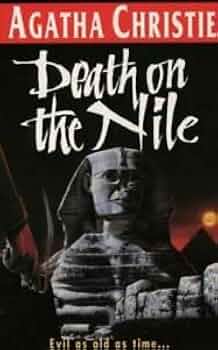
A canny reader will recognize that the pearls do not lead to the killer if they notice how the solution to the theft is constructed procedurally but mostly not deductively. Miss Bowers shows up to return the pearls after her hypochondriacal client steals them. Poirot realizes immediately that these pearls are fake. He suspects Tim Allerton of being the real thief because he has heard Mrs. Allerton mention Joanna Southwood, whose name is known to the detective regarding a series of thefts. (How fortunate!) Perhaps the most outrageous part of this solution is when Poirot confronts Tim and says of the pearls: “There is only one place they can be! I have reflected, and my reason tells me that this is so.” Yet there is no reasonable clue that should lead Poirot to the rosary hanging in Tim’s cabin. Like everything else about this plot strand, Poirot’s guess makes sense – but he’s still guessing, or using information not supplied to the reader. It’s a slight weakness to a very entertaining subplot.
- The most ridiculous is the telegram about vegetables that Linnet receives instead of Signor Richetti, which lends some international intrigue that is necessary to the plot only as a way of bringing Colonel Race onto the scene. It’s a bit of silliness that is too underdeveloped to be much fun.
- The most forgettable is the presence of Fleetwood, the crewman who wanted to marry one of Linnet’s maids until she put a stop to the relationship. As I mentioned, I keep forgetting this character was even on the boat.
I reluctantly remove a point for these little weaknesses, but I want to say that they generally don’t bother me a jot.
Score: 9/10
The Poirot Factor
Why is this such a perfect representation of Poirot? Because we see him in all his glory as both a detective and as a man. We’ve discussed his sleuthing, so let’s look at the other. We watch him dining in pleasure at Chez Ma Tante, playing the tourist throughout Egypt, and making choices with his heart. His fondness for Jackie is genuine: it leads him to put pressure on her to turn back from her evil course, even when it seems her worst crime is stalking her rival. In the end, he is definitely on Jackie’s side, for he understands how a woman could be laid low by the love of a man. In deciding her fate, Poirot makes the sort of choice reserved for special cases, as we have seen in Orient Express and will witness again in Five Little Pigs: he lets Jackie avoid social ruin, prison and execution on the dock.
In return, Jackie takes her lover with her, giving Simon, in Poirot’s words, “an easier death than he deserved.” When Mrs. Allerton remarks, “Love can be a very frightening thing,” Poirot reveals more of himself than we are used to when he replies, “That is why most great love stories are tragedies.” Perhaps this gives us insight into why the great detective himself has avoided this aspect of life.
Score: 10/10
The Wow Factor
“Linnet Doyle, who had been Linnet Ridgeway, the famous, the beautiful, the wealthy Linnet Doyle was dead. Sir George Wode read about it in his London club, and Sterndale Rockford in New York, and Joanna Southwood in Switzerland, and it was discussed in the bar of the Three Crowns in Malton-under-Wode. And Mr. Burnaby said acutely: ‘Well, it doesn’t seem to have done her much good, poor lass.’ But after a while, they stopped talking about her and discussed instead who was going to win the Grand National. For, as Mr. Ferguson was saying at that minute in Luxor, it is not the past that matters but the future.”
I suppose that “wow factor” is really a personal reaction. There are certain Christie titles that, no matter how often I re-read them, give me a deep sense of satisfaction: Nile, Five Little Pigs, The Hollow, A Murder Is Announced and And Then There Were None hit me in a way that goes beyond “mere” enjoyment. These books work as puzzles and as entertainment; they inspire a rich emotional response and provide insight into the human condition.
And when an artist accomplishes that, you can only sigh and say, “Wow!”
Score: 10/10
FINAL SCORE FOR DEATH ON THE NILE: 49/50
THE POIROT PROJECT RANKINGS SO FAR . . .
- Death on the Nile (49 points)
- The Murder of Roger Ackroyd (48 points)
- The A.B.C. Murders (46 points)
- Three-Act Tragedy (42 points)
- Cards on the Table (36 points)
- Death in the Clouds (35 points)
- One, Two, Buckle My Shoe (34 points)
- Murder in Mesopotamia (30 points)
- Hallowe’en Party (29 points)
- Hickory Dickory Dock (29 points)
- Dead Man’s Folly (28 points)
- The Mystery of the Blue Train (26 points)
- Elephants Can Remember (22 points)
- The Big Four (21 points)
Next time . . .
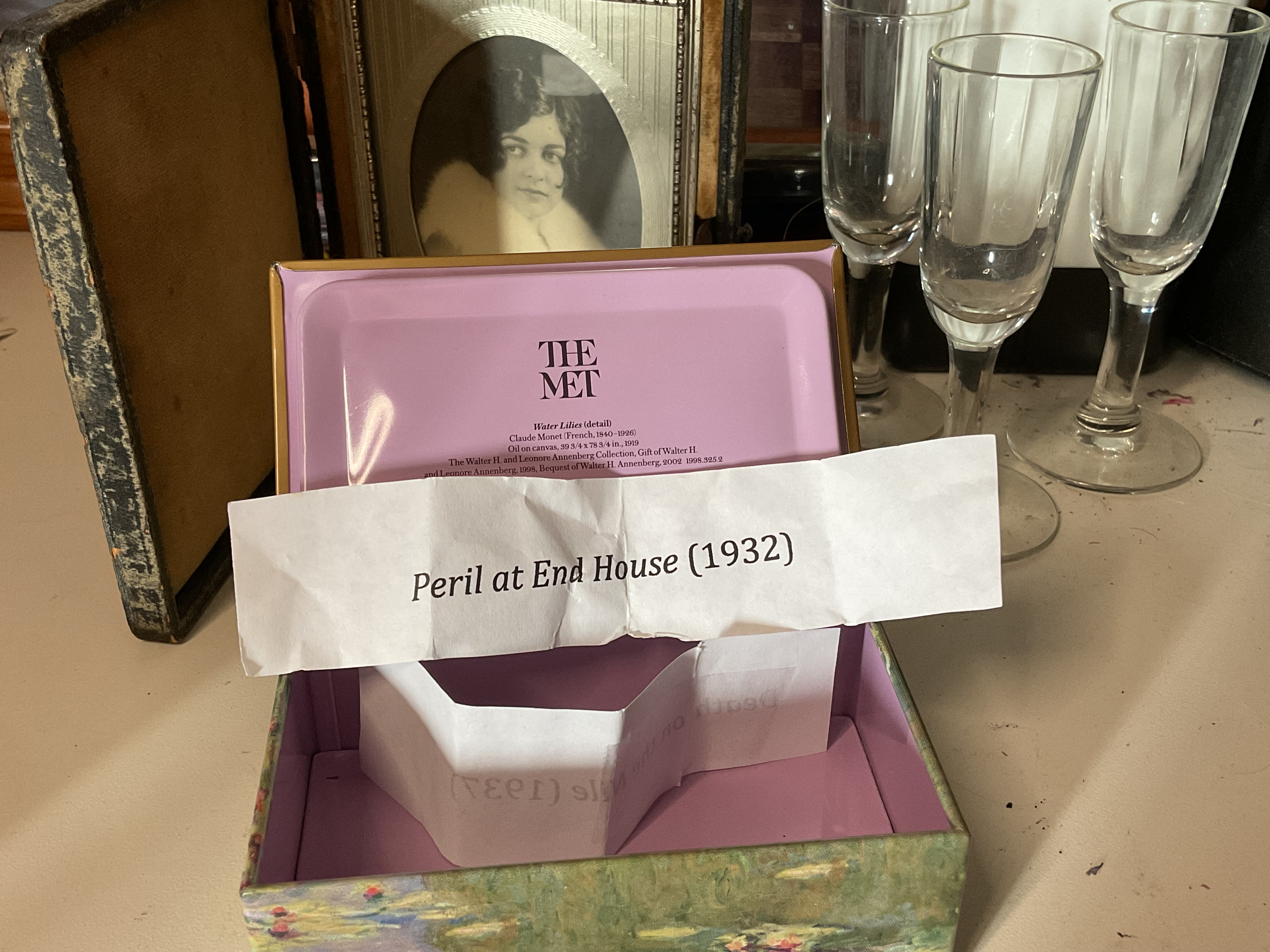
The Yuletide season brings an early 1930’s classic . . . and the conclusion of our Poirot Project!
 Ah Sweet Mystery!
Pingback: MY AGATHA CHRISTIE INDEX | Ah Sweet Mystery!
What a great novel with so much to unpack. Of the three films, Ustinov’s is the gold standard, Suchet is pretty decent, and Sir Kenny’s efforts. Oh my God!
There’s so much wrong starting with Gal Gadot’s Linnet (she’s so sweet she’d never steal her best and only friend’s man) to the ship which wasn’t a real ship. Over and above all the other issues, horrifyingly, Sir Kenny SENT the crew off the ship, including the captain, to camp on the banks of the Nile, leaving the passengers unattended. No steward to call is petty compared to letting passengers anywhere near the bridge or the engine room. Seeing LIVE STEAM in the kitchen tells you that something is happening in the engine room but where’s the crew?
Anyway.
A point about Jackie’s anger. She’s furious at Linnet for going after her man. I’d bet she’s equally angry — even if it’s unexpressed — that when Simon proposed marrying that rich, ex-friend harpy for her money and then murdering her and she agreed so Simon didn’t hang, she knew what he’d have to do to make Linnet believe him.
Linnet must have been used to people, including men, going after her for her money.
Simon had to not merely pretend to Linnet he loved her, he had to prove it, night after night, as they consummated the marriage. That is, Jackie knew her lover was loving someone else and with her agreement.
That had to eat at her.
LikeLike
This was actually much easier to solve than most of her books.
LikeLiked by 1 person
You’re smarter than I am! I never figure out whodunnit.
LikeLike
Brad, you’re a fan! 😀 This is one book I am uncomfortably aware of as NOT loving as much as everyone else. The characters are the best part, as you’ve eloquently described; my especial favourite is the relationship between Linnet and Jackie and the lightness of hand with which Agatha deals with it. My gripes and comments (in no particular order):
In spite of all this, the book still lives rent-free in my head and I often think about Linnet (another poor little rich girl of Agatha’s) and her cut-short life. One of Agatha’s best-written victims, I would say.
LikeLike
Pingback: THE POIROT PROJECT #15: Peril at End House | Ah Sweet Mystery!