Ah, Christmas! A chance to assemble with our loved ones for some spiritual reflection, the trading of presents, a table laden with feasty things round which our beloved family sits. Such joy! Such peace! Such bliss! Unless your table is packed with drunken uncles, sullen teens and a clan that angrily encompasses both ends of the political spectrum. If that’s the case – if no amount of tinsel or roasted goose or candied walnuts or holiday cheer will calm your family down! – then may I suggest the perfect remedy: gather around the TV and watch a movie.
The twelve days of Christmas are the perfect time to kick back and take in a flick. And while many people restrict themselves to the “same old same old” of Christmas classics, I like to watch one of my favorite types of film: the ensemble movie. It’s the perfect solution for families who are close and for those who can’t stand their relatives. That’s because in an ensemble movie, everyone is important. You know you’re watching one of these films when the credits roll, and the word “starring” is followed by “in alphabetical order.”
Ensemble films are often pretty complex, which is the perfect accompaniment for the slow digestion of one’s beef. Other than that, they can be funny or sad, stately or thrilling. They are often much longer than the typical film; after all, you have a lot of people and storylines to sort through. This is the perfect way to pass a few hours with those in-laws you despise or the wealthy brother you haven’t said much to since 1993. If you all like the movie, you can bond over it. And if the others don’t think much of your taste, they can sneak out of the room and leave you in peace.
Today, I have assembled for you twelve of my favorite ensemble movies – one for each day of Christmas. (I have tried to lightly theme them against the lyrics of that famous song.) In compiling this, I made two rules for myself: the first is “No Christmas movies,” so you won’t find Love, Actually on this list, although I love that film, so there’s no reason why you can’t slip it in. The second rule is that, since certain favorite directors of mine specialize in ensemble films, I’m limiting the list to one film per director. This sometimes necessitated a difficult decision, one that I will mention (along with delightful discards) as I come to them.
Now grab a pencil and some popcorn – here we go!
* * * * *
On the first day of Christmas, my true love gave to me . . . a partridge in a pear tree
Such a dear old-fashioned image! Perfectly fitting to place the oldest film in this collection: 1932’s Grand Hotel. The slogan for the Metro Goldwyn Mayer studio was “more stars than there are in heaven,” and MGM frequently tried to pack half of them into their biggest pictures. Directed by Edmund Goulding, and based on a best-selling 1929 German novel by Vicki Baum, this has a sumptuous cast – Greta Garbo, Joan Crawford, both John and Lionel Barrymore, Wallace Beery, Lewis Stone, and Jean Hersholt. Each plays a character who could be the subject of a movie of their own: the penniless secretary trying to find both love and success, the desperate businessman in need of a deal, the dying clerk looking for a final chance to live a little, the dashing criminal, and the artist so disillusioned with her life, she longs to end it – at any rate, she wants to be alone!
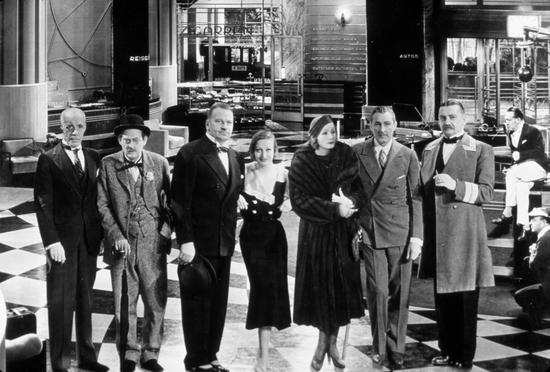
Set in post-WWI in the most sumptuous hotel in Berlin, Grand Hotel opens with the words of the brooding, scarred staff doctor: “People coming, going. Nothing ever happens!” Nobody has ever misread a situation more completely! A great many strangers converge on the hotel and become involved in each other’s lives. and, to varying degrees, come to care about each other. And although most of their dreams are dashed into dust, the very act of connection manages to sweep away the state of ennui and hopelessness in which they find themselves. The pairing of John B. and the Divine Garbo anchors the multi-faceted plot, but my heart belongs to the other characters. Crawford shows how likable she could be onscreen, Beery is a magnificent boor, and nobody could wallow in pathos like Lionel Barrymore. There’s not a tree in sight, but I bet by movie’s end you’ll be feeling quite Christmassy!
On the second day of Christmas, my true love gave to me . . . two turtle doves
A pair of turtle doves might suggest a love story, and don’t get me wrong: Peter Bogdanovich’s 1971 classic The Last Picture Show contains multiple varied romances. But really it’s about the panoply of life in the dusty Texas town of Anarene. The focus is ostensibly on the younger generation: best buddies Duane (Jeff Bridges) and Sonny (Timothy Bottoms) fall out over their shared passion for the beautiful but callow Jacy (Cybill Sheppard). As all three go about making the worst possible choices of their lives, they are watched over by the older generation, who are all painfully aware of the mistakes the kids are making because, heck, they made the same ones themselves!
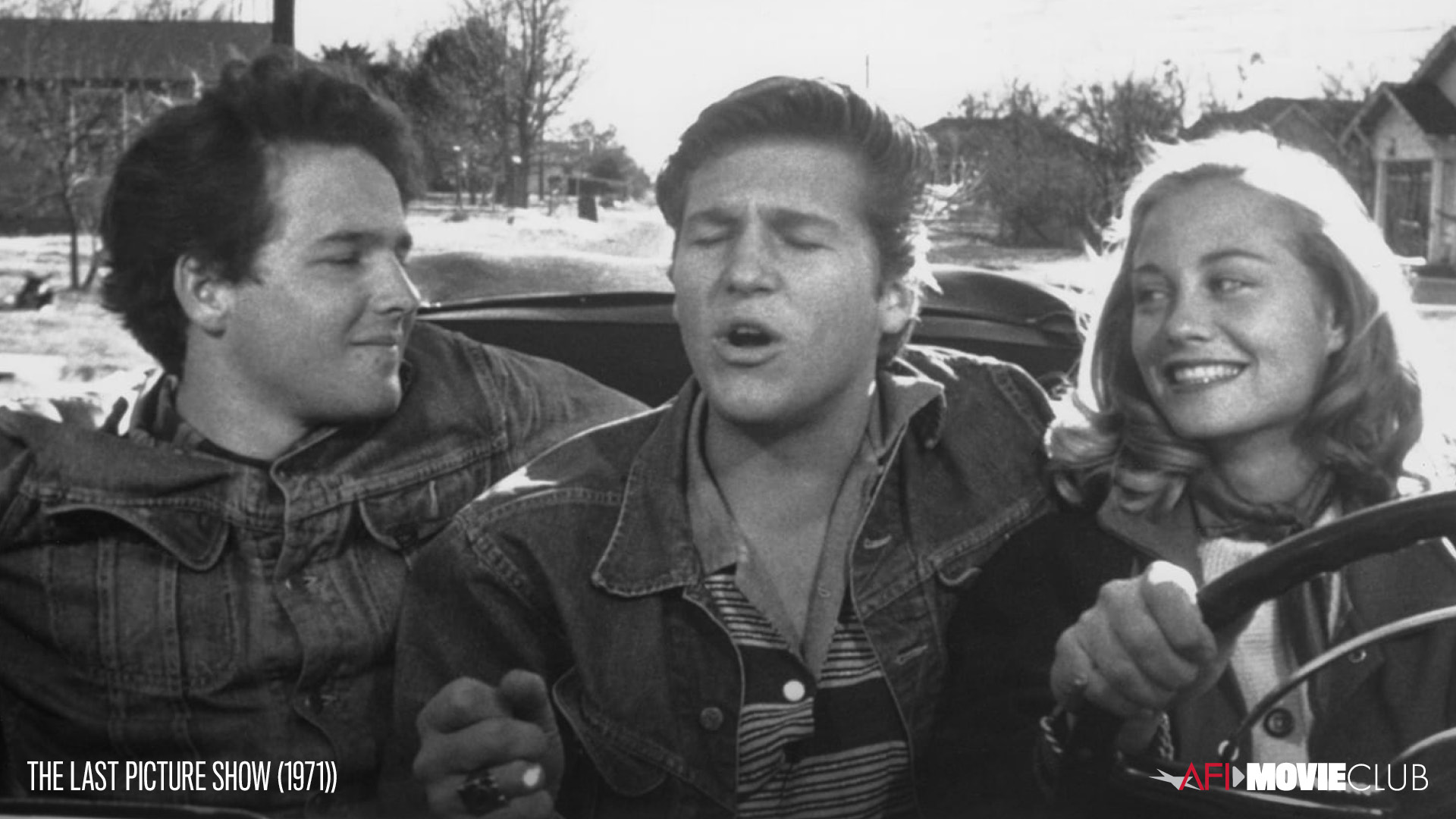
Ben Johnson and Ellen Burstyn are great as townsfolk who feel helpless in their responsibility for these young people. But it’s Cloris Leachman who steals the show – and won an Oscar – as the faded wife of the town coach who makes every wrong choice in the book in a last stab at true love. The whole thing is gorgeously shot in black and white by Robert Surtees. This was only Bogdanovich’s second picture, but it is an assured triumph.
On the third day of Christmas, my true love gave to me . . . three French hens . . .
The three “hens” I have in mind are the trio of siblings who form the center of Woody Allen’s 1986 treasure, Hannah and Her Sisters. Hannah (Mia Farrow), Lee (Barbara Hershey) and Holly (Dianne Wiest) form a brilliant depiction of how the rivalries of childhood shape our relationships with our adult brothers and sisters, our parents, our lovers, our children and our friends. The present generation of same circle round the sisters, and the stories they tell fall around three successive Thanksgiving dinners. I know, I know – but there aren’t twelve days of Thanksgiving!
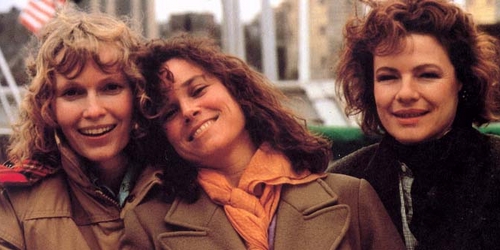
The humor is plentiful, but it is “mature Allen” humor rather than slapschtick, and the film is as moving as it is funny. For once, Allen doesn’t put his own perforance in the center of the action, although he has given himself a choice role as Hannah’s ex. (Let’s not waste any time looking for real life irony here!) Farrow, Hershey and Wiest are all brilliant; Wiest won an Oscar for her performance, as did Michael Caine as Hannah’s emotionally faithless husband. But they are surrounded by stars, including Maureen O’Sullivan (Farrow’s real-life mother) and Lloyd Nolan as the parents and Max Von Sydow as Hershey’s horrific artist lover. Under Allen’s direction, and armed with his brilliant script, he allows every actor in this excellent ensemble to shine, including Julie Kavner, Carrie Fisher and Sam Waterston in smaller roles.
What I love about Hannah is that, with all its sprawl, it defines the true nature of family as a group of individuals bound together by DNA, which they didn’t ask for, or contracts, for which they failed to read the fine print. We torture each other, but we can’t live without each other. As Allen’s Mickey learns in a brilliant moment in the balcony of a movie theater, of all places, without our human connections, however imperfect, we are nothing.
On the fourth day of Christmas, my true love gave to me . . . four calling birds . . .
Way back when, in a time of technological shift, I went to some store and bought my first DVD player. Of course, I needed a movie to watch on my new machine, and for my very first DVD, I chose Robert Altman’s Nashville (1975). The movie was over twenty years old by then, but it has resonated with me since I first saw Altman’s painful celebration of America’s 200th birthday!
1976 was our Bicentennial, but it was also an election year in a decade where we were still smarting from the Vietnam War, Nixon’s malfeasance, and a country divided over what to make of the peanut farmer who had replaced him. Altman captures the tumultuous nature of that time in this epic ode to country music by introducing us to two dozen characters all coming together for a huge gala concert in Nashville to benefit an outsider candidate for president.
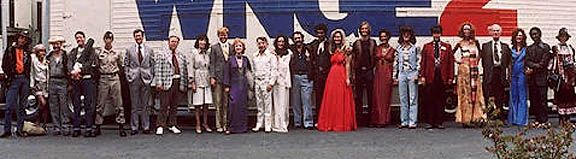
Who knows where Joan Tewksbury’s screenplay ends and the improvisation begins, but it feels like we are dropped into the middle of every scene where we can choose our own adventure to follow this character or that as they sing, fight, plot and dream. The hierarchy of Nashville country music is delineated, from the king and queen (Henry Gibson and Ronee Blakeley) to their various consorts (Karen Black, Timothy Brown), to various musical interlopers who might or might not be destined for stardom (Keith Carradine, Barbara Harris, Gwen Welles). We meet families, agents and producers, and various outsiders who may or may not be up to no good. The dozen or so plotlines meander purposefully throughout the film, sometimes just barely intersecting, until everyone converges on the gala, where history is made.
It only took a moment for me to decide between this one and the also brilliant Gosford Park, a cross between Downton Abbey and Clue that fits more easily into the world of this blog. But the brilliance of Nashville – the music, the performances (Lily Tomlin will break your heart), the epic complexity of it all – wins me over every time.
On the fifth day of Christmas, my true love gave to me . . . five golden rings . . .
I’m always wary of Quentin Tarantino, whose excess of violence often appalls me. That said, I have watched and enjoyed Pulp Fiction many times and might have recommended it here – until the director came up with a fairy tale for the ages, 2019’s Once Upon a Time in Hollywood.
Set fifty years earlier in 1969, at the cusp of great change in the film industry, the story centers around three people: a fading Western actor (Leonardo DiCaprio, in my favorite role of his), his stunt double and friend (Brad Pitt, ditto), and the real-life actress, Sharon Tate (a luminous Margot Robbie). If you have not seen this film, I really don’t want to spoil it for you. Let me just say that the presence of a character like Sharon Tate, most famous for being a victim of the Manson clan, lends an ominous overtone to the proceedings before you even walk into the theater. And Tarantino expertly plucks our emotions over the tragic inevitability of her fate. He manages to temper our stress with the charming comic drama revolving around DiCaprio and Pitt, but over 161 minutes I kept worrying!!!
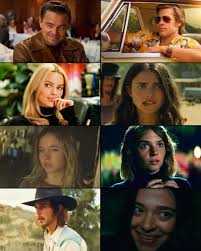
And then Tarantino performs a little miracle. And that’s all I’ll say.
I might not have seen this because I figured that with Charlie Manson at the center of the action, the director who gave us Reservoir Dogs and Kill Bill and – well, all his movies would make us suffer. But I ran into a friend on the street who had just come from seeing this: he raved about the film and then assured me that, extraordinary for Tarantino, it included almost no violence.
My friend was lying. But I will say this: the violence, when it comes, occurs at such an extraordinary moment in this narrative that it feels like a ritual cleansing!
On the sixth day of Christmas, my true love gave to me . . . six geese a-laying . . .
Lord knows that the film industry has made brilliant hay out of the tragedies and vicissitudes of war. Frankly, I have grown weary of war pictures; my excuse is that I know so well how horrible war is that I don’t need to watch any further evidence. But I am a fan of Christopher Nolan, and when he brought Dunkirk to us in 2017, I went along for the ride and found myself watching one of Nolan’s best films and one of the best cinematic depictions of wartime ever made.
I chose it for this day because of the geese. We have lots of geese in my neighborhood: taking a walk can be a challenge, both for the large flocks waddling across your path and for the voluminous amounts of, er, evidence, they leave behind. But they’re also beautiful when they all hop into the water and float away, or when they fly across the horizon in formation. Land, sea, and air, baby!

And that’s what Nolan does here: he tells us the story of the evacuation of Dunkirk through three perspectives: the week-long actions on the beach, the attempted support during one day of a rescue flotilla of every kind of boat, and a one-hour air battle. These separate aspects of the event are expertly merged in a non-linear narrative The Oscar-winning editing by Nolan stalwart Lee Smith is brilliant, as is the cinematography Hoyte van Hoytema, which was also nominated. (He went on to win the award working with Nolan on 2023’s Oppenheimer.)
I’m grateful that the film does not resort to chopping up everyone’s limbs, but it doesn’t shy away from the horrors of war either. And the massive cast is simply wonderful.
On the seventh day of Christmas, my true love gave to me . . . seven swans a-swimming . . .
Okay, we’ve gotten really intense here, so let me offer some relief – in the form of a gaggle of beautiful dames hacking away at each other! 1939’s The Women is one of those star-studded miracles that MGM made look easy. I’ve seen the 1936 play by Claire Boothe Luce, and it’s good. But it is made to sparkle with a brilliant adapted screenplay by Anita Loos and Jane Murfin and guided by director George Cukor, the best of the best when it came to working with female stars.
And what stars they are: from the moment the cast is introduced in the opening credits, each of them emerging from the image of various animals, this glorious cast is out for blood – or, rather, the chic nail polish known as Jungle Red. Norma Shearer is the heroine, Mary Haines, whose husband Stephen (never seen – no man is seen here) is carrying on with a not-so-common shopgirl, Crystal Allen (Joan Crawford, the absolutely perfect bitch). Given how noble Mary is and how obvious our Crystal, the whole thing might have blown over quickly. But Mary never counted on all her girlfriends to fan the gossip in such a way that Mary’s marriage would go down in flames.
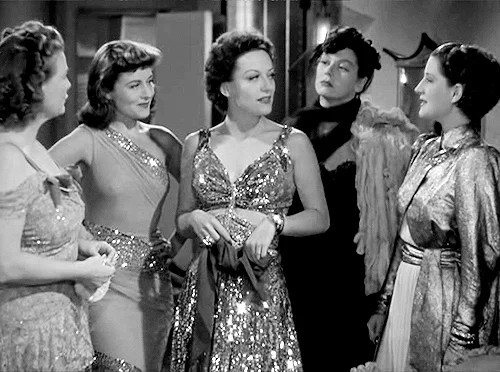
And it’s that fabulous entourage of females that makes the film, headed by Rosalind Russell in a masterpiece of a performance, and including Joan Fontaine, Mary Boland, Paulette Goddard, Phyllis Povah, Virginia Weidler and Marjorie Main. I’ve watched this film so many times that I think I know it by heart and still thrill to the second moment in 1939 when black and white cinematography switches to color – this time for a fashion show!
After the ravages of Nashville, Hollywood, and Dunkirk – you’re going to need this frothy cocktail of a film!
On the eighth day of Christmas, my true love gave to me . . . eight maids a-milking . . .
When you hear the word “milking” you probably think cows, but this theatre guy thinks “milking for laughs!” So how about one of the funniest movies ever made with one of the most brllliant ensembles of comic geniuses? Christopher Guest has made a bunch of them, but the one dearest to my heart is 1997’s Waiting for Guffman. It is a love letter to the theatre, from its title hearkening to Godot to its perfectly encapsulated pastiche of small town life, community theatre, and the classic “let’s put on a musical” trope.
The heart of the film is drama teacher and former Broadway has-been Corky Sherwood, played by Guest himself, who has been tasked by the City Council to put on a show celebrating the 150th anniversary of Blaine, Missouri. Corky is a theatrical legend in Blaine, where he literally burned down the house staging the musical version of Backdraft! Now he gathers his favorite actors, plus some surprising new talent, to create an original revue, Red, White, and Blaine. And the biggest thrill of all: Corky has invited a Broadway producer named Mort Guffman to fly down and see the show, with the chance that this will mark Corky’s return to the Great White Way!
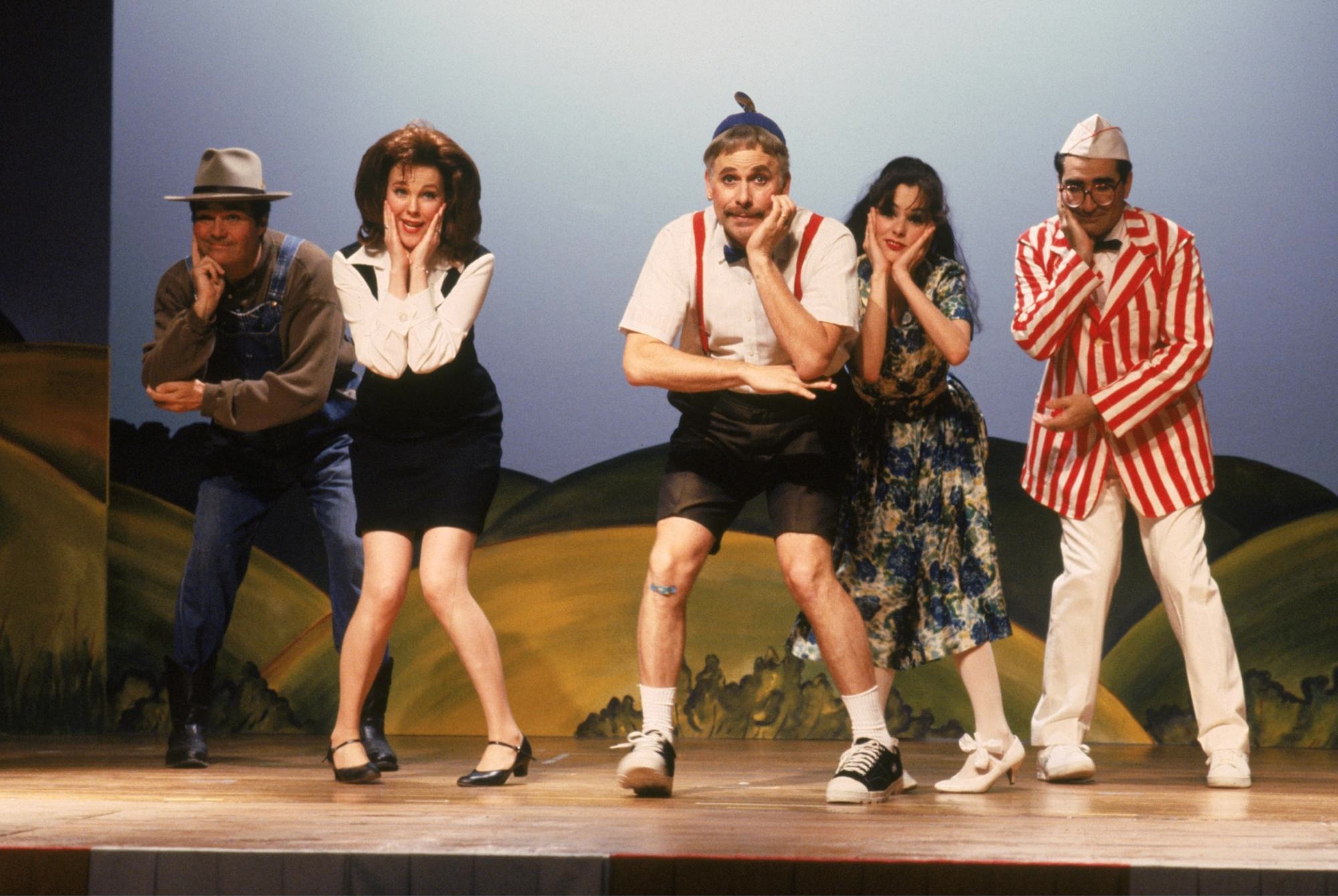
Everything that follows is hilarious, thanks to an ensemble that includes Catherine O’Hara, Fred Willard, Eugene Levy, Parker Posey, Bob Balaban and Michael Hitchcock. From auditions to opening (and closing) night, this film fills my heart with such joy that I can’t even . . .
Want a bonus? Guest’s follow-up mockumentary, Best in Show, is just as hilarious. All the actors above, in completely different roles, plus Jane Lynch and Jennifer Coolidge!! I recommend you double-bill it on the eighth day of Christmas!
On the ninth day of Christmas, my true love gave to me . . . nine ladies dancing . . .
I’m a sucker for the three films Busby Berkeley made in 1933. 42nd Street is the classic backstage musical, and Footlight Parade contains a brilliant star turn by James Cagney. But my favorite – and the most ensemble-like of the films – is Golddiggers of 1933, co-directed by Mervyn LeRoy. Made in the height of the Depression, the film is not afraid to turn its comic sights on the worst excesses of that period of our history.
The film focuses on four chorus girls (Joan Blondell, Ruby Keeler, Ginger Rogers and Aline MacMahon) who must scheme and sweat in lean times to help producer Barney Hopkins (Nat Sparks) put on a show. The new revue is guaranteed to be a success, thanks to the discovery of a brilliant young songwriter, Brad Roberts (Dick Powell). Unbenownst to the gang, however, Brad is actually a young millionaire whose older brother J. Lawrence Bradford (Warren William) is dead set against his brother being in the show business. Accompanied by his associate Faneuil Peabody (Guy Kibbee), Bradford sets out to separate Brad from the “cheap and vulgar” golddiggers who have him in their clutches. Fortunately, Blondell, Keeler, Rogers and MacMahon have other ideas.
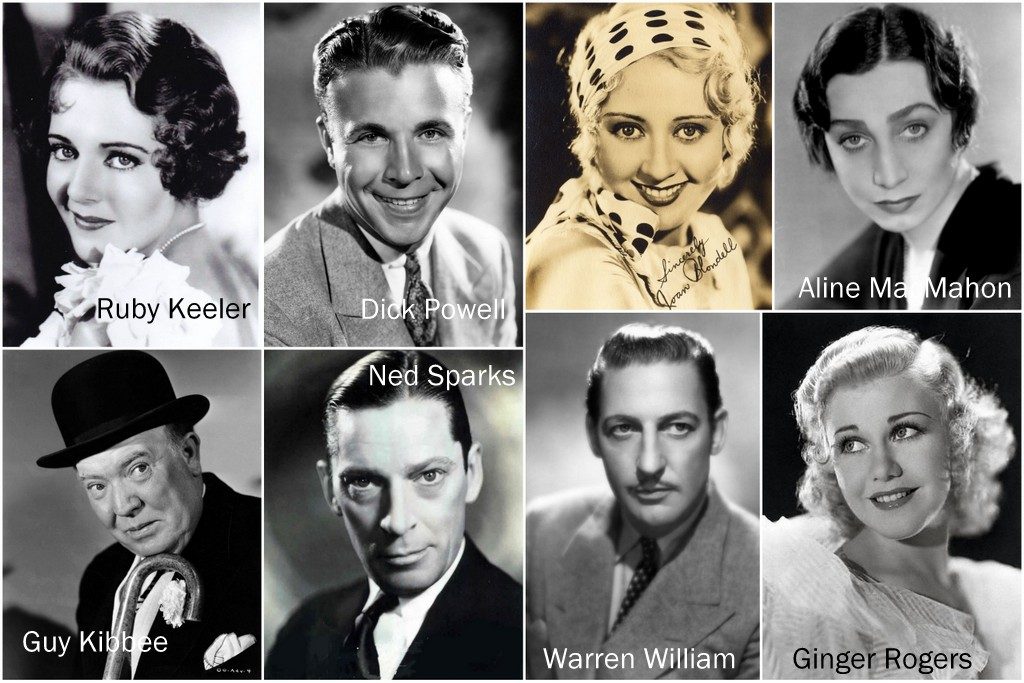
Every actor is at the top of their game. The dialogue, by Ben Marxson and David Boehm, crackles. The three big musical numbers showcase Berkeley’s epic imagination and spotlighted certain performers.“We’re in the Money” is Ginger Rogers’ show all the way, highlighted by her rendition of the song in pig latin. “Shadow Waltz” is the perfect Keeler/Powell love song on steroids. But the film’s highlight is its finale, “My Forgotten Man,” where Joan Blondell sets up the tragedy of our returning soldiers, and Etta Moten turns it into a mournful wail.
An alternative choice for seeing Ginger Rogers and other ladies dancing is Stage Door (1937), which rivals Golddiggers as a look into the seamier side of the show business and The Women for female star power. Besides Rogers, there’s Katharine Hepburn, Lucille Ball, Eve Arden, Gail Patrick, Constance Collier, and a 14-year-old Ann Miller!
On the tenth day of Christmas, my true love gave to me . . . ten lords a-leaping . . .
The leaping I’m thinking of comes at the very end (and has nothing to do with lords). But I couldn’t make up this list without including Magnolia, the 1999 roundelay of pain and forgiveness, written and directed by Paul Thomas Anderson. Jason Robards (in his final role), Julianne Moore, Tom Cruise, Philip Seymour Hoffman, John C. Reilly and William H. Macy head an enormous cast of mostly misfit people, uncomfortable in their success, burdened with issues of guilt and/or anger, all of whom simply want to find happiness.

The way Anderson weaves these people’s lives together is a staggering achievement in itself. The way he sustains suspense and summons our empathy even for the most repellent of these characters is brilliantly done. It has been too long since I’ve sat down and watched this one. As dark as it gets, it ends in a burst of . . . well, I won’t tell you, but it’s an act of God that brings about a hope of redemption that is perfect for Christmas.
On the eleventh day of Christmas, my true love gave to me . . . eleven piper’s piping . . .
Do you know what we need for our penultimate viewing? A corking good murder mystery, that’s what! And there can be no better choice than 1978’s Death on the Nile. Hercule Poirot (Peter Ustinov) is en vacance; his friend Colonel Race (David Niven) is undercover. They meet cute at a luxury hotel in Egypt and then sail down the Nile where they encounter the eleven “pipers” whose interactions will lead to the deaths of five people!!
At the center of it all is the dramatic romantic triangle of sleek millionairess Linnet Doyle (Lois Chiles), her scrumptious new husband Simon (Simon MacCorkindale) and his spurned lover Jackie (Mia Farrow). Around them swirl eight magnificent suspects, none of whom thinks much of the high and mighty Mrs. Doyle. But who killed her? Her maid? Her attorney? The covetous American lady with the caustic companion? The drunken romance novelist and her daughter? The Communist? Or the controversial doctor?
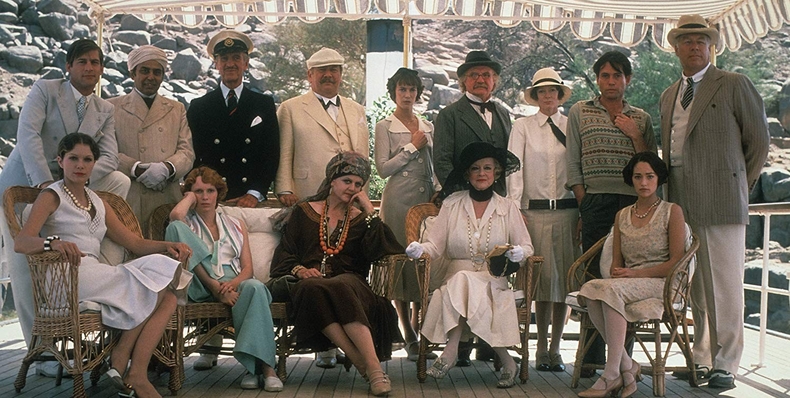
The mystery is rendered beautifully (and is probably as faithful to the novel as we’re ever going to get). But it’s the performances that make this film sing, particularly the work by classic divas Bette Davis, Angela Lansbury, and Maggie Smith. Sit down with a blanket drawn over your knees, make yourself a Golden Sepic, and watch this movie again and again till you can recite every bon mot these characters utter. You won’t regret it.
On the twelfth day of Christmas, my true love gave to me . . . twelve drummers drumming . . .
We end our twelve-day ensemble marathon as we began it – with a trip into classic cinema. One of my favorite auteurs is Sidney Lumet, a true actor’s director. He came out of the gate running with his debut film, 1957’s 12 Angry Men. Based on a 1954 teleplay that Reginald Rose wrote for the series Studio One, the film uses the jury deliberations during a sordid little murder trial of a young boy of color to expose the fractures within American society. Sure, each juror is a little too on-the-nose as a representation of some sector of our country: the business hotshot, the immigrant, the bigot, the elderly. But Lumet garners such amazing performances out of each of his actors that these characters spring to life before us. Henry Fonda has never been finer, and his whittling down, one by one, of eleven of his fellow men who walked into the jury room without an understanding of their responsibility as American individuals makes for gripping drama.

So go ahead: queue up your set! Grab a handful of those old DVDs. Scour the streaming services or check your library – but watch these films! I guarantee that by the end of your journey, you will be fully imbued with the spirit of Christmas. Or Hanukkah. Or Kwanzaa! Just get watching!
Happy Holidays from me to you!
 Ah Sweet Mystery!
Merry Christmas Brad! I’ve enjoyed this year’s articles. Although I’ve seen only a few on your Christmas list, I will now have to watch the rest. Have a great holiday and an excellent New Year.
LikeLiked by 1 person
The same to you!
LikeLiked by 1 person
Not seen GUFFMAN and have always found NAGNOLIA overbearing and overly indebted to Altman’s superior, SHORT CUTS. But this is a magnificent bunch of films, Brad. Thanks chum. Hope you are having a great Christmas.
LikeLike
That was “MAGNOLIA,” honest …
LikeLike
A good list of movies from across the decades and the style of making films. Hope you are having a great holiday season.
LikeLike