“To all the English-language readers, I hope you enjoy it slowly to the end. Or perhaps better to say, enjoy it at your own pace. Since time is indeed something precious to us all.” (author Masateru Konishi on his new novel)
Time is indeed precious, and while in many ways this has felt like the longest year in my memory, it has still rushed by, as years tend to do. And during 2025 fans of Japanese honkaku and shin honkaku mysteries have had much to celebrate! The translation game is in full swing, and the number of newly available titles keeps increasing. Thanks go to Pushkin Vertigo, the publishing house at the center of this “Mill House”, but it’s the translators who I would like to thank, especially Louise Heal Kawai, Brian Karetnyk, and Ho-Ling Wong. English-speaking readers almost can’t keep up with all the new titles being made available thanks to your talent and hard work.
It’s certainly not due to the translators that my experience with honkaku this year has been mixed, and so when Louise announced on social media that her latest effort would be coming out in December, I decided to take a chance and make it my final read of the year.
Masateru Konishi has made a name for himself in Japan as a playwright, TV screenwriter, and creator of manga. His first novel, My Grandfather, the Master Detective, debuted in 2023, and if it doesn’t become a manga or TV series in the near future, I’ll eat my hat, karaage-style. Certainly it contains the attributes of a traditional honkaku novel: it presupposes a world where classic mysteries are a guiding principle of what we read and how we solve life’s problems. There are plenty of references to the Masters: to Poe and Christie, Queen and Carr and Chesterton, with nods to the classic Japanese authors like Yokomizo and Edogawa Rampo.
But Grandfather is something else: if shin honkaku authors are playing around with hybrid books (mystery/horror, mystery/science fiction, mystery/fantasy), then Masateru has created a cross between a genre work and one of those delicate modern Japanese novels that celebrate man’s relationship to his fellow man, to nature, to his culture, and to the essential joy of reading.
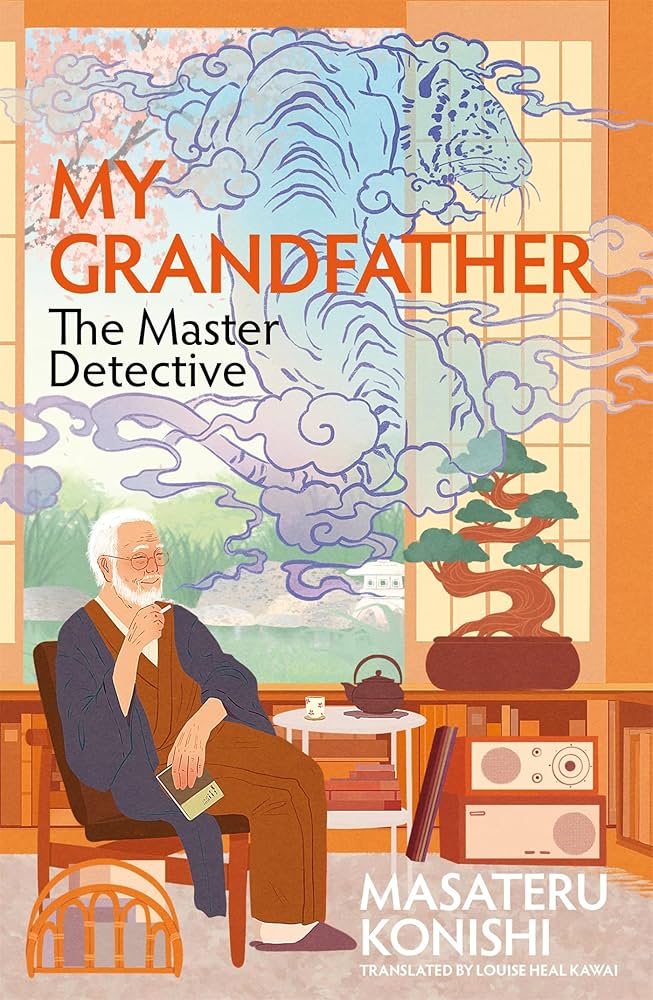
The heroine of our story is Kaede, a shy but good-hearted primary schoolteacher whose favorite person in the world is her Grandfather. He spent his career as a school principal, not as a petty bureaucrat but as one of those special educators who know every child by their name and interests and who spends his days taking care of his students, staff and school grounds. (His nickname was “Principal Window Wiper.”) Grandfather has always been a mystery fan as well; in fact, he once belonged to a mystery club that included among its membership several famous authors. He has instilled in his granddaughter a deep love for the genre, and for stories, in general, engaging in a persistent exercise where he encourages Kaede to make stories out of the world she observes around her.
It’s a beautifully rendered relationship, made all the more poignant by Grandfather’s recent diagnosis with early onset Lewy Body Dementia, a disease characterized by progressive physical disabilities akin to Parkinson’s, as well as hallucinations that leave the sufferer confused. Kaede takes every opportunity to visit the old man and bring him stories to distract him from his ever more alarming symptoms. And since this is a shin honkaku novel, what are the odds that these stories will be of the mysterious variety?
The cases that Kaede brings to her Grandpa to solve draw their inspiration from the Golden Age mysteries we have all read and loved: a locked room mystery set in a local restaurant reminds us of Carr; a woman who dives into the primary school swimming pool and disappears brings back Van Dine and Carter Dickson; a classroom that seems to be haunted by the ghost of a young girl hearkens back to Chesterton. Kaede comes across these cases through colleagues and friends and potential boyfriends, records the information they share, sometimes even draws a helpful map of the scene of the crime, and then scurries to her Grandfather, who lights up a Gauloises and proceeds to think. Ironically, he is often assisted in his deliberations by the hallucinations that plague him, allowing him to utilize what he calls his “little scarlet cells.”
The solutions to these cases are not particularly complex, but they are clever, and what I love about them is how Masateru pulls as much from popular culture as from the old Masters. So, yes, expect references to Harry Kemelman and Gaston Leroux and even Seishi Yokomizo. But inspiration also springs from riddle stories like Frank L. Stockton’s “The Lady or the Tiger” – the final pages comprise a riddle story that will have Christie fans smiling – from Harry Potter, even from World Wide Wrestling! Sometimes Grandfather lays out a clever and rather sordid explanation of a problem, but then puffs on his Gauloises and announces, “Kaede, I’m sorry. The tale I’ve woven was not the optimal solution,” – and then comes up with a completely different solution.
Not only are the constant references great fun, but the discussions around the authors and stories are fascinating. One of Kaede’s two beaus in the tale, a rather pig-headed actor named Shiki, is fond of baiting Kaede for her love of the Golden Age authors. At one point he complains about how outdated and stereotypical the plots, setting and characters are of “those translated classic locked-room mysteries” – and then he adds this about the names:
“It’s a total drag to try and keep the full names of every member of the ‘Fortescue family’ straight in your head. When Imhotep’s daughter, ‘Renisenb,’ makes an appearance, it just doesn’t stick. The more elaborate the name, the more artificial the whole thing feels. And instead of giving them some complicated surname, why don’t they just stick to given names, or even nicknames? Or better still, how about just using ‘Grandmother’ or ‘Brother’ and leave it at that?”
Shiki, buddy, I get what you’re saying – and I love that you referenced two Christie novels to make your point! I feel exactly the same way . . . about the mysteries I read translated from the Japanese!!! Interestingly, Masateru follows Shiki’s advice. Few of the characters are given names; instead, they are introduced to us through nicknames and professions. This made things easier for me to follow, and I didn’t even need a cast of characters at the start of the novel to keep people straight!
When Shiki isn’t complaining – or even when he is, because he’s always complaining! – he engages both Kaede and his old schoolmate (and rival beau) Iwata in great conversations. His reasoning concerning “The Lady or the Tiger?” made it all but certain which door the hero opens at story’s end. And Shiki’s comparison of the vast similarities between classic detective fiction and professional wrestling made me want to turn in to the WWF channel and become a fan!
The final two cases mark a turn in the narrative. In “The Phantom Lady,” one of Kaede’s closest friends interrupts a murder attempt and finds himself arrested and under suspicion. The need to find the “phantom woman” who can prove his innocence comes straight out of Cornell Woolrich’s novel of the same name. And in the final tale, “The Riddle of the Stalker,” Kaede’s own troubled past comes back to haunt her, putting her and her grandfather in mortal danger.
My Grandfather, the Master Detective may not be for everyone. There are no Rube Goldberg-like devices, no families in extremis, no cursed villages or insane relations committing a string of bloody murders. Yet there are murders and other crimes, and I can promise you one nasty psychopath hiding in plain sight! For the most part, however, this book is heartwarming and funny. Sometimes Grandfather’s “logic” seems like wild guesswork, but I didn’t really mind that at all. I was too caught up in the relationships between family members and between friends, as well as whatever semblance of modern Japanese culture the narrative represented. Consider this the most satisfying honkaku mystery I’ve read all year!
 Ah Sweet Mystery!
“Sometimes Grandfather’s “logic” seems like wild guesswork, but I didn’t really mind that at all.”
Ellery Queen fan, ain’tcha?
LikeLike
Pingback: Books I Received at Christmas – crossexaminingcrime
Pingback: My Grandfather: The Master Detective (2023; 2025) by Masateru Konishi [Trans. Louise Heal Kawai] – crossexaminingcrime