It’s England, 1933, and Bertie Carroll is one of the most successful playwrights on the West End, with stage hits like Witness for the Defense, The Hollow Mousetrap, and And Now They Were Zero. Okay, I made those titles up, but you get the point: Bertie writes mystery plays, and he’s a hot ticket – just like what would happen to a certain mystery writer we know when she really set her sights on the stage in the 1940’s! But Bertie is not one to have a swelled head: he makes the journey to Brighton (in the rainy off-season, no less) to support his old school chum, producer-director Arthur Cochran, as he presents a short run of one of Bertie’s early lesser efforts, Murder by Association.
The cast is small: rising star Teddy Howard is playing the male lead, local talent Jenny Ashcroft is the ingenue, and veteran bit player Robert Loughton is the butler (whom Bertie would like everyone to know did not do it, as the playwright would never stoop to such a cliché!) But the real draw is the leading lady, Celia Hamilton, who was once married to Arthur Cochran until she crossed the Atlantic to begin a career in Hollywood films.

Anyway, she used to be big, but now Celia is trying to segue from a fading career in film back onto the stage. She has agreed to star in her ex-husband’s small-town production in the belief that it will eventually make its way to London. Until then, Celia is practicing what stage stars have been doing practically since murder mysteries were invented: she is being a raving bitch and making everyone’s life miserable, including her fellow actors, poor Charlie, the stage manager, and Constance, Celia’s dresser, who doubles as a maid in the play.
The script calls for Celia to be shot to death. If only she had read Enter a Murderer by Ngaio Marsh, or Cue for Murder by Helen McCloy, or Come to Paddington Fair by Derek Smith, or . . . well, you get the gist – if only Celia had done her reading, she might have been nicer to everyone before opening night because when the gun is fired, and Celia falls . . . she falls for good! Fortunately, Bertie, thoughtful creator of stage mysteries, is in the audience, and he has brought with him another old school chum, Hugh Chapman, who happens to be a detective with Scotland Yard! Can these two put their heads together and solve this death on the pier?
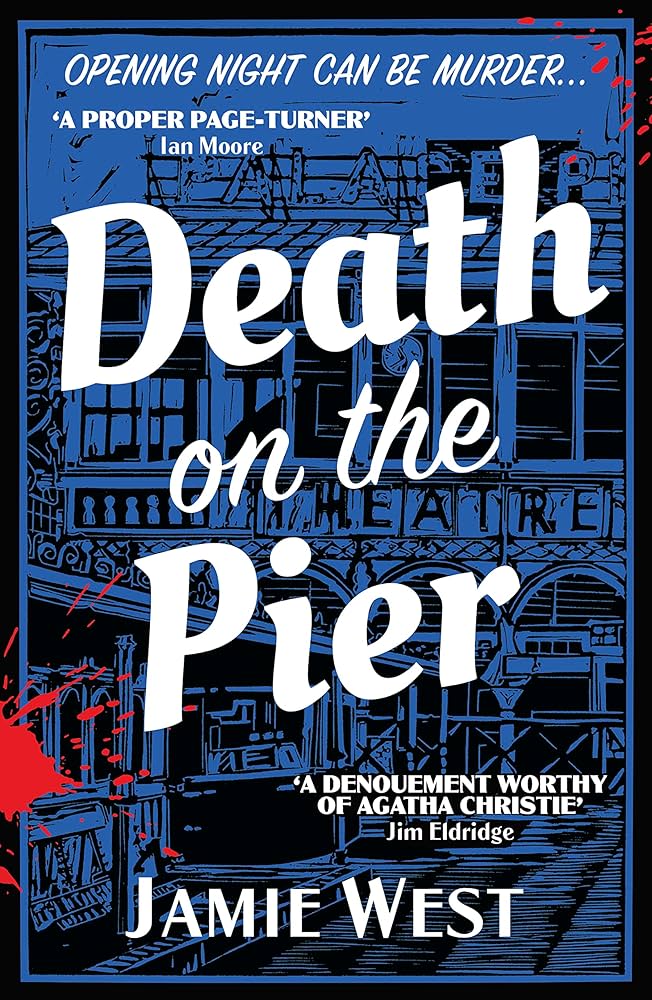
Two years ago, I had the pleasure of being on an episode of All About Agatha with author Jamie West and director Chris Diehl to speak with our host, Kemper Donovan, on the topic of staging an Agatha Christie play. Chris produces and directs down in Southern California, and I have been doing my thing up here in the north. Jamie was the exotic one, an actual British theatre techie working in London’s West End on such productions as Dear Evan Hansen and Hamilton. He had also written one book, Death on the Pier, and was about to come out with a second, Murder at the Matinee.
I bought both titles pretty quickly, but the mill of Brad’s TBR pile grinds slowly, and it has taken me a while to get to Jamie’s first. Granted, the initial set-up he gives us is a tried and true staple of classic theatre mysteries, but it is enlivened by Bertie Carroll himself, an unpretentious and nice fellow who is not bedazzled by his success. Bertie also happens to be gay, which was still sadly a tricky part of oneself to navigate in 1930’s England. And in Hugh he has found a sympathetic friend and, perhaps, something more . . . ? It may take a few more cases to find out!
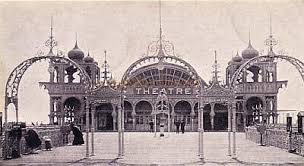
Jamie immerses himself in the architecture and technical aspects of the Palace Pier Theatre, an actual real-life place with a history that is, in itself, somewhat mysterious. (Read the notes at the end of the book!) The circle of suspects is small but well-characterized, and the author has clearly been reading his Christie in his efforts to drop clues within the text. Perhaps it was to my disadvantage that I have worked so long in the theatre because, at least here, nothing fooled me.
I’m not that brilliant an armchair detective, but once in a while this happens to me that I just click with the killer’s plan as it’s happening and I can’t be dissuaded from seeing the light! This happens even with the classics – They Do It with Mirrors, Calamity Town, The Emperor’s Snuff-Box – so Jamie shouldn’t feel bad if this old stage-monkey figured things out. Certain of my own experiences as a theatre person helped me out (no, folks, no murders here, I promise!) Still, it’s a clever mystery, and Bertie and Hugh are great company for whom I’m rooting to find some happiness together. And I’m looking forward to being stumped by Murder at the Matinee and whatever new Bertie Carroll cases are on the horizon.
 Ah Sweet Mystery!