“’Deduce, Poirot, from the following facts! Here is a young lady, richly dressed – fashionable hat, magnificent furs. She is coming along slowly, looking up at the houses as she goes. Unknown to her, she is being shadowed by three men and a middle-aged woman. They have just been joined by an errand boy, who points after the girl, gesticulating as he does so. What drama is this being played? Is the girl a crook, and are the shadowers detectives preparing to arrest her? Or are they the scoundrels, and are they planning to attack an innocent victim? What does the great detective say?’
“’As usual, your facts are tinged with your incurable romanticism. That is Miss Mary Marvell, the film star. She is being followed by a bevy of admirers who have recognized her. And, en passant, my dear Hastings, she is quite aware of the fact!”
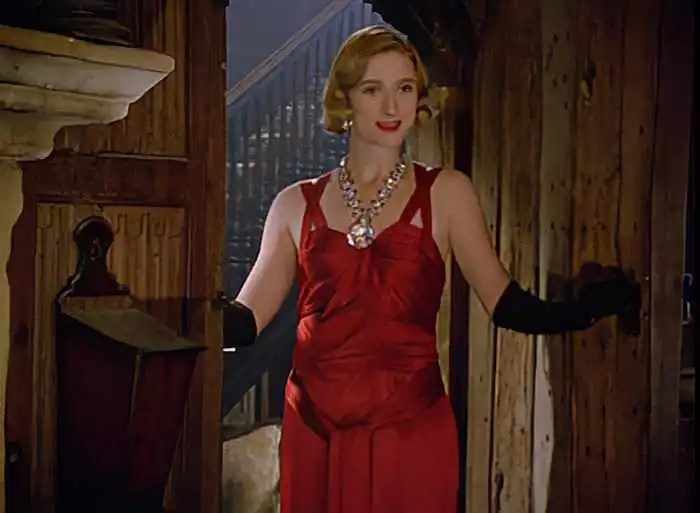
Not every character in an Agatha Christie story makes a dramatic entrance – but actors do. Mary Marvell first appeared, as if out of a Sherlock Holmes tale, in the April 1923 story, “The Adventure of the Western Star” as a victim of theft and other perfidies. She was referred to Poirot by Lord Cronshaw, whose nephew had been murdered a month earlier, in the March 1923 tale, “The Affair at the Victory Ball,” where actors also figured prominently – one of them much more nefariously.
After she became a playwright, Agatha enjoyed warm relationships with many of the actors with whom she worked, people like Richard Attenborough and his wife Sheila Sim (the original Sergeant Trotter and Mollie Ralston in The Mousetrap) and Francis Sullivan, who starred in several Christie productions, including Black Coffee (returning as Poirot after playing the role on tour in Alibi), Peril at End House (as Poirot), Murder on the Nile (as Canon Pennefather), and Witness for the Prosecution (as Sir Wilfred Robarts, which earned him a Tony Award in 1955).
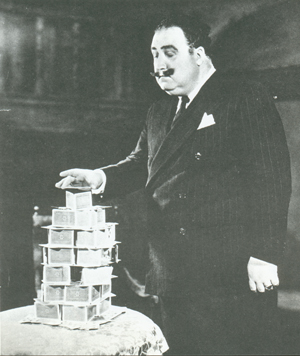
As she describes in her autobiography, Christie would go down to Sullivan’s house in Haslemere and swim. “I always found it restful to stay with actors in wartime, because to them, acting and the theatrical world were the real world, any other world was not. The war to them was a long, drawn-out nightmare that prevented them from going on with their own lives in the proper way, so their entire talk was of theatrical people, theatrical things, what was going on in the theatrical world . . . it was wonderfully refreshing.”
Despite her professional experience, Christie never set one of her books wholly in the theatre. Perhaps she had too much respect for the work undertaken by her thespian friends on behalf of her own plays to offer a personal take on the tired tropes of imperious stars, jealous understudies, and the prop gun loaded with real bullets. This didn’t stop her from utilizing theatrical characters in her books just as she would any profession: as suspects, murderers, and victims. She had great fun with their larger-than-life personalities, their physicality and creativity, their egoism and ruthlessness. Let’s face it: these qualities are a great deal more fun than the dry preciseness of a solicitor or the efficiency of a nurse – although Christie made equally effective use of these professions.
One of Agatha’s greatest gifts as a mystery writer was her ability to foresee and manipulate reader expectations; thus, our star-struck beliefs of what actors were like could be used against us in the game of murder that Christie played. For her longtime fans, I suggest that this effect was cumulative. On the podcast All About Agatha, every time an actor appeared in the narrative – or a suspect mentioned experience in amateur theatricals – the podcast hosts, Catherine and Kemper, would sound an alarm, an excellent reminder of how Christie trained us to respond in a certain way to the actors in her books, although the – excuse the pun – role they played in the plot was as varied as the characters on an actor’s resume!
Let’s look, then, at the intriguing way Christie incorporated dramatic elements through the very people who practiced it. Sometimes, as when the actor played the role of killer, the puzzle plots were steeped in theatricality. In the examples I’ve chosen where an actor is the victim or a mere suspect, Christie is more subtle, playing upon our expectations about these characters to intrigue and surprise us. Note that we’re about to head into MAJOR SPOILER territory, and you will better appreciate what follows here and in our next post if you have already read these titles: Lord Edgware Dies (1933), Murder on the Orient Express (1934), Three-Act Tragedy (1935), the Poirot short story “Problem at Sea” (1936), Evil Under the Sun (1941), The Hollow (1946), and The Mirror Crack’d from Side to Side (1962).
* * * * *
THE SUSPECT
Actors don’t have to be guilty – or dead – to enliven a Christie tale. Agatha was fond of inserting a member of the acting profession into some of her more stolid family mysteries, including Veronica Cray in The Hollow, Magda West in Crooked House, and Rosamund and Michael Shane in After the Funeral. All of them make for juicy red herrings and provide dramatic color and even humor whenever they appear. Let’s make a deeper examination of one of them, Veronica Cray, whose presence in 1946’s The Hollow has a charged effect on the overall novel. She makes her entrance in the middle of Chapter Eight:
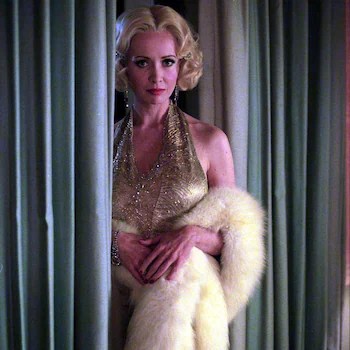
“And then, dramatically, unexpectedly, with the unreality of a stage entrance, Veronica Cray came through the window!The French windows had been pushed to, not closed, for the evening was warm. Veronica pushed them wide, came through them, and stood there, framed against the night, smiling, a little rueful, holy charming, waiting, just that infinitesimal moment before speaking, so that she might be sure of her audience.”
In the closed circle of country squires and city professionals inhabiting this novel, Veronica sticks out like a sore thumb, albeit a fabulously plastered one. I confess that when I first read The Hollow, this struck me as a flaw. In the Angkatell family and their hangers-on, Agatha has crafted one of her most indelible casts, each of them grounded in reality and bursting with inner life. The finest twists in this story stem not from the puzzle plot, which is arguably one of Christie’s most simple, but in the actions and reactions of the characters from the opening to the devastating final page.
Veronica Cray stands apart from all of this. She feels like a construct from an earlier era of Christie’s writing, a walking assemblage of theatrical cliches. There is nothing real about her, an impression that Veronica takes great pains herself to present from the moment she first appears. Unlike the other women, we are never given a glimpse inside her mind but watch her play a variety of roles throughout the novel in order to get what she needs. First the glamorous movie star in need of both a box of matches and a chance to contrast her glamor with the dowdiness of country dwellers. Then the temptress, longing to ensnare her old love, John Christow. Then, in front of the police, she becomes “an exceedingly good-looking, expensively dressed woman who is also a good businesswoman.” She flashes her “camera smile” and proves that she is “no fool.”
It’s difficult, frankly, to take Veronica seriously as a suspect. Her more important function here is as an outsider and a catalyst. Before she arrives, we are introduced to a circle of people in a state of emotional stasis: everyone seems to have found a way of accepting the obstacles that prevent them from achieving happiness. John is not fully satisfied with either of the female relationships in his life, but he has his work to preoccupy him. Neither Henrietta nor Gerda can have John entirely, but Henrietta has her art, and Gerda has the wifely title, the home, and the children. Edward pines for Henrietta, Midge pines for Edward, and David hates everyone (because he is a teenager and that’s what they do.) Lucy and Henry are perfectly content to enjoy their lives and worry about the younger folk, but they will also protect their loved ones in any way they can. All in all, it sounds like a normal family.
With her grand entrance, Veronica interrupts and shatters this stasis. She displaces Gerda as the outsider of the family, causing the Angkatells to move past their forbearance of Gerda’s gaucheries and insecurities and form a protective shield around her after John’s death. Now it’s Veronica whom everyone “wishes” had done the murder, the one suspect whom nobody would lift a finger to help. She caused this tragedy; she should get what’s coming to her.
But Veronica’s presence provides a more intriguing contrast than the intrusion of Hollywood glamor into a country estate. Before the murder, every appearance she makes has the aura of a staged scene, as opposed to the thoughtful conversations and inner monologues through which Christie has introduced all the other characters. Her cool surface personality stands in sharp relief against Henrietta’s intellectual superiority and creative spirit, or Gerda’s neurotic fears. After the murder, however, the roles are reversed, and the source of “theatricality” comes from everyone but Veronica.
Hercule Poirot signals this transformation himself with his first entrance in Chapter Eleven. Oddly, he has chosen the countryside for an extended vacation and has been invited to lunch with his neighbors at the Hollow. He selects a costume that will clearly identify the role he is to play here: “He knew well enough the kind of clothes that were worn in the country on a Sunday in England, but he did not choose to conform to English ideas. He preferred his own standards of urban smartness. He was not an English country gentleman, and he would not dress like an English country gentleman. He was Hercule Poirot!”
His physical entrance takes nearly three pages of walking, but when he finally comes upon the family at the swimming pool, Christie imbues the moment with a telling theatricality that she allows both Poirot and the reader to misinterpret:
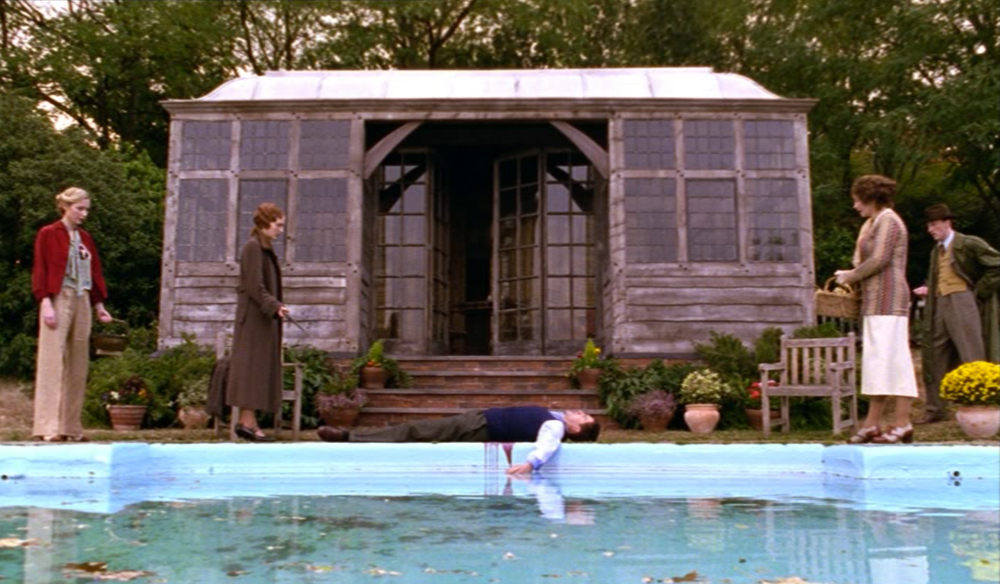
“. . . what he was looking at was a highly artificial murder scene. By the side of the pool was the body, artistically arranged with an outflung arm, and even some red paint dripping gently over the edge of the concrete into the pool. It was a spectacular body, that of a handsome, fair-haired man. Standing over the body, revolver in hand, was a woman, a short, powerfully built, middle-aged woman with a curiously blank expression. And there were three other actors . . . It was clear to Poirot that several different paths converged here at the swimming pool, and that these people had each arrive by a different path. It was all very mathematical and artificial.”
Poirot misinterprets the artificiality of the scene to mean that the man lying by the pool isn’t dying. This gives the reader a rare sense of superiority over the sleuth, as we have already witnessed John Christow being shot. Perhaps we shouldn’t be so smug, for what we don’t notice – and what Poirot already has a glimmer of – is that these people are enacting a scene. It is brilliantly improvised, but the Angkatells have made a pact to honor John’s dying wish and protect his killer from harm. This isn’t the broad sort of acting mastered by the likes of Veronica Cray, and so we may not be aware of it for a while. But Poirot, cleverer than the rest of us, will not be fooled.
* * * * *
THE VICTIM
If the presence of an actor as a suspect imbues a Christie plot with theatricality, consider the result when an actor becomes the victim. Halfway through the first chapter of 1941’s Evil Under the Sun, Arlena Stuart Marshall makes her entrance:
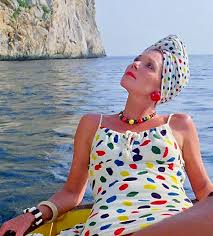
“It was then that a woman came down past them from the hotel to the beach. Her arrival had all the importance of a stage entrance. Moreover, she walked as though she knew it. There was no self-consciousness apparent. It would seem that she was too used to the invariable effect her presence produced. She was tall and slender. She wore a simple backless white bathing dress, and every inch of her exposed body was tanned a beautiful even shade of bronze. She was as perfect as a statue. Her hair was a rich flaming auburn curling richly and intimately into her neck. Her face had that slight hardness which is seen when thirty years have come and gone, but the whole effect of her was one of youth – of superb and triumphant vitality . . .There was that about her, which made every other woman on the beach seem faded and insignificant. And with equal inevitability, the eye of every male present was drawn and riveted on her.”
This description is one of the most brilliant character tricks Christie ever devised. It invites us not so much to know all about Arlena as to assume we know all about her. Her self-assurance, her beauty and allure, marred only by “that slight hardness” that comes with middle age, a flaw over which she triumphs (“the whole effect of her was one of youth”), the way she draws attention and dominates the scene. Clearly, this is a manipulator, completely in control of the effect of her entrance, and a predator who causes all men to look at her and all women to fade away. Rosamond Darnley calls her “a man-eating tiger,” says she’s no good to her husband or step-daughter, and predicts that she will destroy the Redferns’ marriage. Emily Brewster likens her to the “type of woman who likes smashing up homes.” Major Barry is reminded of another woman out in Simla, a married temptress who enjoyed driving other married men mad.” And the Reverend Stephen Lane calls her a menace, “evil through and through.”
Admittedly, Arlena’s outward behavior leans into these descriptions. Her bronzed, exposed body and artfully arranged flaming auburn hair is meant to attract; she even makes Poirot’s mustaches “quiver appreciatively!” She hasn’t the emotional make-up to be a quietly devoted wife or stepmother, and she doesn’t discourage Patrick Redfern’s attentions. Her actual appearances on the page are brief, and most of what we learn about her comes from the biased opinions of those around her. We are given no chance to see whether she is insecure or worried about her age or even lonely. Is it any wonder we cast her in the role of villainess long before she is murdered? Perhaps we even consider that she deserves to be this novel’s victim.
As it turns out, Arlena is playing a role, albeit one she has practiced so thoroughly throughout her professional life that it has become natural to her. She exudes beauty and confidence because it draws people to her, appeals initially to some of the more innocent ones, like Kenneth Marshall, and repels others, like the near-maniacal Reverend Lane. It also attracts a series of cads, who recognize her neediness under the falsely confident exterior, take physical and financial advantage of her, then abandon her.
Thus, Arlena is not a maneater but one who is herself devoured by a pair of monsters who go by the name of Patrick and Christine Redfern. Patrick is a serial murderer – Poirot calls him “a killer for pleasure and for profit.” Part of the way Poirot identifies the Redferns is by recognizing the pattern of their scheme and finding a past death, the murder of Alice Corrigan, that conforms to this pattern. In comparing that past crime to the one on Smugglers’ Island, however, we find some telling differences that speak to why Arlena Marshall’s murder is at the forefront of the plot. Alice Corrigan was a housewife. She is murdered by her husband, Edward, who provides himself with an alibi through his accomplice, a respected games mistress at the local school, who pretends to find Alice’s body and reports her murder while Edward is miles away, travelling on a train.
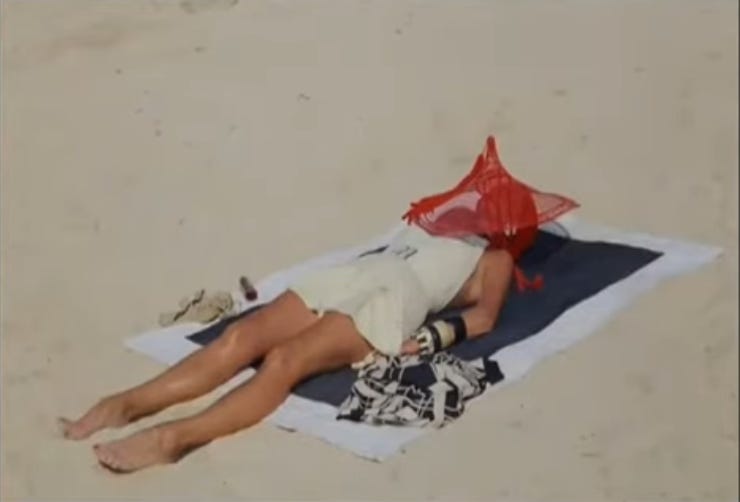
The murder of Arlena Marshall is much more theatrical, as befits the victim. Both Patrick and Christine must indulge in actual role-playing for this crime. Patrick plays the besotted swain/unfaithful husband and then feigns grief in front of Emily Brewster in order to convince his dupe that “Arlena” is dead. Christine, who actually is a robust games mistress, has the harder task of appearing frail and insecure; then, in order to provide Patrick with an alibi, Christine must become Arlena’s understudy, playing the role of Arlena by applying stain to her pale exposed body, knocking out the actress, and switching bathing garments.
From Arlena’s first entrance, Christie has introduced the element of theatricality into the proceedings. However, she misleads us into thinking we know from where that element originates. Through the use of costume and role-playing, Patrick and Christine Redfern and Arlena all contribute to her death and to the fallacies of the circumstances surrounding her murder that hoodwink the reader. But if Christie can instill theatricality into her puzzle plots by placing an actor in the role of suspect or victim, can you imagine how it works when an actor is the murderer? That’s what we will tackle next – appropriately, on the Ides of March!
 Ah Sweet Mystery!
I am really looking forward to this book!
LikeLiked by 1 person