“She was such a beautiful creature. She had such a wonderful gift. She had a great power of love and hate, but no stability. That’s what’s so sad for anyone, to be born with no stability. She couldn’t let the past go, and she could never see the future as it really was, only as she imagined it to be. She was a great actress, and a beautiful and very unhappy woman. What a wonderful Mary, Queen of Scots she was! I shall never forget her.”
Up to a point, Jason Rudd’s ode to his wife, Marina Gregg, in 1962’s The Mirror Crack’d from Side to Side, could describe the real-life actress Gene Tierney: beautiful, gifted – replace Mary, Queen of Scots with Laura or Leave Her to Heaven – and lacking in stability. (She battled manic-depression all her life.) Tierney achieved stardom in her early 20’s, married famous designer Oleg Cassini, and dreamed of having a family with him. At 22, she became pregnant, and after filming Heaven Can Wait for Ernst Lubitch (the first time she received top billing), she planned to go on maternity leave and join her husband in Kansas where he was stationed in the Army. But first Tierney decided to do one more favor for her fans: like many other actors during the war, she went to the Hollywood Canteen and mingled with the enlisted men and women, nurses and other fans.
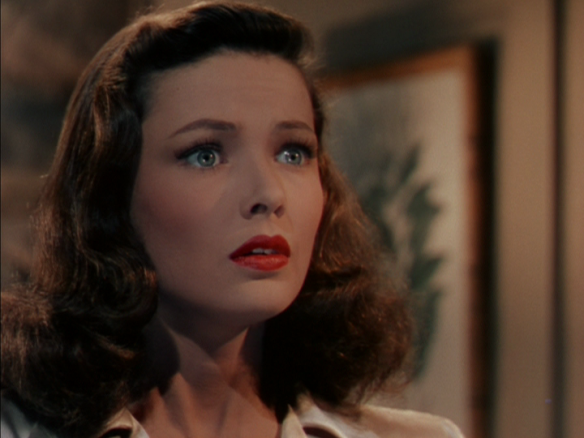
What happened is not theatrical, just tragic: Tierney contracted German measles, and her daughter Daria was born with severe and irreversible damage to her brain and body. At the age of two, the Cassinis placed their child in an institution for the specially disabled, and she remained in care until her death in 2010. This happened before the public became aware on the effects of measles on pregnancy and twenty-two years before the development of a measles vaccine. It was a tragedy that unfortunately gave too many women a reason to identify and commiserate with Gene Tierney.
The extraordinary plot point of this story occurred two years after Daria was born. Tierney was attending a tennis function when a a gushing fan came up to her and told her they had met before: when she was enlisted in the Marine Corp, the woman had gone to the Hollywood Canteen for the purpose of meeting one of her favorite actresses; in fact, she had broken quarantine in order to meet Tierney. “By the way,” she asked the actress, “did you happen to catch the German Measles after that night I saw you at the Canteen?”
“She never knew how, or when or from whom she had contracted the disease . . . until one afternoon when a perfectly strange woman came up those stairs and told her the fact – told her, what was more – with a great deal of pleasure! With an air of being proud of what she’d done! She thought she’d been resourceful and brave and shown a lot of spirit in getting up from her bed . . . It’s a thing she has boasted of all through her life.”
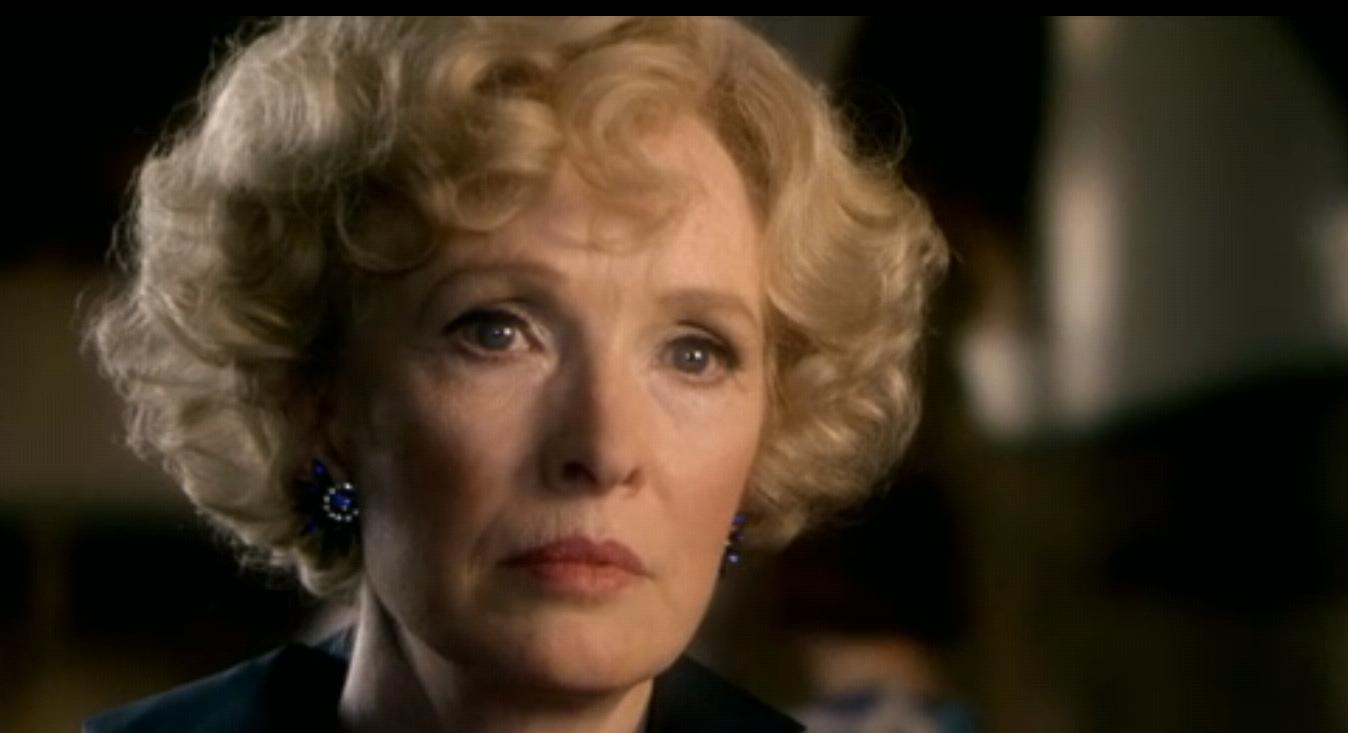
In its page on The Mirror Crack’d from Side to Side, the Agatha Christie website (agathachristie.com) includes this observation: “The plot was inspired by Agatha Christie’s reflections on a mother’s feelings for a child born with disabilities and there can be little doubt that Christie was influenced by the real-life tragedy of American actress Gene Tierney.” I have no doubt that this is true. As an author, Christie must also have realized the dramatic power of that scene between the two women, for it becomes the central moment in the novel – and in every film adaptation. As Heather Badcock prattles on, Marina Gregg’s face becomes focused over her shoulder and a frozen look appears on her face. “The curse is come upon me,” writes Tennyson about the woman in the poem from which Christie took her title. In typical Christie fashion, she cleverly inserts a clue by having Dolly Bantry misquote the poem: “The doom is come upon me.” Heather’s oft-repeated story has sealed the doom of both these women.
The Mirror Crack’d from Side to Side is a hardly a detective story: the development of suspects is thin, and the clueing is, by necessity, vague. (After turning in her manuscript, Christie got a letter from her editor suggesting that the solution was too obvious and was asked to make some changes.) It is, rather, a novel of contrasts: the painful but inevitable transformation of St. Mary Mead into a modern community, and the odd juxtaposition between the villagers and the incoming film people. Christie depicts all this with the dramatic eye of a designer or director: the contrast between the “old” village and the new shopping area; the bucolic “Queen Anne and Georgian” cottages and the newfangled houses in the development; the casting of Miss Marple’s helpmates, the odious Miss Knight and the practically perfect Cherry Baker; the line of guest dignitaries, pulled from both village and Hollywood royalty, who stand on the staircase waiting to greet Marina Gregg.

And at the center is that moment at the top of the staircase (ask any director how excited they would be to have a staircase and landing included on their set – so many levels!) where Heather beams with pride and sentences herself to death as Marina stares fixedly – not at her film rival or her ex-lovers or her abandoned adopted child – but at a portrait of the Madonna and child, an image that epitomizes what Marina wanted more than anything and then lost.
What stifles the theatricality a bit in this novel is the fact that Christie simply can’t display this scene head on. Nor can she invite Miss Marple to attend this soiree! The reason? Marina’s feelings would be too obvious – certainly to our sleuth, but possibly to the readers, as the publishers feared. And so we get Heather’s story “in rehearsal,” so to speak, when she meets Miss Marple outside her home. And we never hear the words “rubella” or “measles” until just before the final reveal, when Marina is lying in state, saved from the consequences of her actions by her loving husband.
Still, whether in rehearsal or in retrospect, Heather Badcock’s favorite memory sparks one of the darkest moments of theatre in the Christie canon. And one more significant point that goes a long way toward proving the theory of “Dark Marple”: Hercule Poirot entertained Jane Wilkinson as a client, befriended Sir Charles Cartwright, and traveled under intimate conditions with both Mrs. Hubbard and Colonel Clapperton before he discovered and exposed them all as murderers. Miss Marple is never introduced to Marina Gregg. Agatha Christie couldn’t allow them to meet. Because, you see, had they met, Miss Marple would have immediately known.
INDEX
This is a chronological list of all the actors who appear in Agatha Christie’s writing. I hope. Here is where I could use your help: if you can recall a character whom I have forgotten to include, I would appreciate your putting a reminder about that person in the comments below. Thanks in advance!
“The Affair at the Victory Ball” (March 1923 in The Sketch)
- Chris Davidson is an actor who attends a costume party as Pierrot but disguises himself as Harlequin in order to murder . . .
- Coco Courtenay, an actress to whom Chris was supplying drugs
“The Adventure of the ‘Western Star’” (April 1923 in The Sketch; collected in 1924 as part of Poirot Investigates)
- Mary Marvell is an actress whose priceless jewel is stolen
“The Man in the Mist” (first published in The Sketch in 1924, then collected in 1929 as part of Partners in Crime)
- Gilda Glen is a famous actress with a complicated romantic history; after she is murdered, Tommy and Tuppence Beresford use the wisdom of Father Brown to find her killer
“The Witness for the Prosecution” (first published in Flynn’s Magazine in 1925 under the title “Traitor’s Hands,” then collected in 1933 in The Hound of Death and in the U.S. in 1948 in The Witness for the Prosecution and Other Stories.)
- Romaine Heilger is a former actress who uses her skills of impersonation to save her husband, on trial for murder, from the gallows. In 1953, Christie adapted the story into a play, arguably her best. Romaine’s name was changed to Christine Vole. In the story, she successfully gets her husband acquitted, although he is, in fact, guilty. In the play, Leonard rejects his wife for another woman, and Christine stabs him to death in the courtroom, turns to the Judge and cries, “Guilty, my lord.” In the 1957 film version by Billy Wilder, arguably the best Christie film adaptation of all time (that’s what everyone agreed to at the 2024 Christie Festival!), Christine is given a flashback to her performing days (because she was played by Marlene Dietrich!). In the end, after she stabs Leonard, Sir Wilfred Robarts hurries to announce that he will defend her. Clearly, Witness got more theatrical as its form evolved!
The Big Four (1927)
- Claude Luttrell, a former actor turned master of disguise is the dreaded Number Four in this global conspiracy – there is a suggestion that his decision to bring the world to its knees has something to do with his lack of success on the stage
The Mystery of the Blue Train (1928)
- Kitty Kidd is a renowned actress and male impersonator who, under the guise of Ada Mason, personal maid to Ruth Kettering, abets The Marquis in stealing the Heart of Fire ruby.
“The Dead Harlequin” (first published in March 1929 in The Grand magazine; later collected in The Mysterious Mr. Quin)
- Aspasia Glen is a performer who assists a killer out of her love for him
The Seven Dials Mystery (1929)
- Babe St Maur is a New York actress and, for Christie, a rare good guy within the profession; a member of the Seven Dials organization, she poses as Countess Radzky
The Thirteen Problems (1932)
- Jane Helier is a member of the club’s second iteration; she comes across as air-headed, but the story she tells “The Affair at the Bungalow” (a tale full of actors), proves to be a fictional “dress rehearsal” for the vengeance she wants to take on another actress – Miss Marple talks her out of it!
Lord Edgware Dies (1933)
- Jane Wilkinson, an American actress, is the chief antagonist, who murders her husband in order to marry another man
- Carlotta Adams, an American impersonator, is Jane’s dupe/accomplice and is murdered to prevent her spilling the beans
- Bryan Martin is an actor and a suspect
- Donald Ross is a young actor who figures out the switch and is killed by Jane to shut him up
Murder on the Orient Express (1934)
- Linda Arden, a premiere American stage actress, is the guiding hand of the conspiracy and disguises herself as Mrs. Hubbard, a loud-mouthed tourist
Three-Act Tragedy (1935)
- Sir Charles Cartwright is both the novel’s hero/amateur sleuth and its villain, killing three people to remove all obstacles to his marrying Hermione Lytton-Gore
- Angela Sutcliffe is a veteran actress, one of Sir Charles’ oldest friends, and an unwitting suspect
“Problem at Sea” (first appeared in the February 1936 issue of The Strand under the title “Poirot and the Crime in Cabin 66″)
- Colonel Clapperton was once a music hall performer who makes use of his ventriloquism skills to provide an alibi for the murder of his wife (in a vocal sense, he “disguises” himself as her!)
One, Two, Buckle My Shoe (1941)
- Gerda Blunt, a ruthless murderer, performed in the same repertory company in India as . . .
- Mabelle Sainsbury-Seale, an unwitting victim
Evil Under the Sun (1942)
- victim Arlena Marshall is a retired musical comedy actress
The Hollow (1946)
- Veronica Cray is a Hollywood actress and former lover of John Christow’s – her appearance at the Hollow instigates John’s murder
Crooked House (1949)
- Magda West is a flamboyant stage actress and mother to Sophia, Eustace, and Josephine
After the Funeral (1953)
- Rosamund and Michael Shane are relatively unsuccessful actors
The Mirror Crack’d from Side to Side (1962)
- Marina Gregg is a movie star
- Lola Brewster is Marina’s rival
 Ah Sweet Mystery!