In classic literature and drama, the concept of characters going about in costume was a commonplace plot device. The Greek gods disguised themselves as mortals to wander about causing trouble. Odysseus disguised himself as a beggar to check up on his wife’s fidelity. In nearly every Shakespearean comedy, somebody wanders around in disguise: often it is the play’s heroine, like Portia in The Merchant of Venice, Rosalind in As You Like It and Viola in Twelfth Night, dressed as a man in order to infiltrate the society of men (and so that a pretty young actor who usually got stuck with the women’s roles could spend most of the running time in trousers!) In Charles Dickens’ unfinished final novel, The Mystery of Edwin Drood (1870), one of the primary puzzles is the identity of the mysterious sleuth, Dick Datchery? Is this investigator perhaps Edwin himself, not truly dead – or perhaps Helena Landless, who as a child had disguised herself as a boy to escape Ceylon with her brother?
In early 20th century crime fiction, the use of disguise was a common trope in thrillers and melodramas. Prolific best-selling authors like Sax Rohmer and Edgar Wallace made disguise a central plot device. Master criminals like those found in Wallace’s The Ringer (1925) or The Clue of the Silver Key (1930) eluded the police by using disguises. As the fair-play puzzle mystery developed and gained in popularity, the employment of physical disguise continued, but in reduced and subtler forms. In closed circle mystery, every murderer was “masked” as one of the innocent and “unmasked” at the denouement with nary a false moustache or wig in sight.
From girlhood on, Agatha Christie had egalitarian tastes in literature and art. She loved her Shakespeare (more about that later), Dickens and the classic poets, yet she was equally well-read in Edgar Wallace and Arthur Conan Doyle. (We all know what pleasure Sherlock Holmes took in donning a disguise and fooling his friend Watson.) Agatha loved attending melodramas and pantomimes, where disguise ran rampant. Of the nine novels Christie wrote during the 1920’s, five are thrillers, and disguise plays a key role in each of them.
In 1922’s The Secret Adversary, both Tommy and Tuppence disguise themselves in order to infiltrate the organization of Mr. Brown, a master criminal who is also also adept at disguise; at one point, someone also impersonates bumbling hero Julius Hersheimmer. Christie’s 1924 thriller is named for a disguise: The Man in the Brown Suit, and one of the master criminal’s confederates, Arthur Minks, disguises himself as multiple characters throughout the novel, including a cleric, a count . . . and a party hostess!
In 1925’s The Secret of Chimneys, multiple characters float around in disguise, including the jewel thief known as King Victor, the American tourist Mr. Fish (be wary of American tourists in Christie!!!) and the actual murderer. 1927’s The Big Four, which was actually published in serial form in The Sketch in 1924, concerns a quartet of powerful villains intent on world domination. Easily the most intriguing of these was Number Four, “The Destroyer:”
“’And so we come to the last member of the gang – we come to the man known as Number Four.’ Poirot’s voice altered a little, as it always did, when speaking of this particular individual. ‘Number Two and Number Three are able to succeed, to go on their way unscathed, owing to their notoriety and their assured position. Number Four succeeds for the opposite reason – he succeeds by the way of obscurity. Who is he? Nobody knows. What does he look like? Again nobody knows. How many times have we seen him, you and I? Five times, is it not? And could either of us say, truthfully, that we could be sure of recognizing him again?’”
We’ll discuss Number Four a bit more presently, but none of his disguises are as shocking as the simple fake moustache worn by Hercule Poirot to impersonate his “brother” Achille Poirot impersonating his brother Hercule!!!
The Seven Dials Mystery, Christie’s final thriller of the decade, concerns a secret organization where all the members meet in masks. One of the most thrilling moments in that novel takes place near the end, where the Seven Dials are unmasked to surprising effect, and the true nature of their conspiracy comes to light. This leaves four puzzle mysteries, and one of these, 1927’s The Mystery on the Blue Train, has a number of strong thrillerish elements, including a master criminal/jewel thief/murderer who literally wears a mask when he’s doing business and who employs as a confederate a renowned actress/male impersonator who is key to the murder plot.
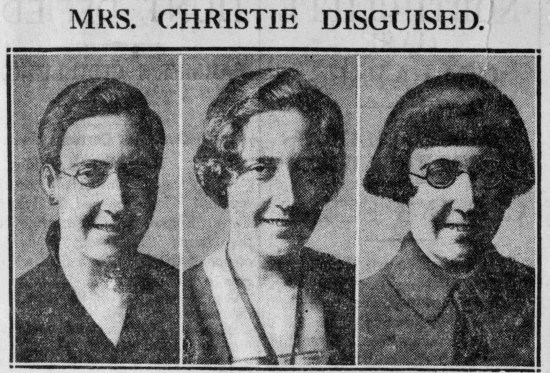
Clearly Christie enjoyed the trope of disguise, and her public enjoyed her use of it. Not only that, but Agatha herself disappeared in 1926, some journalists speculated that she was herself in disguise, hiding in plain sight! It would have been the “thrillerish” thing to do – but Agatha would not limit disguise to her thrillers. From the very start, the characters in her whodunnits made equal use of disguise.
In Chapter 11 of her debut novel, The Mysterious Affair at Styles (1920) we hear the following testimony at John Cavendish’s trial: “An assistant from Parkson’s,Theatrical Costumiers, testified that on June 29th, they had supplied a black beard to Mr. L. Cavendish, as requested. It was ordered by letter, and a postal order was enclosed. No, they had not kept the letter. All transactions were entered in their books. They had sent the beard, as directed, to L. Cavendish, Esq., Styles Court.”
Raise your hand if you have ever put on a fake beard and a gentleman’s clothes and managed to fool your loved ones, or your friends, or even the community at large. It’s an extraordinarily difficult thing to do in real life. But Golden Age murder mysteries are not real life; sometimes murderers resort to theatrical means to perpetrate their plans – as the killer’s accomplice does in The Mysterious Affair at Styles when she – she!! – dons a beard and pince nez and almost exonerates the real killer.
Christie would go on to incorporate disguise in all manner of ways throughout her career, right down to the final cases she wrote for Miss Marple and Hercule Poirot. Ironically, these two final examples are better founded in logic than what came before: in Nemesis, the killer, a woman, disguises herself as a man in order to push a boulder down upon Elizabeth Temple. She does this from a distance and never interacts with another person and almost succeeds in convincing everyone that the crime was committed by a man. In Elephants Can Remember, a mentally deranged woman kills her sister and takes her place, utilizing wigs to maintain the illusion. This would seem to be an impossible impersonation – and it is impossible! She fools nobody close to her, especially her sister’s husband and dog.
It’s the fooling others, of course, that is the big stumbling block when it comes to disguise. When, in The Mysterious Affair at Styles, the killer’s accomplice walks into the village chemist’s shop to purchase strychnine, there is a risk, for her, as a member of the community, that someone will recognize her. It helps her immensely that she is 1) related to the killer, and 2) possesses “a deep voice, almost manly in its stentorian tones, and . . . a large sensible square body, with feet to match.” (SPOILER: disguise is always easier in Christie for a manly woman or a womanish man!)
THE SERVANT PROBLEM
An author’s responsibility would seem to include making the use of disguise as feasible as it is justified. Fortunately for many Golden Age crime story writers, the inherent snobbery found in the British class system provided such feasibility. It is exemplified in a story by G. K. Chesterton called “The Invisible Man” (published in 1911 in The Saturday Evening Post and Cassell’s Magazine and then collected that same year in The Innocence of Father Brown.) Here a man is murdered by a thwarted rival for his affections of a beautiful young woman. Four citizens have been stationed to observe the victim’s residence, and all swear they saw no one enter or leave. Moreover, for some time before the murder, the woman had been hearing the distinctive voice of the rival and yet was unable to see him. Is the killer indeed a phantom? Then how to explain the footprints in the snow?
The answer is simple – if you can embrace the notions of class that permeated Edwardian England: the killer is a postman, a figure so common in our daily lives that nobody, so the theory goes, really notices him. Whether or not you can choose to accept this idea, Agatha Christie made use of it over and over again. In fact, she paid direct homage to Chesterton and Father Brown himself in the Tommy and Tuppence story, “The Man in the Mist” (first published in December 1924 in The Sketch and collected in 1929’s Partners in Crime).
The most astounding example of the servant disguise in Christie can be found in arguably her most theatrical novel, 1934’s Three-Act Tragedy. The central character is Sir Charles Cartwright, a much-lauded, much-loved actor. At the start of the novel, he invites a group of friends and neighbors to his house for a cocktail party. These people all know Sir Charles to varying degrees, and their relationship to him (and perhaps to each other) is further sealed when a man drops dead from poison at the party.
A couple of months later, nearly all these people gather for a dinner party at the home of Sir Bartholomew Strange. Most notably absent is Sir Charles, Strange’s best friend, because he is vacationing on the Riviera. Actually, although he is not dining at table, he is there – serving the dinner to all his friends, including his potential girlfriend – but disguised as the butler. Nobody there recognizes him by his face, possibly because none of them have taken the time to glance at a servant’s face. Ironically, it is his act of service which leads to Sir Charles’ undoing: one of the more observant guests eventually recognizes his hands, which she watched as he performed his duties.
As for other examples, we have already spoken of The Big Four (1927) where Claude Darrell – Number Four, “The Destroyer” – appears in various roles. When he plays a notable character, such as a famous Russian chess master, it is a person whom nobody in the vicinity has ever met. Mostly, Darrell takes on working class roles, like a lunatic asylum keeper, a country doctor, and a butcher’s boy.
The killer in The Mystery of the Blue Train (1928) is a notorious jewel thief who operates in a mask and wig in order to disguise his true identity. However, he murders Ruth Kettering with the help of an accomplice who is barely noticed because she works as Ruth’s maid, and who, after the murder, escaped from the train because – as accomplished actress and male impersonator Kitty Kidd – she is able to disguise herself as a mere boy.
In 1935’s Death in the Clouds, the dentist Norman Gale seats himself on a plane, flirts openly with the novel’s heroine Jane Grey, then exits the cabin, puts on his dental jacket, returns posing as an airline steward, and commits the murder without any further disguise but with the assurance that nobody will pay attention to the help! A significant side-note here to point out the significance of disguise in this (or any) story: when Hercule Poirot asks Norman to go undercover and investigate another suspect, Norman assembles a ridiculous disguise that anyone would see through for the express purpose of convincing Poirot that Norman is incapable of assembling an effective disguise.
In Appointment with Death (1938), Lady Westholme disguises herself as an Arab servant and is thus easily able to approach Mrs. Boynton to kill her in broad daylight. Later on, she bears witness to the presence of this non-existent servant in order to give herself an alibi. She even convinces a gullible friend that she, too, saw this non-existent killer!
In the 1942 Miss Marple story, “The Case of the Perfect Maid” the Skinner sisters perpetrate a fraud by having one of the sisters disguise herself as the “perfect” maid, go on loan to other ladies’ houses, and rob them of their valuables.
In Sparkling Cyanide (1945), one of the killers disguises himself as a waiter in order to openly poison Rosemary Barton’s drink in a crowded restaurant – and then tries the same trick a year later on her sister. Perhaps an understanding of human psychology aided the killer in finding the right moment to strike, but he could rest assured that the customers would not recognize his face.
In The Pale Horse (1961), the killer assumes the guise of various working-class stiffs – a meter reader, a repairman, and so on – in order to replace a common household item with a similar item containing thallium poison.
The same argument about servants could also apply to foreign characters in Christie. In Dead Man’s Folly (1956), one of the killers, who has been playing the role of a Caribbean heiress in exotic clothing and make-up for years, disappears from a fete by stripping herself of her bizarre finery and walking off the grounds in the drab garb of a foreign exchange student. Another murderer reverses this pattern by trading a uniform for something more exotic: in the 1929 Miss Marple short story, “The Blue Geranium,” the sensible Nurse Copling disguises herself as a gypsy named Zarida: “Black hair in coiled knobs over her ears – her eyes were half closed – great black rims round them – she had a black veil over her mouth and chin – and she spoke in a kind of singing voice with a marked foreign accent . . . “ In this cliched outfit she is able to fool her patient over several visits and bring about the woman’s death.
Let’s set aside this common mistake of ignoring the help and examine nine of the more fascinating and/or problematical uses of the device, the success of which might seem inconceivable to many of you, but which lead to some of Christie’s most brilliantly theatrical scenes.
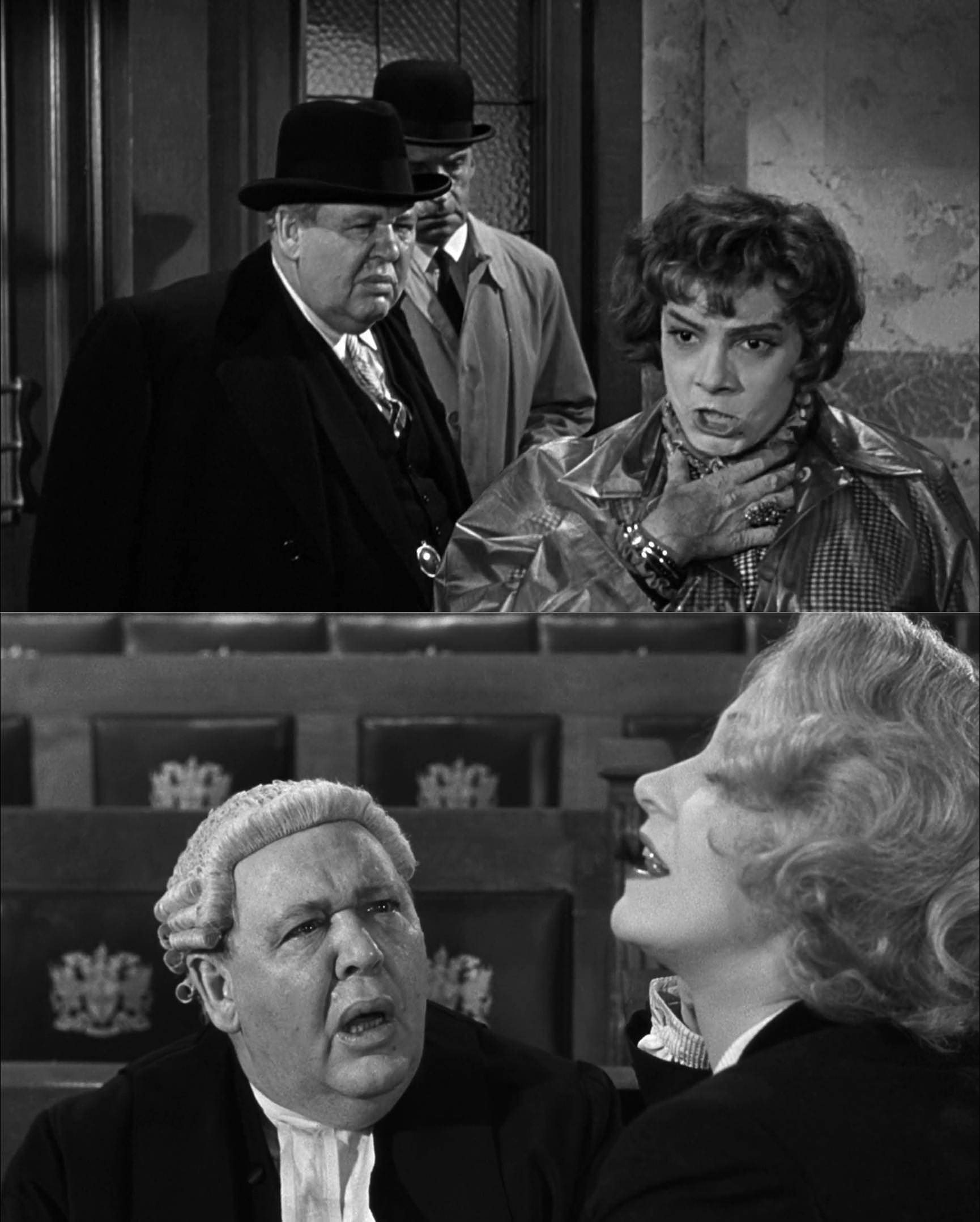
“The Witness for the Prosecution” (1925)
- The Perpetrator: Romaine Heilger Vole
- Qualifications: She is a retired actress and possesses the skills to play a part.
- Motivation: Leonard Vole has been charged with the murder of Miss Emily French. He assures his attorney that his devoted wife Romaine can provide him with an alibi. But Romaine is a sharp woman: she quickly sums up that a jury will have trouble believing a devoted wife’s words and comes up with a plan to “betray” Leonard and then have her testimony discredited.
- Disguise: Mrs. Mogson, the hideously disfigured wife of Max, the non-existent lover of Romaine Vole, with whom she plots to get Leonard convicted so that they can be together.
- The Dupe: Mr. Mayherne, Leonard Vole’s solicitor, and the British legal system
Analysis: This shouldn’t work! Mr. Mayherne is described as “precise in manner . . . practical, not emotional . . . with a pair of very shrewd and piercing gray eyes. By no means a fool.” He interviews Romaine Vole, a striking foreign woman, and observes her closely. It seems absurd that he would be caught up in her larger-than-life impersonation. And yet Mr. Mayherne is desperate: he doubts the innocence of his own client and, falling for Romaine’s act of despising her husband, he realizes that she is a most unsatisfactory witness.
And Romaine plays her part beautifully. She sets a perfect scene in a small, dirty room at Shaw’s Rents, “a ramshackle building in an evil-smelling slum.” The character she portrays is “bent in figure, with a mass of untidy grey hair and a scarf wound tightly round her face.” When she briefly exposes her visage, it is scared an “almost formless blur of scarlet.” In the play and 1957 film, she fools the attorney completely; she has to show him in the end who she was to make him believe (“Want to kiss me, dearie?”) In the original story, however, Christie inserts an oft-used trope: the habit. As Romaine flounders on the stand, Mr. Mayherne notices her unconsciously clenching and unclenching her right hand. And he remembers . . .
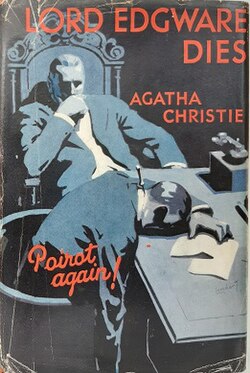
Lord Edgware Dies (1933)
- The Perpetrators: Jane Wilkinson and Carlotta Adams
- Qualifications: Only Carlotta is in disguise, and she is a skilled impersonator
- Motivation: Jane wants to kill her husband in order to marry another man whose inconvenient religious beliefs will not countenance divorce. Her motive is so strong and obvious that she feels it necessary to establish a perfect alibi. Carlotta is not similarly motivated. She wants to make some money by exercising her talents in service of playing a good joke.
- Disguise: Carlotta is introduced to us right away as a woman who can brilliantly impersonate Jane, and this is what she does. While Jane is murdering her husband, Carlotta attends a dinner party in another part of town as “Jane Wilkinson.”
- The Dupes: The police, the dinner guests, and . . . Hercule Poirot!
Analysis: This and Three-Act Tragedy are the most overtly theatrical books in Christie’s oeuvre. One takes place in London and the other in various parts of the country, but both their settings are theatre-adjacent, and both novels are filled with characters employed in the dramatic world. Much of the theatrical tone stems from the personalities – divergent though they are – of the actor-murderers, Jane Wilkinson and Sir Charles Cartwright. As we have discussed, the latter is depicted as a man always in the process of playing a role. Jane, in contrast, is always being herself: a wholly theatrical personality, charming but shockingly frank, incapable of caring about what lies beneath the surface, possessed of a native cunning rather than intelligence or shrewdness. Her plan nearly succeeded because of its native simplicity, because, as Poirot describes, “Oh! That strange brain – childlike and cunning. She can act! . . . Did she feel the slightest pang or remorse for any of her three crimes? I can swear she did not.”
Unfortunately, this book has always pissed me off! Until the very end, everyone, even Poirot, assumes that Jane went to dinner while Carlotta visited Lord Edgware’s home. Since she had no motive to murder the man, it is assumed that the real killer hired her to visit the victim in order to frame Lady Edgware. When Carlotta also dies, the police assume that she killed herself out of remorse. And when Poirot figures out that her suicide note was faked and that she was murdered, he spends the rest of the book trying to figure out which suspect other than Jane hired Carlotta to go to Edgware’s house!
It takes the death of Donald Ross, a much smarter actor and Jane’s fellow dinner guest, to set Poirot in the right direction. The “Judgement of Paris” clue is a mightily entertaining one, but why should Poirot require such a boon turn his theories the right way round? In terms of the rules of the novel, the disguise works – and the bonus is that it also condemns Jane because, as Donald Ross reveals, costume alone cannot hide the true character of a person. But nobody considers at the start that the positioning of the two women could have been reversed because – well, because they can’t consider it if there is to be a novel! It’s a problem that has vexed me for years!
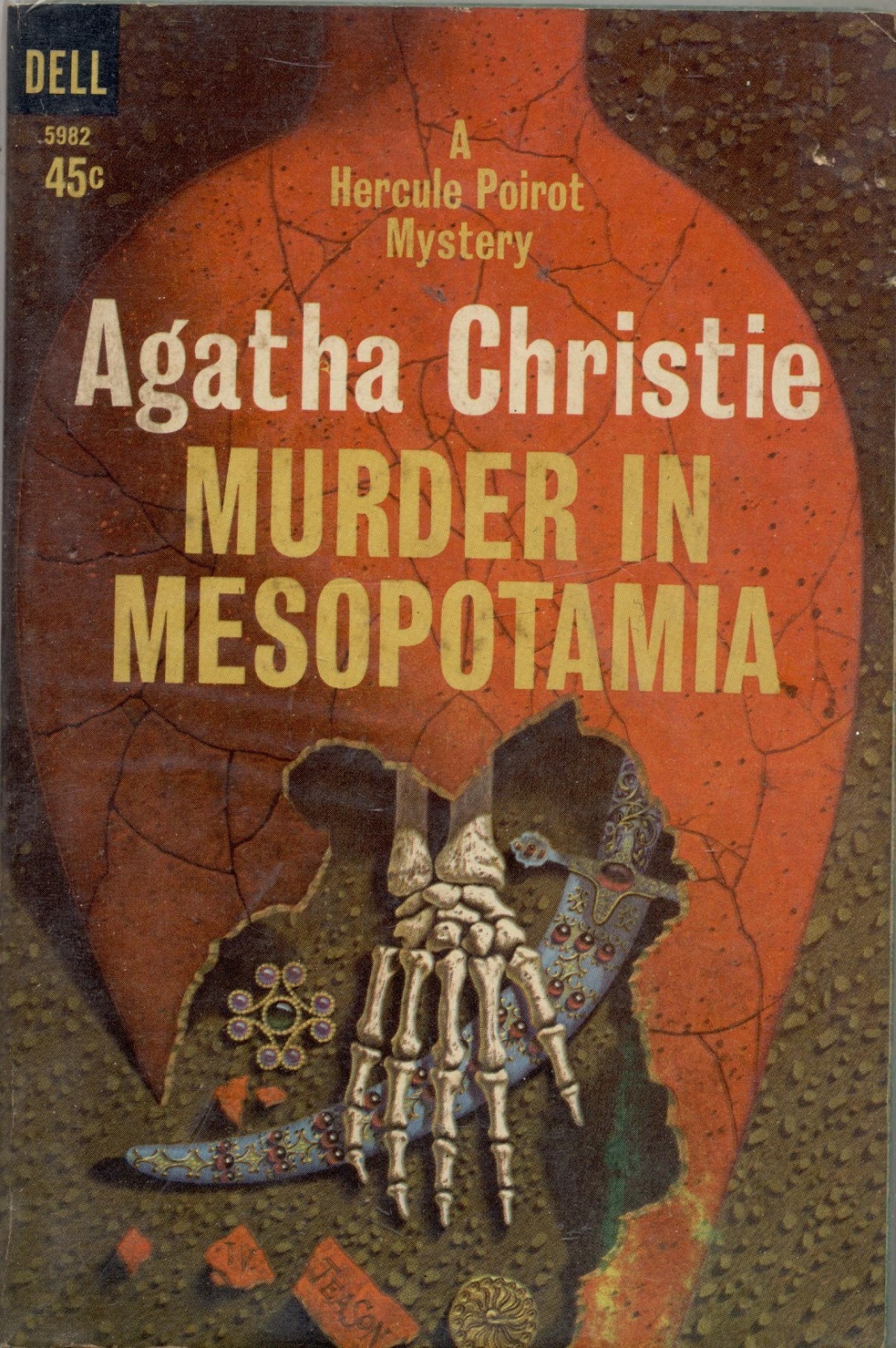
Murder in Mesopotamia (1936)
- The Perpetrator: Frederick Bosner
- Qualifications: A former career as a spy must have taught him to lie well; plus, he’s pretty much insane
- Motivation: To reclaim his wife and be assured that she will never love anyone but himself.
- Disguise: Bosner, presumed dead in a train accident, assumes the identity of famous archaeologist Eric Leidner
- The Dupe: His wife, Louise, and the archaeological community
Analysis: By all reason, this should be considered an impersonation rather than a disguise. Frederick Bosner, arrested by the U.S. State Department as a German spy, was erroneously reported to have perished in a train derailment. Upon finding the disfigured corpse of the real Dr. Eric Leidner, Bosner stole the dead man’s identification and . . . assumed his life!?!?! Who knows what amount of education and subterfuge this entailed, but “Leidner” managed to carve out a distinguished career and to surround himself with a team of experts who counted on his knowledge and management skills at each tell they excavated. He did all this while keeping close and obsessive track on his wife Louise, sending her warnings every time she grew close to another man. Nobody suspected this darker side of the man, which is why I suggest his experience as a spy served him well.
However . . . one of the hardest pills to swallow in Christie’s canon is the idea that Louise Leidner could not recognize that the two men she fell in love with and married were one and the same guy!! Fooling his wife on a day-to-day basis puts Bosner’s impersonation well within the parameters of disguise, a situation that is well-nigh impossible for the canny reader to accept!
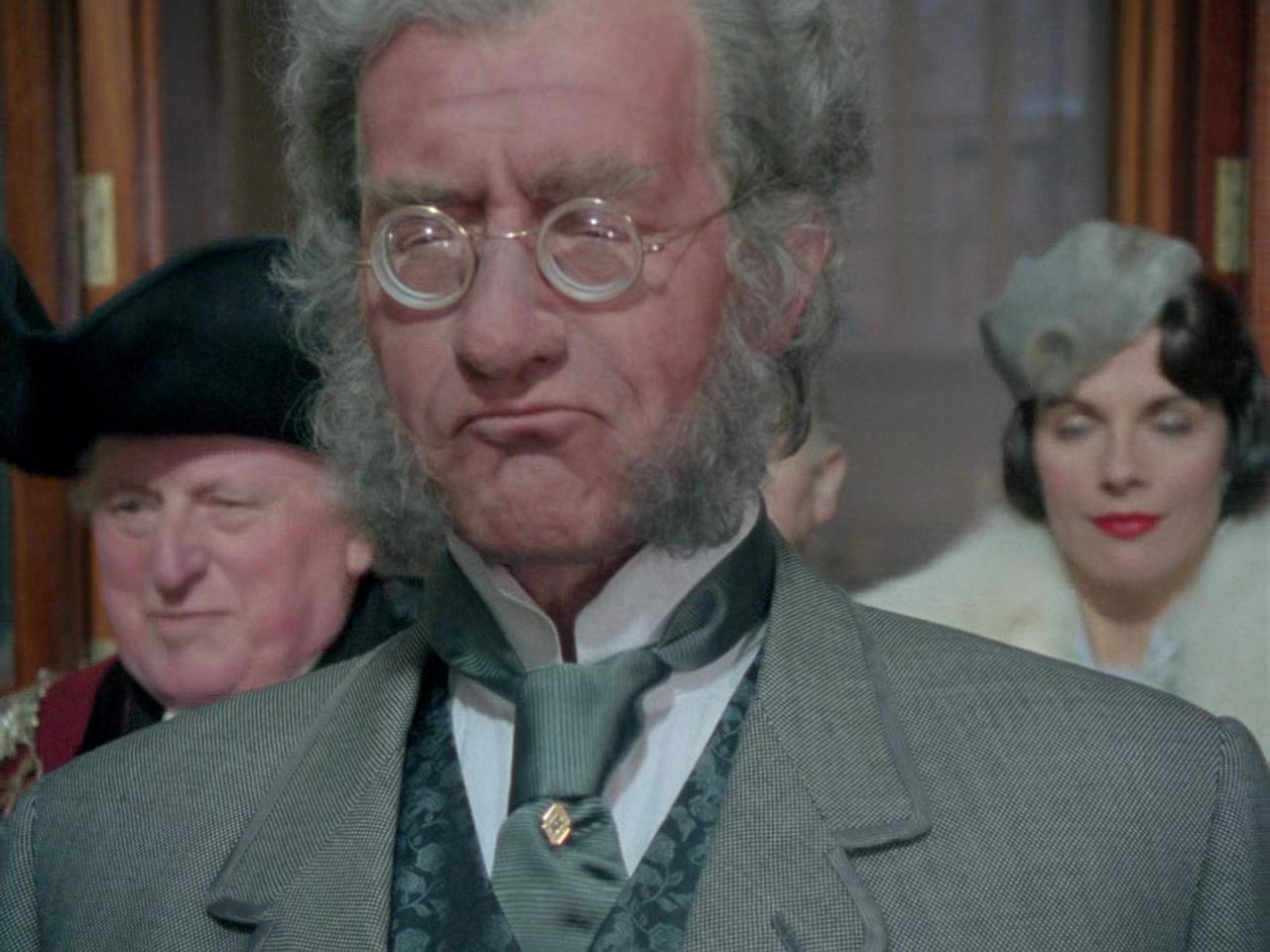
“The Dream” (1938)
- The Perpetrators: Mrs. Benedict Farley and Hugo Cornworthy
- Qualifications: Only Hugo is in disguise; he has no known theatrical training but knows his subject well
- Motivation: Another deadly duo: Cornworthy and Mrs. Farley are lovers plotting to kill her wealthy husband and get their hands on a quarter of a million pounds, tax free!
- Disguise: Cornworthy disguises himself as the victim, Benedict Farley
- The Dupe: None other than Hercule Poirot!
Analysis: This tale is chock-full of theatricality, beginning with the victim, eccentric millionaire Benedict Farley. Christie’s description marks this man as a “character” rather than a mere human being. He is physically notable for his crest of white hair, beaked nose, thick eyeglasses, and his frequent costume of a “famous patchwork dressing-gown.” His physicality and eccentricities make him easy to study and impersonate.
The office where Poirot meets “Farley” is lit like a stage set: “The corners of the room were dim, for the only light came from a big green-shaded reading-lamp which stood on a small table by the arm of one of the easy chairs. It was placed so as to cast its full light on anyone approaching from the door. Hercule Poirot blinked a little, realizing that the lamp bulb was at least 150 watts.”
This sort of dramatic lighting is anything but conducive to regular business and puts the guest at a visual disadvantage. Even as “Farley” pours out his story of a nightly recurring dream where he commits suicide with a gun, Poirot is half-aware of the theatricality of the situation. “He had known other millionaires, eccentric men, too, but in nearly every case he had been conscious of a certain force, an inner energy that had commanded his respect. If they had worn a patchwork dressing-gown, it would have been because they liked wearing such a dressing-gown. But the dressing-gown of Benedict Farley, or so it seemed to Poirot, was essentially a stage property. And the man himself was essentially stagey. Every word he spoke with uttered, so Poirot felt assured, sheerly for effect.”
This is rightfully considered one of the best short stories of the 1930’s, packing multiple tricks into its thirty or so pages. Not only does Christie include this element of disguise, but the murder itself is one of her rare impossible crimes – and one with a very clever solution. I do love how theatrical it is – why, even the alibis of all the suspects for the evening when Poirot visited “Farley” are theatrical: Mrs. Farley and her stepdaughter attended a play called Little Dog Laughed, while Cornworthy went to the movies.
Or so he said!!
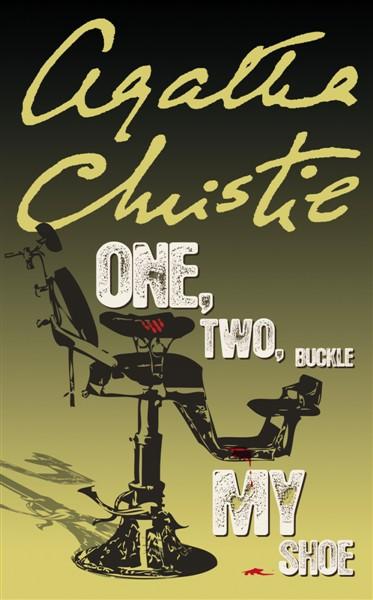
One, Two, Buckle My Shoe (1941)
- The Perpetrators: Alistair Blunt and Gerda Blunt
- Qualifications: Years earlier, back in India, Gerda performed in amateur theatre; Alistair is a politician!
- Motivation: Alistair married a wealthy and influential woman in order to secure his political future; as too often happens in Christie, he neglected to divorce his first wife (he didn’t really want to!) The Blunts carry out multiple murders in order to protect his secret.
- Disguise: Alistair disguises himself as his own dentist, Henry Morley (first disposing of the poor man!) in order to administer an overdose to a blackmailing patient. Gerda assumes multiple personalities: as Mrs. Sylvia Chapman, she lures her old friend Mabelle Sainsbury-Seale, who could expose Blunt as a bigamist, to her death. She then poses as Miss Sainsbury-Seale in order to assist Blunt in setting up the murder at Morley’s dental office.
- The Dupes: Ultimately, all of England – for how can the British Isles be free if Alistair Blunt isn’t running the country’s finances?!?
Analysis: One could argue that a number of Christie’s puzzle plots are overly complicated, a common enough complaint made by touchy modernists about Golden Age mysteries. Sometimes this works just fine, but in One, Two, Buckle My Shoe . . . I’m not so sure.
The disguise that Alistair Blunt assumes to murder Mr. Amberiotis, that of a dentist, is clever. Amberiotis has never met the real Dr. Morley, and as Christie displays most amusingly in the opening chapter, most people view dentists with a fear akin to dread. That Blunt needs to murder the real dentist to enact his plan feels horribly callous, but this act perfectly explains why Poirot refuses to go along with Blunt’s argument at the end that no individual’s life is worth the value of Blunt’s influence on the British economy.
The matter of Gerda Blunt is more problematic. She takes on three roles here, although one of them, Mrs. Albert Chapman, is never seen by any living characters in the novel. Gerda impersonates Miss Mabelle Sainsbury-Seale, whom she has already murdered. Poirot meets her under this guise twice. He keenly observes a woman of “nearer fifty than forty. Pince-nez. Untidy yellow-gray hair – unbecoming clothes – those depressing art greens!” And while their first encounter is brief and occurs while Poirot is anxious over his upcoming appointment, after the murder he interviews her with Japp and has an opportunity to really see her.
The next time Poirot sees Gerda, she is disguised as Blunt’s second cousin Helen Montressor, “a sturdy woman, clad in a tweed coat and skirt, black-browed with short-cropped black hair, who was talking in a slow, emphatic Scotch voice . . .” Granted, they don’t spend a lot of time together, but Poirot is completely taken in by the woman’s disguise. Given the detective’s skilled powers of observation, that’s a hard pill to swallow. At least, Mabelle and Helen never travel in the same circles, which is more than I can say for another disguise trick coming up later.

Evil Under the Sun (1941)
- The Perpetrators: Christine and Patrick Redfern
- Qualifications: They are an experienced pair of con artists who have already resorted to murder for gain.
- Motivation: Patrick has wooed actress Arlena Marshall and extracted large sums of money from her. To protect himself from exposure, he and his partner Christine plot Arlena’s murder and use disguise to establish alibis for both of them.
- Disguise: Christine disguises herself as Arlena’s “corpse” in order to fudge the time of the murder and give Patrick a solid alibi.
- The Dupe: Miss Emily Brewster, a witness to the discovery of “Arlena’s” body.
Analysis: One of the more brilliant uses of disguise because, despite the need for exact timing, the trick is quite simple. Christine applies a fake tan to her body and wears a swim outfit that is a duplicate to Arlena’s under her bulky caftan. She heads to Pixie Cove, which causes the actress to go into hiding in a nearby cave, and then assumes Arlena’s position on the beach in time for Patrick to “discover” her and announce she is dead in front of Miss Brewster.
The crime is pretty much perfect, following a similar template the Redferns have used before (on Alice Corrigan), although then they did not need to employ a disguise. Like all Golden Age criminals, the pair make a couple of damning mistakes: Christine foolishly tosses the tanning bottle into the sea, where it nearly hits Miss Brewster; later on she exposes the lie she told about having vertigo, which would have prevented anyone from using the steep stairs from the cliff down to Pixie Cove.

The Body in the Library (1942)
- The Perpetrators: Josephine Turner and Mark Gaskell
- Qualifications: Josie has been a professional dancer and hostess, which no doubt has given her some expertise in make-up.
- Motivation: Ruby Keene, Josie’s cousin, has ingratiated herself with tycoon Conway Jefferson. Josie and Mark murder Ruby and a teenager named Pamela Reeves and enact a complicated scheme to provide themselves with alibis. Later, they plan on doing away with Jefferson so that Mark can inherit a share of the man’s fortune before he has the chance to alter his will.
- Disguise: This time, it is the victims who are disguised – lured by the possibility of getting a screen test, Pamela Reeves is murdered and placed in Basil Blake’s home, then later switched by Basil to the Bantry’s library, where she is mis-identified by Josie as Ruby Keene, whose body has actually been burned in George Bartlett’s car.
- The Dupes: The police, who will confuse the bodies and thus accept Josie and Mark’s alibis.
Analysis: P. D. James once said, “Let those who want pleasant murders read Agatha Christie,” yet even she acknowledged the brilliant way Christie played on the tired trope of the body in the library. Here we find no country squire, no wealthy uncle, no foreign diplomat. This body is young, female, and tawdry, “dressed in a backless evening dress of white spangled satin; the face was heavily made up, the powder standing out grotesquely on its blue, swollen surface, the mascara of the lashes lying thickly on the distorted cheeks, the scarlet of the lips looking like a gash.” The nails on her hands and feet are painted “a deep blood red,” and yet the nails have been bitten to the quick.
This is disguise, pure and simple: it approximates the low opinion that most of the characters have of Ruby Keene, a naïve opportunist who in reality lies burnt to death in a car in a quarry many miles away. The body in the library is that of a sixteen-year-old Girl Guide with dreams of stardom named Pamela Reeves. With all respect to P. D. James, these are not pleasant murders. Pamela has been lured by the killers with promise of a screen test, drugged, transformed to resemble Ruby Keene, strangled and dumped in Basil Blake’s home, and from there transported and laid sprawling on Colonel Bantry’s library floor.
Much talk is made throughout the novel about how Ruby herself donned costume and make-up to hide her low origins and make herself more alluring to the guests at the Majestic Hotel. That the killers’ plan was largely exposed by the telling detail of Pamela’s bitten nails, a detail that no disguise could hide, makes it one of the more satisfying – and theatrical – clues in the canon.
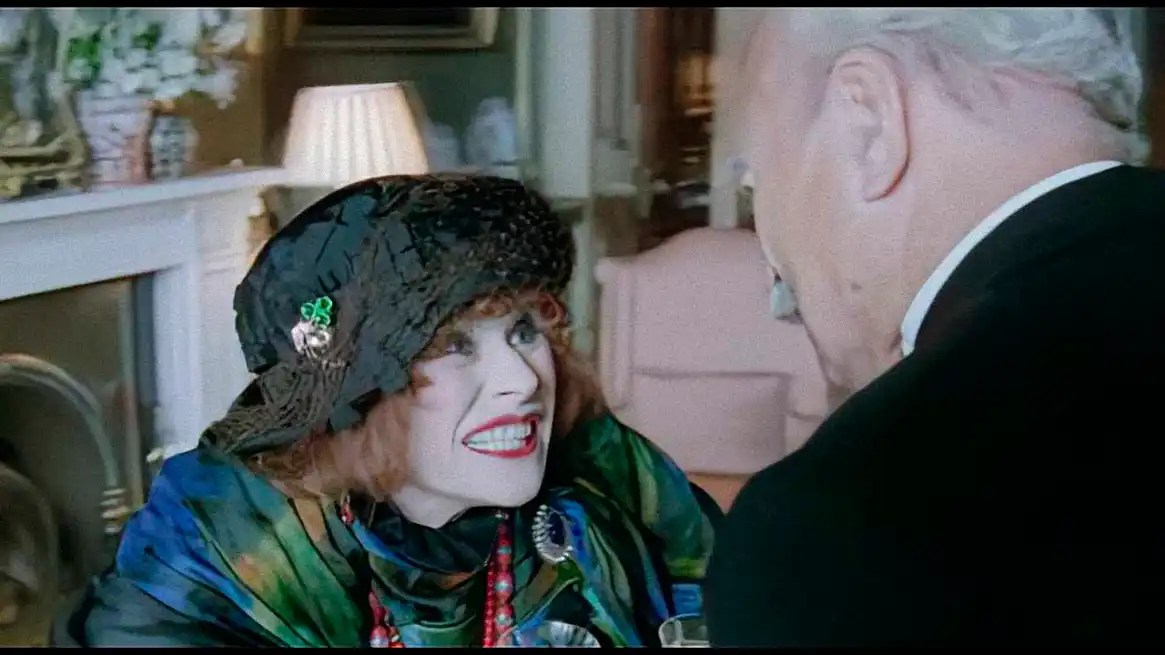
After the Funeral (1953)
- The Perpetrator: Miss Gilchrist, companion to Cora Lansquenet
- Qualifications: Close proximity to her roommate Cora, allowing her to study the woman’s personality and manner, and giving her access to Cora’s wardrobe
- Motivation: Miss Gilchrist hopes to profit by Cora’s death via a camouflaged Vermeer painting in order to restore herself to her former glory as proprietress of a teashop
- Disguise: Miss Gilchrist pretends to be Cora and attends “brother” Richard Abernethy’s funeral in order to plant the idea that Richard was murdered; thus, when the real Cora is found dead, investigators will tie her murder to Richard’s
- The Dupes: The Abernethy family and their solicitor, Mr. Entwhistle
Analysis: This is my favorite use of disguise in the canon. Due to an estrangement with the rest of the family after an unsuitable marriage, Cora is unfamiliar to most of the remaining clan. Garbed in funeral gear and much-practiced to impersonate the quirky character of Cora, Miss Gilchrist manages to pull the wool over nearly everyone’s eyes. Only Helen Abernathy, one of the few to really remember Cora, is bothered by some half-seen anomaly: Miss Gilchrist had practiced being Cora in front of a mirror and ended up performing a backward impersonation of a significant facial habit.
Miss Gilchrist almost gets away with murder because she embraces the theatricality of Cora’s character, “dressed in wispy, artistic black with festoons of jet beads,” and takes advantage of Cora’s lifelong propensity for awkward gaffes to make the dramatic (and false) announcement, “But he was murdered, wasn’t he?” All of this contrasts perfectly with the real persona that Miss Gilchrist projects, that of “a spare faded-looking woman with short, iron-gray hair. She had one of those indeterminate faces that women around fifty so often acquire.” As resentful as she is to be reduced in circumstances to a quasi-housekeeper/companion, Miss Gilchrist embraces the position because she understands how privileged folk tend to ignore and underestimate the help. It’s a perfect cover!
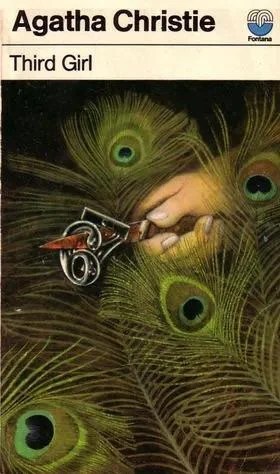
Third Girl (1966)
- The Perpetrators: Robert Orwell and Frances Cary
- Qualifications: Not clarified, but both are career criminals and have pulled off many scams
- Motivation: To enjoy the fortunes of Andrew Restarick, the man that Robert Orwell befriended and then replaced after Restarick died
- Disguise: Orwell’s impersonation of Restarick is just that – an impersonation. It is Frances Cary who carries out a bold disguise, as both Mary Restarick, “Andrew’s” golden-haired wife, and Frances, Norma Restarick’s London roommate
- The Dupes: Norma and the world at large
Analysis: I don’t care what combination of purple hearts, LSD, hemp and other “curious substances” have been slipped to Norma Restarick; the idea that she could never tell that her roommate and her stepmother were one and the same person seems ludicrous. But this is what we are handed here. It leads to one moment that feels extremely clever in restrospect: Claudia has just “discovered” the body of David Baker, and in the deft fashion of someone expert at playing a part, she arranges her reaction: “Her mouth opened and then shut. She stiffened all over – her eyes staring at the prone figure on the floor; then they rose slowly to the mirror on the wall that reflected back at her own horror-stricken face. Then she drew a deep breath. The momentary paralysis over, she flung back her head and screamed.”
I find this nearly as hard to swallow as Dr. Leidner in Murder in Mesopotamia, which, despite that howler of an impersonation, is a better mystery than this one. I can only imagine that a 76-year-old Christie was so taken with the, to her, outrageous costume and make-up of the Carnaby Street generation that she figured her characters would accept as two people a woman who assumed such contrasting disguises.
The use of costume by Christie’s criminals, whether ostentatious or under the radar, reflects the cleverness, desperation and overweening ego of these murderers. We applaud their chutzpah – and are glad that each and every one of them was eventually unmasked!
 Ah Sweet Mystery!
My father was a policeman for 20 years in central Delaware. He said — OFTEN — that people saw what they expected to see. Witnesses were unreliable, even eyewitnesses, and witnesses to the same crime scene or car accident would contradict each other.
I remember running a red light when I was 19 in Dover and he asked me afterwards what the arresting officer looked like. I had no idea! I talked to that man, face to face, for several minutes!
You see what you expect to see which is why Poirot likes collecting many witness statements and seeing who confirms what.
Also consider those famous “selective attention” experiments where the audience is asked to watch the basketball players wearing white and count how many times they make a shot. Very few people notice the actor in the gorilla costume walking through the players!
People see what they expect to see and they don’t pay attention to what they perceive as routine and unimportant.
LikeLiked by 1 person
I am no more observant than the next guy! The first time I saw SLEUTH on stage, I was totally fooled! However, I do think it takes a lot of nerve to don a disguise, and play a role in front of your family or close friends, as several of the murderers in Christie do! I suppose that in the stress of the moment of murder, people could forget a familiar gesture, or something similar in the eyes! Christie took brilliant advantage of our human frailties!
LikeLike
She sure did!
LikeLike