My Book Club decided to read John Dickson Carr last month – one of his best, I must say – but since I had just re-read it a mere – oh, wait, has it been six years already?!? – I decided to return to my long-standing series, A Carter Dickson Celebration. Since it has been almost exactly a year since I last touched those waters, I should remind you that while I read a lot of Gideon Fell adventures as a kid, for some silly reason I avoided Sir Henry Merrivale. And now that I’m all grown up and frightfully mature, I’m making things up with The Great One and covering the titles written under the nom de plume “Carter Dickson.”
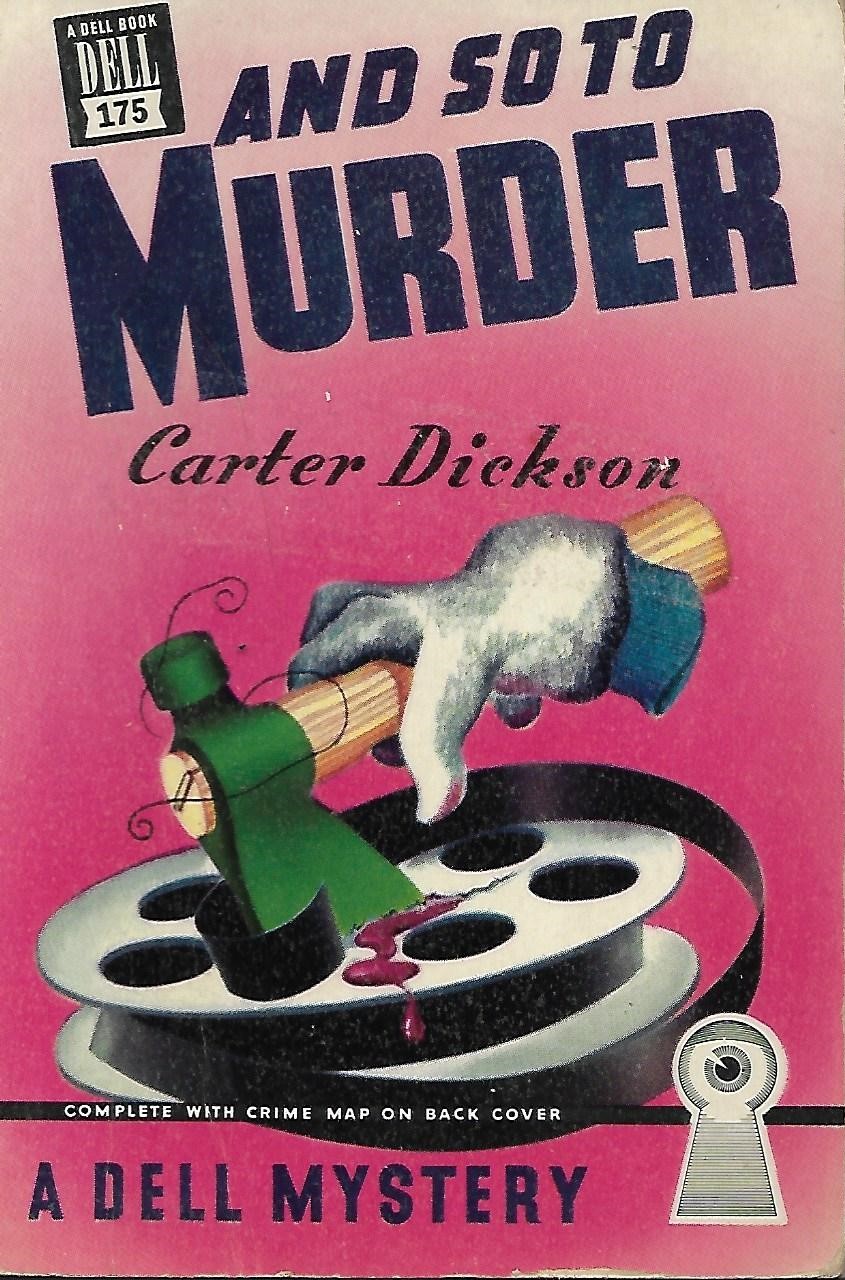
The next HM adventure takes us into the 1940’s and drops us smack dab into the middle of the war. If the last book, The Reader Is Warned, swept us up in the ickiness of Third Reich philosophy, the announcement of war comes right in the middle of And So To Murder and gives Dickson the chance to show us its immediate effect on civilian life and to give us HM in all his glory as an official at the War Ministry.
But, really, And So To Murder is all about the movies.
And it’s hilarious.
To be honest, I had had some qualms about reading this one, which may partly explain the Celebratory delay. I had heard that it didn’t have much of a mystery going for it – not even a murder to be had. But I had also heard similar misgivings about The Punch and Judy Murders and, as you can see below, it ranks awfully high on my list. And So to Murder isn’t going to rate quite so high because, in the end, it feels rather slight as a mystery. It reminds me of a comment I read just the other day about the classic screwball comedy, His Girl Friday, and how much it straddles the world of film noir. And, really, that’s what And So to Murder is: a screwball comedy dipped in acid . . . of the sulfuric variety!
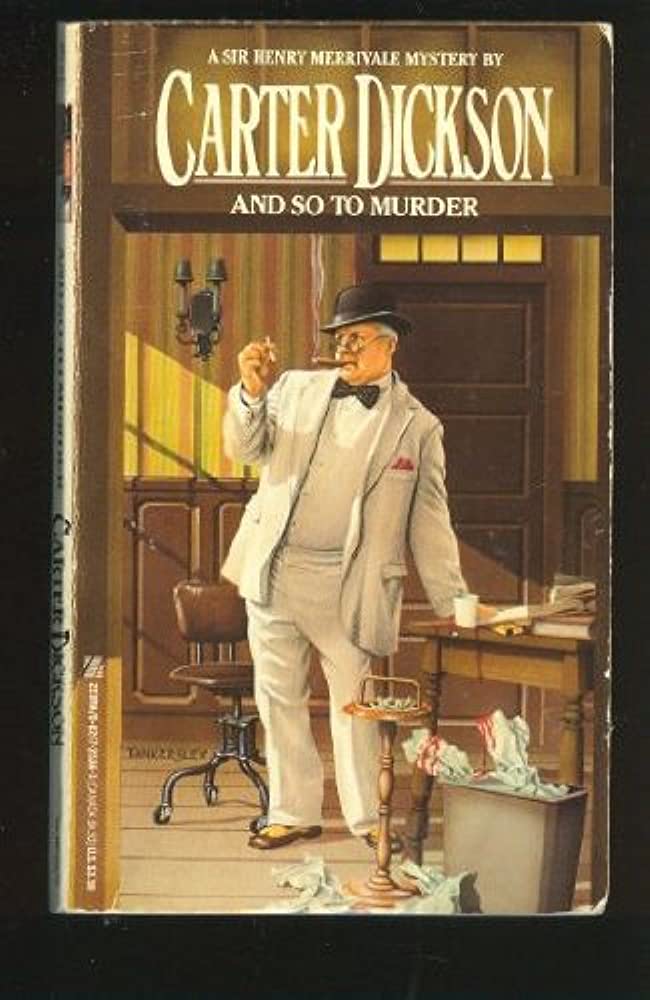
Monica Stanton, the daughter of a vicar, has managed to write the raciest novel in years. When Albion Studios contacts her to say they want to adapt Desire into a film and that they want her to come work for them, she jumps at the chance. But in one of the earliest moments of wackiness, producer Thomas Hackett explains to her that she will not be adapting her own film: no, that honor will go to detective story writer William Cartwright, while Monica will be adapting Cartwright’s latest mystery.
The fact that Monica loathes William Cartwright, who has been held up to her by her disapproving family as the hallmark of fine writing – and that her loathing is confirmed upon meeting him and learning that he sports a beard – has the stamp of “Rom Com” all over it. It doesn’t take an armchair sleuth with any skill to deduce that these two will fall into each other’s arms by journey’s end. And the means to that end is that, from the start of her employment at Albion Studios, Monica becomes the prey of a fiendish would-be killer who uses horrific methods to try and bring her down.
As war is declared, windows painted black, and rationing begun, a whiff of espionage hangs in the air. But how could this have anything to do with the newest employee at the studio, and a vicar’s daughter to boot? Nobody in the small cast of characters – the producer, the director, the leading lady or her Teutonic husband – seems to have a motive for wanting Monica out of the way. And I will say that, although I pounced on the villain’s identity pretty quickly, that motive is the most clever bit in the novel, at least as far as the mystery is concerned.
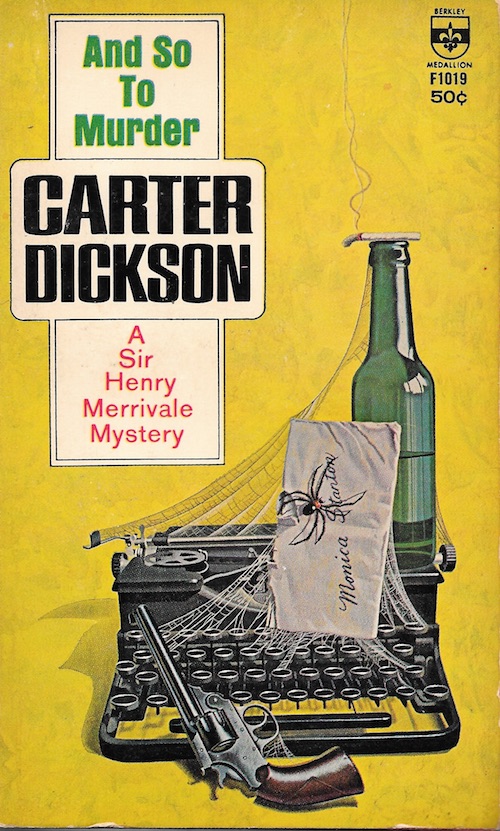
The real joy is in watching Dickson poke fun at the movie business. That silliness about two authors adapting each other’s books is only the start of what sometimes feels like a comedy from Ealing Studios, where everybody is very determined but just a bit off. The wackiness is exemplified by a series of blackout sketches involving an American director named Aaronson who is trying to make a historical film about the Duke of Wellington that cannot fail – as long as it hews as far away from historical accuracy as possible.
The lunacy of the film industry has an effect on everybody – even Sir Henry Merrivale, who it seems was a pal of the stage actor Sir Henry Irving and had hoped to parlay that friendship into a contract playing Richard the III. Merrivale shows up late to the proceedings but manages to interrupt his important war work – work he fears will lead him to a dreaded seat in the House of Lords – to solve the mystery and save a persecuted writer’s life.
Genre-wise, as I said, it all feels rather slight – and there’s a minor bit of “impossible” business that left me shaking my head. It has bothered me enough that, if you’ll excuse me, I’m going to ask those who have read the book a question in ROT-13 to see if they can make sense of it:
Gvyyl UNGRF Cynlre pvtnerggrf! Fur bayl fzbxrf Purfgresvryqf. Fb jul qvqa’g Wbr cercner n cbvfbarq Purfgresvryq? V xabj ur fgbyr Gvyyl’f pvtnerggrf bhg bs ure bssvpr, ohg ubj pbhyq ur or fher fur jbhyqa’g whfg ohl zber Purfgresvryqf vafgrnq bs obeebjvat bar bs gur qrgrfgrq Cynlref? Va snpg, Zbavpn unq eha bhg urefrys! Ubj pbhyq Wbr or fher fur jbhyq fgbc naq ohl zber pvtnerggrf?
Still, I had a great deal of fun reading And So to Murder . . . and it makes me sad to think that Carr/Dickson, a truly amusing writer when he wanted to be, had so little of his own stuff adapted to film. It played extremely well on the radio (listen to the first season of Suspense or read some of his plays in The Door to Doom or The Island of Coffins), and I’m sure he could have made a successful transition to the movies had anyone been interested. As it is, while reading this novel, I found it especially easy to picture the scenes in my head, with John Mills and Valerie Hobson reuniting from their Great Expectation days as Bill and Monica. Someone call Sarah Phelps and let’s get this stuff on TV!
 Ah Sweet Mystery!
Sarah Phelps? Noooo
LikeLiked by 1 person
I swear that was a joke!!!
LikeLike
One trusts Brad is having his wicked way with us. And I’ve seen her in the flesh and lived to tell the tale … Now David Renwick would be awesome!
LikeLiked by 1 person
I still don’t understand why Ten Teacups has slipped so low out there, I love it! But this is a great review of a really entertaining HM novel that tends to get too easily ignored. Thanks Brad!
LikeLike
I remember — I know not where — being told this was a terrible book and a stain on Carr’s career, so I read it with great trepidation…and it’s utterly delightful. I wouldn’t be surprised, or disappointed, if we got a reprint of this before too long — it certainly deserves it.
LikeLiked by 1 person
I too recall someone saying this was a bad Carr. Not his best in terms of mystery, sure, but a really enjoyable read.
LikeLiked by 1 person
The Puzzledoctor and I have very differing opinions on Ten Teacups / Peacock Feather, so that may be it – we’ve been disagreeing online about it for well over a decade 😆
LikeLiked by 1 person
I recall enjoying this one, even if the mystery is pretty slight. Although I read this somewhat recently, this may be the Carr novel that faded from my memory the quickest. Still, I love the awkward romantic setups that Carr was doing at this point in his career, similar to The Case of the Constant Suicides.
One could argue that this is the first book that starts what I categorized as the second era of Merrivale, with the impossible crimes starting to take a back seat and the stories being more light hearted.
LikeLike
I wonder if there is a deeper parody involved in how Monica’s relations are fine with books about murder, but abhor books about sex.
I do appreciate the comedy and that Carr did not feel the need to have the murder succeed.
LikeLiked by 1 person
There might be, but I know Christie’s vicars all love mysteries; one of them writes a better sermon due to a time crunch caused by his rapture over the book he was reading. And Monica’s father was much more accepting of her work than he Aunt was.
LikeLike
Sure, it probably is very realistic, I just wonder whether we are meant to see any sort of incogruency in it. There is something about the phrasing, along the lines of calling detective novels “nice”, that made me feel that way, but it could be me over-interpreting.
LikeLiked by 1 person
Oh, I certainly acknowledge some satire here. It always amazes me how uptight American audiences are about sex, while they gleefully go watch people get shredded a part in action, movies and horror films. And he sounds like William Cartwright wrote mysteries in an Edgar Wallace sort of vein, given all the fiendish traps included in his books!
LikeLike
Pingback: ACDC, PART TWELVE: (Thumbs) Up Periscope for Nine- and Death Makes Ten | Ah Sweet Mystery!
Pingback: ACDC, PART THIRTEEN: “You’re Starting to Get Sleepy” . . . Seeing Is Believing | Ah Sweet Mystery!
Pingback: “Double, double, Doyle and trouble” – The Case of the Baker Street Irregulars | Ah Sweet Mystery!