It looks like we’re going to have a little run of Dolores Hitchens over at Chez Ah Sweet Mystery this year. Having been introduced to the lady with the dark, fine The Watcher, I found out at Book Club last week that we would be covering The Alarm of the Black Cat in July. This is the second in a series of twelve mysteries Hitchens wrote between 1939 and 1956 under the pseudonym D. B. Olsen that featured little-old-lady sleuth Rachel Murdock and her sulky feline Samantha, and so I figured I should seek out Miss Rachel’s debut novel, The Cat Saw Murder. Fortunately, both of these books have been published by Otto Penzler under his American Mystery Classics imprint, putting them at my fingertips.
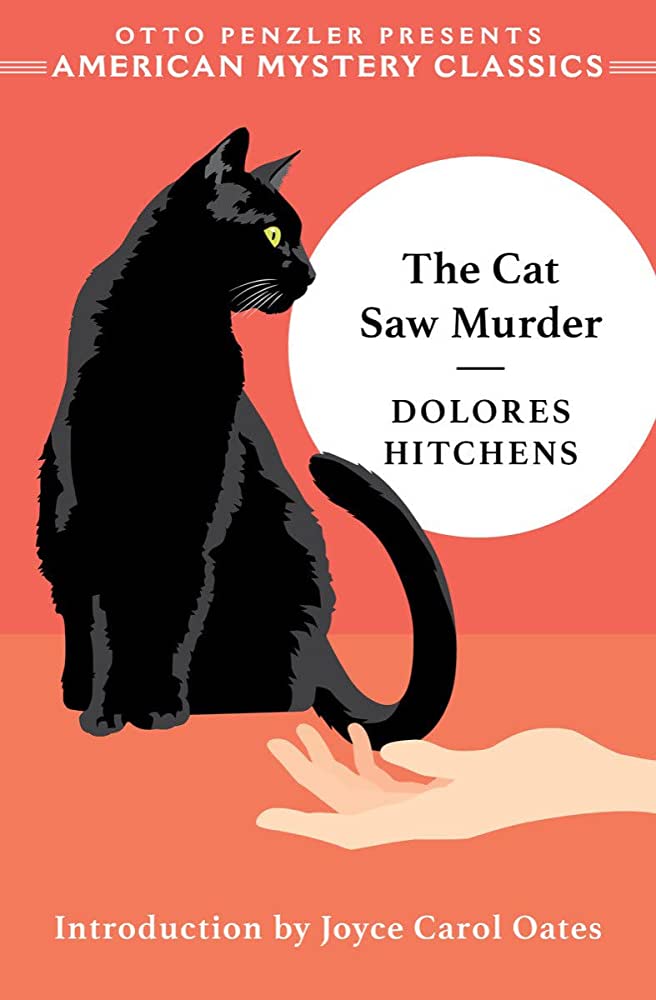
One of the distinctions of this series is that Penzler provides an Introduction, sometimes penned by his own hand, but often provided by other authors. For Cat, we have an introduction by no less august a personage than Joyce Carol Oates. Prolific author of over sixty novels, as well as poems, plays and essays, Ms. Oates has dabbled quite a bit in the genre; in fact, her most recent book, which came out this year when the author turned 84, is called 48 Clues into the Disappearance of My Sister. Her writing about Hitchens’ book certainly reveals Ms. Oates’ love of the mystery genre but is also somewhat frustrating in what she gets wrong.
I don’t mean to cut into Ms. Hitchens’ time, but for some reason Oates writes several times about “locked-room” mysteries (which The Cat Saw Murder is most assuredly not) and, like so many modern folks these days, she gets it totally wrong. She defines the locked-room mystery three times in her Introduction:
- “The ideal Golden Age mystery is a “locked-room” mystery in which ingenuity is the point, demonstrated by the (unknown) murderer and the sleuth who tracks and eventually names him . . .
- “The primary mystery is a conventional one involving murders in close quarters, with a limited cast of characters/suspects, as in a formulaic locked room mystery . . . “
- “. . . the sort of awkward circumstances that would be unlikely in actual life, but are characteristic of murders in locked-room mysteries in which there are numerous suspects in close proximity, each of them will have to be interrogated by the sleuth.”
Is everybody clear that what Joyce Carol Oates is describing here is a “closed circle” mystery, which is a hallmark of most Golden Age crime novels. This is where an author takes pains to limit the scope of which people had the opportunity and motive for killing the victim; usually this is done by placing the significant characters in a specific place and possibly preventing outsiders from being at this setting, at least at the relevant times. That’s why isolated mansions, ships, trains, and places of business where a security guard can keep watch of the elevator come in so handy.
A locked-room mystery is something altogether different – it means that some aspect of the crime itself is seemingly impossible. A man is found shot to death in his study, with the doors locked and the windows barred – and yet there is no gun! A woman is found stabbed and strangled and shot and poisoned on a beautiful white beach – with not a mark or footprint on the sand all around her. That sort of thing! I think I can speak for a whole bunch of fans when I say this confusion has got to stop! Perhaps Ms. Oates is unaware of the difference? Perhaps the critics who praise a closed-circle mystery as a great locked-room case don’t know any better? But a mystery publisher like Otto Penzler, the man who brought out 2015’s The Black Lizard Big Book of Locked-Room Mysteries and has re-issued The Chinese Orange Mystery and The Red Widow Murders knows exactly what I’m talking about. I expect more from you, sir!
Dolores Hitchens had only written a couple of books (The Clue in the Clay and Death Cuts a Silhouette), both published under the pen name D. B. Olsen and both featuring a police investigator named Stephen Mayhew, when she conceived of the idea of having a little old lady play amateur detective. It was 1939, and out of England had come the first adventure or two of Miss Jane Marple and Miss Maud Silver. Seventy-year-old Rachel Murdock might fit right in at a tea party with that pair. She lives with her sister Jennifer in their late father’s large, drafty, Los Angeles home, and she certainly sounds like a cozy old lady, albeit a rather depressed one:
“In the bleak spaciousness of their white breakfast room the little table looked woefully astray, as though it had wandered out of a kitchenette apartment somewhere and didn’t know how to get back. The Misses Murdock themselves seemed somewhat lost. They were tiny and gray and very old; two quaint figures in gingham, wrapped in woolen shawls against the cold of the large unheated house and perched upon their chairs at the little table, munching their toast and sipping milk.”
They share these quarters with an heiress: Samantha is a lush, golden-eyed black cat who belonged to their late sister Agatha, a woman who had gone a little strange toward the end of her life and given her fortune to her trusted feline companion. Samantha provides aloof companionship, and Rachel makes use of the rest of her time by devouring murder mysteries, both in book and movie form.
“(She) had read Beverly Barstow’s Cunningly Killed and had considered it really good. In it seven people, no less, met hideous death. Miss Rachel still remembers, on dark nights, the place in the book where the little boy finds his cold and bloody grandmother stuffed into the pen with his pet rabbits. She had unwisely read that section aloud to Jennifer. Jennifer had had to sleep with her for nearly a month afterward, with Miss Rachel on the side of the bed next to the door . . . .”
A long life has given Miss Rachel a modicum of common sense, and the mysteries have given her the bug to solve one of her own. The stage seems set for what the back cover of this edition describes as “A prototypical ‘cat mystery’ written before the subgenre became a staple of cozy mystery fiction” and “an endlessly surprising whodunnit with a focus on felines.” I have no doubt that this may turn some people off. Maybe they’re dog people. Maybe they don’t believe a cat can slink into the picture without everything getting all adorable and cute and . . . oh, well – cozy! And while it’s true that this book takes a lighter tone than The Watcher or, I imagine, Kitchens’ other examples of domestic suspense, there’s little that’s cozy about the crimes Miss Rachel finds herself thrust into solving.

When she receives a frantic call for help from her niece, Lily Stickleman, Rachel journeys to the seaside town of Breakers Beach. Yes, she brings the cat with her, which I realize is a very cozy thing to do. If it makes you feel any better, someone tries to kill Samantha almost immediately and most cruelly. It’s representative of what Miss Rachel finds in the seedy apartment house right off the beach where Lily is staying. The residents are just as seedy, beginning with Lily herself. A large, stupid whiny woman with a history of hooking up with bad men, Lily has gotten involved in a con job gone wrong, the boyfriend who led her into it has disappeared, and she owes a lot of money to a dangerous pair of neighbors. She begs her aunt to come up with a solution to her woes, but before Miss Rachel can do anything, she finds herself drugged with morphine at Lily’s bedside, helpless to do anything while someone enters the apartment and hacks Lily to death with an axe.
Enter Detective-Lieutenant Mayhew of the Breakers Beach police, a big tough guy who quickly develops a soft spot for Miss Rachel. Ms. Oates describes him in the negative as “something of a cinematic ‘character’ – mercurial, short-tempered, a sexist . . .” I figure Kitchens was looking for a way to jazz up her original detective (see above), and she turned to a popular prototype: Stuart Palmer’s Miss Hildegarde Withers, the spinster schoolteacher who had by now joined forces with Detective Oscar Piper in seven book adventures. And while Mayhew may be all Ms. Oates says he is, I actually liked the guy, and I liked how his pulpy attitudes played off of Miss Rachel’s deceptively sweet nature. It’s a promising partnership, and if this book featured one without the other, it would be far less interesting.
Oates confuses again in her Introduction when she says “One of the novelties of The Cat Saw Murder is that the account of the mystery is jointly narrated, by both Miss Rachel and Mayhew, from some undisclosed future time; while the homicide case is past tense, the narration is present tense, a distinction likely to distract some readers with frequent time shifts, and an obscure perspective, in which detective Lieutenant Mayhew seems to have acquired an informal personal relationship with Miss Rachel.”
Again, I don’t mean to correct a distinguished author, but none of this is quite correct! The novel is told in the third person and, like every Miss Marple novel, switches perspective between the investigating officer (who interviews suspects and travels to find witnesses) and the amateur (who snoops mercilessly and nearly gets caught plenty of times). The narrative is told in the past tense, but Kitchens enjoys lightening the mood by inserting little comments about what certain moments revealed, in retrospect, about this pair. (It also gives us the assurance throughout that everything will turn out all right in the end, which is the coziest this novel gets!)
In the manner of many American detective stories, Cat combines ghoulishness with giggles. There is a sequence occurring on the beach, involving a drunken man and a possible corpse, which epitomizes this, and there are nice shifts between humor and suspense as our pair of outwardly mismatched sleuths conduct their separate inquiries. While Miss Rachel literally risks her neck searching for bloodstains (or the absence thereof) in her neighbors’ apartments, Mayhew goes to the apartment of a rich lady to check a suspect’s alibi and gets out fast because the lady gets a little frisky. Here’s where we get a nice sample of that “present tense” perspective:
Mrs. Terry has told her friends that Mayhew is big and good-looking, but brutal, my dears, simply brutal! His abrupt, rushing departure, surprised her. There are nearly two hundred pounds of Mrs. Terry to be surprised, but Mayhew managed nicely.”
Based on what I’ve read so far, Dolores Hitchens will prove no threat to Agatha Christie in the puzzle department, but her prose is highly readable and her plotting breathless. The Cat Saw Murder reaches its climax on the cliffs around the San Dimas Caves above San Diego. While the killer may come as no surprise, certain aspects of their identity bring the plot around full circle in a satisfying way. The most important thing is that the novel has established a nice three-way partnership between the policeman, the old lady, and the cat. It has even provided romantic subplots for two of them! It’s a sure bet that, between The Alarm of the Black Cat and a couple of reprints I just purchased from Stark House, there will be more Hitchens on this blog in the future.
It makes me feel all warm and cozy inside.


I am glad that you enjoyed your second Hitchens outing, which is different in style to the first one you read. I did spot the false alibi in this one quite easily, but I very much enjoyed this book. Can’t remember now if I nominated it for a Reprint of the Year award. Hoping The Alarm of the Black Cat is as good.
LikeLiked by 1 person
The blurb makes the mystery sound a bit more complex?? Here’s hoping!
LikeLiked by 1 person
this sounds fantastic!
LikeLiked by 1 person
Thanks for this review. I look forward to reading this author 🙂
LikeLike
Pingback: A HOLIDAY FROM MURDER | Ah Sweet Mystery!
Pingback: SNOOP SISTER: The Alarm of the Black Cat by Dolores Hitchens | Ah Sweet Mystery!