If you select at random any one of the eighty-two novels featuring Perry Mason, you stand a good chance of finding an opening in Mason’s office with secretary Della Street looking over the black-eyed blondes, dangerous dowagers, and haunted husbands looking pacing the reception area, selecting one and then escorting them into Mason’s inner sanctum with a jaunty, “Got a client for you, Chief!”

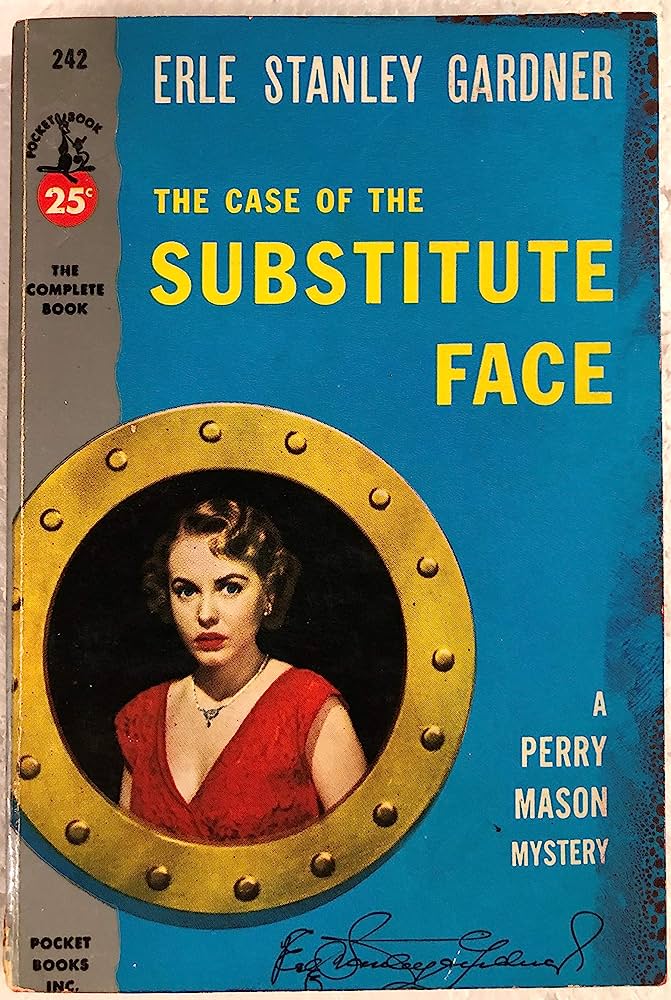
But sometimes Erle Stanley Gardner’s plot wheel must have landed on a different space, and things begin a little differently. Take the ace attorney’s twelfth adventure, 1938’s The Case of the Substitute Face. Here we find Mason and Della returning from a trip through China and Japan where Perry was studying the police methods of the Far East, after which the pair decided to make a jaunt to the island paradise of Hawaii on their way home. As they stand on the liner deck staring at the receding shoreline and waiting to honor tradition by tossing their leis into the ocean waters near Diamond Head, Della sighs and says, “I’ll never forget this, Chief!” To which Mason responds:
“It’s been a wonderful interlude, but I want to start fighting. Over there is something which civilization has commercialized but can’t kill, a friendly people, a gentle, warm climate where time drifts by unnoticed. I’m leaving it to go back to the roar of a city, the jangle of telephones, the blast of automobile horns, the clanging of traffic signals, clients who lie to me and yet expect me to be loyal to them – and I can hardly wait to get there.”
We love Perry Mason because the man loves his work. It turns out that he doesn’t have to wait until he gets home: One of his fellow passengers, Mrs. Newberry, approaches Mason and asks him to look into some trouble involving her husband Carl. Until recently, the man was the bookkeeper for the Products Refining Company and spent his days grumbling about not having the money to give his beloved stepdaughter Belle all the advantages she deserved. But then, he “won the lottery,” quit his job, changed his name and his wife’s name from Moar to Newberry (the surname of Belle’s late father) and started moving the family around the country, ending up in Hawaii for six weeks.
Nothing suspicious there, right?
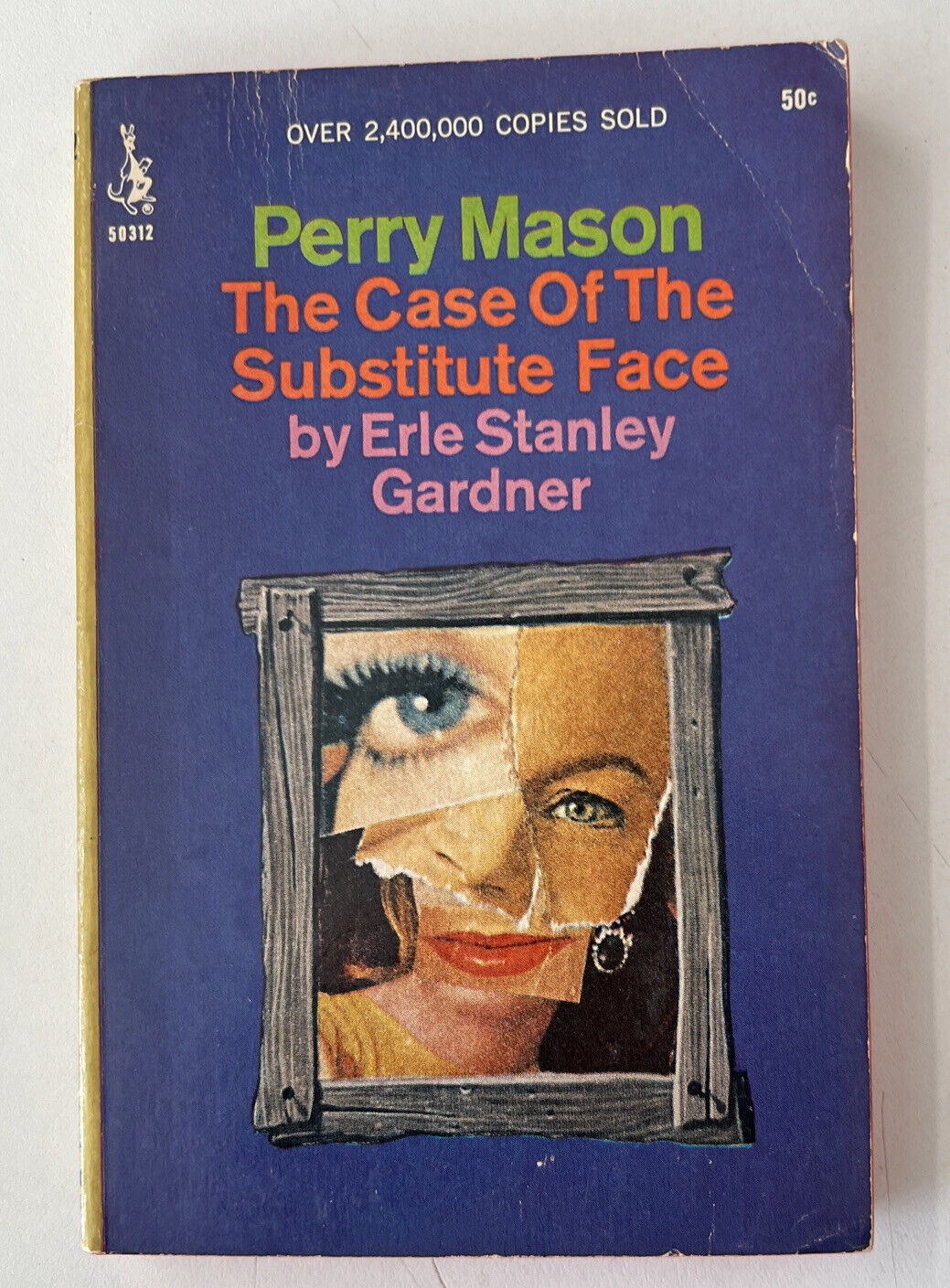
It looks like Carl Newberry’s plan has worked because Belle has recently attracted the attention of wealthy socialite Roy Hungerford, who is starting to ignore his girlfriend, the “rich and ruthless” Celinda Dail, who is also on the ship with her father, Charles Whitmore Dail. And Dail happens to be the the president of – wait for it – the Products Refining Company! Is it any wonder that, for some reason, Carl Newberry doesn’t want to leave his cabin? Or why Mrs. Newberry is so worried. And her fears are compounded because somebody has stolen a framed picture of Belle and substituted it with that of a famous Hollywood starlet whom Belle closely resembles.
Mason is asked to serve as an intermediary between the Newberrys and the Products Refining Company. If Carl has embezzled funds, as his wife fears, she hopes that a deal can be struck where Carl will return most of the money in exchange for avoiding prosecution. The lawyer agrees to take the case, provided he never meets Carl Newberry and makes it clear that he is not representing the man but aiding his daughter, to whom Della Street, who happens to be Belle’s roommate aboard ship, has taken a shine. But before negotiations can be satisfactorily completed, a storm breaks out at sea, and a man goes overboard. By the time the ship docks in San Francisco, Mrs. Newberry has been charged with her husband’s murder.
There is a certain aspect of this business that seems all too obvious to any well-read mystery connoisseur but especially to one who recently dabbled in a certain shin honkaku crime novel. Putting that aside, however, this is a cracking good read, and Mason is in high form in terms of the dirty, er, tricky games he plays in his practice of the law. We see this over and over again in the books, and here Gardner gives Mason the space to explain to his trusted P.I. sidekick Paul Drake the reason for his constant chicanery:
“A person is accused of crime, and immediately the whole law-enforcement machinery gets busy, unearthing evidence to prove he’s guilty. When he tries to get evidence to prove he’s innocent, he runs up against a brick wall. The authorities are sullen, indifferent or downright hostile. He has to hire his investigators, and naturally, he can’t hire a whole police force, no matter how rich he is. That’s why I have to resort to what it has pleased the district attorney to refer to as ‘spectacular practices which have made a burlesque of justice.’”
Mason pulls some amazing stuff in this novel in his efforts to prove that certain witnesses have been corrupted, by their own guilt or by vanity, and to figure out what happened aboard ship on that stormy night. Paul Drake provides as much comic relief as support as he rails against being dragged into situations that threaten his continued employment. But the MVP here is Miss Della Street, whose closeness to Mason has never been more apparent and whose loyalty to her “chief” threatens to turn her from the ace attorney’s greatest asset to a liability.
To my delight, the trial takes place in San Francisco, and if we don’t hit the courtroom until the halfway point in the novel, the scenes therein are really exciting. The one-shot D.A. here is particularly revolting:
“Donaldson P. Scudder, a slender, anemic individual, with skin which seemed almost transparent, and the precise, academic manner of one who is completely removed from human emotions . . . “

Perry Mason plays Scudder like a fiddle, and the final trap is particularly delicious, especially coming after a tense episode that threatens to tear Perry and Della apart. But in a last minute denouement, the truth is revealed, and our favorite legal trio can return to Los Angeles. Not for the first time, Perry looks misty-eyed at his secretary and you almost think things could turn romantic. But then Della pulls her hand away and makes her boss face the facts:
“Let’s not yet too sentimental. You know as well as I do that you’d hate a home if you had one. You’re a stormy petrel flying from one murder case to another. If you had a wife you’d put her in a fine home – and leave her there. You don’t want a wife. But you do need a secretary, who can take chances with you – and you have another case waiting in Los Angeles.”
These early cases continue to delight me with their combination of legal legerdemain, classic clueing, and noirish suspense. (There’s a terrific gangster in this one!) Many of these 1930’s titles barely qualify as whodunnits – which puts them at odds with the strict formula that the CBS series adhered to. The book formed the basis for the 32nd broadcast episode of the first season in 1958, twenty years after the novel was written. Like the novel that followed it, The Case of the Shoplifter’s Shoe, Substitute Face is structured so differently from the stodgy pattern of the series: introduce the victim, the defendant and five or six suspects, have the trial, and let Mason unmask the killer on the stand with a lot of fireworks.
Those fireworks take place much more effectively in the novel, which has been stripped to its barest bones for TV. Most heartbreakingly, everything Della does in the book is gone, and she is reduced to shorthand taker and sandwich deliverer. In fact, half the book’s characters are missing, and then the screenplay adds two extraneous gentlemen – one of whom is unmasked at the end so anticlimactically that even Perry Mason confesses his surprise at the reveal. There is no San Francisco – how can you have Hamilton Burger if the trial takes place in SF? – but fortunately, Mason’s biggest bluff against the D.A. from the novel remains intact and is the best part of the hour. Honestly, my long-standing love of the series I grew up with does take a beating when I compare it to the specific novels I read.

And just a bit of super-trivia here: the defendant is played by Lurene Tuttle, who also played the defendant in the episode based on Shoplifter’s Shoe. In fact, Tuttle played the defendant four times on the series, more than any other actor, and also got to be a witness in a fifth episode – and the murderer in her final turn.
In his recent review of the Mason adventure that came before this one, The Case of the Lame Canary, my buddy JJ informed us that the book was meant to be Perry’s swan song for various interesting reasons, but that the great acclaim for the novel in serial form revived Gardner’s energy and belief in his finest character. This is evident by the great enjoyment derived in the two follow-ups. I echo my pal when I say it’s truly wonderful that an author so delightful was so prolific, and I’m looking forward to many more sojourns with Perry, Della and Paul, as well as D.A. Jim Selby and P.I.s Bertha Cool and Donald Lam.


I’ve not read this, but it stands to reason it would be a good one — Gardner clearly got his mojo for the series back and went at it all guns blazing.
LikeLiked by 1 person
I feel like when I read Gardner decades ago, it must have been later Mason novels, which I feel leaned in much more to the traditional mystery structure of the TV show. He was more prolific in the second half of his career than the first, and that might not have been a great thing – although time, and more reading, will tell.
LikeLiked by 1 person
Never a favorite title for me, your piece has motivated me to read it again.
Did you know, Gardner had four secretaries and often dictated four different stories simultaneously?
Read the Case of the Bigamous Spouse. It’s a good mystery and there is a very funny interchange between Mason and the man-of-all-hats in a small mountain town. Unfortunately, the teleplay took all the fun and mystery out of the story.
LikeLiked by 1 person
I’m starting to think that was the norm with the teleplays. Granted they were adapting a novel into fifty minutes. But the playfulness and the sexiness and most of the suspense from the books is gone. Hard to wrap my head around that!
LikeLike
Pingback: A HOLIDAY FROM MURDER | Ah Sweet Mystery!
Pingback: SHE WALKS IN BEAUTY LIKE . . . The Case of the Borrowed Brunette | Ah Sweet Mystery!
Pingback: BRADLEY’S BEST OF ’23 AND A PEEK AT ’24 | Ah Sweet Mystery!
Pingback: WHO TAW THE PUTTY TAT?!? The Case of the Lame Canary | Ah Sweet Mystery!
Pingback: THE ERLE STANLEY GARDNER INDEX | Ah Sweet Mystery!