He’s baaaaackkkkkkk!
My trip to the East Coast this year was relatively brief and oddly shaped. Two days in New York to see a show and hang about Hell’s Kitchen, followed by five days canoeing on a private lake in Connecticut and eating my way through Stamford, Greenwich, New Canaan and Darien (pronounced Dahr-ee-ENNNN). Then I returned to NYC for another five days, with five shows and a trip to a certain bookshop on the agenda.

After three years of cowering in my little flat, I had to get my sea legs back. But, by and large, the vacation was good to me . . . until the last day, when Jet Blue became the airline most likely have its name changed to “You’re Dead To Me.” I won’t go into it, for fear of being bombarded with other people’s war stories about the current state of air travel. It is what it is.
Today’s post is devoted to my theatre experiences this year. If you follow me on Facebook, you have already seen the stuff below in raw form. (I tended to dictate my thoughts into my phone after the show, and several times I pushed the wrong button and had to start over when I was almost done. It made my thoughts turn fondly to that scene from Citizen Kane when Joseph Cotten sits at his typewriter, ominously plunking out his review of Susan Alexander’s operatic debut. Herewith are my slightly edited thoughts on the six shows I saw; the mystery stuff comes tomorrow.
* * * * *

I started with something very special . . . Once Upon a One More Time, the new musical set in a crazy fairy tale world and scored with nearly two dozen songs from pop queen Britney Spear’s songbook, is not the sort of musical you would associate with yours truly. But I had a very special reason for attending: my former student, Ashley Chiu, was making her Broadway debut in this show. I was fully prepared to go and suffer through a loud show and hug Ashley afterward, especially after reading some of the reviews.
I’m not sure these reviewers got it when they wrote about the show. I’ve never been a part of The Britny Army, but it’s huge, and a large contingent of them was at the Marquis Theater with me that night. Some critics didn’t get the placement of Spears’ songs in John Hartmere’s libretto about a group of fairytale princesses learning how the patriarchal narrative of their stories has betrayed their quest for a worthy “happily ever after” – but the audience got it. You could hear it in their reaction as each song began: that knowing burst of laughter and joy as beloved characters (mostly in their Disneyfied versions) popped and snapped and brought these classic stories into 2023, creatively and politically.
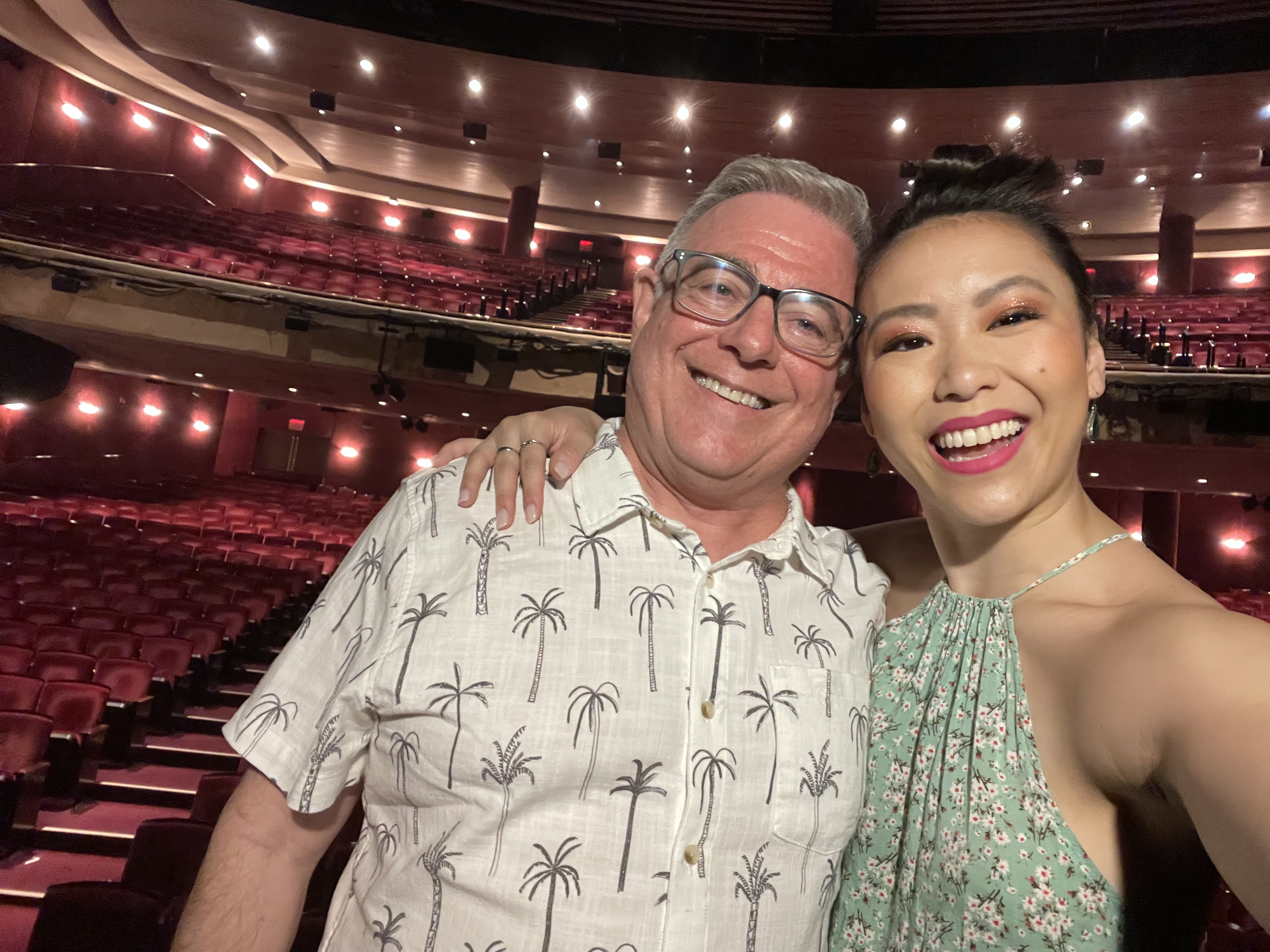
Every princess in classic, Laura has thought she earned her right to happiness: Sleeping Beauty (played by our own luminous Ashley), Snow White, and the Princess and the Pea had to literally sleep (or not) for it; the mermaid Ariel sacrificed her voice and Rapunzel her hair; and Cinderella, like most of the others, was horribly abused by a mother figure. The musical begins at the end of their stories, which, according to contract, they must relive daily for the amusement of children everywhere. Their daily grind is supervised by a harsh taskmaster known as The Narrator, who sees everything done by the Prince as perfection but who scolds and berates his flock of princesses and then tells them to be grateful for their happiness.
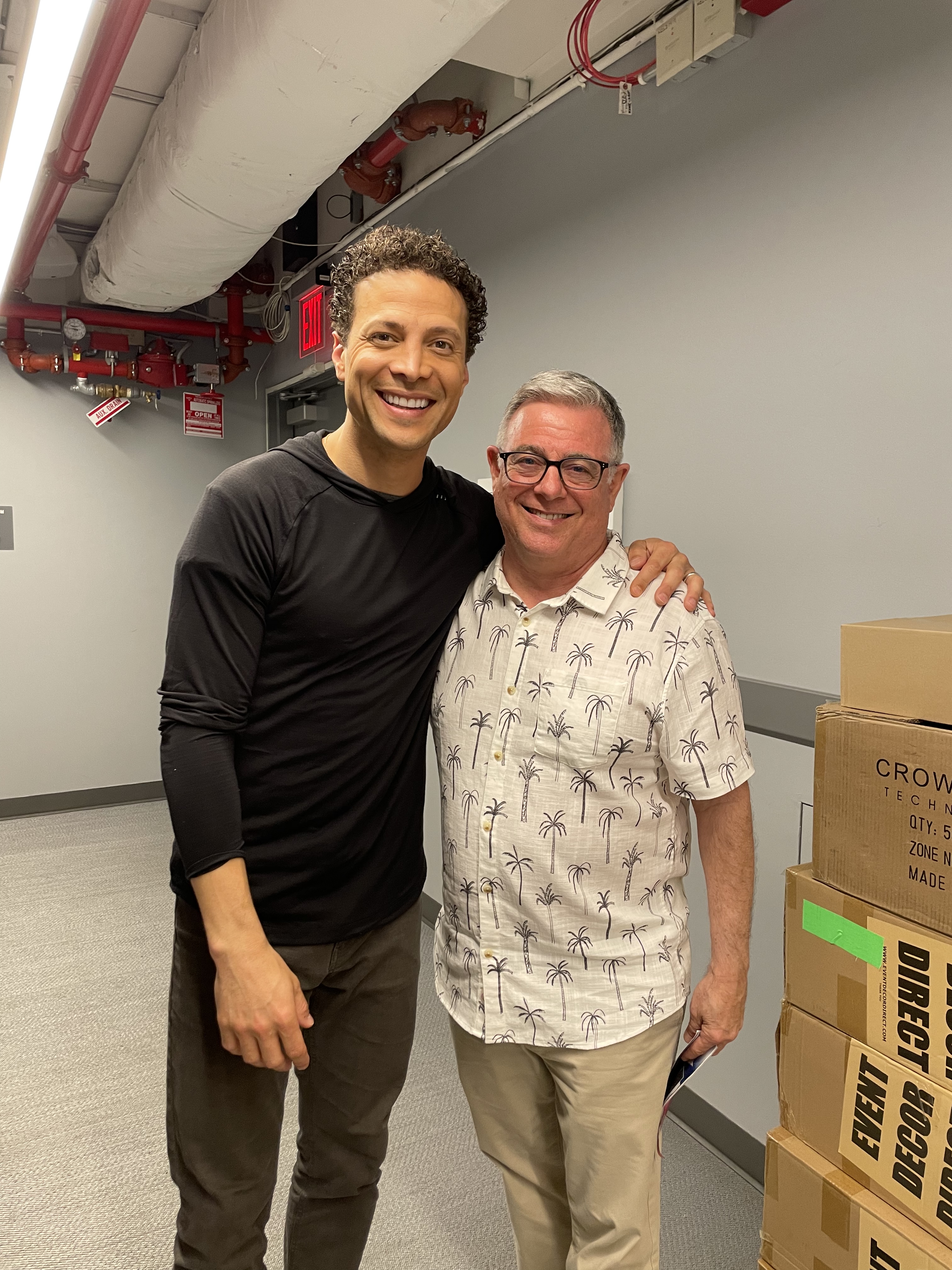
Cinderella has long suspected that her happy ending with Prince Charming (a charmingly shallow and funny Justin Guarini) was a sham, and she soon discovers how true this is with the help of the original Fairy Godmother (the OFG), a banished sprite who offers Cinderella enlightenment by sharing Betty Friedan’s The Feminine Mystique. When Cinderella disobeys the rules and shares the volume with her book club composed of all the other princesses, the path to true enlightenment begins. And it reaches its climax when the girls discover that all their princely true loves are – the same man!
Into the Woods it ain’t, and having just seen the tour of the Broadway revival of Woods in San Francisco, I was heartily reminded of that. OUaOMT never takes itself too seriously, even if the message its sending is a healthy one, as well as one that resonates with those who have followed Britny’s recent family travails. The truth is, Into the Woods will always be one of my favorite musicals, and Once Upon a One More Time will not. But there’s much fun to be had here, and if Woods deals with eternal truths about the human spirit and the responsibilities we have to each other, the feminist spirit of OUaOMT’s message will resonate with the young women who will flock to see it. The attempt by American women to forge their own successful narrative is being attacked anew, and this show teaches that no single fairy tale fits all girls. Everyone must be given the freedom to write their own story.
There’s also a gay subplot, involving subsidiary Prince Erudite and Snow White’s favorite dwarf, Clumsy. May I say that when these two men kissed, it prompted a huge cheer from the audience that set my heart aglow, especially since on this day the Supreme Court had set another boulder of prejudice careening down the pike.
Does the story make total sense? Um . . . not all the time. Does the happy ending it manufactures for these characters feel tacked on? Most certainly. But the fine performances and the ebullient spirit of Spears’ songs seen in this context push us past these mild hiccups. Given how they’re written, Cinderella has a hard time matching the Prince’s hilarious vanity, but Briga Heelan works nicely with Guarini. I saw the understudy for Snow White, Salisha Thomas, and she was lovely, as was Jacob Burns as Erudite. Of course, the show was stolen by the villains: Amy Hillner Larsen and Tess Zoltan made hilarious stepsisters (who get to do a LOT more than the steps in Woods) and Jennifer Simard takes the prize channeling Bette Davis as the wicked Stepmother. Her story arc takes a bizarre turn at the end, but I just wanted to watch Simard do it all, so I didn’t care much about that.
And Ashley, Ashley, Ashley! She lit up the stage from start to finish. All I can claim is that I put her in pink first! The rest she did on her own! And the folks in my community can claim with pride that we knew her once upon a one more time!
* * * * *
It’s hard to believe that Parade, the musical docu-drama/ love story, with a book by Alfred Uhry, and music and lyrics by Jason Robert Brown, debuted on Broadway twenty-five years ago. Both men won Tonys for their work – and that’s all the play got. And now, along comes the revival, honored at the awards ceremony at last for production and direction of this dark, complex, and beautiful show.
I imagine this production, which originated off-Broadway, has been stripped down from the original, but under the striking direction of Michael Arden, the stage – with a large, square wooden platform in the center and various tables, benches and chairs on either side – feels lush and teeming with life.
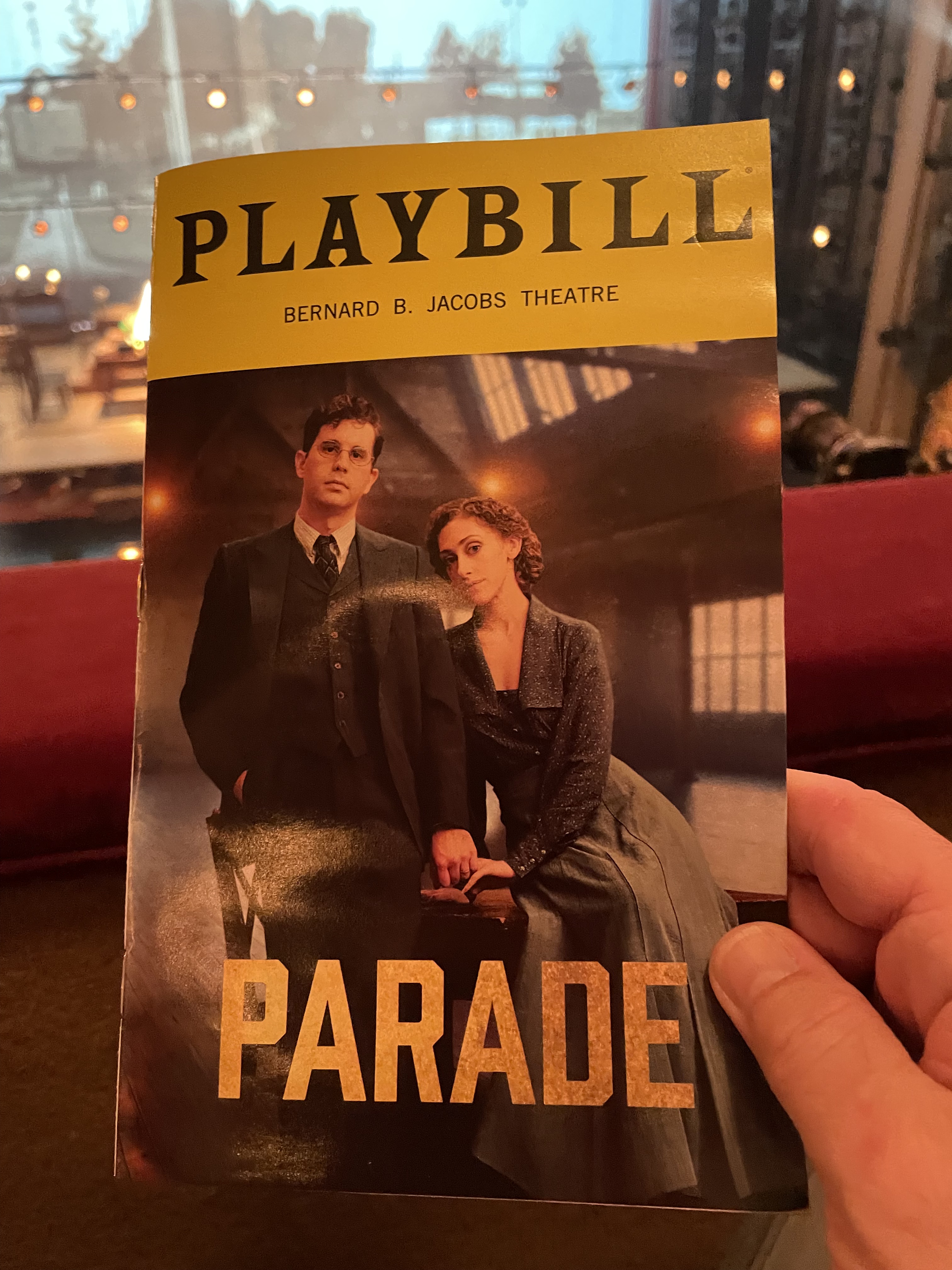
I said this is a docu-drama. Arden leans into this by placing vintage photographs behind the actors who play these real-life characters, and by providing title cards, à la Law and Order, to identify time and place over the two-year period that chronicles the murder of Mary Phagan, and the arrest, conviction, and ultimate lynching of her boss, Leo Frank. That Frank was innocent is beyond doubt; that he was scapegoated because he was Jewish and because various people – a grieving, angry populace, a politically opportunistic district attorney, and a couple of reporters in need of a big story – had to win, is abundantly clear.
If Parade was only this, it could be unbearable to watch. But it’s a couple of other things, too. As I alluded, mostly it is a love story. It tells of how the Franks, who are barely surviving as a couple because Leo is a fish out of water in Marietta, Georgia, and socially and romantically inept, find their way through horrible adversity to a deep, romantic love for each other. The central and most tender scene in the play occurs near the end when Lucille brings a picnic to share with her husband in his jail cell. It is the first meal they have shared in two years, and although he has been sentenced to life in prison because, thanks to Lucille, the governor has commuted Leo’s death sentence, they are so full of hope that they flirt and fantasize and tenderly make love. They also sing the show’s most passionate song, “All the Wasted Time,” and I can’t think of many ballots that’s so clearly delineate a pivotal moment in a dramatized relationship than this one does.
When they’re singing, Ben Platt and Micaela Diamond bring down the house together. When they’re acting, however, it’s her show. The word on the street was that this production always intended to focus more on Lucille’s dogged heroism. But Leo was never a hero in Parade, always a victim. His dramatic arc is that suffering makes him a better human being and husband. It’s right there in the script: Lucille is shunted aside by everyone in Act One, then takes matters into her own hands in the second half. Diamond plays the hell out of the part. Thin and pretty in a faded way, she becomes luminous by the end.
Platt is a wonderful singer and, to me, a fine comic actor. But when he plays it serious, all the tics come out. Leo Frank is socially awkward, but he’s not Evan Hansen. Platt shoots his lines out at super-speed and gives them awkward inflections; when he sings big notes, he shuts his eyes, tight, ducks his head back, and scoops it forward like a turtle coming out of his shell. He’s supposed to seem very non-sexual until the end, but there’s a scene in the first act where Mary’s coworkers testify how Leo would come onto them, and the actor is supposed to play a perverted fantasy version of the real guy. Platt could not bring this off.
Still, Diamond brings out the best in him, and their songs together soar. They are aided by a terrific cast in supporting roles: it’s always great to see Howard McGillin on stage (as the Old Soldier in the opening and the trial judge later on). Sean Alan Krill and Stacie Bono are warm and comfortable as the Governor and his wife; I really noticed this time how expertly Uhry switches to them whenever we need relief from the terrors happening in Marietta, and given how sharply we critique our modern politicians these days, it’s nice to meet one who chose to do what’s right over what was politically expedient.
They face off against a trio of villains, all wonderfully performed: Paul Alexander Nolan as the DA who lusts to be governor; Jay Armstrong Johnson has the reporter in his cups, who is jonesing for a scoop so badly that any fake news will do; and Manoel Felciano as an editor who may be the progenitor for the Proud Boys, as he attempts to use his influence to kill as many Jews as he can.
As much as Parade is about everything I’ve said, it is also a powerful illustration of the state of life for Black people in the post-Civil War South. The song “Old Red Hills of Home” is one of the most beautiful modern musical opening numbers, but it is sung by a community waxing nostalgic for those prewar days. As the white citizens all sing magnificently and wave their Confederate flags, the Black characters stand off to the side, staring with unfathomable feeling at their neighbors. In the homes and workplaces we enter, they are the servants and lowest of employees who must assume a mask of deference in order to avoid trouble, yet are painfully aware that their new “freedom” has scarcely altered their position in the community.
One man, Newt Lee (Eddie Cooper) stands up to the D.A., a moment that earned the character and the actor loud applause. The others are not so lucky: the prosecution forces the Frank’s maid Minnie (Danielle Lee Greaves) and an escaped convict named Jim Conley (Alex Joseph Grayson, who steals the show from everyone) to perjure themselves in order to give the court its unjust conviction. Finally, we meet the Governor’s butler and maid, whose masks of servility drop when they are alone. In the Act Two opener, “A Rumblin’ and A-“Rollin’,” they sing sardonically about how a Jewish man fighting local prejudice still gets the support of other white men, including governors, Thomas Edison, and Henry Ford, while a black man in the same position can expect nothing like that:
“I can tell you, this, as a matter of fact
That the local hotels wouldn’t be so packed
If a little Black girl had gotten attacked
Go on, go on, go on, go on.
They’re comin’, they’re comin’ now, yessiree
‘Cause a white man gonna get hung, you see.
There’s a Black man swingin’ in every tree
But they don’t never pay attention.
In Arden’s hands, this Parade makes us pay attention and makes us sadly note how little things have changed. The production begins with a picnic, and ayoung man who is pulled away from his girl,so that he can take arms and fight in the Civil War. He comes back a cripple, and there is no clear sense that he and his girl were ever reunited. Two hours later, we watch Leo and Lucille have their final picnic before he is wrenched away from his jail cell and lynched on the branch of a tree. A third picnic ends the show: this time it’s a young modern couple who mimic the actions of both earlier pairs. Who knows what will happen to them, but as they set down their meal and begin to make love, the title appears beneath them stating: “It is still ongoing.” It’s a sad reminder of how prescient Parade remains in our present time. And it is why we Jews forever repeat the mantra: “Never forget.”
* * * * *
This has never happened to me on Broadway before: I went to see Peter Pan Goes Wrong, performed by Mischief, the theatre troupe responsible for The Play That Goes Wrong and a host of other riotously funny slapstick sequels, all featuring an inept troupe called the Cornley Players. You can watch most of their stuff on YouTube, including PPGW, but any chance to see this exceptionally talented group live is an occasion to celebrate. I saw The Play in London and laughed my head off. The only dampener was the presence of two exceptionally long-haired teenaged girls on my right who hated the show. They kept sighing and squirming against me and floucing their long straight locks into my face.

Peter Pan isn’t by any means as clever a piece as The Play. As someone commented on Facebook, the basic idea sounds an awful lot like a famous monologue from Christopher Durang’s 1978 one-act play, ‘Dentity Crisis. And you can find videos on YouTube of actual productions of Peter Pan that went very wrong, even without the help of a group of talented comedians. But it was the actors themselves I had come to see, and most of them were there: Henry Shields, playing Chris Bean, a pompous actor and “your die-rrrrrrector,” who has cast himself as Mr. Darling/Captain Hook; Henry Lewis playing Robert, the actor who wants everything Chris Bean has, but ends up playing the dog Nana, Peter’s shadow, and anything else left over in the play, and who spends most of his time in all the shows trying to sabotage Chris; Charlie Russell as leading lady Sandra, not allowing being cast as sweet little Wendy to stop her from shagging most of the cast; Nancy Zamit, the one I want to just sit and have tea with and laugh all day, as actress Annie, who quick-changes her way through Mrs. Darling, Liza the maid, Tinker-Bell and a Lost Boy; and Chris Leask as Trevor, the stage manager, who allows the audience to become closely acquainted with his butt crack.
(Sadly, two of my favorite actors were missing: Jonathan Sayer, who plays the pathetic can’t-learn-a-line actor Dennis was out that evening, and Dave Hearn, the Grinner, was not in this cast. The man who replaced Hearn was slightly better than Sayer’s understudy, but both of the originals were sorely missed.)
I knew well to arrive at the theatre early because there’s always a terrific pre-show, dominated by Trevor and his crew, but involving actors trying to “help” in hilarious ways. Turns out the British man sitting behind me with his wife and son was wearing this really loud shirt which attracted the actors, and soon they were climbing all over him, trying to “fix” his chair or sending long electric cables out into the audience to try and get more power for the stage. Through it all, the company interacted with people in funny ways, commenting on how many people had brought their children, “even that ugly child” or flirting or insulting or preening in wonderful ways.
At that point, I should have been paying more attention to the way the audience was responding. In my fantasy of being called upon to assist the actors in prepping the show, I imagine that they would adore me because I had the good sense to play the “straight man” to their tomfoolery. Now I’m sure there’s always one person in the crowd who thinks they are funnier than the material on display and who seek to show off. On this night, that type of person was legion.
The play began. The actors were wonderful as always. The slapstick was crazy and violent and fun – and full of surprises to first-timers, such as when Wendy lays back on the top bunk of a triple-decker bunk bed with a sigh, causing the bed to collapse and crush her enormous “younger” brothers. It should have been a lovely, hilarious evening. But the audience . . . . oh, God! Never has a group of yahoos worked so hard to ruin a performance. It isn’t that the actors didn’t know how to handle them; they do, in fact, encourage audience participation and they are readily prepared with ad-libs in case a bit goes south. But these fools never stopped. They refused to be led by the company; instead, they demanded to be the leaders.
I had a beautiful seventh-row center seat, but so did a bunch of rude people. The guy on my right reminded me of Archie Bunker. This jerk from the Bronx laughed too long and had a loud, high-pitched cackle that could shatter glass, and he kept up a running commentary of responses to the actors that he thought were hilarious but were actually rude bordering on cruel. Then there was the kid behind me, the son of the British guy with the loud shirt, who loves Mischief enough to know all their shows by heart and so kept shouting, “The chair’s going to collapse,” “He’s going to get stuck in the doggy door,” as if to prove his “intelligence” to the entire crowd. The guy on my immediately left was dead silent. He oozed his contempt for being dragged to this show and kept stealing glances at his phone where he was streaming a wrestling match.
I was in hell, and I blame it all on social media, which has given people the sense of entitlement to say anything they like and feel safely insulated from any condwquences for their words or actions. I clung to any chance the actors had to give back as good as they got. At one point, when Captain Hook needed to hands to uncap a bottle of poison, he started a bit with a little boy in the audience that was clearly part of the show. Even though the kid wouldn’t stop issuing his own smart-aleck remarks, Henry Shields handled him with aplomb. And Shields’ responses were hilarious because they were true. He remarked at how American children were as confident as they were inadequate. He blamed the boy’s behavior on his mother’s parenting (she was sitting next to the kid), and at one point he shouted, “This is not television! I can see you, too!!”
Who knows if the audiences at the Ahmansen Theatre will react the same way when the show transfers to Los Angeles for a five-week run. All my L. A. friends should run and buy a ticket!
* * * * *
Sweeney Todd what is the Freddy Krueger of British Victorian fiction, I monster who killed men in his rigged up, barber chair and fed them to his confederate Nellie Lovett, who stripped the meat from their bones and baked it into succulent pies. Todd debuted in an 1846 Penny Dreadful called “A String of Pearls” and recurred in stories and plays for over a century. (Freddy Krueger had a pretty long run, too, appearing in something like ten movie, a TV show, and even a video game.)
In 1970, playwright Christopher Bond wrote a play that brought a humanizing aspect to Sweeney by giving him a tragic backstory. Stephen Sondheim saw Bonds play in 1973, and spent the better part of the decade, brooding and composing until he had fashioned his most epic work, a near opera that was gruesome and hilarious and deeply moving. (It was my great good fortune to see the national tour of the original production, starring Angela Lansbury and George Hearn, when it played in San Francisco.) In his head, sometime had pictured a production similar in intimacy to Bond’s play, just elevated by music. But producer Harold Prince wasn’t interested in that: he envisioned a mammoth set and staging that would embody the victimization of the common folk during the Industrial Revolution. Sondheim conceded, and Prince’s vision certainly was effective.
Still, subsequent productions have stayed on a smaller scale, both for financial and creative reasons. The smaller scale also works beautifully, even if some of these productions have assumed the silly sobriquet. Teeny Todd. This is a show that seems to inspire high concepts: there was the famous small cast version by John Doyle, where the actors also played the instruments. Frankly, that one didn’t resonate with me; all I could ask throughout was: “why”? So what I would have liked to see took place in an actual pie shop. I mean, who doesn’t like to eat along with the cast? Heck, I directed my own small-scale production somewhere around the turn of the millennium. It was marked by one of the cast members losing their finger backstage during a performance, for me having to go on and die in their place onstage, and for our prop mistress creating the most delicious meat pies I have ever tasted! (Dark red chocolate!!) I sent a summary of all these adventures to Mr. Sondheim himself in a letter, and I have his reply occupying a place of honor by my bedside.

The latest Broadway revival straddles the space between the epic and the intimate. Mimi Lien’s set, with its working bridge and tower with an attached derrick, is a darker, more symbolic implication of the era than the original. But it’s Natasha Katz’ lighting that really sells it, amply helped by the sound design of Nevin Steinberg. (Both these people are well deserving of their Tonys, and the whole company should be grateful to them for what they bring to this bloody table.) The show is directed by Thomas Kail (Hamilton) and choreographed by Stephen Hoggett (Harry Potter and the Cursed Child) – and it shows, particularly in the way the ensemble moves around, partly as if they’re being buffeted about by history and partly as if they’ve been hit with a spell.
I have no problem with change or modernization. I have stressed here that Hal Prince’s original concept isn’t the be-all or end all of Sweeney Todd. But my problem with the current production is that I’m not sure exactly what it’s trying to be. It has its own weird language, particularly in the way it evokes humor. One of the smartest aspects of the original idea was the way it melded the tragedy of Grand Guignol with the goofy fun of English music halls. Kail isn’t going for either one here, and while the dramatic sections are effectively staged, (and – I cannot stress enough – really helped by the lighting), the humor seems rooted in sitcoms, which is, well, weird. As a result, I found myself increasingly put off by the one person I most wanted to see in this show: Annaleigh Ashford. I had been prepared for the fact that Ms. Ashford had found a whole different language with which to portray Mrs. Lovett. She is a fine actress and comedian, and here she uses her body and voice in a multitude of ways that made the audience scream with laughter and made me miss Angela Lansbury very much. Ashford proves her acting chops in the late parlor scene where Tobias (another modern rendition of a character, but this time much more effective in the hands of Stranger Things star Gaten Matterazzo) sings “Not While I’m Around” to her. Here, Ashford found things that I never saw Lansbury do: as obsessed with Sweeney Todd as she is, here we find a Mrs. Lovett who truly enjoyed hanging around with Toby and now must face the fact that he is a danger to her plan and must be destroyed. We see worry, we see bluff – but here Ashford adds a strong sense of grief, making the scene actually heartbreaking.
Sweeney Todd is a musical about obsession: the “hero” is obsessed with revenge and the “heroine” with love. In this production, Ashford translates that love into a desperate need for sex, which is odd because the actress is so young and pretty that she could find sex with just about any other member of the company if she had a mind to. As for Josh Groban . . . well, he sings the role beautifully, but his idea of obsession seems to be a perpetual squint. I think that if I had close my eyes, I would have believed in him more. But my other Sweeneys, I have seen, including Hearn, Bryn Terfel, and Michael Cerveris, all seemed stuffed to bursting with pain and rage, , Groban played the role like he was dead inside. His huge musical moments – “My Friends,” “Epiphany” and that moment after he kills the Beggar Woman and learns the truth about her – were musically stirring but visually stunted. He was like a hollow shell out of which a beautiful recording of the songs burst through.
Everyone else did a good enough job, except for the actor playing Anthony the sailor. His rendition of the part and his singing felt too modern (and too off pitch). I didn’t hate the show. You can’t hate something as brilliant as Sweeney Todd, and Groban and the ensemble sang the hell out of it. The whole experience was made worse for me by something that wasn’t the company’s fault. Once again, I was surrounded by an audience on steroids. Maybe this is the hottest ticket on Broadway. Or maybe, as three gentlemen were discussing during intermission, there was a group present – maybe a Josh Groban or a Stranger Things fan club. Whatever the reason, they screamed and stamped and laughed at everything! Everything! I thought the balcony might cave in, and I was on it!! It went beyond the brilliance of the play itself and annoyed me enough to contemplate making a few meat pies of my own.
* * * * *
Some Like It Hot is “officially” one of the greatest movies of all time. It has been proclaimed as such on critics’ lists and in audience acclaim since it opened in 1959. Everything – the script, the performances, the direction – is hilarious. Marilyn Monroe is so delightful that you have no idea what a mess she was while making this picture (unless you read Tony Curtis’ autobiography). And the film was so ahead of its time in terms of LGBTQ themes that it is credited with helping to decimate the dreaded Hays Production Code.

You would think that the story of two jazz musicians who witness the St. Valentine’s Day Massacre, then disguise themselves as women and join an all-girl band in order to escape the mobsters trying to silence them would make a fabulous musical. But when Jule styne tried it in 1972 in a musical called Sugar (producer David Merrick couldn’t get the rights to use the movie’s title), it pretty much laid an egg.
In 2002, a national tour of a slightly reconstituted Sugar, now with the movie’s title affixed to it, came through San Francisco. Its big gimmick was that Curtis, the original Joe/Josephine, starred here as Osgood Fielding III, the part originated in the film by Joe E. Brown. Curtis can be very funny when he wants to be (he was in the movie), but he was miscast as Osgood – or maybe they refashioned the character to make him more Curtis-like. Anyway, it didn’t really work, although Tony Curtis was very handsome and charming. The attraction for local audiences was that local girl (and former student of mine) Ashlee Fife was kicking up her heels in the chorus. (Maybe all my students named Ashley/Ashlee will succeed at this!!) The night I saw the show, there were a million friends in the audience, and Ashlee shined. But even her amazing dancing couldn’t keep audiences from noticing that the ”new” Some Like It Hot was just as tiresomely old-fashioned as Sugar had been in its first run.
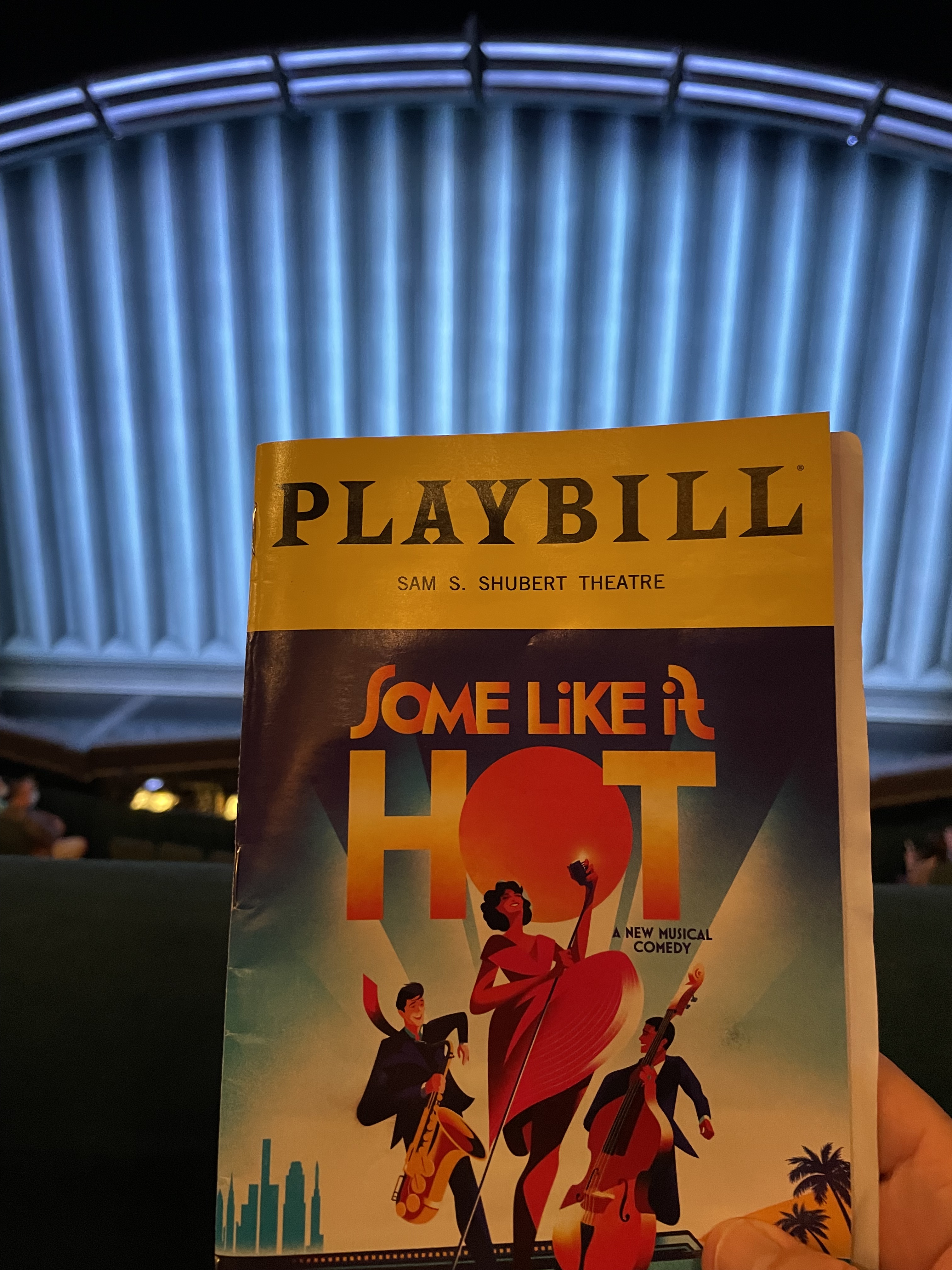
Still, it is such a classic film that somebody was bound to try again. This time, we’ve got Marc Shaiman and Scott Wittman, who successfully showed how to turn a period musical film into a stage musical with Hairspray, and their collaborator is Casey Nicholaw, director/choreographer extraordinaire, who was responsible for Aladdin, The Book of Mormon, Mean Girls, and my beloved The Drowsy Chaperone, among others. What this team has created is something of a hybrid between classic musical-comedy and cutting-edge LGBTQ coming out story, and I’m not sure that it works entirely. Interestingly, I blame most of this on the old-fashioned part: whereas Shaiman and Witman nailed the pastiche of early-60’s pop/rock music in Hairspray, here they have fashioned a score that sounds like a dull jazzing-up of Anything Goes. The songs’ rhythms and melodies all sound alike, and the lyrics just aren’t that funny. Even the requisite comedy numbers for Osgood (his introductory “I’m a Sad Millionaire” and the “Let’s Misbehave” rip-off, “Let’s Be Bad”) rely on Nicholaw and his performers to pull them off; listening to them elicits nary a chuckle.
The choreography and some of the performances salvage the evening, which was nice for me in the moment but won’t do all those future community theatre and high school productions much good. Because this seems to be a show that plays better than it reads or listens (believe it or not, there are shows that do the opposite – as a couple of examples, listen to then see Anyone Can Whistle or Merrily We Roll Along.) Since a fairly faithful adaptation like Sugar didn’t really work (too easy to compare the iconic film performances with the stage actors and find the latter wanting), it was probably a wise move to nudge this incarnation’s storyline into the modern era with a noble tackle at gender identity. What we end up with, however, is an odd hybrid.
It begins like the straight farce of the film, with Joe and Jerry (Christian Borle and Tony-winner J. Harrison Ghee, both amazing) working for gangster Spats, witnessing their boss kill a few stoolies, hiding out in the ladies’ dressing room, borrowing some of those ladies’ street clothes, and then hightailing it on a train to California in the employ of Sweet Sue (a delightful NaTasha Yvette Williams, whose part has been expanded to make her the Emcee for the evening).
And then the two buddies/brothers split the show off in two directions. The part featuring Joe pretty much sticks to the traditional. Borle leads into his googly-eyed unattractiveness as a woman, and the best running gag in the show is how everyone notices this and pities him for it, to the point that Joe is quite upset that no one finds him “pretty.” But no one in the audience takes this seriously. In many ways, Borle is playing out the joke that Jack Lemmon was assigned as Jerry/Daphne in the film. Neither character wants to be a woman, but if he has to be a woman, then he wants to be considered attractive as any man or woman would desire to be. Joe falls for the band’s singer, Sugar Kane (we saw the understudy, who was okay) and then spends the rest of the play switching costumes back and forth and nearly getting caught at it a dozen times. All of this is better than anything I saw in Sugar.
Jerry/Daphne’s story is different from anything I saw in Sugar. Oh, there’s still the romance that occurs between the hapless Daphne and the adoring Osgood, but it all feels different handled by Ghee and Kevin Del Aguila as the millionaire. They are both absolutely terrific in their roles, but the farcical aspects of their incipient romance soon give way to more serious stuff. In the second act, Osgood takes Daphne and some of the other girls down to Mexico on a wild spree, and he sings a truly weird song to Daphne called “Fly, Mariposa, Fly.” (A mariposa is a butterfly.) Essentially, Osgood is telling Daphne that he sees through her, understands who she really is, and wants her to embrace the change that is happening within her. It sure doesn’t feel like we’re talking about the film’s surface transformation here; it’s as if Osgood is speaking a language that wasn’t composed until the recent attention paid to non-binary identity. It’s a good thing, but it’s also a bit strange in this context. The show definitely asks you to just “go with it.”
Even weirder is how much time is spent dealing with Joe’s reaction to Jerry’s news, sung to their friend in a wonderful confessional by Ghee called “You Coulda Knocked Me Over with a Feather.” The play wants to explore this more realistically, and so Joe has trouble with Jerry’s truth and has to work it out in one of the show’s worst songs, a big dance number called “He Lied When He Said Hello.” I mean, was there ever any doubt that Joe would accept everything about Jerry, who here is a Black character? We’ve already seen how, even as a child, Joe and Jerry ignored what the world around them was saying about Black and white boys being equal friends. We’ve watched Joe refuse to let Jerry accept the casual racism he encounters in every walk of life. So what’s the big deal, especially in a comedy, if Jerry sometimes feels male, sometimes female, but loves his friend in exactly the same way no matter how she’s dressed?
So yeah, this is not your mother’s Some Like It Hot. The imposition of modern-day issues robs it of the chance for being consistently hilarious. But Borle and Ghee and Nicholaw’s work are all wonderful, and the message the show leaves you with is as feel-good as any, you should pardon the expression, “straight” comedy does. As I mentioned above, though, I fear that the musical’s weaknesses will show in the future when less talented companies attempt to produce it.
* * * * *
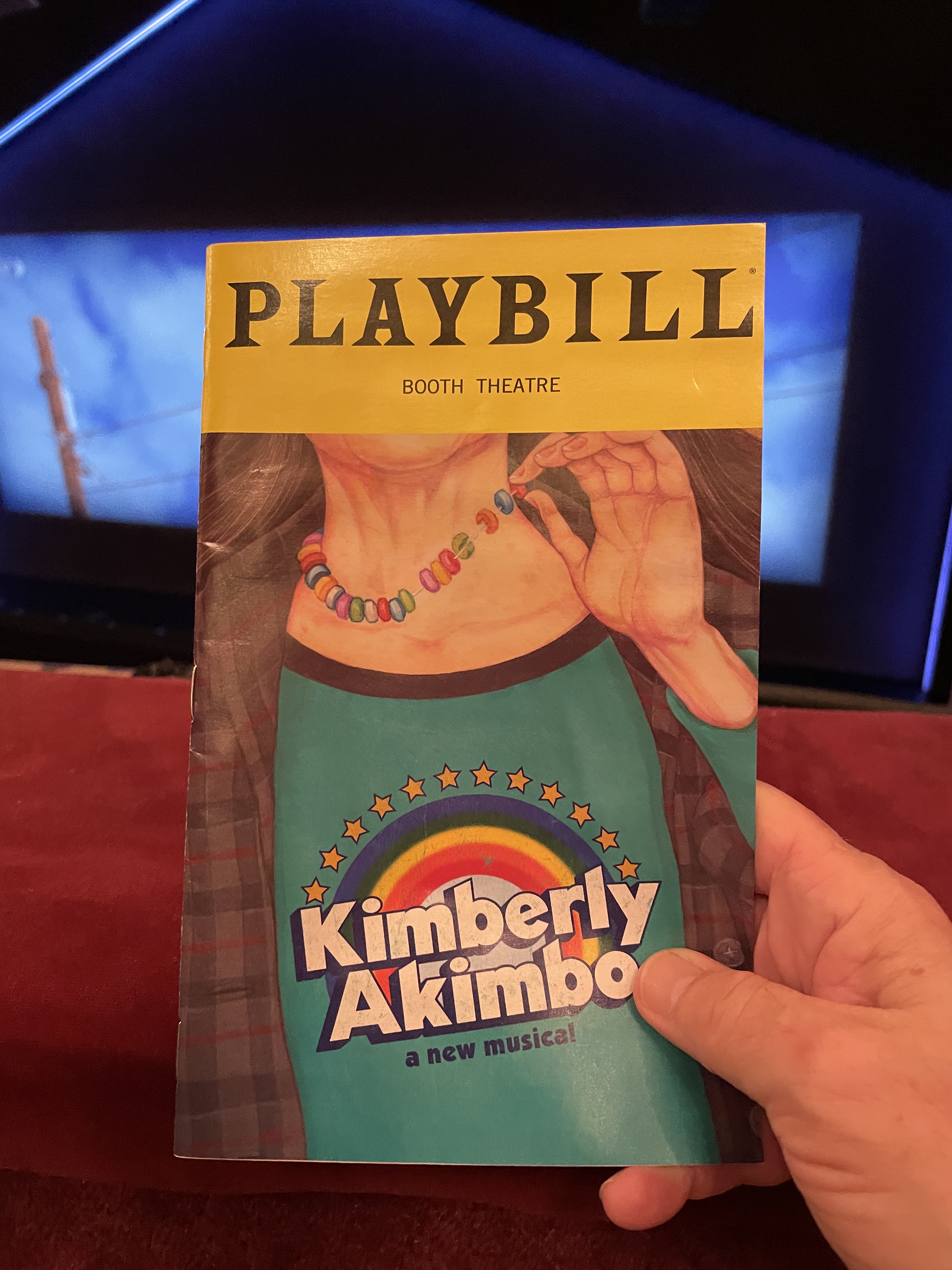
Saved the best for last! Who would have thought that the story of a girl dying of a rare genetic anomaly, whose parents are narcissistic and abusive, and whose aunt is a genuine criminal, even a killer, would turn out to such a hilarious and touching musical? Back in 2015, my favorite theatrical experience by far while visiting New York, was Fun Home, and once again, Jeanine Tesori has topped my list. This time, her collaborator is David Lindsay-Abaire, who has adapted his own play into book and lyrics for this year’s Tony-winning musical, Kimberly Akimbo.
The program notes tell us that Tesori was drawn to this play because it’s about a girl “who realizes in a very short amount of time that you should live until you die as opposed to start dying when you live.” That girl is perfectly realized in the performance of Victoria Clark, who I last saw onstage in 2015 when she played the Fairy Godmother in Cinderella. Saddled with a family of losers, Kimberly stands on the cusp of her 16th birthday fully aware that a child suffering from progeria, the “aging disease,” has an average lifespan of sixteen. Nevertheless, she is determined to live fully the life of a teenager with whatever time she has left, and to do that in THIS family means that she must, literally and figuratively, be the only adult in the room.
Clark is extraordinary here, perfectly embodying the body and spirit of a teenage girl. Topping her supporting cast is Justin Cooley as Seth, the neglected expert at making anagrams, fluent speaker of Elvish, and tuba player who wants to be Kimberly’s friend. For the musical, Lindsay-Abaire expanded his cast to include four high school students, each of them totally adorable in their awkwardness and fervent, misplaced affections. They provide a delightful counterpoint to the growing relationship between Kimberly and Seth that centers the story.
The play switches back and forth between school and Kimberly’s dysfunctional home life (David Zinn’s set is awesome), and there we meet Pattie (Alli Mauzey), Kim’s accident-prone, hypochondriacal and very pregnant mom; drunken dad Buddy (Steven Boyer), and the unwelcome but fabulous Aunt Debra, the best monster on Broadway (I’m talking to you, Sweeney, Todd!”) played by the remarkable Bonnie Milligan who, like Clark, fully deserves her Tony. I’m telling you, folks: the story, the production, the performances . . . this is the show that will stay with me for a very long time.
And most remarkable of all is the onstage relationship between Clark, who got her start on Broadway in this same theater building thirty-eight years ago, and 19-year-old Justin Cooley, who in 2021 was a finalist at the National High School Jimmy Awards and here makes HIS Broadway debut. They are brilliant together, and I can only imagine what Cooley’s resume will look like in thirty-eight years. Josh Groban could learn much from this kid.
* * * * *
And there you have it: six shows in six days. It may have been the holiday week, but there were many empty seats scattered throughout most of these theatres; the cast of Peter Pan even wrapped up their curtain call with a plea to tell our friends to come fill the theatre for the final weeks of their run. Sweeney Todd was the hottest (and most expensive) ticket, and it drew a hot crowd – too hot by half, in their over-zealous reaction to everything the actors did onstage. Maybe it’s a post-COVID reaction for me, though, because New York has never felt so crowded. And when you have a million people pushing up and down Times Square each night, and there is a similar crowd crosscutting back and forth on each avenue from 44th to 50th when the theatres turn on their lights, and you have to ask “Pardon me, ma’am, what’s that awful stench?” and the answer is a combination of Canadian wildfire smoke, burnt pretzels from a thousand food carts, subway discharge, and human sweat . . .
It’s an experience I wouldn’t trade for anything, but it’s one that I can only take in small doses.
 Ah Sweet Mystery!
Sounds like a wonderful if very intense time – you’ll be dining out on it for years😁 Very envious indeed.
LikeLiked by 1 person