I don’t think any mystery writer drives me half so crazy as Paul Halter!
If you do a search on this blog of the author’s name, you’ll come up with a series of reviews where the reactions range from delight to sheer exasperation. Every other year or so when Santosh Ayer, who is kind enough to check out the blog, posts an announcement that John Pugmire has translated and published another Halter title through his invaluable press, Locked Room International, I hie myself to Amazon and order the book. And then . . . I pray.
I pray that the new title will please me, that the puzzles will be clever and the atmosphere rich, that Halter’s trademark over-the-topness will not topple the whole affair into the abyss. I pray for another The Gold Watch or The Phantom Passage, although I’ll happily settle for another Death Invites You. And I fervently pray that I won’t find myself in the throes of another The Vampire Tree or The White Lady.
Of course, the problem is that I’m not being fair to Halter. Since 1987, he has been channeling his love for classic British mysteries into novels and stories, mostly set in English villages and cities and concerning people named Cunningham and Sheridan and Smith, and paying homage to the situations found in Golden Age crime novels, particularly those of John Dickson Carr where people fall off high towers or lie on sandy beaches with no footprints around them or perish alone behind locked doors. And we forget as we read this extension of Carr (and of Hake Talbot and Agatha Christie and the rest) that Paul Halter is French and that all his work is filtered through a very non-English sensibility.
Which brings us to 1998’s La Cri de la Sirène, the twelfth Halter novel to feature that expert on strange phenomena Dr. Alan Twist and his sleuthing partner, Inspector Archibald Hurst of Scotland Yard. In its 176 pages, it provides an homage to, not one, but three Carr novels – and then it goes for something much, much more. In a way, that is the problem with The Siren’s Call, that trop de choses, that tout et l’évier de la cuisine that Halter tends to lean into. But one cannot fail to admire the author’s audaciousness or deny the cumulative Gallic effect one gets at the end of the book.
First, a little history: when he sat down to write his first mystery, The Curse of Barbarossa, Paul Halter had intended to revive the career of his favorite fictional detective, Dr. Gideon Fell. Unfortunately, the Carr estate would have none of it, and the author was forced to come up with an original sleuth. What Halter claims to have done was to essentially take Fell and rename him Alan Twist. Frankly, I don’t see it. Aside from a shared attraction to unexplainable phenomena and a love of food, Twist’s physical appearance and mannerisms seems wholly different to the gargantuan appetites and proclamations of the good doctor.
In the end, Halter published an amended version of Barbarossa after he had produced nine other Alan Twist novels. And then, two novels later, he came up with The Siren’s Call, which does something few classic authors ever did: at the height of his success, he reaches back and provides a full-length origin story of how his detective came to detect. It all happened in the tiny-but-legend-crammed Cornwall village of Moretonbury, where a young (well, 40) and eager Alan Twist, newly ordained a Doctor of Philosophy at Oxford, has been invited by Jason Malleson, the lord of the manor, to investigate a mysterious phantom seen wandering around the house’s attic and evidently hiding out in the notorious Rose Room where it . . . cleans stuff.
Okay, this isn’t quite the homage to Carr’s The Red Widow Murders to which I might have alluded earlier. I mean, some dangerous and mysterious things have happened here, but so far nobody has died. As mysterious phenomena go in Halter, this one is just so-so. But when Twist first stops at the local inn to grab a room and a beer, he meets the man who will become his partner in crime-solving, Archibald Hurst, newly promoted at Scotland Yard from detective to inspector. And Hurst is investigating a lulu of a phenomenon! It seems that the village is being haunted by a banshee, a vengeful female spirit whose horrific cry terrifies the townsfolk because they know that whoever does not hear her call is doomed to die. And those who have died in the past, all of them members of the wealthy Cranston family, have fallen off towers and cliffs, all seemingly besieged by a winged figure.
Now we’re in the province of one of my favorite Carr novels, He Who Whispers, although that book featured a presumed vampire rather than a banshee. (And it’s a bit unfortunate that the cover of The Siren’s Call shows a young woman clearly sporting vampire fangs!) As I recall, the death off the tower in Whispers was explained most satisfactorily. There are four such deaths in Halter’s novel, and their explanation is . . . a mixed bag.
But wait! I don’t want to give too much away, but ultimately the crux of The Siren’s Call brings us to a third title by Carr and another of my very favorites. The return of Jason Malleson from war, including his survival from a horrific shipwreck of a boat called – wait for it! – the Argo, provides Halter with a chance to take the basic circumstances of the Tichborne Claimant scenario found in The Crooked Hinge (including references to the Titanic and a guy named Patrick) and create his own take on it. And if you fall on the side of those who simply don’t buy what happens in Hinge, (not me! I love that book!), I can’t wait to see how you’ll react to events as they unfold in The Siren’s Call.
In the end, I can’t help but feeling that the book is a bit too much of a hodgepodge of . . . well, a bit too much! But then you get to the final page, where Halter performs another of his tricks, and one can’t help but admire Halter’s chutzpah (that’s French for audaciousness) at going as far as he does. Despite being Alan Twist’s “first case,” this is most definitelynot the Halter to start with. Read The Demon of Dartmoor to start inoculating yourself against the author’s excesses. Then read The Gold Watch or The Phantom Passage to see how brilliant Halter can be.
The rest is up to you.
* * * * *
Final “Twist” . . .
I mentioned above that Paul Halter had originally intended Alan Twist to be Gideon Fell, and yet when permission was denied and Halter claims he simply changed his sleuth’s name, the character resembled Fell not at all. The Dr. Twist we meet in The Siren’s Call may have “a gleam of mischief in those dreamy blue eyes,” but he hasn’t got Fell’s self-confidence or panache, for “at 40 years of age, he was still looking for his way in life.”
But then, perhaps in an homage to his original intent, Halter introduces a character who will become important to the proceedings. He is an elderly lexicographer named Jeremy (same cadence as “Gideon”) Bell (rhymes with Fell) and he is described as,
“. . . not a model of discretion, with his elephantine form, his double chins, his brigand’s mustache, the black cape around his shoulders, the pince-nez he had trouble keeping on his nose, and his deafening twaddle – which nevertheless denoted a certain erudition. He enjoyed tobacco as much as beer and scattered ashes on everyone around him.”
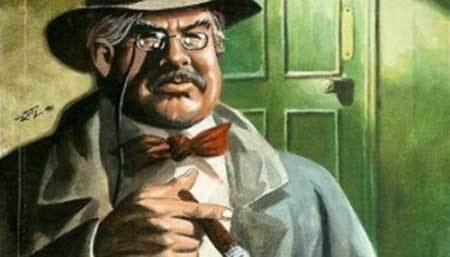
If I’m not mistaken, someone has cloned Dr. Fell and Sir Henry Merrivale here! Jeremy Bell even speaks in Carr-ian tones: “Oh! Excuse me, Mr. Policeman! I wouldn’t dream of listening to your conversation. But the nymph of the vines transmitted the echo of your words, by Bacchus!”
Frankly, it illustrates how unlike Fell our Dr. Twist really is. But I’d like to think that, with The Siren’s Call and the inclusion of Jeremy Bell, Paul Halter has gotten in his homage to the great detective, plus a bit of a last laugh on the Carr estate!
 Ah Sweet Mystery!
It is indeed a vampire lady on the cover – Carol Marsh in Hammer’s DRACULA (1958) to be precise…
LikeLiked by 2 people
I think I pointed that out image source in Steve’s review of the book 😁 I remain unconvinced by Halter but not unentertained …
LikeLiked by 1 person
I couldn’t read Steve’s review until I had finished reading the book – you know what a spoiler he is!!! 🤪
I’m not sure which, if any, Halters you have read. My feelings for him veer wildly from title to title; I don’t think this has happened to me with any other author! What’s more, we bloggers all disagree about different titles. Or perhaps we all just have different levels of tolerance for Halter’s brand of crazy.
LikeLiked by 1 person
I have read DEMON OF DARTMOOR (which I enjoyed the most) in English and THE MADMAN’S ROOM and THE BLOODY MATCH in Italian. So not a lot …
LikeLiked by 1 person
Show-off!
LikeLiked by 1 person
Well, it’s not like I’m really recommending them … 😁
LikeLike
I didn’t particularly like this book. See my comments under Steve’s review.
LikeLiked by 1 person
I have been enjoying reading your reviews (and those of others as well). Yes Paul halter is a mixed bag but I have liked some of his books a lot. The madman’s room, the invisible passage….haven’t read sirens call yet…..
LikeLiked by 1 person
I admit I’m less susceptible to some of Halter’s excesses than many of my fellow bloggers. But if you have been reading my reviews, you know there are many that I’ve enjoyed. I love The Invisible Passage and The Gold Watch. I was infuriated by The Invisible Circle, but my dear friend Jim Noy loves that one. I’m sure you’ll have your own reaction to each new Halter you read, and we’re bound to disagree. After you read The Siren’s Call, I’d be really interested in hearing your opinion!
LikeLike
I thought I detected an homage to Till Death Do Us Part as well.
Not Halter’s greatest work to be sure.
LikeLiked by 1 person
I can’t believe I’m going to say this, but I haven’t read TDDUP. It was spoiled for me a long time ago.
LikeLike
This was my first Dr. Twist novel, but not my first Halter. I had read (and hated) the very gory Brouillard rouge a few years before. I think John Pugmire and Dr. G. persuaded me to give Halter another whirl. Sirène was the first Halter to arrive from France; the three Masque tomes (comprising Halter’s first 15 novels) arrived a fortnight after. I enjoyed it – more for the motive and surprise murderer than for the methods. My thoughts are here: https://grandestgame.wordpress.com/list-of-authors/paul-halter/le-cri-de-la-sirene-paul-halter/
In hindsight, it strikes me as one of a series Halter set in small villages around the time – like L’homme qui aimait les nuages or Les larmes de Sibyl.
LikeLike