Last night, Theatre Works, one of the Bay Area’s most accomplished theatre companies, opened its 53rd season – and welcomed its new artistic director, Giovanna Sardelli – with a production of Mrs. Christie by Heidi Armbruster. Sardelli herself had directed the world premiere of this play in 2019 at the Dorset Theatre Festival, but Armbruster had been workshopping the play since 2015 where it began as a one-woman show and eventually blossomed into the full-cast production we saw last night.
As popular as Agatha Christie is in my little world, I viewed the announcement that Theatre Works was presenting a play about her with much surprise and not a little trepidation. Because of course this was going to be another full-throated exploration into 1926! How could it not be? Christie’s accomplishments as an author, and even as a doyenne of the theatre, are not inherently theatrical. No, if you want to dramatize a story about Agatha Christie, you either make something up where she is the detective in her own life – or you talk about 1926, possibly the most dramatic year of Christie’s life.
It was in 1926 that Christie finally left Bodley Head, the publishers who had given her such a raw deal, for William Collins, where she began her reign with the first novel to which one could assign the term “classic”: The Murder of Roger Ackroyd. But artistic success was tempered by domestic tragedy. First, her beloved mother died. And then Archie Christie demanded a divorce, explaining that he had fallen in love with Nancy Neele, his golf partner.
Chances are most of you know all this already. Numerous biographies and fictionalized historical novels have plunged into Christie’s despair at losing Archie and devoted much thought on what prompted the climactic event in that emotional spiral – the eleven-day-long disappearance. The one person who never offered an explanation was Christie herself, and for nearly a hundred years, those who care about the author have by and large respected her privacy.
In Mrs. Christie, one person who shows no such respect is Lucy, a modern-day Christie super-fan who has come to her first Agatha Christie Festival. Already, Lucy is disappointed by the event as it seems to have devolved into a giant cosplay party, a “Comic-Con for Christie fans.” (Does that really happen in Torquay?) While everyone is downing weak cocktails in bad Poirot costumes out on the lawn, Lucy sneaks into Greenway House for a look around the room where Christie wrote her books. A frazzled guide gives Lucy a thrill by pushing a button on a Dictaphone and letting her hear Christie’s voice. A young man named William appears who is the assistant to Notebook Man, an authority on Christie (who can only be Dr. John Curran!). He is attracted to Lucy, and so he shares with her the photostatic copies he stole of pages from a hitherto unknown seventy-fourth notebook that appears to contain clues to a previously unknown story, novel or play by Christie.
This part of the play makes for mildly amusing comedy. It’s all too clear that Lucy has grievous secrets of her own, but she plays along and eventually steals the pages to solve this Christie mystery on her own. Well . . . not quite on her own. There’s another woman present at the Festival who tags along, an elderly woman in tweeds who knits contentedly, sees in every person around her a parallel to somebody from her village, and likes to solve mysteries, too. Would it surprise you that her name is Jane?
The problem here is that neither Lucy nor the mystery she longs to solve are nearly as compelling as the other story unfolding at the same time onstage. Because we are also at Greenway in December 1926, watching Archie Christie canoodle with Nancy Neele as a high-strung Agatha falls apart in their presence. It’s a fact that Archie demanded a divorce, that Agatha wouldn’t grant it and begged Archie to stay, that he stayed but nothing worked and that eventually they parted forever. In this version, Archie appears only to torment Agatha and parade Nancy before her, but in all fairness, Agatha is too far gone emotionally to deal rationally with this situation. She shouts and cries and is rude to her beloved secretary Carlo. And when, in the second act, she finds herself at the Old Swan Spa in Harrogate, things take a decidedly surrealistic turn: time seems to speed up as one meal blurs into another, and Agatha begins to have long conversations with a mustachioed detective who appears in her room. She even pulls him into her bath and tries to kill him.
Yes, that really happens.
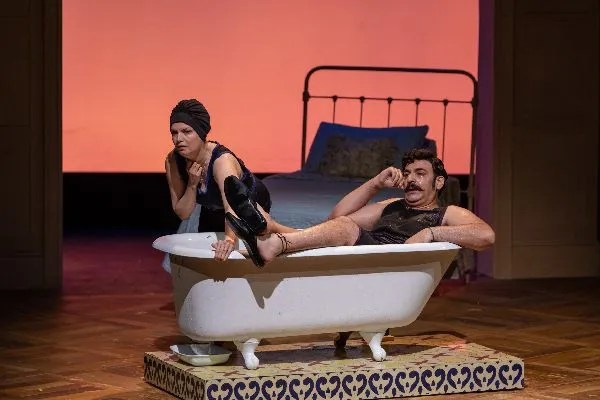
As you might have guessed, in the final section of the play, past and present merge. Agatha Christie and Lucy meet and, all too easily, solve each other’s problems by deciphering the words in the notebook pages and staging – a murder mystery. It’s not a very good murder mystery, and you can choose to be either amused or nonplussed to see Hercule Poirot and Miss Marple hurling accusations at each other. But there’s a very cute dog (albeit a very incorrect breed of dog playing Christie’s beloved Peter) that acts as deus ex machina, and by the end Lucy and Agatha have both gotten over their grief because that’s what reading or watching a classic mystery can do for you.
In her director’s notes, Ms. Sardelli reflects on how, upon returning to this play since the 2019 production, it felts so much more relevant to modern times: “In delving into the grief and loss our two onstage heroines are experiencing, this play was helping me solve the puzzle of my own pandemic-related grief.” Sure, Agatha feels trapped at Greenway House, both in a loveless marriage and at a significant turning point in her life. She is a wife and mother but seemingly not very good at either. And she is a very good writer but not sure if she wants to be anymore, particularly when this incarnation of Archie says straight out that her writing has ruined their marriage.
But what Mrs. Christie eventually boils down to is a very simplistic idea, that old chestnut about how classic mysteries get you through hard times. I offered that advice to all of you for free on March 14, 2019, one day after I was sent home from school, never to return. Even after an eight-year genesis, Armbruster’s play still doesn’t seem to know exactly what it wants to be. It’s alternately mildly funny and mildly dramatic and mildly fantastical. I’m not sure diehard Christie fans will appreciate much about it: the delving into private affairs, the joking at the expense of rabid fans who don’t appreciate such nosiness, or the facile way this private tragedy is ultimately resolved. The appearance of “Aunt Jane” and the mustachioed “Le Detective” are fun. The Marple experience works better here, although Jane Marple would never ever ever ever ever say, “Tally ho!” The actor playing Poirot was young and attractive and, in the bathtub scene, barely clothed. I liked the things he was saying to Agatha, but I found the combined physical/verbal message a bit confusing.
The production at Theatre Works was well staged on a beautiful and highly flexible set by Christopher Fitzer. I especially liked the performances of Elissa Beth Stebbins as Carlo (and as a very efficient maid at the spa), Lucinda Hitchcock Cone as Jane, and Max Tachis as both publisher William Collins in the past and William, the assistant to Notebook Guy in the present. (At last night’s performance Tachis took a tremendous spill onto the ground and rose up with such aplomb that I nearly applauded.)
Both Jennifer Le Blanc as Agatha and Nicole Javier as Lucy spend the first two thirds of the play at such fever pitch that it became hard for me to sympathize with them. (And if I can’t sympathize with Agatha Christie, you know there’s a problem.) When they finally meet, they both relax and turn back into the rational focused women they used to be in order to find some order and method in their emotionally disordered lives. Thanks to the work of Agatha Christie, the Queen of Crime, and to the clear minds of Poirot and Miss Marple, our two heroines find their peace by writing and staging a mystery. How I wish that the mystery they came up with – and the play itself – had rivaled the brilliant way that the real Christie tackled the puzzles of crime and of life.
* * * * *
CORRECTION: A good friend read this review and reminded me that any events between Agatha and Archie Christie pertaining to their separation and divorce, real or imagined, would have taken place at Styles, their home during their marriage, rather than Greenway House. (The latter was a vacation home for Agatha and Max.) And, indeed, Ms. Armbruster makes it quite clear that the events in her play take place at Styles. My apologies for that mistake.
However . . . it was a fairly natural mistake because the idea that Lucy could “run up from the lawn” during the Agatha Christie festival into either house is crazy! Greenway House is the closer to Torquay, but it is still a few miles away. And, as my friend informed me, Styles is miiiilles away from Torquay.
We’ll chalk it up to artistic license.


 Ah Sweet Mystery!
What fun this must have been to watch!
Harvee at https://bookdilettante.blogspot.com/
LikeLiked by 1 person
Sounds like it needed less Christie and more Pirandello 😁
LikeLiked by 1 person
It was more limoncello than Pirandello. I like dual-time stories, but this one felt unoriginal.
LikeLiked by 1 person
I do like that approach, especially when Tom Stoppard and Terry Johnson do it.
LikeLiked by 1 person