Tis the scary season, and I have a problem: as a boy, I loved a good horror movie, but as a curmudgeonly man, I have become fear-averse. More specifically, I have become viscera-averse! All the hacking, stabbing, piercing, gouging, rending, tearing, slicing and dicing have done me in (er, emotionally!) I have such distaste for the level of gore spewing forth from the horror films of the past few decades that I have pretty much given up on the genre altogether.
At least . . . I have given up watching it. I’m still perversely curious about my old stomping grounds. When the latest gorefest premieres, it tends to appear on a site called The Movie Spoiler. There viewers post detailed synopses of these movies in all their blood-soaked glory – and I read ‘em! I find it fascinating that filmmakers want to display all this oooey gooey stuff on the screen and that most of you sickos out there want to watch them!
But even I think that this practice of skirting the cinematic issue by reading all I can about films I have no intention of ever seeing is kinda weird. This October, I really wanted to watch some scary movies that would not gross me out. I had even intended posing the question on social media in order to get viewing suggestions. And then a buddy of mine, author James Scott Byrnside, recently posted his own list of some of his favorite horror movies. Now, if you have read Byrnside, you know that the man doesn’t shy away from gore himself. And truth to tell, nearly all of the movies on his list are not my cup of, er, tea – films like Inside, a glistening example of French extremist horror that I just heard about from the guys over at the Screen Drafts podcast.
Clearly, most of the films on Byrnside’s list are gonna be too much for me! Still, I reached out to him with my question because a couple of the titles on his list were examples of giallo films, those stylish movies that tend to dazzle the eye as they unfold tales that combine the whodunnit with the slasher/horror movie. Perhaps the most famous giallo director is Dario Argento, creator of The Bird with the Crystal Plumage, considered by scholars (yeah, there are folks who study this stuff!) as the first full-on giallo film. I asked Byrnside if he could recommend any of these films that I might be able to both enjoy and stomach – and he sent me three titles! And now, as a public service to you, I have watched these three movies and am prepared to impart my opinions about them so you other Squeamish Stanleys out there have more choices as well!
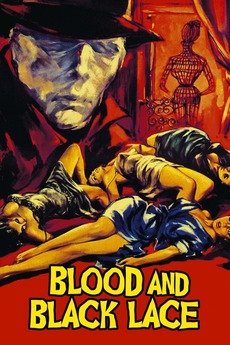
Blood and Black Lace (1964)
Before Argento, there was Mario Bava, who was considered “the Master of Italian Horror.” Blood and Black Lace was inspired by the popular Italian mysteries known as gialli for their distinctive yellow covers, and while the genre had some evolving to do (and Dario Argento would be the man to do it), many elements of this film conform to what would come to be the expectations of what one would find when viewing a giallo film. Byrnside told me that, as a fellow mystery lover, I would probably find this one the easiest to deal with, plot-wise, since so many gialli let their style run rampant at the expense of a coherent plot.
There is a plot of sorts here: a young model is murdered outside Christian Haute Couture, the fashion house where she worked, and it is discovered that she kept a diary full of secrets, one for each of her many co-workers. As the diary makes the rounds of different people, a faceless killer begins to dispatch the models in all sort of horrifying ways. Ultimately, we discover who is behind the mask and whether or not justice will be served.
As I said, giallo films can veer toward any one of a number of genres: the whodunnit, the horror movie, and the slasher film (American slashers owe their existence to the Italian horror masters). In many cases, a slasher movie is a whodunnit; the main difference is that whodunnits are puzzles, while slashers tend to be devoid of clues, relying on a surprise unmasking of an unlikely maniac. American filmmakers like John Carpenter (with Halloween) and Sean S. Cunningham (with Friday the 13th) directed films that could qualify as gialli, with nice twists as to the identity of the killer – although the twist in Halloween actually comes during the prologue! But then “franchise fever” took hold, and the killers in both these films were transformed into immortal monsters. The whodunnit aspects were largely jettisoned (with a few exceptions), and the plots became razor thin excuses for the real ride – all them kills.
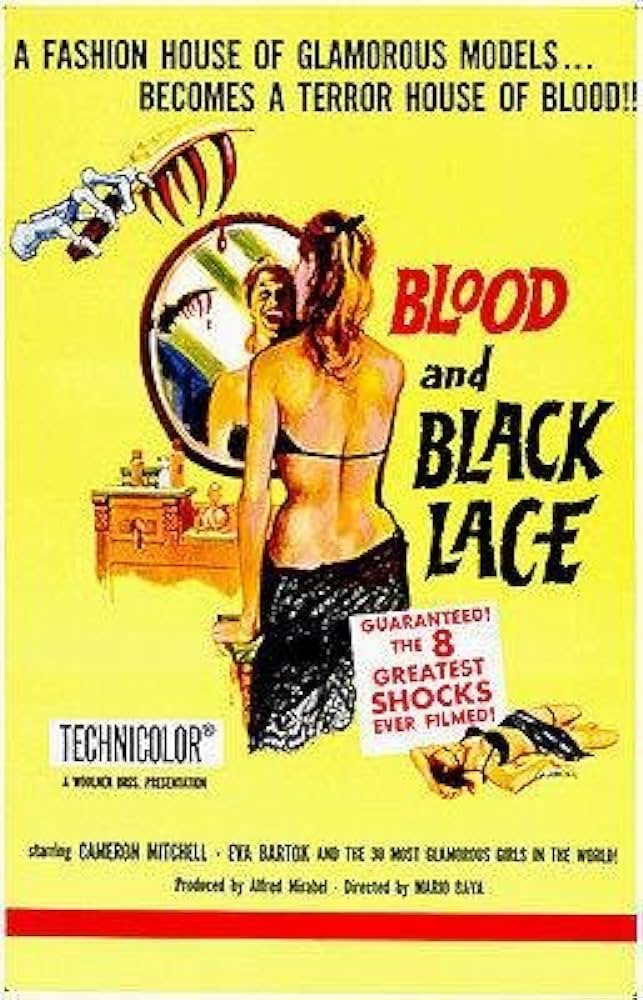
There’s no way Blood and Black Lace could become a franchise because the fiend behind all these killings is all too human and the plot behind their spree is completely resolved at the end. The film is a whodunnit in that there is a withholding of the identity of the killer until the end. But this is definitely more of a slasher picture, as no clues are offered to help you deduce the murderer. And, like all slasher pictures, there is a huge horror element at work here. The plot is mostly a bare tree on which to hang the murder scenes. Still, there’s more going on in this plot than in other gialli I’ve seen; it belongs to a certain breed of films like Diabolique (1955) and Hush, Hush, Sweet Charlotte (also released in 1964) for reasons that will become apparent after you’ve watched.
I think most people who feel like I do about gore would do all right here. The killings are well-staged and creepy as hell, and some of the victims have terrible damage inflicted upon them. But the make-up is so stylish as to cause a bit of a remove from what these garish wounds represent. And – spoiler! – nobody is sliced in half or chopped into bits and served to Grandma Leatherface for dinner.
I thought Blood and Black Lace actually looked terrific. The color palette is amazing, and the way the camera works is mesmerizing, especially the evocative way the shots are lit. (Evidently, Bava used a children’s toy wagon to create tracking shots.) I loved the opening credits sequence, which shows each actor posed beautifully in the fashion house. And the murder scenes generate great suspense, especially a scene set in an antique store, where the killer keeps appearing and disappearing to drive his victim crazy. The only problem for me was that once the solution was revealed, we still had ten or so minutes to go and the whole film slowed down as the final scenes attempted to resolve the situation and release a couple more twists.
Still, if you’re looking for a stylish horror mystery with some scares and suspense and some welcome restraint in the depiction of actual violence, then I can highly recommend this one to you.


The Fifth Cord (1971)
Those looking for a bloody slasher film may want to shy away from The Fifth Cord, but I understand why Byrnside recommended it to me. This is a pretty nifty whodunnit, based on the 1964 novel by an actual mystery author, D. M. Devine. I recently reviewed a book by Irish author Nigel Fitzgerald because he had been recommended by Dr. John Curran. At the Bodies from the Library conference where John spoke about Fitzgerald’s career, he also talked about Devine, whose first novel, My Brother’s Killer (1961), is probably his most famous.
The Fifth Cord begins at a distressing New Year’s Eve party where everyone seems to be troubled or depressed – kind of why I avoid New Year’s Eve parties myself! This includes reporter Andrea Blid (Franco Nero), an alcoholic sad sack – although he’s so gorgeous it’s kind of hard to buy this! Andrea is keeping his eye on his ex-lover Helene, even though he has a perfectly lovely new girlfriend named Lu waiting at home. Also at the party is Dr. Richard Binni, who is saddled with a bitter, crippled wife named Sophia, and poor John Lubbock, an émigré from Australia who has come to Italy to teach and who watches jealously as his co-teacher and friend Edouard proposes to the beautiful Isabella.
After the New Year is ushered in, everyone disperses, and a despondent John heads home taking a route through a long, dark tunnel (of course! it’s giallo!). There he is brutally attacked, but he is rescued by Walter and Giulia, a pair of lovers who happened to be making out near the tunnel’s entrance (and whom you can add to your suspect list!) John is brought to the hospital where he is attended to by none other than Dr. Binni. And the next day, when the newspaper decides to write a story about the attack, they send John’s other fellow party-goer, Andrea Blid, to investigate.
It’s a fairly slow start, but . . . did I mention how Franco Nero makes a really attractive alcoholic sad sack? As Andrea starts sniffing around, it seems that all the people I’ve mentioned have some sort of sordid connection to each other. And then the murders begin. Here is where director Luigi Bazzoni starts to strut his stuff. The murder scenes are stylishly shot, not in the same baroque manner as Bava or Argento would use, but suspensefully all the same. There’s a climactic attack that is especially heart-rending as it involves a small child, and it leads to a neat final chase and unmasking. I have to say that I pretty much nailed the killer. I imagine the motive was something of a shock to 1971 viewers – some reviewers painted it as an unfair surprise – although it felt plainly trumpeted to me in an early scene.

The Fifth Cord straddles the realms of slasher film and whodunnit, for while you still don’t get the clues you need to solve the case, there are elements here that feel right at home in a more traditional murder mystery. In nearly every sense, this film is more realistic than the gialli I have been used to seeing, and yet this story feels more like one my friend Sergio might have perused from that treasured stack of yellow books he keeps at his bedside. It may not contain the ghoulishness a true Halloween-phile is searching for, but this is a mystery flick that one could watch at any time of the year.

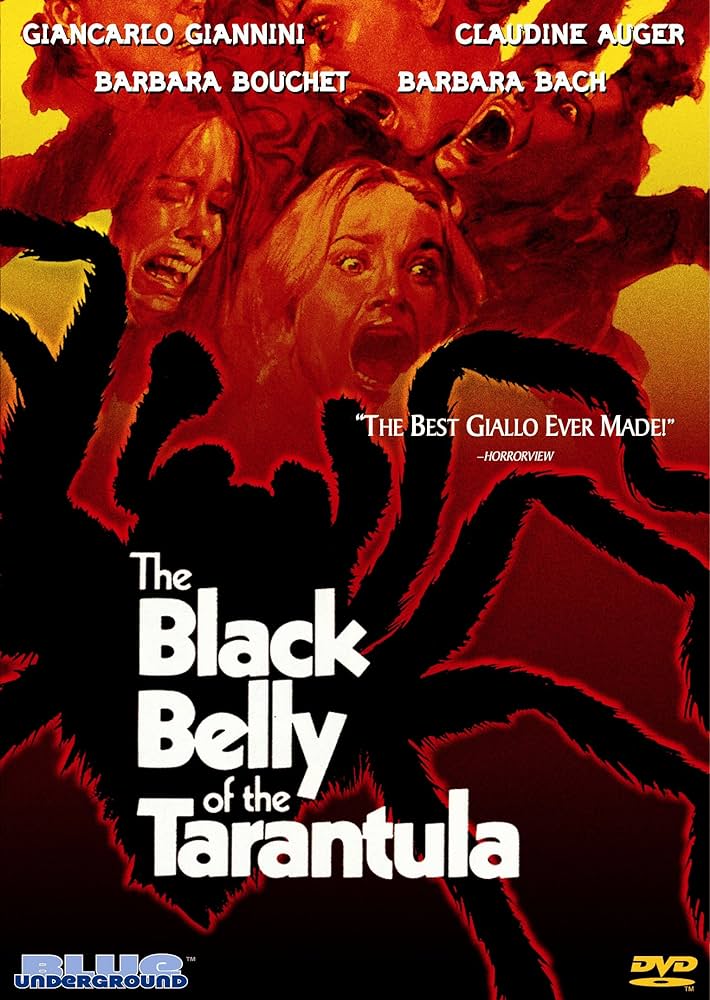
The Black Belly of the Tarantula (1971)
Directed by Paolo Cavara, this was by my least satisfying watch of the line-up. Its attempts to be both artistic and erotic are fitfully successful (I mean, with Giancarlo Giannini starring . . . what’s not to like?) It’s the only one of the trio of films where the cop is the central figure, and Giannini cuts a sympathetic figure as Tellini, a disgruntled homicide inspector who is called to the home of a man named Paolo after he discovers the murdered corpse of his wife in her bed. The couple were estranged, so the husband goes right to the top of the suspect list. But this murder is a strange one: before cutting poor Maria open with a knife, the killer injected her with insect venom that paralyzed her, forcing her to helplessly observe her own murder.
This is by far the choppiest plotline that I watched, and it isn’t helped by really weird editing and the poorest English dubbing yet. Nearly everyone in the cast dies, not all of them at the hands (encased in grotesquely fat surgical gloves) of the killer. That means we’re too low on suspects to make this a creditable whodunnit, and although the killer is someone we’ve met, I must warn you that the denouement is pretty disappointing. The murders are fairly well staged, and there’s a lot of hand-held shaky cam throughout to keep us feeling unsettled.

While I recognize that the violence quotient here is minimal compared to all the modern-day horror films I complain about, it’s still pretty icky and some of the murder scenes made me flinch as knives entered bodies and began to slice. Since it’s barely a whodunnit and a bit too artsy-fartsy to be a horror film, Tarantula falls squarely in the slasher category. But really it’s a drama about Tellini, the hapless cop, who makes love to his wife a lot and wishes he had the nerve to quit the force. I mean, the final shot comes straight out of The Bicycle Thieves! Then there’s that very very very 70’s score by Ennio Morricone, which plays almost constantly and can’t help undercutting the suspense. Tarantula flew under the radar for many years after its release but has come back into favor. Some horror critic called it the greatest giallo ever made. I think that guy is crazy.
Many thanks again to James Scott Byrnside for his recommendations. If any of you reading this are a horror and/or giallo fan and happen to have some recommendations that fall within my purview (good suspense, good mystery, light on gore), I would appreciate your recommendations below. Oh, and if you don’t mind more than a touch of gruesomeness wrapped in an intriguing and very funny mystery package, pick up one of Byrnside’s novels on Amazon. They get my full-fledged recommendation!
May your Halloween week be a Boo-tiful thing!


Love to see you entering the realms of giallo, Brad. It’s a subgenre I have long been interested in even if I too have only dipped my toe into those murky depths. I recently watched “Blood and Black Lace” for the first time and had a great time with it. It is, I think, perfect archetypal giallo; its bold colors are the best and I love that opening you described with the fun, percussive music.
Argento’s “Deep Red” probably has the best mystery of any giallo I have seen, though I worry that that might be a bit too gruesome for you. I also think Argento’s “Suspiria” is one of the all-time great horror films, but I though giallo enthusiasts push back pretty hard when you try to classify it as anything other than a supernatural horror (and it is really gnarly to boot). For a modern twist, I am an ardent defender of Edgar Wright’s “Last Night in Soho.” It gets the giallo sensibility just right with a unique story and some perfectly calibrated performances from Thomasin Mackenzie and the late great Dame Diana Rigg.
LikeLiked by 1 person
Unfortunately I know the twists to both Deep Red and Last Night in Soho. (That DR twist seems to be a favorite of gialli screenwriters!) I remember the giallo draft on SD where the GMs “disqualified” Suspiria as supernatural horror, and I guess I agree. The second and third films on this list are both on Tubi, and there seem to be quite a few other titles that pop up there under the category of “mystery/thriller.” I just don’t know if any of them are any good!
LikeLike
Argento’s Trauma has a twist/misdirection that feels somewhat Golden Age, although fairly gory. Like something Byrnside would do. Tenebre also has a good misdirection regarding the identity of the killer.
LikeLike
Hey, two out of three ain’t bad. I’ve had Black/Tarantula as my favorite Giallo for a while, but yours is the fourth or fifth bad review of it I’ve seen in a row. It’s been a few years since I’ve seen it and perhaps I fell in love with the diabolical murder method too much. This was the film that introduced me to the tarantula hawk which I used for the novel in Barrington Hills Vampire…only with people instead of spiders. Nostalgia might be at play. I’ll watch it again and tell you if you are correct. In the meantime, I think two of the recommendations on my post might be tame enough for you to enjoy. Death Walks on High Heels is sleezy, but fun and Alice, Sweet Alice is a genuinely good shocker.
LikeLiked by 1 person
Hey, The Fifth Cord is pretty sleazy, too, and that was part of its charm.
SORTA GENERAL SPOILER – It seems like every other giallo casts a sorta famous and/or past his prime male star who investigates the murders and then discovers he himself is actually the killer. Giancarlo Giannini played the role in such a foggy way that it seemed this film would go there. I’m grateful it did not, but I couldn’t help feeling a bit cheated at the reveal.
Thanks for the further recs! I will let you know how I managed!
LikeLike
Bava really set the giallo template with BLACK LACE, a combination of German Krimis and the traditional whodunit, but beautifully made as only Italians can. All his films are incredibly stylish (he did his own photography no matter what the credits might say – Ubaldo Terzano was his very talented camera operator).
BIRD WITH THE CRYSTAL PLUMAGE comes highly recommended. It is fairly bloodless and tells a good story (it’s an uncredited adaptation of a Fredric Brown novel, not saying which one to avoid spoilers 😁) and has great set-pieces. DEEP RED is his best but very gory by comparison.
You may want to check out PERVERSION STORY (aka ONE ON TOP OF THE OTHER) starring Jean Sorel and Melissa Mell and directed by Lucio Fulci – it was made in San Francisco and I think you might get a real kick out of it – no blood at all but a pretty satisfying story all round.
Before embarking on BLACK LACE, Bava made a beautiful looking black and white comic giallo, THE EVIL EYE (aka THE GIRL WHO KNEW TOO MUCH) that is lots of fun, co-starring John Saxon.
Have a great time with these ultra stylish movies Brad!
LikeLiked by 1 person
The House With Laughing Windows is a fantastic movie. I’m not quite sure it would qualify as a giallo, lacking some of the genre’s important trademarks. The finale might also be a bit too gruesome for your taste.
Some other, more mystery-oriented gialli you might enjoy:
The Child (1971) set in Venice, featuring George Lazenby in hist most prominent turn outside Bond.
The Bloodstained Shadow (1978) another atmospheric Venetian giallo.
Puzzle (1974)
Seven Blood-Stained Orchids (1972)
LikeLiked by 1 person
Thanks for the recommendations! I will give these a try – and good news! The Surgeon General has announced that taking your hands and placing them over your eyes again and again counts as exercise!!!
LikeLike
What the heck??? All but one of these have the same solution!!! There’s a real social comment going on here!!!
LikeLike
Consider it a brilliant way of mis-direction. After watching five movies with the same solution you would expect the sixth to have the same twist, just to be surprised to find out that … the butler did it!! 🙂
LikeLiked by 1 person