“Let justice roll down like waters and righteousness like an everlasting stream.” (Amos 5:24)
In the early days of World War II, with bombs continually threatening to burst over her ultramodern London flat, Agatha Christie decided to write Hercule Poirot’s last case. She put a lot of thought into how she would end the career – and, indeed, the life – of her famous Belgian detective. As John Curran points out in Murder in the Making, the seeds of the plot can be found as early as 1934’s The A.B.C. Murders (“’I shouldn’t wonder if you ended up by detecting your own death,’ said Japp, laughing heartily.”) and the 1936 novella “Murder in the Mews” (“’Do you know, Poirot, I almost wish sometimes that you would commit a murder.’”). This is neither the time nor the place to discuss how Curtain has always left me cold, but you can’t deny the thought that went into it: the return to Styles Court, the reunion of Poirot with his beloved narrator/Watson Hastings, and an intriguing puzzle plot that incorporates Christie’s beloved theme of justice – as in miscarriage of, or natural vs. legal.
Somewhere around this time (or maybe late in the decade, according to Curran), Christie also wrote a final case for Miss Marple, and it seems equally clear to me that she was not thinking things through as carefully as she had for Poirot. But then, how could she? Curtain had been written after at least seventeen other Poirot novels established him as the current preeminent fictional sleuth; Sleeping Murder followed one, maybe two, novels and a book of short stories. Was the author being prescient? She had written more about Tommy and Tuppence, and yet their final case, such as it is, would have to wait until 1973. Had she figured out back then how important Miss Marple would become to her in the latter half of her career? The most popular mystery author of the era wanted to leave some income behind for her family in case she didn’t survive the war. Did the selection of a protagonist really matter?
Whatever the reason, that book, Sleeping Murder, is depressingly mundane, at least as far as its sleuth is concerned. Once again, a miscarriage of justice is at the heart of the case, and the solution has a rare whiff of perversion about it. But the characters are flat, Miss Marple spends most of her time gardening, and in general the storyline and the spirit that marks a “final case” is completely missing. Try comparing this case to the one unfolding in Curtain – there’s really no comparison. That is why I chose to order the ranking of that Marple novel as if it had been published right after it was written. That, and because the final Miss Marple book to appear during her lifetime so clearly possesses the storyline and the spirit of a final case.
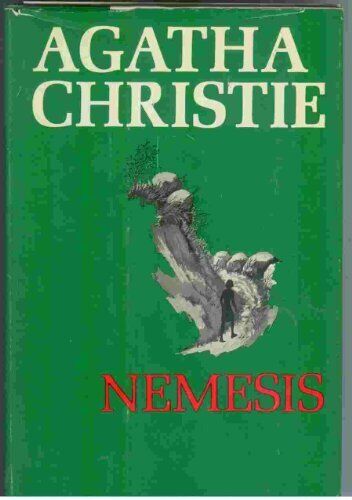
Nemesis is a special book, but it’s not because of its plotting or its characters or its setting – although there are a few delights to be found in each category. No, Nemesis is, first and foremost, a novel about its title character: Miss Marple. Indeed, “The Marple Factor” dominates every category of my rankings. The circumstances surrounding the mystery follow the lines of Christie classics like Murder on the Orient Express and Five Little Pigs; that is, once the facts have been laid out, the depths of tragedy surrounding the aftermath of an earlier crime permeate the reader’s consciousness.
But this is, from first to last, Miss Marple’s book. Unlike Poirot in Curtain, she occupies every page, and it is her point of view through which we see events. What’s more, Curtain chronicles the fall of Poirot: oh, he solves the case, all right, but he pays the ultimate price in order to bring a maniac down and protect Hastings and the other denizens at Styles. Nemesis, on the other hand, raises Miss Marple to the full heights of success and respect that she deserves. In all the other books, the police whisper about her powers and accept her help on a vast sliding scale of willingness. Here, for the first time, she does not share duties with a policeman, although – in one of the silliest of all the aspects of the plot – she is surrounded by allies and protectors. And in the inevitable climactic chapter where Miss Marple explains the case, her audience includes the Assistant Commissioner of Scotland Yard, the governor of a major prison, and the Home Secretary!
Nemesis displays much of the “fuzz” that unfortunately permeated the final four or five books that Christie wrote. Looking at it purely as a murder mystery is a mistake. Approaching it as a symposium explaining Miss Marple’s methods of detection works a little better. Most successful are the readers who open their hearts to the book and let its emotional power wash over them “like an everlasting stream.” Listening to John Curran and Kemper Donovan lovingly spar over the merits of the book on All About Agatha, one feels a pull from both sides. Dr. Curran will always come down on the side of the puzzle plot, and that barely exists here. (Rereading it in this modern age, the “puzzle” feels laughable.)
But if one accepts that and looks at Nemesis as a final chance to hang out with Miss Marple and really get to know her, warts and all, it’s easy to understand why Kemper loves this book, why biographer Laura Thompson calls it “Agatha’s last masterpiece.” It is, as Thompson describes, “a beautiful book . . . not really a detective story, but a somber meditation on the realities of love.” I agree with her, which makes it easier to forgive the book its vague timeline, its “ramblings and repetitions.” There is so much nostalgia here: references to past cases (and much borrowing from them by Christie to patch this plot together). There is also a fitting ending for Miss Marple. That it’s a happy ending thrills me to bits, and I have to admit that while I felt the tragedy around Verity Hunt’s death, it was the final page, where Miss Marple leaves the offices of Broadribb and Schuster with a smile on her face and a huge check in her hand, that brought me to tears.
* * * * *
The Hook
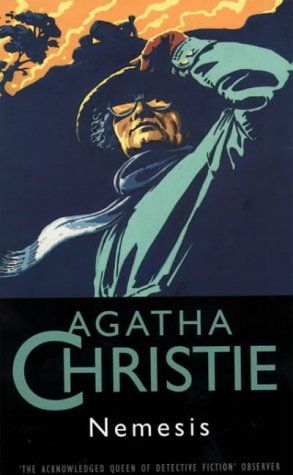
“I will not pretend that there are not pleasures and desires – things that one has not been able to indulge in or to afford – I think Mr. Rafiel knew quite well that to be able to do so quite unexpectedly would give an elderly person a great deal of pleasure.”
The hook in a Christie novel can be long or short, but, plot-wise, it tends to get quickly to the point. Colonel Protheroe deserves to be killed (says, of all people, the vicar); someone puts a dead blonde in the library; the morning newpaper displays an ad for a murder; a man is seen killing a woman on a train – it doesn’t take more than a page or two for murder to take center stage.
But in Nemesis, Christie plays it coy. This is because, as we find out in the end, Mr. Rafiel is being coy with Miss Marple to lure her in and have her investigate with an open mind. The result is that, as in The Mirror Crack’d from Side to Side, Miss Marple is the best thing about the opening chapters of this book. She is discovered reading the newspaper, much like Mrs. Swettenham did at the opening of A Murder Is Announced. She sees a name, “Rafiel,” in the obituaries, and at first she can’t quite place it. Then she remembers a long-ago adventure on a Caribbean island and the grouchy old invalid who helped her solve a murder.
Except, as it turns out, this wasn’t so long ago. It just seems like that because Miss Marple’s short-term memory has undergone a significant decline in the mere eighteen months since she hit the beach in St. Honoré. Are we to believe that something so significant as the capture of a wife-killer could happen a year and a half earlier and Miss Marple can’t remember a figure as imposing as Jason Rafiel who figured so centrally into the case and who helped her nab the murderer? Was she too distracted by her intervening vacation to Bertram’s Hotel to remember? As it turns out, that fuzzy incapacity to remember names will plague nearly every person in the book, making it less of a character flaw and more of a way for Christie to stall when she doesn’t have that complex a case to unfold.
The same thing happens with ages and dates. The first impression Miss Marple makes on the lawyer Mr. Broadribb when she arrives at his office: “Seventy if she is a day – nearer eighty perhaps . . . “ But I swear that lady who showed up in 1928 at the Tuesday Night Club, draped in lace fichu and nodding pleasantly over her knitting, must have been at least seventy back then. This would put her at around 113 in 1971 when Nemesis takes place. I know –GAD authors played fast and loose with chronology, but takes a moment to adjust. We’ve been through a couple of wars and much generational change with Miss Marple, and she has remarked on many aspects of these changes. She’s old!! Didn’t we just read a novel where Miss Marple visits that bastion of Edwardian tradition, Bertram’s Hotel, a special place from her own childhood?

I want to move past the chronology problem, but it keeps cropping up. Esther Walters, with whom Miss Marple has maneuvered a “fortuitous” reunion, remarks to herself: “I thought she had died a long time ago.” And yet, only a year has passed since they saw each other, and Miss Marple had not seemed that frail in St. Honoré. But Mr. Rafiel had! In A Caribbean Mystery, he is described thusly: “. . . he looked like a wrinkled old bird of prey. His clothes hung loosely on his shrunken form. He might have been seventy or eighty or even ninety.” His most common descriptor in that book is “old.” And yet Miss Marple says to Esther, “I won’t say (he was) getting old – because he really wasn’t old.” And Mr. Broadribb repeats this at the end of the book, saying Mr. Rafiel was far too young at his death to have been senile.
There’s definitely a bit of retconning going on with Mr. Rafiel’s character, including endowing him with a family, including a delinquent son who has been convicted of a brutal murder. One may assume that this had not crossed Christie’s mind when she was writing A Caribbean Mystery. Still, the most significant fact that has transferred from one book to another is the bond that was formed between the old man and the lady detective. Mr. Rafiel wants Miss Marple to investigate a crime, and he is willing to pay her twenty thousand pounds if she succeeds in doing . . . something. That’s 391,208 pounds in 2023 currency, or $474,496.18 for us American fans. Clearly, Mr. Rafiel means business, for this is not chump change! And what I love is watching Miss Marple be tempted by this money, and being forthright about the temptation:
“Partridges. It is very difficult to get partridges nowadays, and they are very expensive. I should enjoy a partridge – a whole partridge – to myself very much. A box of marron glacés are an expensive taste which I cannot often gratify. Possibly a visit to the opera. It means a car to take one to Covent Garden and back and the expense of a night in a hotel.”
And so Miss Marple sets off – on a case of her very own. This time, it’s personal . . . again. But rather than seek justice for her poor murdered housemaid or protecting her friend who witnessed a murder, Miss Marple is trying to live up to the faith that Mr. Rafiel, basically a stranger, has placed on her frail shoulders. That sense of purpose, of what another character will call “a pilgrimage,” along with the connectivity to Miss Marple’s history (and our history of reading about her) is what makes this opening hook sing.
Score: 7/10
The Closed Circle: Who, What, When, Where, Why?
Who?
Nearly two dozen characters flit in and out of Nemesis, but this is, first and foremost, Miss Marple’s story. Again, it doesn’t pay to look at this book as a “traditional” murder mystery, but Christie tries to fake us out early on when Miss Marple is sent on a coach tour of Famous Houses and Gardens of Great Britain. Christie even provides a list of the passengers, just as she did in the Poirot classic, Death on the Nile. In fact, Mrs. Riseley-Porter, her niece, and the niece’s long-haired swain are a retread, both in character and in plotline, of Nile’s Miss Van Schuyler, Cornelia Robson, and Mr. Ferguson (or Fanthorp, take your pick), while Mr. Caspar is a benign throwback to another suspicious foreigner, Mr. Richetti (and how sad that a 1971 novel still contains “suspicious foreigners.”). In an earlier Miss Marple short story, either of the two married couples on the bus would include a man trying to murder his wife (or, less often, vice versa).
Both Elizabeth Temple and Professor Wanstead are important to the plot. Miss Temple calls to mind Miss Bulstrode of Cat Among the Pigeons, and I find it remarkable that her own pilgrimage takes her so directly into danger and death and that she was so long about it! Why does she wait until ten years after Verity’s death to talk to Archdeacon Brabazon about her? I like Professor Wanstead because he is one of Miss Marple’s rare non-policeman male friends and serves as something of a Watson to her. I’m reminded of the silly character played by Stringer Davis who assisted Margaret Rutherford’s Miss Marple in those early films. Wanstead is in no way comic, but his conversations with Miss Marple feel like something original that we don’t see in her other novels.
Of the half dozen characters who stand in sharpest relief, two of them are dead and one is in prison until page 265. Mr. Rafiel is certainly a presence in death as he was in life just two novels ago. The victim Verity Hunt has to bear the weight of tragedy but doesn’t emerge as much of a character. Ironically, the circumstances surrounding her death resemble an earlier Marple victim, Ruby Keene in The Body in the Library, and even though we feel even less for Ruby after her death, she is more fully fleshed out on the page. The same happens with the minor victims. The foolish but innocent Girl Guide Pamela Reeves is better realized than the slutty Nora Broad because at least we get to see Pamela through the eyes of her parents and her girlfriends.
Michael Rafiel is the most problematic character here, and that might have to do with Christie’s casual descriptions of him as a predator and possible rapist. I think most modern readers heave a sigh at how Christie embraced the genetic origins of bad behavior. How many children of “ruthless” parents were murderers, often insane ones? But Christie softens her stance on Michael as the book winds down. Much of this comes through in Miss Marple’s discussion with the Archdeacon, who had agreed to marry Verity and Michael, and whose insistence that Michael could not be a murderer echoes the prison warden and convinces Miss Marple that Michael is innocent. Yes, it’s hard to swallow the sympathy thrown at Michael and the desire to have seen Verity’s love quite possibly reform a man who seemed to have cut a violent swathe of young female victims.
This is made even worse by Christie’s insistence, through Miss Marple and other characters, of assigning some of the blame for this to the young women who would wear too much lipstick and throw themselves at these “bad boys.” Bad girls like Norah Broad get into one wrong car too many, and good girls like Verity Hunt lack the common sense that seems to be only the province of withered spinsters. As Miss Marple explains,
“She knew that he was unreliable, she knew that he was what was technically called a bad lot, but that is not what puts any girl off a boy. No. Young women like bad lots. They always have. They fall in love with bad lots. They are quite sure they can change them. And the nice, kind, steady, reliable husband, got the answer, in my younger days, that one would be ‘a sister to them’, which never satisfied them at all.”

There is a parade of young men like this that suffuses Christie’s canon – a “murder of Montys” if you will, in reference to Agatha’s tragic older brother. I can’t help thinking that, with Nemesis, Christie is also able to give the final “Monty” his own ending: not quite happy, but one full of the possibilities that her brother would never live to see.
Which leaves us with the sisters Bradbury-Scott – the Three Sisters (Chekhov), the Three Witches (Shakespeare) . . . and really the only Three Suspects (Christie). The middle sister, Lavinia Glynne, is the “normal” one, and Christie spends only a few half-hearted moments casting any sort of suspicion on her. That leaves scatterbrained, possibly insane Anthea and Clotilde, who is compared around six times to Clytemnestra. And here we go back to the territory of Sleeping Murder, where a choice phrase from The Duchess of Malfi clues everyone into the idea that Helen Kennedy was murdered by a jealous swain. Social propriety (and an insufficient education in Jacobean tragedy) kept many readers from suspecting that the jealous swain was Helen’s brother. In Nemesis, Miss Marple repeats three or four times that she could see Clotilde, like Clytemnestra, killing a straying husband, seemingly dismissing her from any other sort of murder since she is a spinster.
But just as often we are informed of how deeply Clotilde loved Verity, how she dressed her in nice clothes and took her on trips and gave her art lessons to improve her artistic skills and her mind. Archdeacon Brabezon, who is certainly aware of the love between women, given his story of the elderly woman who killed her partner, describes the relationship between Clotilde and Verity, the younger woman full of hero worship and gratitude to the woman who replaced her mother, the older woman full of “that terrible word” love for the girl. The Archdeacon even talks about girlhood “crushes” on older women, although I don’t believe Verity ever harbored lesbian feelings for Clotilde. (The film Notes on a Scandal comes to mind; oh, what a Clotilde Dame Judi Dench would have made!) I’m also influenced by Margaret Tyzack’s wonderful portrayal of the character in the Joan Hickson adaptation of the novel.
Imagine my surprise then upon re-reading to find that the three sisters, while not minor characters here, are not in the novel that much. Imagine how obvious it seems that Clotilde is the only character in the novel who could be the killer, how much Christie might have been depending on the innocence of her public to not recognize the depth of her feelings for Verity, no matter how clearly characters describe them over and over again in the book. Again, one needs to move away from the expectations of Nemesis conforming to the requirements of a traditional whodunnit. In that case, Clotilde is a magnificent character. I wish Christie had delved a bit more deeply into her sisters so that we could have gotten a deeper sense of how their lives were ruined by Clotilde’s sense of guilt.

What?
I didn’t mention the Misses Barrow and Cooke in my character list. I very much like this suspicious pair who turn out to be trained security agents deployed by Mr. Rafiel to guard and protect Miss Marple, but they are part of the problem with this plot. The whole “plan” Mr. Rafiel conceives to guide Miss Marple to uncovering the truth behind Verity’s death is too much to swallow. Let’s say that Rafiel was a smart enough planner to be reasonably sure that Miss Marple would accept his challenge. He books her on the tour, requests that Professor Wanstead be on the same bus, and hired Cooke and Barrow as watchdogs, figuring Miss Marple won’t ask them any questions even though she sees through their poor disguise in a few hours.
So how does Rafiel know that Elizabeth Temple will be on that bus? Because, as it turns out, her presence matters, as she guides Miss Marple to the idea of love as “the most terrible word.” And does Rafiel have any inkling when he requests that the Bradbury-Scotts host Miss Marple that one of them might be Verity’s killer? Given how little interest he showed in Michael’s life, this idea seems far-fetched. No, the path Miss Marple follows here feels uneasily like a fortuitous board game. The only “step back” our sleuth takes is when she visits Esther Walters, but then that scene is really an Easter egg for long-time fans (and a chance to assure us after A Caribbean Mystery that Esther got a happy ending). From then on, everything that happens sends Miss Marple forward, and while she spends an inordinate amount of early time in the dark, between Professor Wanstead and Archdeacon Brabezon, she is filled in pretty completely.
I will say in the book’s favor that there is far less wasted time than I recall from my long-ago first read, where the plot seemed to meander. Once she steps about the coach bus, Miss Marple’s pilgrimage races along, step by step, to its inevitable conclusion.
When and where?
The path Miss Marple takes through Nemesis covers a lot of geographic ground, from St. Mary Mead to London and then through the countryside. None of it is described in particular detail, except perhaps the Old Manor House and its gardens:
“It was a neglected garden, a garden on which little money has been spent possibly for some years, and on which very little work has been done. The house, too, had been neglected. It was well-proportioned, the furniture in it had been good furniture once, but had little in late years of polishing or attention. It was not a house, she thought, that had been, at any rate of late years, loved in any way.”
None of this matters to me because the real setting of this novel is the landscape of Miss Marple’s mind. Sometimes she dithers. Sometimes she pretends to dither. But through it all, we are immersed in her thoughts, her memories, her process of detection, and her feelings. We’ll talk about this more in a bit. For now, let’s just savor what a gift we have been bestowed to hang out inside Miss Marple’s head.
Score: 6/10
The Solution and How She Gets There (10 points)
“Ah,” said Professor Wanstead, “I see you are an actress, Miss Marple, as well as an avenger.”
The Casebook of Jane Marple is littered with evidence of, well, naming killers with no evidence and of setting dramatic traps for culprits for whose culpability there is no legal proof. Miss Marple’s theories are always correct, not because they are the only possible solution but because they make dramatic sense. You want clues? Stick with Poirot.
The solution of Nemesis becomes so readily transparent that it almost feels like an inverted mystery, a cat and mouse game between Miss Marple and whichever Bradbury-Scott sister killed Verity. Ultimately, neither Lavinia nor Anthea could be the culprit because . . . well, the level-headed sister and the scatterbrained sister make for much poorer reveals than the closeted Clytemnestra!
There are clues – or things that Miss Marple refers to as clues. That convenient mound in the garden that is covered with Polygonum Baldschuanicum, which disturbs Anthea to no end and brings a tear to Clotilde’s eye; the package that Anthea mails to a charitable institution; the repetition of Miss Temple’s proclamation of the horrors of love, coupled with the repetition of how much Clotilde loved Verity. Mostly, there is Miss Marple’s understanding of human nature, which she thinks about and describes with becoming modesty. She tells Professor Wanstead:
“I would not set myself up as a good judge of people. I would only say that certain people remind me of certain other people that I have known, and that therefore, I can pre-suppose a certain likeness between the way they would act. If you think I know all about what I am supposed to be doing here, you are wrong.”
Nemesis will win no points for its clues, compared to the shopping list of evidence in A Murder Is Announced and even the mighty fingernail clue from The Body in the Library. Clotilde’s method of murder is lifted from Library – and it gives us a fairly good clue in that Miss Marple’s understanding that neither Michael nor Clotilde would have ever smashed in Verity’s face leads to her awareness of Clotilde’s substitution of Norah Broad for Verity.
Even if a reader is on tenterhooks of suspense right up to the very end as to which sister is the killer, what matters here – and what is rendered very well – is how we are invited to enter into Miss Marple’s process and see how much of an act she is constantly putting on during a case. More about this in the next section. Suffice it to say, insofar as Nemesis tries to be a whodunnit, we are given the only solution that manages to surprise more sheltered readers and provide an emotional kick. And the way Miss Marple gets there, while typically lacking in straightforward detection that would satisfy a court (thank God Clotilde drinks the milk!) is a welcome look into the spinster sleuth’s process.
Score: 6/10
The Marple Factor
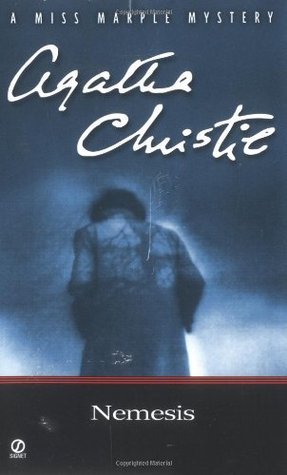
Far from a sterling example of Christie’s ability to craft a puzzle, Nemesis is nevertheless the purest embodiment in novel form of The Marple Factor. For once, we enter her mind and watch her at work. We see how she maneuvers her conversations with the three sisters, with Miss Barrow and Miss Cooke, with the post office employee and other villagers. (She even brags about this last bit to the Home Secretary.) Contrast this with her honesty with Elizabeth Temple, Professor Wanstead, and Archdeacon Brabezon.
Mr. Rafiel picked Miss Marple for this task because he knew how much she embraces justice over sentiment. In her conversations with Professor Wanstead, one can’t help seeing signs of the cold goddess of pure justice she professed to be in the Caribbean. She refuses to see Michael through the eyes of a social reformer or amateur psychologist. If he is innocent of Verity’s murder, she’ll get him out of jail; otherwise, he has made his own bed and has to lie in it.
“Not a very nice business,” said Miss Marple in her most old-ladylike tone.
Professor Wanstead looked at her for a moment or two. “You describe it that way?”
“It is how it seems to me,” said Miss Marple.” I don’t like that sort of thing, I never have. If you expect me to feel sympathy, regret, urge an unhappy childhood, blame bad environment; if you expect me to in fact to weep over him, this young murderer of yours, I do not feel inclined so to do. I do not like evil beings who do evil things.”
Interestingly, she shows much more sympathy in the end for Clotilde, without excusing her actions in the least. This calls to mind the sympathy Miss Marple has always expressed for lonely women. It’s what made her see the killer of three people in A Murder Is Announced as a pathetic, affectionate creature. The Golden Age detective was, by nature, an outsider: rarely delineated in character beyond a few eccentric quirks, rarely expanding their circle of friends, family or experience. The fact that Lord Peter Wimsey changed upon meeting Harriet Vane is actually quite extraordinary.

As a gift in this final novel about Miss Marple, Christie doesn’t change her, but she broadens our perspective and understanding of what makes the lady tick. This is brought home most beautifully on the final pages, when Miss Marple goes to collect her reward. Mr. Broadribb offers to introduce her to an investment broker or to help her select the most lucrative account in which to deposit the twenty thousand pounds.
“Oh, I don’t want to invest any of it –“ she says. “There’s no point in saving at my age. I mean the point of this money – I’m sure Mr. Rafiel meant it that way – is to enjoy a few things that one thought one never would have the money to enjoy.”
Mr. Broadribb and Mr. Schuster keep pressing the point: even a 113-year-old spinster should think about making that money grow for her. But Miss Marple remains adamant: “I’m going to spend it, you know. I’m going to have some fun with it . . . Mr. Rafiel would have liked me to have fun.”
And here’s the part that makes me cry:
“She looked back from the door, and she laughed. Just for one moment, Mr. Schuster, who was a man of more imagination than Mr. Broadribb, had a vague impression of a young and pretty girl, shaking hands with the vicar at a garden party in the country. It was, as he realized a moment later, a recollection of his own youth. But Miss Marple had, for a minute, reminded him of that particular girl, young, happy, going to enjoy herself.”
Christie ends Curtain with the death of one of our heroes, impossibly old and enfeebled, summoning up enough strength to defeat a powerful foe and give his best friend a new lease on life. Nemesis ends with Miss Marple still in full possession of her powers, basking in the glow of her latest success, bringing to a man’s mind of the young pretty girl she used to be.
Oh boy, oh boy, oh boy, oh boy, oh boy!
Score: 10/10
The Wow Factor
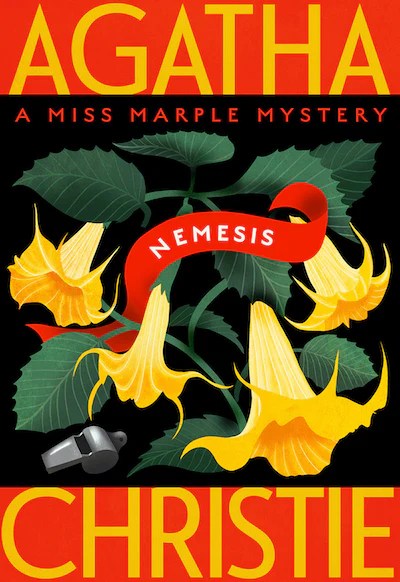
As a detective novel, Nemesis provides a “shock” ending that perhaps doesn’t shock us very much anymore. As a puzzle, it does what the best of the late Christies do: it lures us in with an intriguing premise, takes us on an over-long and bumpy ride, and then ends with a solution that both satisfies and moves us.
Nemesis is ultimately a significant entry in the canon, bringing to a culmination the exploits of a woman whom we have loved and admired for forty-three years. The fact that Christie lets us in enough to stand side by side with the lady, and then instead of shipping her off to dusty retirement and certain death, gives her the sendoff she deserves – an audience with the top London brass, who come to respect (and, delightfully, fear!) her and a big wad of cash. I like to think of her stepping off a bus in London, savoring a good lunch ending with a marrone glacé, followed by a shopping spree at a first-rate linen store. And before she takes the train back to St. Mary Mead, to sit by her garden knitting, much in the same position she took in the Bantry’s library every Tuesday night, with the ghosts of Miss Hartnell, Miss Wetherby and Mrs. Price-Ridley sitting beside her, carefully watching the memory of Anne Protheroe slink past the gate in her tight dress . . . before she does that, Miss Marple will spend the night in a London hotel. A really nice hotel.
Any place but Bertram’s will do.
Score: 7/10
FINAL SCORE FOR NEMESIS: 36/50
Next up, a final summation of the Ranking Marple project . . .
* * * * *
POSTSCRIPT
Each time I create a post about a specific book, I go through the internet looking for a variety of covers with which to decorate my work. This time, as I was searching for a nice assortment, I discovered an unusual cover, and when I clicked on it, it took me right to a blog called . . . Ah Sweet Mystery. And that is how I discovered that I had already written a review of Nemesis six and a half years ago.
I offer a link to that earlier review here if you’re interested in seeing how my views about the book have changed – we all get wiser with age!. Of course, our opinions evolve, and I’m sure that reading Nemesis the context of a year-long contemplation of Miss Marple had something to do with it. So, too, has a life lived – and sometimes half-lived – through the greatest social and personal upheaval of my life.
Recently, some comments responding to an article I published in the magazine CADS also made me doubt the value of what I’m doing here. They suggested that the best approach to take to Agatha Christie would be “enough is enough.” And while I one hundred percent disagree with that sentiment, the comments were personal enough to sting and to bring up a frisson of doubt over my mission here.
Reading my old analysis of Nemesis against the new, I’m not saying that one is right and the other is wrong. There is probably far less difference between them than I imagine. But it has brought home to me the value of re-reading, especially the writings of those you love, and the power of time and experience to change our minds. And that, to me, seems to give what I do here purpose and value. Much to my relief!!!
Thanks for indulging me here.

 Ah Sweet Mystery!
Really enjoyed your take on this book. It’s definitely one for the fans – I would be tougher on it (her final few books are all incredibly frustrating by any objective standard) but your affection for Miss Marple is very contagious. I might even re-read it, one day … 😁
LikeLiked by 1 person
Better yet, you, Nick and I should rank them one day!!!! 😆
LikeLiked by 1 person
We gotta do Ellery Queen first!
LikeLiked by 1 person
Oh, wow! Yes, that’s brilliant! Top 20 Queens! And we can invite JJ to join us! 😜
LikeLiked by 1 person
We have to do it. But maybe Tom Mead needs to join us for that one 😁
LikeLike
With a little more prep time, I’d gladly jump on board a Top 20 Queens draft! Ha!
Your enthusiasm for Nemesis for infectious, Brad. Like Sergio, I should give this one a reread.
LikeLiked by 1 person
Be great to do it Nick – consider yourself engaged. Let us know when you’re ready!!! 👍
LikeLike
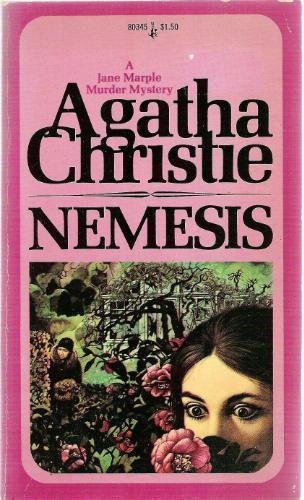
I have been looking forward to you getting back to Nemesis. This book holds a special place for me. My introduction to Christie largely was as a child by my grandmother, who had a dozen or so Christies on her bookshelf, including the Pocket Books edition from 1973 with the pink cover in your post.
Nemesis was the first Marple my young self ever read so it holds a special place for me. I enjoyed it then and it is the only late Christie that I have re-read as it nostalgically reminds me of childhood and my grandmother. I remember discussing the book with her after we both finished it.
Despite its shortcomings that you summarize well, I thought the motive and culprit were unique (i.e., not the common one of greed/financial gain). Most of all the character of Miss Marple is captivating, displaying her trademark intelligence and observational skills on almost every page using non-traditional detection. Her nuanced portrayal adds depth to the story and continues to develop this beloved character. Imagine my surprise when seeking out other Marple books only to be disappointed how little or late she is present in those stories.
LikeLiked by 1 person
P.S. I looked up what is marron glacé. Interestingly it is a sweet confection made from chestnuts (marrons in French). The process involves candying chestnuts in sugar syrup and then glazing them. Nothing for me, but I hoped Miss Marple enjoyed them.
LikeLiked by 1 person
I despise both the texture and the taste of chestnuts, so I’m also willing to bequeath Miss Marple my share. Thanks for sharing your Christie origin story, Scott! I want to collect a thousand of these and publish them! That first title is always special, no matter which one it is. But what I truly love is that your grandmother read it too and you got to discuss it together! For most of my life I have been a Christie loner. 🥹
LikeLike
I looked it up too. And while chestnuts are alright, this particular sweet doesn’t seem very appetizing to me. At least, not as a bucket list luxury! Miss Marple is welcome to my share as well!
LikeLiked by 2 people
I was surprised on reread how much I loved this! Because I had a similar recollection, but it is so much Marple all in one go
LikeLike
Firstly, Happy Birthday! And secondly congratulations on fulfilling your self-imposed Marple challenge – they’ve been great to read.
LikeLiked by 1 person
One series project down – thirty-four to go.
LikeLike
Pingback: RANKING MARPLE: Settling the Scores | Ah Sweet Mystery!
Pingback: MY AGATHA CHRISTIE INDEX (The Blog-iography!) | Ah Sweet Mystery!