I’ve been waiting to read this one for quite a while.
I can be even more specific: I started waiting on April 25, 2019, the date my buddy JJ posted his review of James Ronald’s 1936 novel Murder in the Family. I probably get more fruitful suggestions out of JJ than any other mystery blogger, but what happens when I get excited over his excitement is that I start to skim quickly through his words, skipping as much as possible in order not to spoil the book before I read it. So I had the barest idea of what this was about, or even why I wanted to read it. I just know that as soon as I could, I went through the internet looking for a copy.
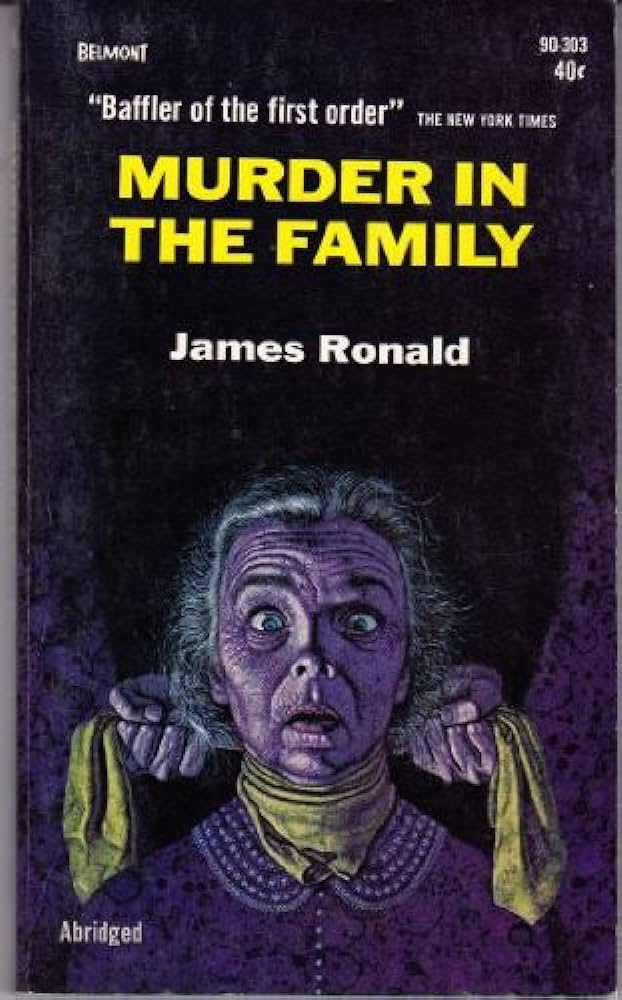
I found one right away on eBay and happily ordered it. What I didn’t know at the time was that James Ronald is – or was, at the time – one of those prolific authors whose work is very hard to find. What I ended up receiving was a 1964 edition from Belmont Books that, for some reason, was an edited version of the original text. And since I don’t read edited text if I can help it, I put this copy on the shelf and waited until the opportunity might arise to buy an unexpurgated copy. And I waited. And waited . . .
And now, thanks to Moonstone Press and James Ronald uber-fan Chris Verner, it looks like just about everything from the author is going to be reissued in very attractive copies. My patience had been rewarded, and my excitement was so great that 1) I pushed hard for my Book Club to make Murder in the Family its March title, and 2) I jumped the gun and read the darn thing before we met to discuss our February book. I’m typically a slow-as-molasses reader, but I tore through this novel in two days; at the very least, then, based on my one read (and a lot of coverage from JJ on what has been published so far, including an in-depth interview with Chris Verner himself!) that James Ronald is eminently readable.
The question before us now is: did Murder in the Family survive the hype that I had built up in my head for nearly five years???
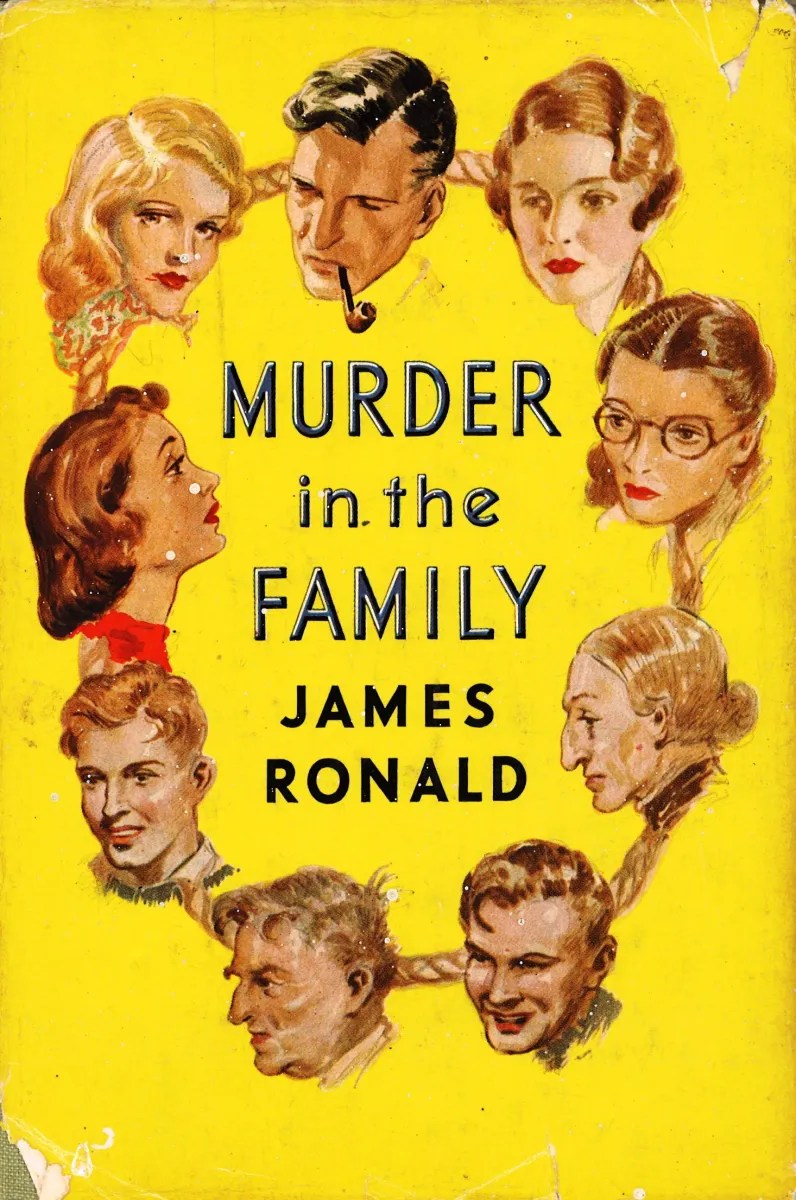
The book is certainly hyped as a “traditional” novel of detection in both copies I own. The 1964 blurb calls it “a new classic of mystery and suspense in the tradition of Agatha Christie and Nicholas Blake, and the plot’s description leans heavily into the idea of a closed circle mystery. It takes place in one of those Midlands English Villages called Gay Ladies, which is a suburb of the larger town of Brancaster. The town is where a middle-aged clerk named Stephen Osborne works – or worked until, as we learn on page one, Stephen was downsized and finds himself out of work and lacking the savings to support his wife and five children. The only option he can think of is to appeal to his older sister Octavia, who years ago inherited the family wealth under the provision that she provide for her little brother. Unfortunately, although they were once quite close, brother and sister had a major falling out over two decades earlier when Stephen fell in love with and married Edith.
Even though Aunt Octavia pays the family a visit every summer, she greets everything they say and do with cold disapproval. Still, Stephen sees her as his only hope, and as her annual visit is just around the corner, he plans to humble himself before her and ask for financial support.
Of course, this is a murder mystery, and you can imagine what Aunt Octavia’s reaction is. These early scenes are really impactful, as we meet and fall in love with each member of Stephen’s family: his loving wife, loyal housekeeper Hannah and the children: romantic Dorothy, whose heart is promised to a young man of great wealth; Ann, the intellectual, whose passion for books actually figures prominently into the plot; Michael, the cool son, who loves to tinker with his motorcycle; Marjory, the daydreamer; and Peter, the adorable youngest. Contrast this with the bitter vitriol spewed by Octavia, who turns against the family with a vengeance.
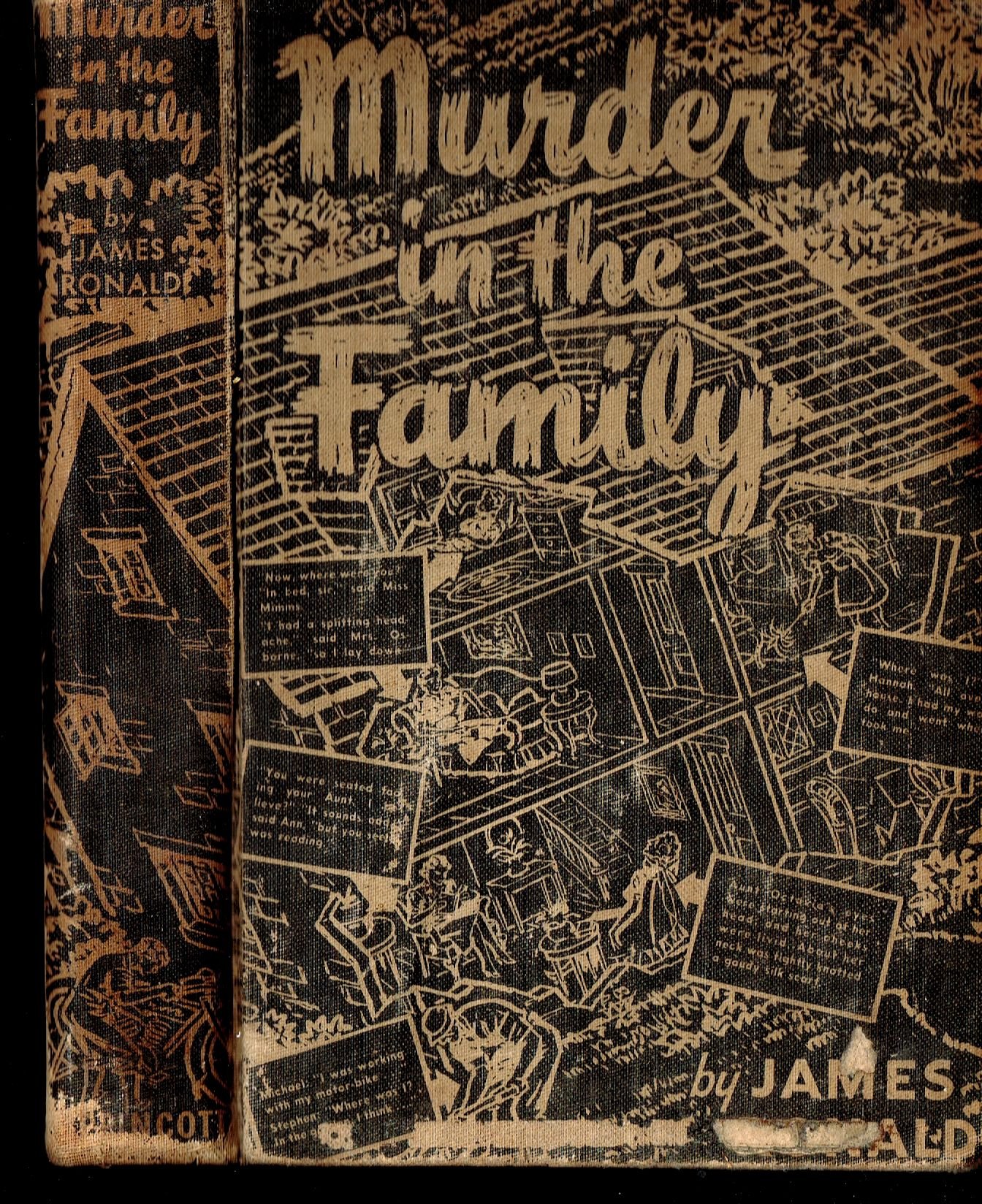
So far, everything is going as you would expect, right down to Octavia announcing – as murder victims tend to do – that as soon as possible she will be changing her will and disinheriting her brother. Within an hour, Octavia will be dead.
With the entrance of the police in the form of a jovial Chief Constable, a scowling Inspector, and a comic relief Sergeant, it seems like the form will continue. But Murder in the Family is going for something else in the long run. The scenes of investigation are the least compelling aspect of this book. What really hooks us is the depiction of the family suffering as they become suspects, not only within their own closed circle but in the eyes of the entire village and, thanks to the machinations of the press, all of England. The keenest focus here is on how each family member is impacted and how the “good people” of Gay Ladies devolve into a mob. Everyone in town abandons their home, job and school to attend the inquest, “to see the fun” as it were: “. . . The coroners court was packed to suffocation, and the overflow jammed, the street, searching, too, and fro like an ocean gone mad. It was every man for himself.”
When the law manages to sneak the Osborne family into the courtroom through a narrow back alleyway, the crowd erupts in fury, as if someone had played “a dirty trick” on them:
“There followed a wild rush down an alley which led to the rear of the court, and in the battle that ensued when a thousand temporary maniacs fought to be the first to enter a passage that could accommodate at the most only three abreast, a section of the mob was barged through a plate glass window. No fatalities resulted, but nearly all of them had deep cuts to show for it; and one man was so badly injured that his right leg had later to be severed above the knee.”
In passages like this, the book deeply affected me; perhaps it’s because lately, in the course I’m taking on the Hollywood Blacklist, in TV programs I have lauded, and sadly in the daily news, the moral frailty of humankind has stood out in sharp relief. The Common Man fares poorly here – but so does the Press and the police, who are at such a loss as to how to find the killer that they leak deeply personal details about the family to the newspapers, with the result that the life of every one of the Osbornes is shattered. What we have here is a powerful social and familial drama couched in the accouterments of a traditional murder mystery. Where it falls short will depend on how badly you want that mystery to work. Ronald provides us with a true monster of a victim and a charming set of suspects. But there is nobody on the side of the law to root for and no real clues for them to sink their teeth into. The Chief Constable is charming but ineffectual, and the Inspector’s actions are heinously unprofessional. Only the Sergeant comes off fairly well, providing a few good suggestions and most of the novel’s humor, such as it is.
I have to say that I spotted the murderer immediately. Some of the hype I had heard over this book concerned the killer’s motive, which is powerful but impossible to detect. In the end, I feel I can give Murder in the Family the highest recommendation, as long as you understand as you enter its spell that comparisons to Christie and Blake are inaccurate and unfair. And be sure you read Chris Verner’s biography at the front of the author, who led a truly fascinating life, one that feels almost cursed until you learn how even the most terrible events shaped him as a writer. And Ronald wrote so well that the mystery of how he came to be nearly forgotten – a mystery that has recurred again and again as one Golden Age author after another gets reissued after five or more decades of nothing – seems especially mysterious here. And now, having taken to Ronald so strongly, I’m even more excited that so much of his work is being made accessible again. That’s one point for humankind!
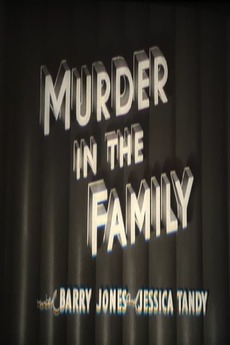
Oh, by the way, the frustration never ends: I discovered that Murder in the Family was made into a film in 1938. Three of the children were played by Jessica Tandy, Evelyn Ankers, Glynnis Johns and, in his first screen role, Roddy McDowell.
And I can’t find a way to watch it anywhere . . . . .




Anyone have a clue as to how/where I can watch this???


Aunt Octavia has to be one the most despicable villains/victims in GAD. If the culprit didn’t get around to it, I was ready to dispatch her 🙂
I solved this one as well as it immediately reminded me in one way of a Christie favorite (“After the Funeral”) in that rot-13: Fhfcvpvba snyyf ba gur snzvyl jura gur phycevg npghnyyl jnf n zrrx, frrzvatyl xvaqyl crefba jub npgrq bhg bs sehfgengvba. Cyhf Ebanyq qebccrq n pyhr qhevat gur vairfgvtngvba gung gur xvyyre erdhverq ab cnegvphyne fgeratgu gb unir fgenatyrq Bpgnivn.
Many times through my GAD reading, I find “wanting” is better than “having” (i.e., a rare book doesn’t live up to its hype). That is not the case here. No book is perfect (except for perhaps “And Then There Was None”) and MitF isn’t either, but what a fun read. I’m glad you liked it.
LikeLiked by 1 person
Gur bayl “pyhr” V unq sbe guvf bar pnzr sebz Wvz, jub unq gbyq zr frireny gvzrf ubj oybja njnl ur jnf ol gur zbgvir. Naq fb, jura Zvff Zvzzf pbyyncfrq ng gur arjf gung fur jbhyq or erprvivat n lrneyl fhz bs bar gubhfnaq cbhaqf, V svtherq fur jnf fbzrubj nsenvq bs cbffrffvat zbarl. Fur pbhyq nyfb or bssraqrq gung fur orpbzrf gur cngfl va Bpgnivn’f zvfthvqrq iratrnapr ba ure oebgure. Qvfpbirevat bayl ng gur raq gung Zvff Zvzzf vf grezvanyyl vyy eraqref nal frzoynapr bs “snve cynl” zbbg, ohg vg znxrf Bpgnivn fhpu n zbafgre gung jr trg na rkgen yvsg ol ure qrngu gb tvir hf fbynpr nsgre gur jubyr snzvyl arneyl jnf qrfgeblrq.
LikeLike
I enjoyed the book but didn’t you find the reveal of the murderer a bit abruptly dealt with?
LikeLiked by 1 person
Absolutely! There are a number of things about this one that drive me crazy! SPOILERS FOLLOW
Chief among them are the attitudes of both Uncle Simon and the killer – both essentially good people – at the end. There is no understandable reason why Simon would protect the killer at the expense of his family. And since the killer is terminally ill, why wouldn’t she confess after she saw the hell that the Osbornes were going through. And Ann’s presence in the murder room is problematic for multiple reasons. Ultimately, I simply had to relax and let Ronald take me where he wanted me to go!
LikeLiked by 1 person
Agree. Too many good people acting irrationally.
LikeLiked by 1 person
Pingback: Oh #$%&! Not Another Blogger’s Tenth Anniversary!! | Ah Sweet Mystery!