Like me, some of you might remember how back in the 1980’s and 90’s, the dairy industry would put the pictures of missing children on their cartons. This was the time – blissfully free of the internet – when wanted posters dotted the bulletin boards in every post office. It seems like a natural fit for publicizing lost kids: after all, everybody likes milk! It turns out that this idea was conceived out of a general frustration with the police force for the low priority they gave to children who ended up with non-custodial parents.
The things you learn on Wikipedia!
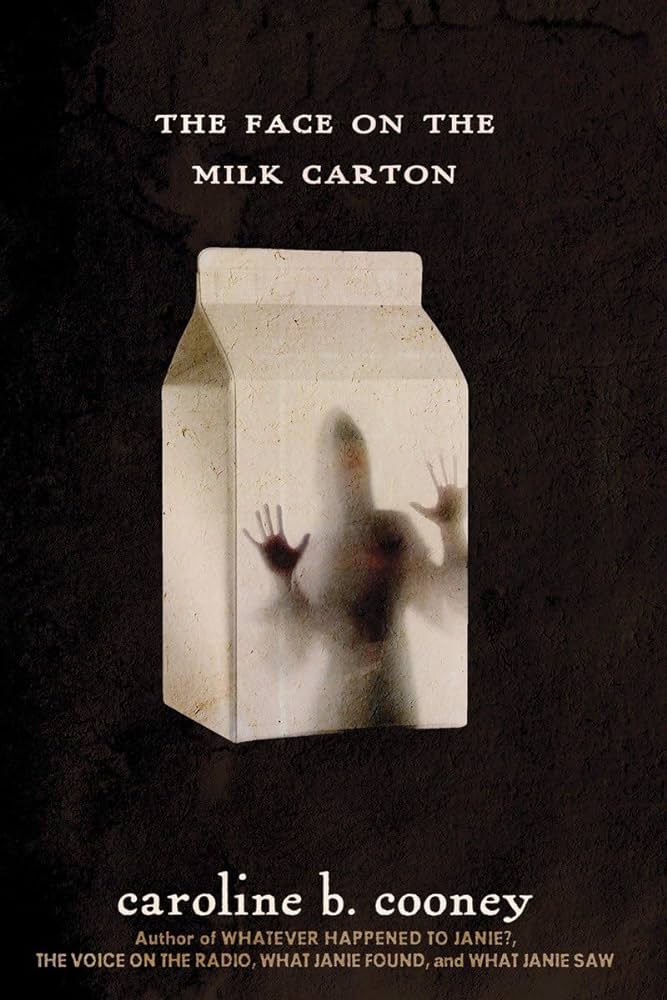
In 1990, prolific YA author Caroline B. Cooney took this idea and went with it. The Face on the Milk Carton told the story of 15-year-old Janie Johnson, who one day at school looks at a friend’s milk carton and sees her own three-year-old face staring at her. Fear grips her as she begins to suspect that the loving couple she has called “Mom and Dad” for her entire life might have kidnapped her.
I’m not going to spoil this for you, but Janie’s story was juicy enough to inspire four sequels over the next thirteen years. There is plenty of (melo)drama that runs the course of this saga, including kidnapped children, weird cults, many mothers of variable quality, and more than one very bad boyfriend. As is standard with young-adult fiction, there are also lessons learned, about self-identity, about forgiveness (both of self and others), trust, sharing, and, of course, love – because love teaches you how to know and accept yourself and others, how to forgive and trust and share. And, more problematic for me, all of this is wrapped in a very Christian bow, as spirituality helps the characters get through their crises and their lessons: they go back to church, they go on a mission, they marry young.
Cooney is still alive and had a long prolific career. If you go to her website, her autobiography reads like 50’s sitcom, part Sunday School lesson:
“The nineteen fifties were a wonderful time to be a kid. We had much more freedom than you have. When we came home from school, we changed our “school clothes” and wore “play clothes.” Then our mothers sent us outside. We were expected to get lots of “fresh air. . .We were always in the woods behind my house, where our favorite games were Cops and Robbers or Cowboys and Indians. A golf course lay beyond it. Rich people played golf. We didn’t know any rich people and the golf course was forbidden. Naturally we played there all the time.”
That halcyon feeling is what Cooney brought to her books, and they entertained – and taught lessons to – millions of young readers for forty years and counting. That’s kind of what books for young people aimed to do in those days, mix advice with adventure, and provide any type of book, be it romance or adventure, science fiction or mystery, with a great big moral at the end. It might explain why I jumped right to Agatha Christie at the age of eleven. She had a much more delightful way of hammering home the message: “Thou shalt not kill!”

Fortunately, the best of modern YA approaches its task from a different angle by trying to create a richly diverse portrait of teenagers trying to navigate our complex world. It’s a tricky road these authors travel: if they try and become too savvy to current trends and slang, they run the risk of their books becoming all too quickly dated. And yet, their stories, and particularly their characters, must appeal to current potential readers. Most important, they must not preach to their audience: it smacks of patronism and turns savvy kids off. And so it’s gratifying to see Australian author Troy Hunter approach the same plot idea as Cooney and simply allow his characters to grow and change and learn without our feeling like there’s a wise, moral adult voice in the background guiding these young people, plot point by plot point, toward making the right decisions.
“So today I became a detective because I uncovered a crime. And not just any crime, but a kidnapping. And not just any kidnapping, but maybe my own.”
Angus Green, the protagonist of Gus and the Missing Boy, is fifteen, overweight, and openly gay. He is also the primary support of his alcoholic mother, who still suffers from injuries sustained in a car accident five years earlier that killed Gus’ dad but miraculously did not harm the boy himself. The pressures of Gus’ home life cause him to seek support in negative and positive ways. I’ll let you discover the negative; on the other hand, Gus is seeing a shrink and has two staunch friends by his side.
Of course, this being YA, both friends have their own problems: Shell is rich and dealing with body and gender issues, while Kane is a handsome straight jock who dropped out of school when a football injury ended any chances of a sports career. This dysfunctional but loving trio, each uncomfortable in their own body and uncertain of who they are going to be, is the best thing about the novel: as they spar, drink, compete for each other’s favor, have angsty sleepovers and go on one essential road trip, it’s a pleasure to be in their company and to root for each of them to find him-, her- or theirselves.
As Gus prefers soda to milk – and since this is 2024 – no milk cartons will come into play here. Instead, Gus, a true crime devotee whose dream is to become a cop, goes searching on the internet one day and comes across a site listing kidnapped children who have never been found. Someone has used AI to create pictures of what these kids might look like today, and Gus is stunned when he pulls up one picture and finds himself staring into his own face.
This is Hunter’s first novel, and his opening deftly sets up the dual nature of a young adult mystery: as the three main characters join together to solve the puzzle of Gus’ parentage, their investigation becomes the means for each of them to journey toward finding their true selves. This is not a puzzle mystery, per se: mostly, Gus, Shell, and Kane use their phones and laptops and local agencies to track down contacts and snatches of information.. Bit by bit, they form a chain of information that leads to the truth of who Gus is and what happened to him. The result for each is devastating and empowering. It’s also quite charming how their love of the genre causes them to frame their investigation along classic mystery lines, going so far as to manipulate the policeman in charge to gather the suspects together in the end to unmask the villain.
Even that doesn’t go as smoothly as our junior sleuths had hoped. The truth is that this mystery ends messily, which is a very good thing. Oh, we get to know the relationship between Gus and the missing boy and what happened to both of them – up to a point. But this isn’t Agatha Christie. There are no neat solutions to either the mystery or to the pressing problems in Gus’ life, no quick wrap-up of all that’s come before. Rather, Hunter endears us to Gus and his friends , plunges them into chaos, and then shows us the path that they will (hopefully) take to find satisfying lives in that space characters occupy after we readers have closed the book for good.
Very messy, a bit snarky, and hopeful without being preachy. Just the way I like it.
 Ah Sweet Mystery!
Julie Campbell also was able to capture the magic of childhood in the early Trixie Belden books.
LikeLike
Pingback: EVE OF POSSIBILITIES: Looking Back on ’24 and Forward to ’25 | Ah Sweet Mystery!
Pingback: EVE OF POSSIBILITIES: Looking Back on ’24 and Forward to ’25 | Ah Sweet Mystery!