“One night in midsummer, at Cheltenham in Gloucestershire, Arthur Fane murdered a nineteen-year-old girl named Polly Allen. That was the admitted fact.”

Earlier this year, I crossed the halfway point in my spasmodic celebration of John Dickson Carr’s alter ego, Carter Dickson. Nine – And Death Makes Ten was definitely a highlight of my journey so far, but it carried with it a warning – although not one of my own making:
“Unfortunately, you’ve hit the end of peak Merrivale with this one. That first run of 11 novels is unsurpassed in Carr’s career. The books going forward are perfectly readable . . . and enjoyable, but they just never reach these heights again.”
That was my buddy Ben, host of The Green Capsule blog, gently scaring me away from the bottom half of the Dickson oeuvre. It’s also an accurate assessment of lucky #13, 1941’s Seeing Is Believing (the yucky U.K. title is Cross of Murder). It’s not a bad book by any means but after the series of bangers that have preceded it, it feels like a piffle. As Roxie Hart sang about her nebbish of a husband: “The whole is greater than the sum of his parts.” But compare the parts themselves to those found in earlier Dickson novels, and they wobble just a little.
But I’ll get to that.
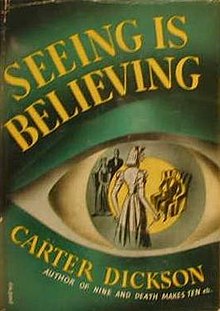
Let’s start with what works: after the high drama, both in setting and situation, of Murder in the Submarine Zone, we’re in a charming domestic setting: Cheltenham and the environs around the home of respected solicitor Arthur Fane. As the novel opens, Fane lives with his much younger wife, Victoria, and his uncle, a charming rogue named Hubert. Behind all this pleasantry lies the whisper of murder, which unfolds in an opening scene that, trust me, you’re going to want to read again after you’ve finished and closed the book.
Thus, the situation is a bit tense when the Fanes hold a dinner party and invite three guests: a handsome soldier named Frank Sharpless, whose bright prospects are endangered by his passion for Victoria; a pretty young thing named Ann Browning, who happens to be secretary to the Chief Constable of the County (which comes in handy!); and Dr. Richard Rich, a disgraced medical man who now makes his living at parties and music halls as a hypnotist. When Rich is challenged to prove the powers of hypnotism (we recently saw how that never goes well), the company reassembles for a second dinner party, where Rich performs his music hall act on Victoria Fane and before them all, she stabs her husband to death.
Except . . . the dagger in question was clearly demonstrated to be made of soft rubber, not deadly steel. And everyone will swear that at no time could anybody have made a substitution. As an impossibility right from the get-go, this is . . . just okay. Dickson milks the scene for every bit of drama he can, but, let’s face it – this is no murder room, no man overboard, no Judas window. It’s a magic trick: nobody could have switched the daggers, but clearly somebody switched the daggers, and all we have to do is wait and discover the trick.

In the meantime, the local police are at a loss. By a fortunate coincidence, a certain War Office bigwig happens to be staying in Cheltenham where he has hired a ghost-writer to help put together his massive memoir. The bigwig, of course, is Sir Henry Merrivale. The ghost-writer, Phil Courtney, is the Watson du jour, and I think he’s one of the better ones. This novel marks a turning point in Dickson’s distribution of Merrivale-ian humor. Previously, the Old Man’s hijinks were cleverly woven into the fabric of the mystery, as in his courtroom behavior during The Judas Window. Here, it feels like a separation has occurred: we get a great many scenes of HM dictating his history, and while some of his stories are funny, and the main idea that the memoir is an act of revenge against childhood slights is even funnier, eventually it begins to feel like padding. Courtney’s presence as pipe-smoking straight man is one of the more charming aspects of these sections.
There’s no doubting the author’s expertise at divvying out the suspicion. While the nature of the crime theoretically exonerates everyone, each suspect is given their moment to shine as a potential murderer. That helps things along a bit because given the reality of classic crime fiction, what with all the romances going on, it basically comes down between two people. Still, Dickson dangles enough before you to cast doubt, and what seemed like weaknesses – a coincidence or two, and a moment of slapstick non-hilarity involving Sir Henry – provide satisfaction in the final explanation. And when you go back and look at what came before, you see how cleverly the author put things – even if it feels, as it sometimes does with Carr/Dickson, that he lied to you.

Still, I can’t help feeling that Ben’s warning has ominous undertones. The Reader Is Warned had a better charlatan than we find here; The Punch and Judy Murders and And So to Murder were tons funnier; and nearly all the books that came before had more exciting impossibilities at their core. There is one book to come that I have read before and enjoyed thoroughly. As for the rest . . . . let’s keep our fingers crossed!
 Ah Sweet Mystery!
Fortunately you still have “He Wouldn’t Kill Patience” and one of my absolute Carr/Dickson favorites, “She Died a Lady” to (re)read. I look forward to those reviews when you get to them.
LikeLiked by 1 person
I remember the essential misdirection of this one, and I don’t mind it. The book as a whole is the fairly tepid middle ground, but then I’m always dubious about hypnotism as a plot feature because it’s never really established what someone definitely can and can’t do when in said state.
Just once it would be nice to have the rules of hypnotism established, y’know? And if everyone behaves differently, maybe establish how the key person behaves under hypnotism before then throwing them into a plot involving it? Ah, well, my thoughts on this one below:
https://theinvisibleevent.com/2019/05/02/seeing-is-believing-a-k-a-cross-of-murder/
LikeLiked by 1 person
My recent read of Herbert Brean handled hypnotism much more dramatically and with different rules. As a book, I enjoyed it far more than this, although as a mystery plotter, Brean doesn’t compare to Carr in this case.
LikeLiked by 1 person
I’m also pretty shocked to see how low Bowstring Murders falls on your list, because I remember thoroughly enjoying that one. Clearly a reread is on the cards.
LikeLiked by 1 person
Well, this is the problem of doing a ranking list and taking five plus years to do it!!! I vaguely remember TBM being juicier than SIB and possibly more enjoyable than White Priory! I just don’t remember anymore!!!!
LikeLike
Yes, I’ve been mulling a list of two recently, and, wow, does it prove difficult when one read some of the books on said list seven years ago.
Also, hey, individual taste goes a long way, so I’m not suggesting you’re wrong — if anything, my memories of Bowstring, which I read as a relative Carr neophyte, are wildly off beam…
LikeLiked by 1 person
To echo Scott’s point, you still have SHE DIED A LADY and HE WOULDN’T KILL PATIENCE, two of the finest detective stories ever written. So Ben needs to stop giving you such rubbish info! Listen to me instead … listen to me … your eyes are … is my hypnotic technique working yet? I’m getting a bit sleepy actually… 😁
LikeLiked by 1 person
I do think the central misdirection could have been better handled, but knowing its nature I think the book works better on a reread.
Aside from the misdirection, I remember it for its vivid illustration of life with more primitive medicine.
LikeLike
You have not commented upon the cheating in the beginning itself!
A fact is a fact whether admitted or not !
LikeLike
Yes, a fact is a fact whether admitted or not. But you’re overlooking the ambiguity brought about by the use of modifiers. If you are to say that all admitted facts must be facts, would you say that an alleged fact must be a fact? The ambiguity in the term “an admitted fact” is the question of whether that means “a fact that has been admitted” or something that has been “admitted as a fact.” There’s a very significant difference. I don’t know if I approve of its use, but I think “claimed fact” or “alleged fact” makes the point of what is being done here.
LikeLike
I actually think you’re wrong here, Scott, in trying to compare “admitted” and “alleged”! There is a lot more certainty attached to the former word. I think Carr plays perfectly fair with the use of the former term, especially, as I mentioned, if you re-read the first chapter and pay attention to the order of events and to who actually did the admitting. But I do think Carr fudges with the full term, “admitted fact:” here he gives it a meaning more like “alleged fact,” without clarifying this.
I don’t think really good mystery authors, ever lie to the reader, but they do create situations that allow readers to lie to themselves. Christie did it brilliantly all the time; so did Carr – but I think it’s done rather clumsily here. It did succeed in its goal, which was to fool me, but it did not leave that pleasant aftertaste that that I got from, say, After the Funeral, which also contains a cheat – but I don’t care!
LikeLike
I think the term “alleged” has misdirected from my point about the frequent ambiguity of modifiers, regardless of their weight or level of certainty. Sometimes it is an ambiguity of reference or scope, as in the comic understanding of “automatic men’s umbrellas” as umbrellas for automatic men rather than automatic umbrellas for men. The ambiguity can also be a matter of relationship of modifier to noun, such as the old joke “ if olive oil is made of olives, and sunflower oil is made from sunflowers, where does baby doll come from?”
Now, let us consider a man who is wrongfully convicted of murder. It is not true that he is a murderer, but it is not necessarily wrong to say that he is a “convicted murderer” despite his innocence, because that term can be understood either to mean a murderer who is convicted of that crime, or merely a person who has been convicted of murderer, regardless of his true guilt. (I’m personally hoping that a certain famous personage will soon be convicted of several crimes. If this happens, many people will still believe that he is wrongfully convicted, but because of that second meaning there will be no fear of charges of slander or libel to say he is a “convicted _______” and I for one will be happy that people will be able to to say it without fear of legal repercussion).
Likewise, the phrase “X is an admitted fact” can be understood to mean:
(a) X is fact, and is admitted as such
Or merely that:
(B) X is admitted as fact
They can both be true, but (b) can definitely be true without (a) being true.
Perhaps the term “accepted fact” would make this clearer. Prior to the era of Copernicus (to my knowledge) it was an accepted fact that the sun traveled around the earth (my knowledge of scientific history is sketchy, so I be wrong on this one, but I’m sure you can find an alternate example to illustrate my point). Now, it was never actually a fact that the sun traveled around the earth, but it is not wrong to say it was an accepted fact, because that term is understood to men “accepted as a fact” rather than “a fact accepted as such.”
Carr’s question of “but who admitted that fact?” is simply another way of recognizing that second meaning of the phrase “admitted fact”: an idea admitted as fact by someone (regardless of its truth), rather than a true fact admitted as such.
I still don’t like the way Carr used it either, but I do believe the ambiguity exists, though it usually doesn’t matter (in the same way it usually doesn’t matter whether a flashback represents an illustration of testimony, a visualization of a memory, or an objective truth that is being described, as they usually come to mean the same thing…but sometimes…).
LikeLiked by 1 person
I meant to write “baby oil.” Baby doll comes from Gadge Kazan.
LikeLike
I think the comparison to Stage Fright is a good one. Hitchcock plays on the audience’s view of flashback as “accepted fact” despite the lack of any rule book saying this must be so. Hitchcock manipulation is perfectly fair, but it still leaves some viewers with a bad taste in their mouths!
I wonder if this novel might work less well in modern times when people have become lazy and have abandoned multiple meanings for different words and phrases. I think the most shocking moment here for me comes at the end when Sir Henry explains the concept of “admitted fact” to the others, as if he had read the first chapter himself! Clearly, Carr knew how some readers would react and was prepared for them.
LikeLike
I think there’s a big difference in that, whether consciously pondered or not, we’re all aware on some level of the ambiguity of written and spoken language in regard to modifiers: we know that a “convicted felon” might refer to either a person who is rightfully convicted of a felony, or a person, regardless of guilt, who has been convicted of one. We know that “X oil” might be an oil made either for or from X (depending on what X is). There are actually many such examples of linguistic ambiguities that we come across frequently. So even if readers took “admitted fact” to mean a fact that has been admitted, they were aware on some level that written language has this possible ambiguity.
But up to the time of Stage Fright, I don’t think most people had ever been forced to realize that cinematic language has such ambiguities, and that a flashback might merely illustrate a character’s (possibly mendacious) testimony, rather than his actual memory of an event. Of course, it really wasn’t the first time this trick had been played— even in a mystery film— but it was the first time it was played on such a large scale. So, even though there’s no rule book regarding the meaning of visual techniques, Hitchcock comes far closer to cheating in that he was working in a language whose ambiguities were not as universally recognized.
LikeLiked by 1 person
I still hold that modern readers, especially younger ones, are less likely to come into a mystery on the lookout for ambiguous language. The first line in the novel states that Arthur Fane murdered Polly Allen. This fooled me entirely because I did not look for ambiguity in the sentence which followed. After I finished the book (and HM pointed out this ambiguity as if he, not Carr, had written the book), I went back and re-read the first chapter. I found it all very clever – but I didn’t like it as much as the scene at Chez Ma Tante in Death on the Nile or the scene in the railway station tea shop in After the Funeral or the different spellings of “inquiries” in A Murder Is Announced. That’s just a matter of taste.
LikeLike
I don’t disagree with that. Personally, I find Carr’s use of it infuriating, and definitely detrimental to my regard for the book. Part of the problem is Merrivale’s omniscience regarding the narrators statements. But a greater part of it is the way he explains it (rather the way he doesn’t explain it). The “but who accepted it as a fact?” doesn’t really explain and remind us of our familiarity with modifier ambiguity. This is sometimes a fault in find in Carr Gravy, in works such as Till Death Do Us Part (in which the latched window gimmick is made to seem much more complex than it really is), and The Ten Teacups (in which an extraordinary coincidence is merely gravy, but his failure to point this out makes the plot seem weaker, and in which the intent of an action makes perfect sense, but his withholding of information regarding it for purposes of suspense makes it appear an unanswered question). In both cases, the solution well explained would be quite strong, but the lack of good explanation weakens the impact. It’s like my problem with the film Dangerous Crossing— the clever idea is there, but not put across. It’s also my problem with the screenplay of the ‘74 Murder on the Orient Express— there’s a good reason for the use of a false clue that will ultimately necessitate the alteration of evidence, but that good reason is never made clear.LikeLike
I think you’re being led astray with it being downhill from here. She Died A Lady, He Wouldn’t Kill Patience, My Late Wives and The Skeleton In The Clock are all more much better than this and there’s a case for The Curse Of The Bronze Lamp and A Graveyard To Let too. There are only two cast-iron duffers, Crimson Blind and Cavaliers Cup.
Oh, and I do like the cheeky misdirection here. The method is nonsense though…
LikeLike