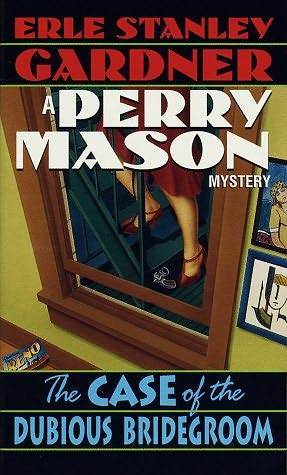
If you only associate Perry Mason with the TV series that ran successfully for nine seasons, you could be forgiven for assuming that author Erle Stanley Gardner wrote traditional whodunits with a legal setting – a murder is committed, the wrong person is arrested, and then Mason gathers all the suspects together in court and plays “Pop Goes the Weasel” until somebody cries out, “I did it!” Yet, as I cross the halfway mark in my list of “marital” titles with 1949’s The Case of the Dubious Bridegroom, it’s clear that these are legal procedurals verging on private eye novels and that, more often than you might imagine, the “whodunit” aspect is almost an afterthought.

This is Mason’s 33rd adventure, and the procedural continues to entertain. The legal point under the spotlight this time is the legality of a Mexican divorce, and the standout variation is that Perry does a lot of driving here, back and forth between Los Angeles, Oceanside, San Diego and Tijuana. Still, the part of me that always craves some sort of who? how? and whydunit found the mystery aspects of this particular case to be – well, let’s just say that in my mind I kept picturing Gardner, hurrying to the secret room on his ranch where he keeps that plot wheel he’s always spinning. And as he spins, we’re starting to be aware of the limitation of choices. Last time the husband was a cad . . . SPINNNNNNN – this time the wife is the monster! Does she – a. cheat on her man? b. try to poison him? or c. come back from the dead? . . . SPINNNNNNN – it’s d. she contests their Mexican divorce and tries to take over his company with fake proxies. And what sort of work does the bridegroom do? . . . SPINNNNNNN – Gee, the wheel seems to be stuck on “mining interests.”
At least Bridegroom starts out with a doozy of an original scene: instead of a client walking into the attorney’s office, we find Perry alone at work at the end of a hot, busy day, exhausted from poring over law books in preparation for a difficult point he wants to make in a current case. He dozes off and is wakened by the sound of footsteps on the fire escape outside his office . . .

This leads to a delightfully screwy encounter with a young woman whom Gardner manages to describe as beautiful in fifteen different ways. Now Perry Mason is fully capable of admiring beauty and not letting it get the better of him. But here his mind is full of questions: why was this blonde spitfire on the fire escape? why was she spying on the Garvin Mining, Exploration and Development Company, whose office is directly above the attorney’s? and, perhaps most thrilling, why was she carrying a gun, which she flung into the alleyway below? Perry’s guest manages to get the better of him and escape. And funnily enough, by the next morning, this screwball moment is a choice item in the morning paper!
The next morning, we proceed with the mystery proper. A new client arrives, none other than Edward Garvin, the CEO of the company upstairs. He has a problem for Mason having to do with Mexican divorces: are they legally recognized in the U.S.? If not, then Garvin has the enviable problem of two wives on his hands. And the first wife, who used to be Garvin’s secretary and knows the ins and outs of the mining business, wants her husband back and control of his company.
And here is where Mason begins to do a lot of driving: a visit to the malicious ex-wife (but, oh, is she lovely!) followed by a sojourn to Tijuana with Garvin and the second missus (a gorgeous redhead) to stay in a new hotel in Tijuana run by the dark and sultry Señora Inocente Miguerinio, whose hips roll seductively when she walks and who speeeeeks like theeees in case you didn’t get that she was Spanish. (There are enough beauties to fill a dozen different paperback covers!) And after a night admiring the Mexican stars, Mason awakens to learn that the ex-Mrs. Garvin has been found sprawled in her car, shot to death, in some Lover’s Lane in Oceanside.

Private eye Paul Drake manages to get a hold of the gun’s serial number from the murder scene before the police arrive (is there anything that man can’t do?) and trace the owner of the murder weapon. And when Perry goes to visit the gun’s owner, he comes face to face with . . . the girl from the balcony in Chapter One. It’s a nice full circle moment, even if I saw it coming a mile away. Other twists in the story are subtler but more compelling, like the matter of identifying the convertible that was seen next to the victim’s car.
Ultimately, though, there’s a certain – I don’t know – sameness? about this novel (SPINNNNNN!) Once again, Paul Drake provides the comic relief, this time in his panicked response to a German shepherd. And just for once, I would like to meet a district attorney who isn’t cocky as hell just so he can be brought down by Mason’s legal fireworks (which aren’t nearly as sparkly here as in previous cases). Alas – as this case is tried in San Diego, there’s no sign of Hamilton Burger. But Della Street is here, always beautiful and invaluable, and we get a nice scene of Lieutenant Tragg being as devious as ever. (I know that Gardner himself felt that actor Ray Collins was far too old to play Tragg, but every time the character appears on the page, I easily imagine Collins saying the lines.)

For once, I couldn’t find any quotable lines of Mason spewing his philosophy or an intimate moment with Della. But there was one thing here that I found fascinating. Gardner occasionally wrote forewords to his books which served to discuss some point of law or procedure and often included a dedication. Here, he honors Mrs. Frances G. Lee, a Captain of the New Hampshire State Police, who had granted Gardner the honor of letting him attend a seminar on Homicide Investigation at the Department of Legal Medicine of the Harvard Medical School. This course aimed at police officers, where “invitations to attend are as sought after in police circles as bids to Hollywood by girls who aspire to be actresses,” was a field mine for a writer of legal procedurals. Gardner marveled at the structure of the class, where students examined models of crime scenes and had to make deductions in a most realistic manner. As Gardner says,
“These are not ‘whodunits.’ They are not like the photographic crimes represented in some of the magazines, where the reader is requested to furnish a solution. These are models used to develop and test the powers of observation and concentration on the part of the students. They are expected to point out the significant clues, which, when rundown, will lead to a correct solution.”
Sounds like a blast – and Gardner was impressed with the acumen demonstrated by the young police trainees who attended. Which leads me to that fascinating point I mentioned, one that I’m sure crossed the mind of many a mystery author but is set out plainly here by Gardner:
“We writers like to record the adventures of outstanding, individual detectives who are generally portrayed as thinking circles around the police. But I am now sure of one thing. I am not going to have any of Mrs. Lee’s graduates appearing in my books. Such an officer would not only solve the crime as soon as the hero quit, but he just might be a hundred or so pages ahead of the procession.”
So yes – the “dumb cop,” like the dumb D.A., is nothing more than a plot device. And we even get a brief glimpse of Mason’s old enemy, Sergeant Holcomb, who got bumped by the more erudite and intelligent Lieutenant Tragg at the beginning of the 1940’s novels, behaving like a Neanderthal for a few nostalgic minutes.
As for adaptations, “The Case of the Dubious Bridegroom” debuted on June 13, 1959 as the twenty-ninth episode in the second season of Perry Mason. Unlike some of my other recent rewatches, this one was essentially faithful to the novel’s plot, right down to having the same killer! And while we lose a lot of the lovely flavor of the book, it’s nice for once to see a screenwriter trying his best to insert as many of the novel’s details as possible into a fifty-three-minute episode.

If I seem at all negative here, it’s probably my fault: I read the first four Masons in my self-proclaimed series pretty much in a row back in December and January. And so I’m going to take a little break (which you won’t even notice) before I tackle the next one. Because I need to keep up my strength in case the books of the 50’s and 60’s start to feel derivative, and I happened to notice there’s yet another mine owner coming up in Book Number Five! The wheel SPIIIIINNNNNNSSSSSS!
* * * * *
ADDENDUM (IN THE PRESENT)
That’s right! This is me writing to you in May (as opposed to Bradley of the Distant Past – around January – who wrote the above.) I’ll explain more in my next post, but you’re about to get an extra dose of Perry Mason, courtesy of my coming down with a bad case of bronchitis and needing an emotional lift. (Gardner has really become my comfort food of late!) I know you probably want me to tackle Lorac or Flynn or Bush or some other hack, but sit back and accept the gift of a bit more Gardner in the next few days.
The bonus, however, is multifold: first, it’s one of the early titles – andit’s got two adaptations!! And second, this one could have been included in this marriage series with only the hint of a stretch, so really, you should have been reading my review of it back in March!
 Ah Sweet Mystery!
Ah, so this is where he shouts out to Frances Lee. I first heard of her in this podcast episode: https://www.futilitycloset.com/2019/11/25/podcast-episode-274-death-in-a-nutshell/
She sounds like a fascinating woman, and a true genius who made a great impact on forensic investigation.
LikeLiked by 1 person
I look forward to reading another Perry Mason the way I feel about my favorite comfort food. This book had all of the usual tropes one expects from Gardner and offered a clever puzzle/plot that moved at a fast clip with no sagging in the middle. The court room scene started well with Mason skillfully making another arrogant district attorney look foolish.
But then we get to the ending … that was an unfortunate disappointment. The denouement was much too rushed into just a few pages and I don’t believe explained well (e.g., how did the culprit get the gun … this wasn’t mentioned). So this Perry Mason started strongly in all the ways that I like but sadly ended with thud.
LikeLiked by 1 person
One of the things I like about this more “thematic” exploration of the Mason oeuvre is that I don’t gobble up all the great books from the 30’s and 40’s and early 50’s and get stuck with two or three dozen lesser later novels. Next year, I have picked a new theme that’ll allow me to start back at the very beginning and cover Gardner’s whole career. And then we start again in 2026! Not a bad way to do things!
LikeLiked by 1 person
Pingback: THE ERLE STANLEY GARDNER INDEX | Ah Sweet Mystery!