In preparation for our upcoming draft of the best female murderers in Columbo, my pal Sergio Angelini sent me a list of twenty-one episodes. I have covered seventeen of them, and today we’ll look at the final four. Then I’m going to explain the upcoming draft to you – and why we’ll only be drafting fifteen episodes!
I’ve only watched nine of the twenty-four Columbos made by ABC between 1989 and 2003, but it’s clear that the network never had a firm handle on the series or the character. Some of this might have been the fault of star Peter Falk himself: as he took on more and more production duties in the latter stages of the series, Falk’s artistic vision may not have always matched his obvious love for the character. (Sound familiar, Mr. Suchet?) And as I have mentioned earlier, the propensity of writers to futz around with the series’ formula had shaky returns. But while it generally pays not to mess around with a good thing, I’m happy to say that there were some quite entertaining exceptions. Each of the four episodes I cover here tried a different twist on the thematic essence of; the results in terms of my enjoyment ended up at 50/50.
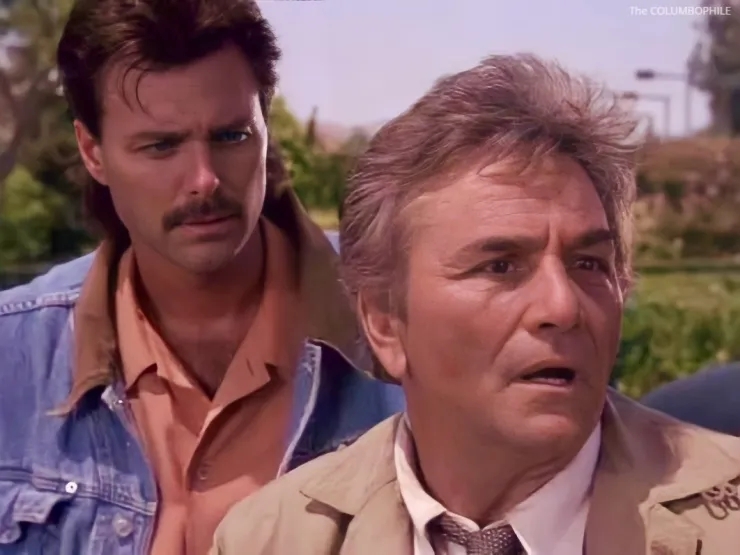
1992’s “A Bird in the Hand” isn’t a whodunnit, but it does play with the idea of who exactly is the prime antagonist. To all appearances, it seems to be hunk-with-a-mullet Greg Evigan as Harold McCain. Harold is a real lowlife, a compulsive gambler whose unlucky streak has made him the target of some very nasty Vegas mobsters. Harold’s only hope is his wealthy uncle “Big Fred” McCain (Steve Forrest), but the football franchise owner has no love for his loser nephew and refuses to bail him out. Harold hopes to have better luck with Fred’s wife Dolores (Tyne Daly), an alcoholic bimbo who has been bedding Harold in secret for years. And so he decides to murder his uncle and then manipulate Dolores after she inherits everything.
The first half of this episode is terrific, as it seems to veer from a typical plotline to one of a would-be murderer so incompetent that everything he touches turns to crap. Harold decides to get rid of his uncle by building a powerful pipe bomb and placing it under Big Fred’s Rolls-Royce. But the morning after he plants the bomb, he learns that compulsive jogger Fred has been killed by a hit-and-run driver while out in the neighborhood for his morning run.
Lieutenant Columbo is called in to investigate, which sends Harold’s nerves a-jangling – how is he going to get that bomb out of Big Fred’s car before someone tries to move it and goes boom?!? This sequence plays out in a delightfully explosive way, and now Harold is Suspect #1 – for the wrong murder. Meanwhile, his attempts to woo Dolores and take over the running of the football team have gone awry. The newly minted widow sees right through her nephew’s manipulations, and while she’s happy to bed him whenever she feels like it, she refuses to finance his sorry-ass lifestyle or pay off the gangsters he owes.

The idea of Columbo facing off against his most incompetent adversary is a clever one, and it probably couldn’t have worked without Dolores there. But as you must suspect by now, Harold is not the main villain of the week – and here is where the episode falters. First, as fine an actress as Daly is, she can’t make the startling transformation of the character from adorably dumb drunkard to canny criminal particularly believable. And secondly, it makes no sense that Columbo would not even suspect a rich man’s widow until the very end. And even then, he is never able to make stick his suspicions that she hit-and ran her own husband; fortunately, there are other murders upon which to hang this killer.
“It’s All in the Game,” 1993’s sole episode, may or may not break one of the cardinal rules concerning Columbo’s character. But it is a fantastic episode! I can’t believe I’m going to say this, but most of the success of this one goes to extra special guest star Faye Dunaway. She might be the biggest movie star ever to grace the show’s set. She is also presumably one of the most tempestuous: one Hollywood luminary after another has spoken about how terrible she was to work with. And yet it was Peter Falk himself who asked Dunaway to play Lauren Staton, and for Falk it was an important decision. The script for “It’s All in the Game” had been written by the star himself twenty years earlier, but he had had to wait until he was the show’s executive producer to get his script on the air.
I think the basic idea Falk had, based on a real-life experience that had happened to a policeman friend of his, would probably have sat better with Columbo fans had it been produced earlier in the series. By 1993, however, the character was set in stone, and one of the basic tenets of Columbo was his deep, abiding love for his wife. Thus, it’s weird to watch the Lieutenant seemingly fall for another woman. One could argue that Columbo is playing Lauren Staton as much as she is playing him. But the strength of this episode lies in the magnetic pull between Dunaway and Falk. They really seem to genuinely like each other. This is confirmed both by the phone calls Lauren makes to her accomplice Lisa (Claudia Christian) and from the conversations Columbo has with his friend Barney, owner of the Lieutenant’s favorite café.

This may be the most sympathetic relationship Columbo has had with any adversary in the whole series. It’s surprisingly sweet to watch, as well as a little disturbing (poor Kate Mulgrew!!). The other main distinction here is that writer Falk keeps some secrets from his hero and from the audience right up to the end, and once they’re revealed, they significantly alter the way we feel about Lauren and her crime. I accept the argument that, by flirting with a suspect, whether real or feigned Columbo is acting both unprofessional and out of character. But in this one case, going off kilter makes for a welcome change! Falk’s clownish goofiness is gone, replaced by an almost schoolboy-like awe for Lauren. And while of course he does not let her get away with her crimes, in the end the Lieutenant fudges with the law in order to bring some peace to this special adversary.
We jump four years ahead to 1997 with “A Trace of Murder.” There are some extremely clever ideas at the basis of this episode. While we have yet another pair of lovers trying to eliminate the woman’s obnoxious and filthy rich husband, the plan is not to kill off the spouse; rather, it’s to frame hubby for another man’s murder. Even better, we discover a half hour in that the male side of this bloody duo is the head of Forensics for the L.A.P.D. – yes, he is a colleague of Lieutenant Columbo! Sadly, far too many negative elements weigh against the quality of this outing.

Clifford Calvert (Barry Corbin) is an obnoxious lout of a Texan who bullies everyone around him and is only happy when he’s chewing on one of his expensive Cuban cigars. Cathleen Calvert (Shera Danese) is fed up with Cliff, but a pre-nup contract makes renders out of the question the idea of divorce. And so she broaches the subject of murder with her lover Patrick Kinsley (David Rasche). Of course killing Cliff will lead the cops right to Cathleen’s door, so she comes up with the clever idea of killing the man who is suing Cliff and framing her husband for the murder.
Unfortunately for the couple and for us, the execution of Cathleen and Patrick’s plan is not clever at all, and by the time Columbo uncovers their third or fourth mistake, we’re all shifting around impatiently. And while I found Rasche perfectly charming as the male villain (and Barry Corbin was a lot of fun as the target), Shera Danese is, well, she’s a pretty terrible actress. This was maybe her sixth role in Columbo, making her the most frequently cast actor in the series. This was also her largest role, and she is whiney and hard to watch throughout.
But her performance and a shaky plot are not the worst things about this episode. No, that would have to be Columbo himself. Falk’s over-the-top impersonation of the Lieutenant is unfunny and downright insulting to his audience of fans. To be fair, part of this stems from the writer, Charles Kipps, who has Columbo doing things I have never seen him do before, like nearly address the fourth wall with his eyes bugging out as he describes out loud what new piece of evidence he has discovered. He does this whenever a new piece of evidence presents itself, and this happens way too frequently because Patrick and Cathleen make one stupid slip after another in the Lieutenant’s presence.
And then, after Columbo runs back and forth across a busy street, tricking the killers into betraying each other, he heads over to Barney’s Bar and gives an endless recap of his solving of the case. Why on earth . . . ?!?!? We were there! We saw it happen! We don’t need this dragged out ending, and we don’t appreciate it.
Six years later, a very grey-haired Peter Falk made his last Columbo episode. He didn’t want “Columbo Likes the Nightlife” to be the last, but after the mess ABC had made of the series by releasing episodes years apart and messing with the formula, audiences had had enough. And this is almost too bad because “Nightlife” is a good episode. As the Columbophile reports in his blog, this was 2003, and police series had changed since Columbo’s heyday. And so it is a relief when Columbo appears and he has stripped away all the clownish behavior from “A Trace of Murder.” Once again, we see him as the outlier for the L.A.P.D. – something of a loner who displays his abilities at ratiocination before our eyes.

The Lieutenant is faced with a younger, different milieu here, the world of rave clubs. Justin Price (a very young Matthew Rhys) has always had a dream of opening his own club, and his friendship with wealthy Tony Galper has assured him of the backing he needs to start. The bad news is that Tony makes his money by being the son of a big Mafia boss, and it gets worse when he visits his ex-wife Vanessa (Jennifer Sky) and discovers that she is sleeping with Justin. Tony attacks Vanessa in a rage, and while defending herself she causes his death. Panicked, she calls Justin and begs hims to come over to help her.
The police would probably have understood and forgiven the circumstances of Tony’s death. But Vanessa is certain that Tony’s dad would have her killed, and Justin knows that if Tony’s loan to him doesn’t go through, his dreams of opening Bait are over. And so they decide to make Tony disappear. Their plan is only partly shown to the audience, but no sooner do they think they have their problem solved when they are contacted by a low-life journalist who has pictures of the murder. All he wants for his silence is $250,000, and this leads to one of the most harrowing murder scenes in the series’ history.
The first twenty-five minutes resemble a Coen Brothers noir – and then Columbo shows up, white-haired but back to form. His examination of the journalist’s “suicide” leads from one deduction to another until Columbo is satisfied that this is murder. The rest of the investigation is like that as well, and it moves rather than drags. Both Rhys and Sky are suitably hot/cool/panicked adversaries. The final gotcha scene plays out at the opening of Justin’s club, whether the revelation of Tony’s resting place plays out dramatically in front of a roomful of curious ravers.

It’s nice to see Columbo go out with a bang; I wish there had been more like this in the second run of the series. And now I’m looking forward to drafting Distaff Columbo with Sergio and Nick Cardillo. We’re going to meet online on July 20th, and I’ll have our results out to you a couple of days later. We did consult today and made what I think is a necessary change: we’re dropping the episodes where the main villain is male because trying to compare these to the full-on distaff episodes is too difficult.
And so, if you want to try ranking these yourself, here in chronological order are the fifteen episodes we will be drafting in July:
- “Ransom for a Dead Man” (Lee Grant, 1971)
- “Lady in Waiting” (Susan Clark, 1971)
- “Dagger of the Mind (Honor Blackman/Richard Basehart, 1972)
- Requiem for a Falling Star” (Anne Baxter, 1972)
- “Lovely But Lethal” (Vera Miles, 1973)
- “Forgotten Lady” (Janet Leigh, 1975)
- “Old-Fashioned Murder” (Joyce Van Patten, 1976)
- “Try and Catch Me” (Ruth Gordon, 1977)
- “Make Me a Perfect Murder” (Trish Van DeVere, 1977)
- “Sex and the Married Detective” (Lindsay Crouse, 1978)
- “Rest in Peace, Mrs. Columbo” (1979, Helen Shaver)
- “A Bird in the Hand . . . “ (Tyne Daly/Greg Evigan, 1992)
- “It’s all in the Game” (Faye Dunaway/Claudia Christian, 1993)
- “A Trace of Murder” (Shera Danese/David Rasche, 1997)
- “Columbo Likes the Nightlife” (Jennifer Sky/Matthew Rhys, 2003)
Where will your favorite land?
 Ah Sweet Mystery!
I believe … we are basically on the same page here. Phew!!
LikeLike
I hope you enjoyed your quick trip through the run of Columbo! I feel these are broadly a good selection – some of the best and few of the worst. Looking forward to seeing where you rank everything! Do you think you’d want to watch the rest at some point?
LikeLiked by 1 person
I probably need to take a break after this intense Falk-a-thon, but at some point I’ll go back and watch the best of the male murderers.
LikeLiked by 1 person