Few modern authors have such a firm and delightful grasp on the conventions and stylings of classic detective fiction that Anthony Horowitz has. This has proven especially true in his television writing: Poirot and Midsomer Murders displayed a deft hand at adaptation, but it was Foyle’s War that really proved Horowitz’ mettle. If you haven’t watched that series, what are you waiting for?
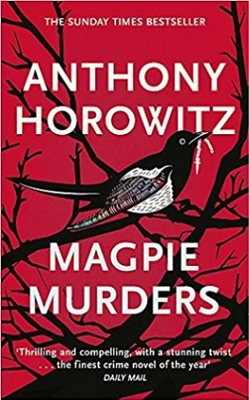
It may come as no surprise that, out of all the Anthony Horowitz novels I’ve read and enjoyed, the favorite of this classic crime fan has been Magpie Murders (2016). At 560 pages it is twice as long as your typical GAD book, but it solved that dilemma by giving us two mysteries for the price of one. There’s the modern-day case presided over by hapless publisher Susan Ryeland, who must solve the murder of her most popular author, Alan Conway, and find the missing last chapters of his final mystery featuring that brilliant German sleuth, Atticus Pünd. And then there is the Pünd novel itself, a charming pastiche of a Christie village mystery.
Granted, I didn’t need that missing chapter to identify both murderers, past and present, and to spot the giveaway clue. Normally, I don’t much enjoy solving the case ahead of time, but it didn’t stop me from enjoying all the meta-fictional aspects of the book and the clever way Horowitz incorporated the stylings of past and present where the story suited them. So it was with great excitement that I discovered the author intended to write two sequels to Magpie. The first of these, Moonflower Murders, came out in 2020, and I bought it right away.
But I didn’t read it right away. I started it, and then I put it away. And then I took it out and restarted it . . . and then I put it away again. Let’s blame the pandemic for that. Or Donald Trump. You choose.
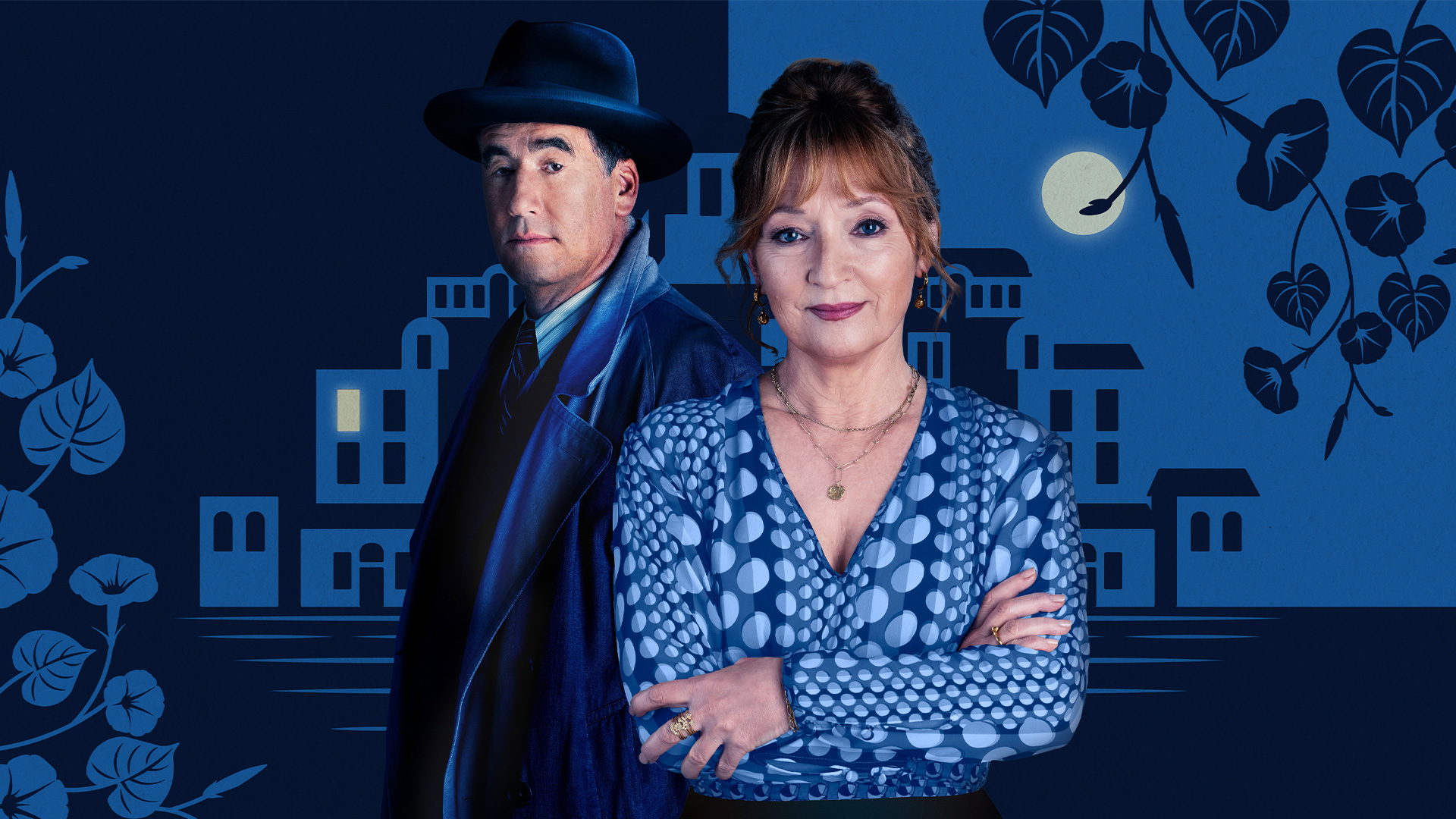
A recent TV ad for the upcoming adaptation of Moonflower reminded me that I have this book stewing on my shelf, and so I decided to read it at last ahead of watching the show. Once again, we get two mysteries in one, and Susan Ryeland is our guide. After the events of Magpie Murders, Susan has quit publishing and accompanied Andreas, her hunky Greek fiancé, to Crete, where she is assisting him in the running of his hotel. The surroundings are paradisical, but the work is grueling, and it never lets up. Susan loves her man, but she misses London, and she misses the intellectual spark of working around books and the tempestuous people who write them.
And then a couple appear at the hotel looking for Susan. Lawrence and Pauline Treherne own and run a luxury inn called Branlow Hall in Suffolk. Eight years earlier, the wedding of their younger daughter Cecily to handsome Aidan MacNeil was interrupted by the brutal murder of a guest, an Australian advertising man named Frank Parris. The victim appeared to have been robbed, and the police arrested the hotel handyman, a Romanian ex-con named Stefan Codrescu, who made the grand gesture of confessing to the crime. Case closed.

Or is it? Of course not – The book is six hundred pages long!! Eight years later, another person disappears from the hotel, and their last known message concerned none other than Magpie Murders victim Alan Conway – and, specifically, his third novel, Atticus Pünd Takes the Case. Learning that Susan used to publish Conway’s books and was involved in the investigation after his murder, the Trehernes offer her a lot of money to return to England, stay at their hotel, and look into the past murder in hopes of solving the present disappearance.
Even though she doesn’t see herself as a true sleuth – and she almost died playing detective in the last book! – Susan is anxious to step foot in England once more, and so she risks her relationship with Andreas and returns to investigate. She meets all the people who were on the scene for Frank’s murder, and she crosses paths once again with her arch nemesis from the first book, Detective Superintendent Locke, now promoted to Chief Inspector, who was in charge of the Alan Conway case and is now looking into the disappearance.
And, of course, halfway through Moonflower Murders, Susan reads Atticus Pünd Takes the Case, and we’re right there reading over her shoulder. At first, the connections between the fictional past and the real one may be too subtle for Susan to find. But after further questioning and one brush with death, she manages to solve her second case. Bring on the third! (Marble Hall Murders is listed on Amazon, but there’s no release date yet.)
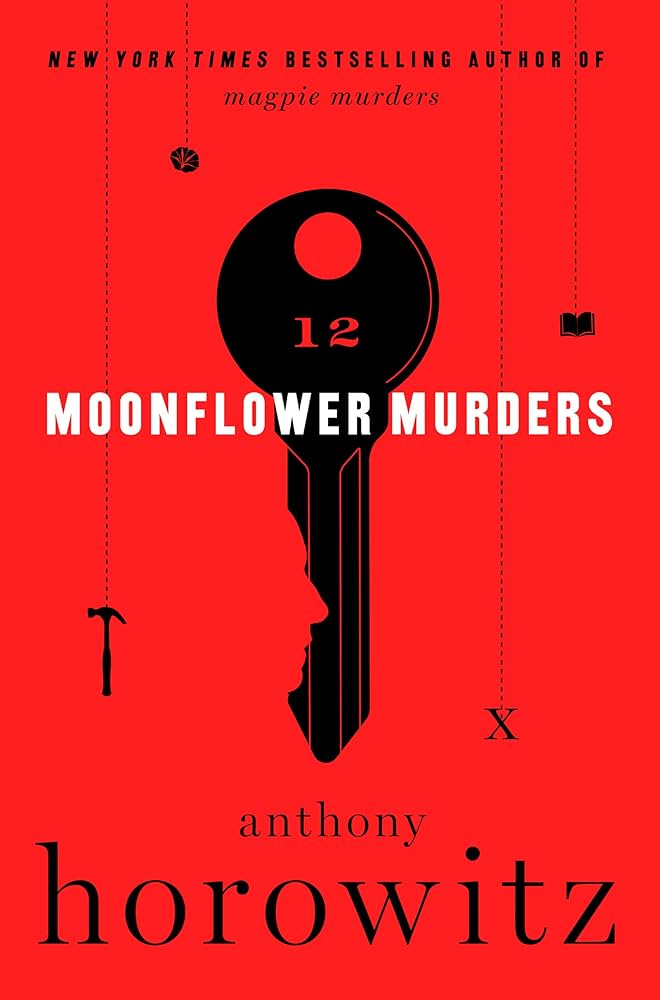
I thoroughly enjoyed Atticus Pünd Takes the Case, although I didn’t find the detective himself as compelling a character. (In all fairness, the Pünd of Magpie Murders is going through an existential crisis, while here he is merely a successful sleuth, and I found him a bland one at that.) However, I didn’t feel quite as sanguine about the present-day mystery. Despite a nice assortment of suspects, the killer seemed fairly obvious to me. There’s also the issue – which, in all fairness, Susan Ryeland points out herself – regarding the way modern technology has affected the modern mystery.
“Alan Conway used to say that the Internet was the worst thing that ever happened to detective fiction – which was one of the reasons why he set his own stories back in the fifties. He had a point. It’s hard to make your detective look clever when all the information in the world is instantly available to everyone in the world at a moment’s notice. In my case, I wasn’t trying to look clever. I was simply searching for the truth. But I’m sure Atticus Pünd wouldn’t have approved of my methods.”It certainly is more fun watching Pünd decipher clues than to hear Susan expose suspects’ secrets through a Google search. And, for a long while, it makes the whole point of the Pünd novel serving as a clue to the answers in the present seem more tenuous than they did in Magpie Murders. Horowitz manages to redeem himself somewhat in the final chapter, where hitherto unseen clues are revealed. These vary in quality, but one of them is really clever.


I loved Moonflower Murders. In the moment reading it during the dark days of the pandemic in 2020, I actually thought it was the superior book to Magpie Murders. Time has reshaped my opinion; the first installment in the series is still the stronger novel, but Moonflower Murder remains one of the best things I have read from Horowitz. I did manage to guess the identity of the killer in Atticus Pund Takes the Case (leaning heavily on so-called meta clues so I don’t know if you can count my victory as the real deal), but I was surprised by the modern-day whodunnit, the dark places to which Horowitz took the story, and those last-chapter revelations were really charming. Plus, I just like hearing Horowitz pontificate on the nature of the mystery genre.
For my money, he’s still the best modern writer playing with the tropes of GAD fiction working today. I never get tired of Horowitz, his clever ideas, and the enthusiasm with which he tells his stories.
Thanks for pointing out that Marble Hall Murders is coming down the pike. I had no idea and it sounds great. Here’s the official summary: https://www.penguin.co.uk/books/454828/marble-hall-murders-by-horowitz-anthony/9781529904345
LikeLiked by 1 person
To be honest, most of my “solving” of Horowitz’ mysteries has to do with recognizing and correctly applying whatever GAD trope he has employed. I “knew” that X was the modern day killer because I knew that X must be that other character. I didn’t get the killer in the past mystery, but I guessed the final twist early on. (Am I being vague enough?)
In Magpie Murders (the past case), I recognized the trope early on and couldn’t stop suspecting that person, which made the whole plot tumble together for me. But in the present day case, the telltale clue stood out like a warning sign in traffic, and I legitimately solved that one.
As for the third novel, it’ll be fun to see what Horowitz makes of continuation novels!
LikeLike
This was such a good book
LikeLiked by 1 person
I think the first book (Magpie) was stronger than this one. Like you I worked out who the killer was in the first present day-set section. On a silly note, my sister pointed out the incongruous behaviour of the chow chow in the Pund novel section – she was like “it would never have done that” lol
LikeLiked by 1 person
Ultimately I found the “pun” childish.
LikeLiked by 1 person
SPOILER WARNING
See? That’s what I thought of the anagram! I liked the lion references – I hadn’t noticed a pattern – but he already did anagrams and that one was . . . well, as you say, it felt like a juvenile clue.
LikeLiked by 1 person
I didn’t know they’d adapted the second book! I’m excited for that. Since Horowitz is a screenwriter, I feel like he knows how to adapt his books to that medium, and it made the first book really interesting to watch despite knowing the story.
I think the third book is supposed to be the last one, but Horowitz also said that about like three Alex Rider books, so who knows.
LikeLike
Still not read this despite loving MAGPIE. I’m glad to hear Nick liked it so much as most review do seem to find it a step down. But yeah, should read it ahead of the telly version … probably reading the next Hawthorne first though!
LikeLike
I loved Magpie and seem to have been equally enthusiastic about Moonflower going by my Goodreads rating. But for the life of me, I can’t remember much of it. Time for a re-read, I guess.
I enjoyed Foyle’s War quite a bit but feel like Horowitz’ Hawthorne series is steadily losing it. The first book was great, the second was good, the third was okay and the fourth is just awful. My problem isn’t as much with the plot as with the writing, which I found tedious. The Horowitz in the book has become a grotesque caricature and it’s put me off that series.
So I’m real glad that he’s continuing the Ryeland series. Hopefully, Marblehall will be just as good.
LikeLiked by 1 person
Pingback: EVE OF POSSIBILITIES: Looking Back on ’24 and Forward to ’25 | Ah Sweet Mystery!
Pingback: THE LONG GOODBYE: Marble Hall Murders | Ah Sweet Mystery!