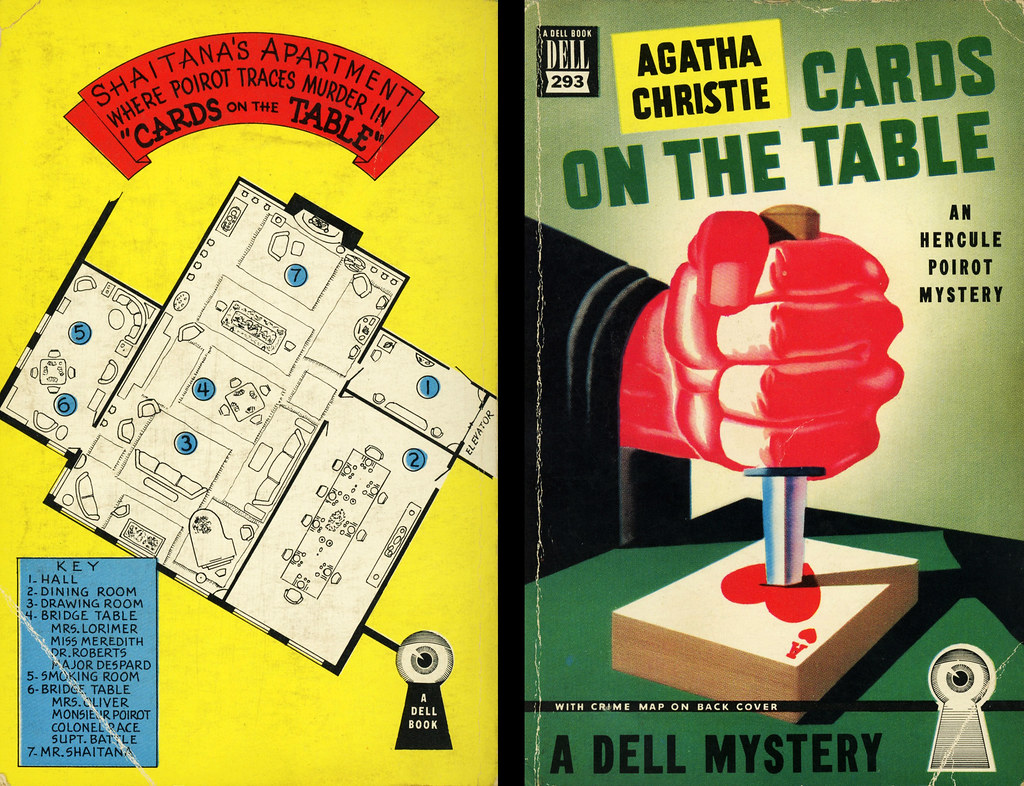
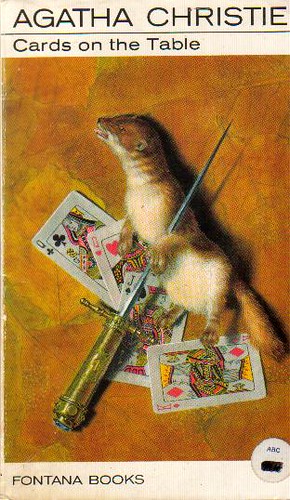
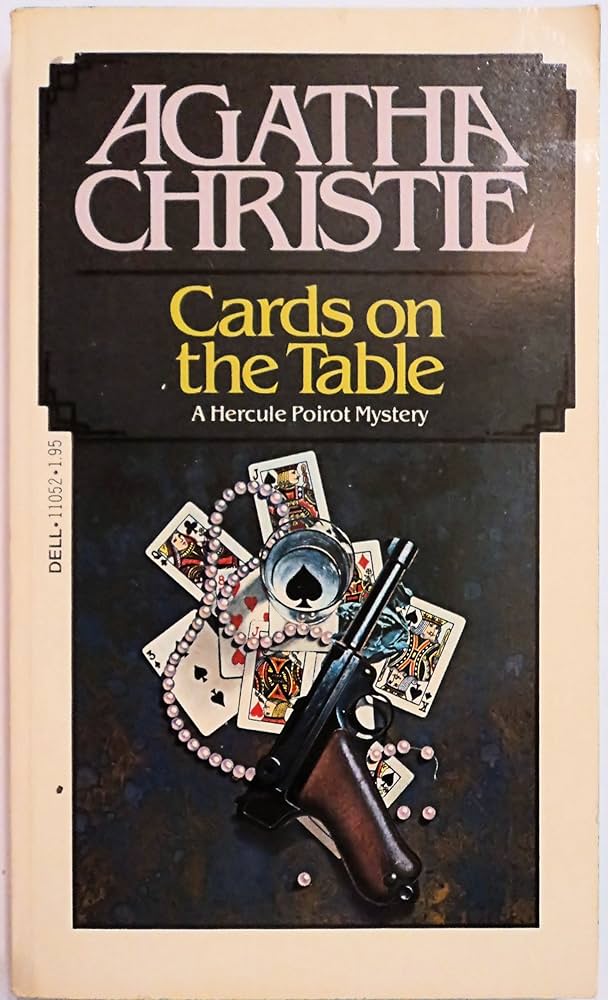
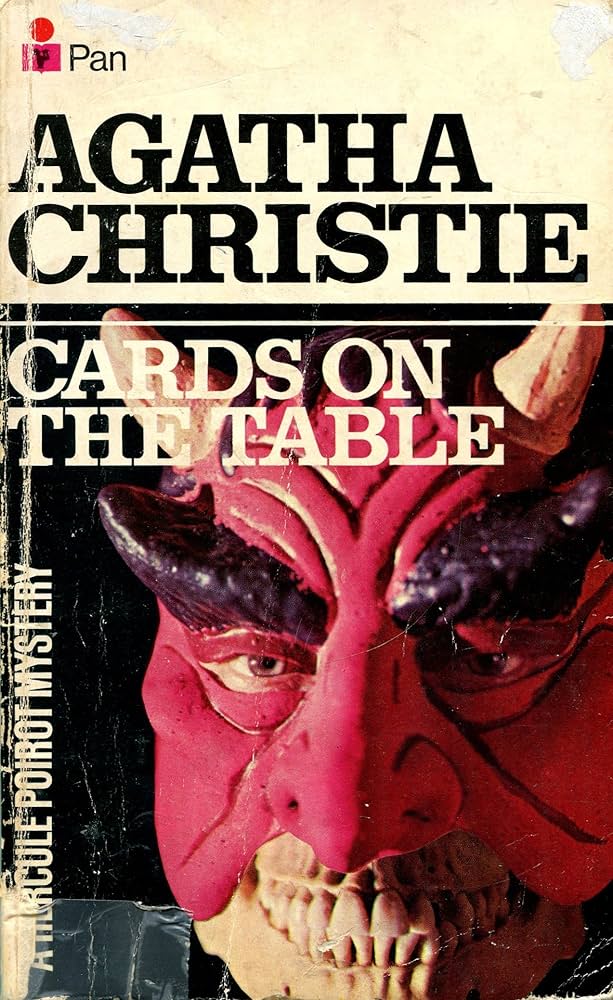
Well, The Poirot Project is off to a furshlugginer start! As I informed you last month, I have identified fifteen Agatha Christie titles featuring Hercule Poirot for which I have so far failed to provide an in-depth article/review. I decided to review these in random order, using slips of paper in a mini-chocolate box as my “spinner,” but I cheated right away and selected 1936’s Cards on the Table as my first title. Why, you ask? I have a singular relationship with this book. At first, it was just one of dozens of Christie novels that I tackled and enjoyed as a kid. And then, nine years ago, I started playing bridge and decided to re-read Cards. It was something of a revelation.

And then, in 2021, I sat down with my friends JJ and Moira for another episode of “Spoiler Warning” on JJ’s podcast, In GAD We Trust, where we discussed Cards in all its glory . . . except, for JJ, there was very little to be found here that was glorious, and we ended up having the most (respectfully) heated conversation about Christie we’ve ever had!
And then – oh, yes, folks, there is another “then” – in 2023, Tony Medawar invited me to speak at the International Agatha Christie Festival in Torquay about “Hercule Poirot’s Favorite Case” which – you guessed it! – turns out to be Cards on the Table. Synching our calendars required my postponing the talk until 2024, and I’m happy to say that my speech went over well with the crowd and left me feeling light-headed, both with joy and, as it turns out, with something else. (Turns out I had COVID . . .) But I made it home, after some TLC from a very kind JJ and his wife, and I sat down and wrote a sizzling 5,000-word essay ranking Cards on the Table.
And then – I lost the essay.

It disappeared from my computer. This has not happened to me in years, and it rankles. I was fond of that article, and I had begun the review of my second Poirot with gusto – only to discover that this article too had disappeared!! Thus, the re-write (or “new” write) you’re about to get may feel a bit furshlugginer, which means “crazy” or “foolish” or “a well-worn piece of junk.” And to make things even crazier, when I went back to my blog to do a bit of research, I discovered that way back in 2017 I actually had written a fairly detailed article about Cards on the Table, so this purpose of this review is (nearly) moot. You can find that article here and then shut your computer and gently back away. Or you can see me fumble through my latest attempt to give this book the ranking it deserves. Up to you!
Agatha was an enthusiastic bridge player, something you can read about in her Autobiography. There she relates a delightful story of playing in a tournament on board a storm-tossed ocean liner at the end of her 1922 world tour with Archie Christie in service to Major Ernest Belcher, who was promoting the British Empire Exhibition. Upon Belcher’s insistence, Agatha found herself partnering the man in a tournament and having to stifle a horrific bout of seasickness when the chance of winning the whole thing fell totally upon her.
Characters in Christie often play bridge, but the first time the game became significant was in the 1923 short story, “The King of Clubs.” Here a suburban family’s evening game is interrupted when a famous dancer bursts through their French windows, her lovely dress splattered with blood, and cries out the word “Murder!” before sinking insensible to the ground. Turns out the titular card was a message of warning to the dancer from a recent visit to a fortune teller, but it also has a clever double meaning that makes this story a highlight – and the bridge matters.
It would be thirteen years before Christie would make bridge matter again. I would like to give you some of the reasons for this, and to do so I usually make straight for Dr. John Curran’s analysis of Christie’s notebooks. Alas, Cards on the Table is one of the few novels that is not mentioned there. Fortunately, there are some interesting occurrences that indicate Christie gave this book some serious thought.
First, Cards is the third Poirot novel to be published in 1936, a year that – spoiler alert! – has been given short shrift on this blog. The first novel of the year was The A.B.C. Murders. we have the return of Captain Hastings to England, fresh from his happy but dull domestic life in South America and anxious to share with his old friend Poirot the thrill of the chase again. Unfortunately, there doesn’t seem to be much worth chasing at the moment, and so our friends indulge themselves by sharing their dream cases with each other. What Hastings comes up with is, as Poirot drolly suggests,” . . . a very pretty resume of nearly all the detective stories that have ever been written!” There’s the body in the library, the curiously twisted dagger or carved stone idol that serves as a weapon, and the typical list of suspects, which must include one or two beautiful young women with auburn hair who are wrongly accused and are eternally grateful to the detective’s right-hand man for always believing in their innocence.

As for Poirot, all he wants is “a very simple crime. A crime with no complications. A crime of quiet domestic life . . . “ And this is the crime he comes up with: “Supposing that four people sit down to play bridge and one, the odd man out, sits in a chair by the fire. At the end of the evening, the man by the fire is found dead. One of the four, while he is dummy, has gone over and killed him, and intent on the play of the hand, the other three have not noticed. Ah, there would be a crime for you! Which of the four was it?”
It isn’t often that Christie provides a tease like this for an upcoming book. But wait – there’s more! We have another rarity in store in the form of a Foreword from the author. And here is where Christie introduces a trope that will feature heavily in the novel (as it did in my speech to the Festival): the notion of classic murder mysteries as a game. This is, to my knowledge, Christie’s most overt acknowledgement to her readers that her job is to write mysteries where she presents all the facts and yet tries to hide the truth until the very end. If we examine such twist-filled specimens as Roger Ackroyd, Orient Express, Three-Act Tragedy, Death in the Clouds and A.B.C. we know that Christie excelled at the sorts of endings that would pull the rug out from under the wariest of readers. And yet here, Christie states her intention to do something completely different:
“There is an idea prevalent that a detective story is rather like a big race – a number of starters – likely horses and jockeys. ‘You pays your money, and you takes your choice!’ The favorite is by common consent the opposite of a favorite on the race course. In other words, he is likely to be a complete outsider! Spot the least likely person to have committed the crime and in nine times out of ten your task is finished. Since I do not want my faithful readers to fling away this book in disgust, I prefer to warn them beforehand that this is not the kind of book!”
So it is Christie’s intention to not provide her usual cunning twist here, merely “a very simple crime” involving one victim, four suspects, and such a minimum of clues that Poirot discovers the key to the solution lies not in alibis or motives, not in pipe cleaners or shattered coffee cups, but in the psychology of the suspects.
There are only four starters, and anyone of them, given the right circumstances, might have committed the crime. That knocks out forcibly the element of surprise. Nevertheless, there should be, I think, an equal interest attached to four persons, each of whom has committed murder and is capable of committing further murders . . . The deduction must, therefore, be entirely psychological, but it is nonetheless interesting for that, because when all is said and done it is the mind of the murderer that is of supreme interest.”
Christie ends her Foreword by telling us that Cards on the Table ended up being one of Hercule Poirot’s favorite cases. With a twinkle in her eye, though, she adds, “His friend, Captain Hastings, however, when Poirot described it to him, considered it very dull! I wonder with which of them my readers will agree.” One could read this as an apology of sorts in advance of a book where there will be no twists (but there are!) and no special features of interest (wrong again!). Or one could simply see this as a uniquely placed Challenge to the Reader.
Only an examination will tell us for sure.
* * * * *
The Hook
“My dear, dear man, you and I look on these things as from poles apart! For you crime is a matter of routine: a Murder, an Investigation, a Clue, and ultimately (for you are undoubtedly an able fellow) a Conviction. Such banalities would not interest me! I am not interested in poor specimens of any kind. And the caught murderer is one of the failures. He is second rate. No, I look on the matter from the artistic point of view. I collect only the best . . . the ones who have got away with it!”
From the very start, Cards on the Table sets up the idea of the classic mystery novel as a game. The book begins with a duel of sorts between two men representing opposing moral forces. On one side is Hercule Poirot, former policeman, private detective extraordinaire, who embraces his thoroughly bourgeois attitudes towards murder as an abominable crime and murderers as criminals who must be caught, tried, sentenced and punished. His opponent is Mr. Shaitana, whose name comes from an Islamic word for an evil spirit that incites humans to sin by whispering in their hearts. Shaitana is known for his parties, some of them respectable, others . . . less so. Most men want to punch him in the nose, while most women . . . well, they’re not quite sure what they want. Shaitana both intrigues and repels. He is a man who knows too much about the people in his circle. As Christie states, Shaitana “was a man of whom nearly everybody was a little afraid.”

The inciting incident here stems from Shaitana’s propensity to collect everything from snuffboxes to those who have snuffed out lives. His invitation to Poirot to come and meet his collection of “successful” murderers is a taunt that challenges the sleuth’s conventional notions of morality and defines the differences in how Poirot and Shaitana view the game that is to follow. Even as he goads his specimens toward murder, Shaitana treats the matter as an entertainment. His attitude towards Poirot in the opening scene suggests that Shaitana wants the killers to stump the detectives, even if it means his own death. Still, one could argue that Shaitana invites four detectives to the party as possible insurance against one or more of the killers there being successful in their quest.
From the start, and throughout the novel, Poirot views Shaitana as a stupid man. He doesn’t see murder as a game – or, at least, it is not a game that he ever wants the killer to win. At the same time, he goes along with the idea of allowing Mrs. Oliver to “play along” with the investigation, even though it might endanger her life. Perhaps he sees the idea of four detectives on the trail of four killers as pleasingly symmetrical; perhaps he simply takes pity on the idea of Mrs. Oliver being left out. Whatever the reason, this decision creates the sense of “teams” and furthers the idea of murder as a game.
For the reader who chooses to play Christie’s game, there is a similar, if more subtle disparity. We have picked up the book to play the game. We have probably ignored, or been intrigued by, Christie’s warning that this is a less clue-oriented, more psychologically-based, mystery than usual. Of course, being the nice people that we are, we want the sleuths to successfully catch the murderer. But we are also game players and mystery fans: we don’t want the detectives to win too quickly, and if there happen to be one or two extra killings before we reach the end, well . . . that’s a good thing, right?
In summation, the opening is literate and intriguing, entertaining and well-paced; by the middle of Chapter Three, the group is plunged into a murder investigation and never looks back.
Score: 10/10

The Closed Circle: Who, What, When, Where, Why?
Who?
“A fine moustache – a very fine moustache – the only moustache in London, perhaps, that could compete with that of Monsieur Hercule Poirot. ‘But it is not so luxuriant!! No, decidedly it is inferior in every respect.’”
We’ve already talked about Mr. Shaitana. He strikes me as the anti-Poirot: he cuts a fine figure and is equally well-mustachioed, but he wishes to project an aura of chaos rather than order. Shaitana is a fellow seeker of evil who instead wishes to foment it rather than quash it. But his appearance in the novel is brief. His vanity both seals his fate and instigates the plot. And we are left with three sets of characters: the four suspects, the four detectives, and the supporting cast.
Of these, the four suspects are the least interesting of the lot. Oh, they are perfectly fine, and I don’t at all mind spending time in their company. Each of them represents a type we have seen many times in Christie before and will see again: in Anne Meredith, we have the shy, pretty girl; in Mrs. Lorrimer, the intelligent society woman; Dr. Roberts is appropriately bluff and hearty like all of Christie’s doctors; and Major Despard is a particularly attractive version of the retired military man at cross purposes in a civilian world. Equally significant is the fact that each of them represents a different type of bridge player, from the true master to the timid beginner, from the conventionally good player to the compulsive risk taker.
Like all suspects, each member of this group has their individual secrets, and on that score, I find Anne Meredith the most intriguing of the lot. Early in my blogging career, I examined the occupations most often found in Christie’s work, and Doctor Roberts epitomizes the wealth of medical folks who kill throughout the canon. I love Mrs. Lorrimer, but she plays things very close right up to the very end; we get the least background on her of all the suspects, and we learn nothing about the murder she committed. As for Major Despard, he is handsome and heroic and gets the happy ending he deserves, but perhaps he suffers the most from being the most innocent suspect in the bunch.

The most fascinating arc belongs to Anne, who is initially presented under the most sympathetic light and who is ultimately unmasked as a cold-blooded sociopath. She inspires Mrs. Oliver’s sympathies and Major Despard’s lust. At this year’s Christie Festival, I listened to a fascinating lecture from Professor Caroline Derry that framed the friendship between Anne and her roommate Rhoda Dawes within the parameters of a youthful lesbian relationship. Ultimately, I believe that Anne cares for nobody but Anne. Rhoda offers affection and a place to live. So does Despard – and when Rhoda also becomes interested, the Major becomes for Anne a prize to be won. Frankly, had Christie made Anne the murderer of Shaitana, I suspect that some people would have found Cards on the Table to be a more satisfying book. But the author had other tricks up her sleeve.
Rhoda Dawes tops a fine list of supporting players. She is one of Christie’s most refreshing heroines, and her fangirl adoration of Ariadne Oliver is charming. It’s lovely to note that not only doe Christie marry her off to Despard, but she brings them back for an encore in 1961’s The Pale Horse just so we can see how happily married they are. Other enjoyable cameos come from Miss Burgess, Dr. Robert’s loyal secretary the frightful Mrs. Luxmore who is the bane of Major Despard’s existence, and the broad-shouldered Sergeant O’Connor, who is known by his policeman colleagues as “The Maidservant’s Prayer!”
Topping the character list – and the true joy of Cards on the Table – are the three sleuths who work with Poirot to solve the case. Yes Christie breaks a major rule of the mystery writer’s game – it’s Van Dine’s ninth about having only one sleuth per mystery, if you’re keeping track – but she also plays a delightful meta-fictional game with the reader. Her canon exists in several universes which, up till now, have never crossed boundaries. But here we have the stolid, wooden-faced Superintendent Battle, who was so helpful on two occasions to the residents of Chimneys; Colonel Race, who caught the Man in the Brown Suit; and, best of all, Mrs. Ariadne Oliver, the creator of the world’s greatest detective, Sven Hjerson and best-selling author of such classics as The Body in the Library and The Affair of the Second Goldfish.

Mrs. Oliver used to do some side work for Mr. Parker Pyne, and how lucky are we to have Christie revive her here because she is hilarious. She champions the powers of feminine intuition, which not even Christie believes in – and yet one of the best jokes in the novel is how Mrs. Oliver plumps upon the correct murderer with her first guess, even though it is only a guess. Her complaints about work, and most notably about her Finnish sleuth, are also very funny and have folks suggesting that she was a stand-in for Christie herself. I rather think Mrs. Oliver is a very clever means for the author to entertain her reader and let off a little steam. Here’s Mrs. O. talking about the complaints that have come from readers and critics regarding the accuracy of her plots.
“I don’t care two pins about accuracy! Who is accurate? Nobody nowadays. If a reporter writes that a beautiful girl of twenty-two dies by turning on the gas after looking out over the sea and kissing her favorite Labrador, Bob, goodbye, does anybody make a fuss because the girl was twenty-six, the room faced inland, and the dog was a Sealyham terrier called Bonnie? . . . What really matters is plenty of bodies! If the thing’s getting a little dull, some more blood cheers it up.”
Christie was much less cavalier about accuracy than her creation, but perhaps she shared a little of Mrs. Oliver’s frustration with all the well-meaning nitpicking from outsiders. At any rate, the character is a gem!
What?
“I’ve got a plan. There are four of us – four sleuths as you might say – and four of them! How would it be if we each took one? Backed our fancy?” (Mrs. Oliver, CotT, Ch. 8)
The problem outlined by Hercule Poirot in The A.B.C. Murders of a man killed in a room with only four bridge players in attendance is a neat one and probably would have made a terrific short story. Because each suspect’s initial story is the same – “I was engrossed in a game of bridge and neither saw nor heard a thing!” –Poirot insists that this case must be solved by studying the psychology of those involved and applying what they find to the facts of the murder. A couple of clues later, the case could be solved to everyone’s satisfaction.
But this, of course, is a novel, and it must cover a more significant amount of ground. Christie quickly establishes that Shaitana’s murder must have been unpremeditated and thus required fast thinking and great nerve. This description easily applies to a bluff doctor and a stalwart soldier, but further examination is needed to see if either or both of the women fit the bill. And so, perhaps to the surprise of realists everywhere, Superintendent Battle accedes to Mrs. Oliver’s request that the four sleuths pool their energies and investigate together.
The problem here is . . . what are they looking for and what are they finding that will extend the knowledge they gleaned from the crime scene and help they find the killer? At the start of this partnership, Poirot clues in the others as to Mr. Shaitana’s true motives for hosting this party: it is a parade of murderers for Poirot’s benefit. The weird thing is, the affair only really works if Shaitana is murdered. Is this some odd form of suicide? Or did Shaitana hope that the inclusion of four detectives would have saved him from a successful attempt at murder? If that’s so, then isolating the sleuths in another room in the apartment proved a fatal flaw in this insurance policy.

Shaitana is dead. Everyone had equal access to his body. Nobody saw anything. What to do? Battle decides they will prove that each of the guests did actually murder someone in the past. There are two problems with this, and they are tied together. Aesthetically, if Shaitana is wrong about his guests, then really there is no book, and so readers expect Shaitana to be correct. The other problem is that this investigation into the suspects’ past reveal nothing about the present murder unless the characters are innocent and therefore have no motive to kill Shaitana. This brings us to an odd exchange between Poirot and Battle:
- Poirot: Our friend Mr. Shaitana was not infallible. He may – it is just possible – have made a mistake.
- Battle: About all four?
- Poirot: No – he was more intelligent than that.
- Battle: Call it fifty-fifty?
- Poirot: Not even that. For me I say one in four.
Through Poirot, Christie is trying to set up a sort of inverse mystery – which of them is innocent? – and it turns out in the end to be true. But there is nothing here – no clue, no offhand comment, no previous knowledge of the suspects – to suggest such a specific possibility, and it feels manipulative on the part of the author.
To her credit, Christie’s inclusion of multiple sleuths succeeds in differentiating each investigation and reducing the chance of “dragging the Marsh” during this middle section. Sadly, we only have three points of view here instead of four because, for some unexplained reason, Christie seems to lose interest in Colonel Race. She gives him one more scene where he reports to the group all he has uncovered about Major Despard’s past, and then he excuses himself to participate in some unknown feat of espionage and disappears for the rest of the novel.
Still, the other three sleuths provide an entertaining contrast in methods. Battle, of course, is pure policeman and gives us perspective of a Crofts-like procedural. Poirot, as promised, is all about the psychology of the case, and he engages the suspects in a delightful array of tests, from assessing the bridge scores to quizzing them on their powers of observation, to a delightful trap involving a set of silk stockings. And Mrs. Oliver is more Marple-like, engaging the people she meets on a more personal basis and uncovering secrets that the men fail to find.
This section also allows Christie to open the novel up, deepen her characterizations of the suspects (particularly Anne), and provide us with four varied past cases (well, three – nothing is ever found out about Mrs. Lorrimer’s murder) that entertain us and further differentiate the kinds of murders each of them would commit. There are many entertaining scenes here: Rhoda’s visit to Mrs. Oliver, Sergeant O’Connor’s “date”, and Poirot’s planning and execution of the stocking trap on Anne Meredith. (How gratifying that the modistes at the millinery shop dismiss the detective as “a nasty old man!”)
When and where?
We travel to many settings, both in London and in its outer environs. Christie, not a devotee of detailed description, still manages pretty well to differentiate where everyone goes. Special consideration must be made for Mr. Shaitana’s sumptuous apartment, Mrs. Oliver’s study, with its birds-of-paradise wallpaper, and the charming area around Wendon Cottage where Anne and Rhoda reside in messy comfort and where Anne tries to drown her best friend.
Score: 9/10
The Solution and How He Gets There (10 points)
“Always I am right. It is so invariable that it startles me. but now, it looks, it very much looks as though I am wrong. And that upsets me. presumably you know what you are sying. It is your murder! Fantastic, then, that Hercule Poirot should know better than you do how you committed it.”
Given the paucity of clues, Hercule Poirot insists that the only way to solve the murder of Mr. Shaitana is to understand the psychology of the four suspects and apply this to the facts of the crime. The murder was audacious and unpremeditated. Therefore the killer must be someone who is prepared to take great risks when backed into a corner. Investigating the past crimes for which each of the suspects was accused, Poirot and his Scooby group discover the following: Doctor Roberts committed a double murder in a most audacious fashion; Anne Meredith murdered her employer when her back was against the wall; Mrs. Lorrimer is a very intelligent and careful person, so much so that nothing about her past crime was discovered; and Major Despard is completely innocent.
From the start, Doctor Roberts is the Most Likely Suspect. He is clearly vain and cocky. He is highly observant of his surroundings, making him the most likely to notice the weapon. And he controlled the most outrageous bidding and play of the hand of the evening, giving him the best chance to operate around Shaitana while his fellow guests were totally immersed in a high stakes game. Almost immediately after the murder, Mrs. Oliver accuses Roberts of the crime. Yes, it’s a guess, and yes, she changes her mind at least once before Roberts is unmasked and she has the nerve to to chirp, “I always said he did it!”
But there is no real proof of Roberts’ guilt to offer the authorities – and then Mrs. Lorrimer, under the mistaken belief that Anne is the killer, confesses to the crime. She has a perfectly reasonable story to tell, but Poirot is not buying it.
“I am not mad! I am right! I must be right. I am willing to believe that you killed Mr. Shaitana – but you cannot have killed him in the way you say you did. No one can do a thing that is not dans son caractère!”
The theory that people can only commit murder in ways that stay true to their character would probably be laughed right out of court, but it is the foundation of this mystery. Mrs. Lorrimer is a planner; ergo, she could not have committed an unplanned murder. She simply would not have taken such a risk. But thanks to evidence of her own eyes, suspicion moves to an actual risk taker: Anne Meredith. Poirot can be credited with proving Anne’s moral instability but he has no control over what happens next: both Anne and Doctor Roberts initiate actions to suit their own desires. Roberts doubles down on Mrs. Lorrimer’s confession, kills her and fakes her suicide. Meanwhile, Anne decides that enough is enough in the ongoing flirtation between Rhoda and Despard; clearly, Rhoda must be murdered.
All of this is beautifully dramatized, and if it had led to Anne’s unmasking before her death, the ending might have been logical, if not particularly satisfying. For there is no deduction that leads to Anne’s guilt, and her death leaves us with too much time left to check her off as Shaitana’s killer. Christie has one more twist left: make the murderer the most likely suspect. I suppose you could argue that Roberts’ actions against Mrs. Lorrimer leave him open to making a mistake that will lead to his arrest. Except – he doesn’t make a mistake! Poirot deduces that he is the killer from the bruise spotted on Mrs. Lorrimer’s arm, but Roberts has an explanation for that bruise, a rational enough one to provide legal doubt.
And that is when Christie makes a fairly big mistake. It is one that we have come to accept in many a Miss Marple novel, where that lady’s intuitive style of detection usually requires some sort of trap to catch the killer. We don’t think of such a thing as a necessity in the Poirot books, which are almost consistently better clued. But that is exactly what Poirot does: he hires an actor to pretend to be a window washer, who is supposed to have arrived first thing in the morning and to have cleaned Mrs. Lorrimer’s bedroom windows while the drapes were open and that lady was sleeping!! And what does Doctor Roberts do when faced with this man’s testimony?
“He leaned back in his chair. ‘I throw in my hand,’ he said, ‘You’ve got me! I suppose that sly devil Shaitana put you wise before you came that evening. And I thought I’d settled his hash so nicely.’”
For me, it’s the only weakness in the novel because it undermines Poirot’s entire premise that an understanding of the murderer’s psychology will solve the crime.
Score: 7/10
The Poirot Factor
As a character, Poirot shines throughout this novel. My preference is always to see him through omniscient eyes rather than filtered through the adoring conscience of Hastings or some other Watson. (There are a couple of exceptions to this.) His representation of “bourgeois” morality, his employment of psychological tests and, best of all, his camaraderie with his colleagues Battle, Mrs. Oliver, and Race are wonderfully rendered here.
We also see numerous moments of evidence that Poirot is more than just a “Thinking Machine,” where he displays genuine emotion. His almost childish sense of competition with Shaitana at the start and his outrage at the man’s moral folly; his fondness for Mrs. Oliver, Mrs. Lorrimer, and the poor, stunted Anne Meredith; and then there’s the hilarious purchase of the silk stockings. Parfaitment!
The fact that he has to “cheat” to bring about this killer’s arrest subtracts a point for me, and the fact that this novel works better with a team of detectives than it would have with Poirot standing alone takes away another. But there is no denying that Poirot is a delight throughout – and so I won’t take away a third point for his spoiling the solution of Murder on the Orient Express to all his readers here. (But seriously, you would be well served to read Orient Express before Cards on the Table!)

Score: 10/10
The Wow Factor
In her Foreword, Christie promises a different sort of murder mystery for Poirot, one driven by psychology over physical clues. In the end, she delivers this – up to a point. The weak finale fairly significantly undermines the power of psychological clueing. Still, there are two factors that, for me, give Cards a fairly strong “wow” factor.
The first is Ariadne Oliver. She is a delight from start to finish. She is also a better foil for Poirot than even Hastings, something Christie herself took note of during the latter part of M. Poirot’s career when Mrs. Oliver would play a significant role in five more novels.

The second is a touch more subtle, and it involves the place Cards on the Table occupies in the canon. It was Christie’s twentieth mystery novel, her thirteenth featuring Hercule Poirot, and the eighth of twelve Poirot novels to be written in the 1930’s. Its central murder plot hearkens back to the classic of 1920’s Poirot, The Murder of Roger Ackroyd. In both novels, a doctor who has engaged in criminal activity is invited to dinner at the home of a friend where he is threatened with exposure of his crimes. In desperation, he murders his friend and cleverly nearly manages to pass the blame on an innocent person.
Most people would never notice the plot similarities between the two books because Christie is so clever at couching these facts in wholly different casings. And many might not notice how much Cards presages the future: three years later, a novel will be published about a mysterious host who gathers together a group of guests who have all murdered before in order to play some horrible games with them!
Sound familiar?
Score: 7/10

FINAL SCORE FOR CARDS ON THE TABLE: 43/50
Next time . . .
For our next case, I reached into the chocolate box and pulled out our next title:

A more problematic Poirot, to be sure! Read along if you’d like. See you in a month.
 Ah Sweet Mystery!
I don’t play bridge and I still loved the novel.
The four suspects really do run the gamut. I wonder if part of Poirot’s evaluation of them included their propensity to future murder.
That is, Mrs. Lorimor would kill only if it was vital and she’d be extremely careful and plan for every detail. Thus, she’d be unlikely to kill a second time. She wouldn’t need to.
Major Despard might murder if he thought it would save someone else. If it was absolutely necessary, he wouldn’t hesitate.
Dr. Roberts had killed before to protect himself and would kill again if necessary. He might even enjoy it! But I don’t think he’d go looking for a victim for the thrill.
But Anne Meredith … That’s interesting. Her murders were hopeful murders. She’d be the person to push someone into oncoming traffic if the street was crowded and no one would notice. Or down a flight of stairs. I think Anne Meredith would get to like it because of the power it would give her. Her confidence would build with each successful murder. And she’d get away with it because of her dewy ingenue qualities.
LikeLiked by 4 people
Respectfully, Teresa, I think I disagree with you here. I don’t think Mrs. Lorrimer or Despard would ever murder anyone again. My belief is that Mrs. Lorrimer killed her husband not out of jealousy or boredom or desire for his money or another man but out of survival. I cannot imagine her ending his life unless she felt trapped in a horrifying existence.
Major Despard didn’t murder anyone. That stupid woman got in the way and pushed his hand. He would kill animals for sport and enemy soldiers in war. Fini!
I think Doctor Roberts is the true monster here. He delights in his devious methods and in getting away with things. He sends both his victims on their way with a smile, knowing that with the next shave, or after the vaccinations kick in, his problem will be over. He enjoys his power over life and death, both as a doctor and a murderer, but I don’t think he values life – at least those of other people – at all.
Anne is the most interesting because we’re watching her process as a killer evolve. She has so far killed for safety, to protect herself against exposure. But her attempted murder of Rhoda is for gain – Anne would call it love – and that is more selfish. I don’t think she would push a stranger into a passing bus – unless that stranger had maligned her in some way. Being a true sociopath, Anne needs some sort of cause to kill, but the severity of that cause is getting lighter and lighter.
And my review of Chorabali goes up tomorrow.
LikeLiked by 1 person
I could see Despard killing someone but it would have to be for honorable reasons. And I could see Mrs. Lorimor doing it again, but again, as you say, it would be for her own survival.
I’m glad you got Chorabali! I look forward to your review.
We watched it three times and each time, we liked it more.
LikeLiked by 2 people
I don’t know if WordPress allows me to include a link to our website for my Instagram essay or to Amazon for purchasing Chorabali (the Indian version of Cards and still the best film version). They don’t seem to post!
LikeLiked by 1 person
Excellent analysis, Brad, well done. It’s next on my Poirot list (which I’ve neglected for over a year) and I’ve sort of been putting it off as it’s not my favourite. Having said that, some books I didn’t enjoy the first time have improved immensely the second or their reading.
But… definitely points off for Poirot spoiling Orient Express, not for the reader, but because he promised the guilty party that he would never tell and the one person he does tell is a blackmailer!
LikeLiked by 2 people
Steve, I’m not sure who this blackmailer is to whom you’re referring (he doesn’t tell Mr. Shaitana), but yours is a great point: for Poirot to tell anyone the secret of the Orient Express totally mitigates the power of that ending. I listened recently to a podcast talking about spoilers in Christie, and the speaker suggested that Agatha, in all modesty, perhaps, but certainly realistically, never dreamed her books would be read a hundred years after they had been published. She assumed each title would enter the public domain, be consumed and then be fodder for the rest of the canon; her readers could “go along” with these spoilers and say, “Oh, yes, I remember that case of a few years back! What a shocker that one was!”
But I have to imagine that some of her readers of the time might have thought, “Wait a minute! That whole affair was so tragic and confidential. And didn’t Poirot and the others agree to let the world know that thieves or terrorists had snuck onboard and killed Mr. Ratchett??? This makes no sense!!!”
LikeLiked by 1 person
Oh, thought he told Shaitana. Whoops.
I’ve heard the same theory speculated about Christie, but by this point, she probably had an inkling that her books were being read and re-read.
LikeLiked by 2 people
Contemporaneously, sure, but ninety years in the future?
LikeLiked by 1 person
Well, she did seem surprised in that Doctor Who episode…
LikeLiked by 3 people
It’s hard to say if Agatha thought she’d be read and analyzed fifty years after her death.
I kinda doubt it, because she was a very well-read woman AND she lived a long time, meaning she observed how artists had their moment in the sun and then vanished.
One of the more interesting things about the Agatha project was learning that in Partners in Crime, she parodied mystery writers of the time (early ’20s) who were so well known she must have assumed her readers would get the joke. A few decades later, she must have seen that many of those writers were already being forgotten.
By now, other than Conan Doyle, G.K. Chesterton, and Baroness Orczy, I didn’t know ANY of those writers!
So maybe she thought she’d be remembered?
And maybe she didn’t.
You live long enough and you see so many once famous people turn into forgotten names in forgotten cemeteries.
LikeLiked by 3 people
To be fair to Poirot, he wasn’t the only one, who couldn’t keep his mouth shut. Someone told Nadine Boynton as well. 😀
LikeLiked by 2 people
That’s right! Worst kept secret in town, I guess!
LikeLiked by 1 person
This novel is in my Christie top 10, though low in that 10 because, as you point out, it’s weak in its clueing, an aspect I consider as important as surprise in providing the sensation of what I call… well, you know. In fact, the solution really doesn’t provide much of EITHER essential element of that sensation, unlike the same year’s ABC Murders, which at least offers a solid surprise quotient (although in clueing is not even as strong as Chesterton’s precursor [inspiration?] short story).
At the same time, however, I consider Cards on the Table to be Christie’s career masterpiece in manipulating and repeatedly shifting our loyalties and suspicions, much like the pre-denouement journey of Carr’s The Crooked Hinge, a novel I don’t find as satisfying as this one because— while no more weakly clued than Cards in the Table— it ultimately offers a solution less persuasive than the possibilities it previously considers. Thus, like Crooked Hinge, I consider the strength of this novel its journey rather than its destination… but what a helluva ride that journey is.
An interesting comparison is also the plot of The Last of Sheila, which stems from the same basic premise. Its solution is ultimately much more generous in expected puzzle plot pleasures, but is admittedly also quite gimmicky— something Cards on the Table is not.
LikeLiked by 3 people
Yes, I agree that the journey is more satisfying than the solution, and I only hope that I expressed that somehow here! Because just saying it directly would have been too simple for me!
I think I feel more positive about the bridge scores than you do. I like what Christie sets out to accomplish with them, and to some degree I think she succeeds. But I grant you that there are dozens of books in the canon with better clueing (although a good number of these are less enjoyable to me than Cards on the Table!)
LikeLiked by 1 person
I think my problem with the bridge scores is not that I don’t consider them interesting clues, but, like the very similar poker playing choices in The Canary Murder Case, they’d probably work better as supplementary corroborative clues than as central indicators.
Behavioral indications and discrepancies (here presented as psychological proofs) are among my favorite types of clues, but they usually best serve to bolster more apparently “tangible” indicators— or at least serve as part of a larger set of corroborating clues.
The more I note the inconclusive nature of even the sturdiest “proofs” (the examples of supposedly “logically inescapable solutions” offered to me to counter my assertions have all fallen down miserably), the more I become convinced that quantity actually transcends quality in terms of clue satisfaction; it is the accumulation of [even individually unpersuasive] clues suggesting the same thing that ultimately convinces and satisfies.
LikeLiked by 2 people
I get what you’re saying: those favorite clues of mine – wax flowers on a green malachite table, Audrey Strange reading everyone’s palm, “You’re worried, Lotty, aren’t you?” – are that much better received because they’re supported by other, maybe less sexy, clues.
LikeLiked by 2 people
Yeah, I believe it’s nearly always the cumulative power of clueing that creates an illusion of conclusivity. For example, add up Poirot’s uncharacteristic drowsiness, Louise Bourget’s use of the conditional tense, Simon’s sudden shouting, the red liquid in he bottle marked “rose,” etc…— together, these add up to a very convincing sense of “this is what MUST have happened!” (retrospective inevitability), though each of them have multiple (if not myriad) other possible explanations, and none of them prove a thing.
And while such clues as the wax flowers on a green malachite table offer a “practical” or “reasonable” sense of conclusivity (though they too are not actually logically inescapable proof of anything either, due to that pesky Sorites Paradox), by themselves they are nothing but the cap of a standard Murder, She Wrote episode. I understand the temptation of employing such a “surplus knowledge” clue— I’ve fallen victim to the temptation myself— but individually they only offer a(n illusory) sense of “proof,” they don’t provide the clearly more desired sense of inevitability. Incidentally, in CURTAINS (not CURTAIN), there are three uses of surplus knowledge clues, only one of which turns out to offer supposed proof of a culprit’s guilt, thus in a sense providing an unstated variation on The Poisoned Chocolates Case.
Which is all good news for the mystery writer: put in ENOUGH clues in the same direction, regardless of their individual strength, and you can satisfy the reader.
LikeLiked by 2 people
Yeah, I believe it’s nearly always the cumulative power of clueing that creates an illusion of conclusivity. For example, add up Poirot’s uncharacteristic drowsiness, Louise Bourget’s use of the conditional tense, Simon’s sudden shouting, the red liquid in he bottle marked “rose,” etc…— together, these add up to a very convincing sense of “this is what MUST have happened!” (retrospective inevitability), though each of them have multiple (if not myriad) other possible explanations, and none of them prove a thing.
And while such clues as the wax flowers on a green malachite table offer a “practical” or “reasonable” sense of conclusivity (though they too are not actually logically inescapable proof of anything either, due to that pesky Sorites Paradox), by themselves they are nothing but the cap of a standard Murder, She Wrote episode. I understand the temptation of employing such a “surplus knowledge” clue— I’ve fallen victim to the temptation myself— but individually they only offer a(n illusory) sense of “proof,” they don’t provide the clearly more desired sense of inevitability. Incidentally, in CURTAINS (not CURTAIN), there are three uses of surplus knowledge clues, only one of which turns out to offer supposed proof of a culprit’s guilt, thus in a sense providing an unstated variation on The Poisoned Chocolates Case.
Which is all good news for the mystery writer: put in ENOUGH clues in the same direction, regardless of their individual strength, and you can satisfy the reader.
LikeLiked by 1 person
I really appreciate about this book, that I knew nothing about Bridge (and still don’t), but nonetheless the clue with the Bridge score was helpful to me. There was one number, that was so completely different from all the others, that I knew it had to mean something.
I also love the setup, the crossover feeling and particular Mrs Oliver. The trap at the ending is a bit cheap, but I don’t mind it as much as you do, because it was made clear from the beginning, what a risk taker this murderer was, and that he could have been seen any time he commited one of his crimes.
I think this is the reason, why the book isn’t ranked among my very favourites (instead it’s probably around position 15 to 20 in my Christie Ranking): “Of these, the four suspects are the least interesting of the lot.”
I think with such a reduced cast of suspects, I expected a bit more from them as characters. But I find none of them as interesting as for example James and Caroline Sheppard, Griselda and Leonard Clement, Nick Buckley, Jane Wilkinson and Carlotta Adams, Mrs Hubbard or Alexander Bonaparte Cust, to just use characters from books, that were published prior to Cards on the Table. All of these books also have their fair amount of characters, that are worse than any of the four suspects here. But I find this more forgivable in books, that have more characters, that not all of them are equally interesting.
LikeLiked by 2 people
I mind the trap at the end more than you because I expect more from Poirot (or, at least, from Christie via Poirot). I felt cheated at the end of The Mysterious Affair at Styles because she used a trap there too, and that novel was, if anything over-clued! I figure she had learned by now that this is not the way you end things in a Poirot mystery! Plus, after all the risks the murderer had taken up to this point, he could have simply continued to bluff his way out of a trial: “I was administering a restorative, I tell you!!”
But I take your point about characters. None of these people is uninteresting, but one might expect much more from Christie out of a cast of four – especially when she herself had made so much over it! The truth is, though, that she did manage to create a rich and complex set of murderers . . . three years later! And then she managed ten of them, and she didn’t even bother with a corresponding set of sleuths; she didn’t need them.
LikeLiked by 3 people
Pingback: MY AGATHA CHRISTIE INDEX (The Blog-iography!) | Ah Sweet Mystery!
Pingback: CHORABALI: A Bengali Re-deal of Cards on the Table | Ah Sweet Mystery!
Really enjoyed your analysis Brad (and very sorry about the IT issues – all bern there, though doesn’t your system do automatic backups?) I think CARDS should score a little higher though – it’s a great Poirot novel!
LikeLiked by 2 people
Yeah, I think it should be higher, too!! But I like the coincidence of the score being the same as the year it was written – don’t think that’ll happen much!
When the project is over, I can look at the scores and see if I need to adjust a bit!
LikeLiked by 2 people
Fantastic analysis!
I liked the book, and have a short review here: https://wordsandpeace.com/2021/03/07/sunday-post-41-3-7-2021/
LikeLiked by 2 people
Pingback: Poirot 14 – Cards On The Table (1936) by Agatha Christie – In Search of the Classic Mystery Novel
Another great piece with many perspectives. I thought CotT was one of her more intriguing, original mysteries. I loved the device of focusing each character on an aspect f Shaitana’s apartment and its contents and the evening itself, based on that character’s natural (or acquired) inclinations.
I can’t really omit a mention of the horrifyingly bad Poirot adaptation of this great story. Television was very very bad to CotT and ruined a terrific mystery by butchering the plot.
LikeLiked by 2 people
Pingback: THE POIROT PROJECT #3: The A.B.C. Murders | Ah Sweet Mystery!
Pingback: THE POIROT PROJECT #4: Dead Man’s Folly | Ah Sweet Mystery!
Pingback: THE POIROT PROJECT #5: Three-Act Tragedy | Ah Sweet Mystery!
Pingback: THE POIROT PROJECT #7: Death in the Clouds | Ah Sweet Mystery!
Pingback: THE POIROT PROJECT #8: The Big Four | Ah Sweet Mystery!
Pingback: THE POIROT PROJECT #9: The Murder of Roger Ackroyd | Ah Sweet Mystery!
Pingback: THE POIROT PROJECT #10: Murder in Mesopotamia | Ah Sweet Mystery!
Pingback: THE POIROT PROJECT #11: Hickory Dickory Dock | Ah Sweet Mystery!
Pingback: THE POIROT PROJECT #12: Elephants Can Remember | Ah Sweet Mystery!
Pingback: THE POIROT PROJECT #13: Hallowe’en Party | Ah Sweet Mystery!
Cards on the Table is one of my all-time favourite Poirot novels. I’ve read and reread it so many times that I practically know parts of it by heart. To me, it contains the funniest episodes in the Poirot canon – in the entire Christie canon I would say. The purchase of the silk stockings is a HOOT – as you’ve rightly said, Brad.
Mrs. Lorrimer (Christie says she’s a ”bridge fiend”) is one of my favourite characters and I wish Christie had fleshed her out a bit more. Her conversation with Poirot at Shaitana’s dinner is very nicely described – she spoke to him about the latest plays – and then they move to world politics and so on. Poirot finds her remarks and judgment totally sound and apt and he concludes she’s an intelligent and a well-informed woman. The way she’s described ”shuffling the cards expertly…”
Her next conversation with him at her residence is also charming – ”But I mustn’t give you a lecture on Bridge, M. Poirot…” and the precise way she’s able to recall each bidding and perhaps each card played – maybe Christie herself was like that?
Ultimately Cards on the Table may not be the most brilliant of Christies but it will always continue to hold a special place! 🙂
LikeLiked by 1 person
I’m not sure if Christie was that way – she hints in her autobiography that she wasn’t much of a bridge player – but as a player myself, I have met some extraordinary people who could do what Mrs. Lorrimer did. I sure wish I could – I’d be a much better player!
LikeLiked by 1 person
Pingback: THE POIROT PROJECT #14: Death on the Nile | Ah Sweet Mystery!
Pingback: THE POIROT PROJECT #15: Peril at End House | Ah Sweet Mystery!