My Book Club is full of fun and fascinating people, but our collective book selections have been a decidedly mixed bag. And so last month, we took a break from these doldrums (perhaps mystery lovers should call them “humdrums”), and did something a little different: each of us shared their ten favorite mysteries from the 1930’s.
This month, we changed up the game: all of us were tasked with selecting five of our favorite Debut Mystery Novels. The rules were simple: each of our choices must be the first mystery novel that the author wrote. Short stories and non-genre fiction didn’t count, so an author could have written a lot before they actually tackled their first novel. We could not discount an author having written under various pseudonyms; thus, if your favorite John Dickson Carr novel is The White Priory Murders, which is the first he published under the name Carter Dickson, or Hag’s Nook, the first Dr. Fell mystery, you are out of luck because his first novel was It Walks by Night, featuring Henri Bencolin. (Not a bad book, though: someone in Book Club included it on his list!)
This game proved to be a challenge to all of us because lots of our favorite authors . . . shall we say? took time to develop their talent. Often, their initial effort was less than stellar. (A Man Lay Dead, anyone?) Still, challenges are part of the fun, and together we came up with thirty or so great books (there was a bit of overlap but less than you might think from seven crazy mystery fans!) An additional saving grace was that we did not limit ourselves to the Golden Age of Detection, so our combined final list included titles ranging from the early 1900s to the present day.
My friend John Harrison has already shared his personal list over at his blog, Countdown John’s Christie Journal. And now I’d like to share mine.
First, a few castoffs that I had considered but couldn’t fit in at the end:
Case for Three Detectives by Leo Bruce. This didn’t end up on my final list mainly because I had already picked it for last month’s 1930s list and didn’t feel the need to talk about it again in Book Club. But it could easily have fit here because Bruce does something hilarious with his twisting around of classic mystery tropes and his satirical take on famous detectives.
The Invisible Host by Gwen Bristow and John Manning. Another 1930s mystery which a fellow Book Club member included in our last conversation. This is easily the pair’s best of the four mysteries they wrote, but I think I almost enjoy the way it anticipates that much better Agatha Christie novel from 1939 than for what the book does in and of itself. Nevertheless, it’s a truly fun read.
Speaking of Agatha . . . The Mysterious Affair at Styles. Given how much I love the lady, the group was quite surprised that I had not included this title! (Fortunately, another member did!) I think Styles is magnificent chiefly for its introduction of Poirot. The mystery is fine and shows amazing promise. However, it’s got some problems: a pacing problem in the middle section, an expectation that readers will be aware of the properties of a specific poison, and an execrable deus ex machina in the form of an incriminating clue that pops up at the last moment.
A Kiss Before Dying by Ira Levin. This wasn’t actually a cast-off. I would have picked this one if I had thought of it. Fortunately, another member of the group did, so we were able to talk about it. Levin didn’t really dabble in crime fiction after Kiss, but boy this novel is incredible, full of heart-stopping twists. It’s one of those mysteries that you simply don’t want to talk about to anyone who hasn’t read it – you simply want to hand them the book and say, “Read it!” (This is exactly what I did with a friend during my recent trip to London: we went to the big Waterford’s on Piccadilly Street, and I made her buy this and one of the titles below.) It’s has been made into a film twice, and it’s one of those books that are simply impossible to film correctly. Read this book!
Okay, here is my list of five, in chronological, rather than preferential, order.
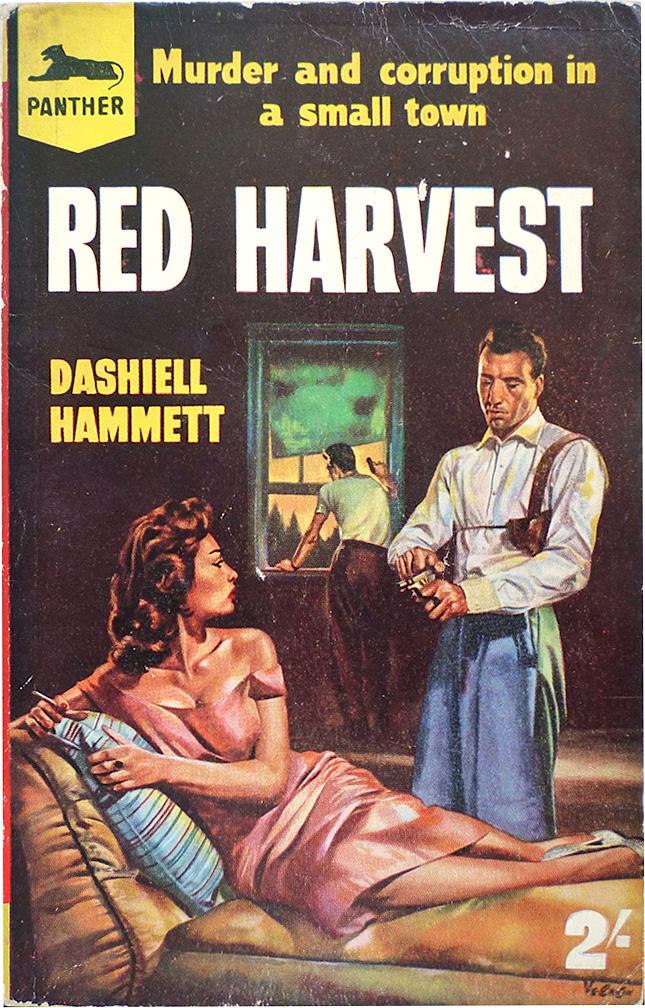
Red Harvest by Dashiell Hammett (1929)
This was an easy choice. I love Hammett’s work, at least the novels. (I haven’t really read any short short stories), and no one novel is quite like the others. Harvest is a masterful blend of pulp and puzzle fiction. The interlocking stories set in the corrupt town of Personville (aka “Poisonville”) are clever and violent and funny and grim and cumulatively add up to something approaching an epic. (I’ve always thought it should be dramatized or perhaps turned into an opera.) Our shlubby hero, known as The Continental Op, faces down gangsters and corrupt citizens with surprising grace and wit, but he finds his chief challenge to be the alternately repellent and alluring femme fatale, Dinah Brand. If only Hammett could have kept it together to write forty more novels instead of a mere four.

Murder Among Friends by Lange Lewis (1942).
Lewis was my favorite authorial discovery in 2023, and her novel The Birthday Murder was last year’s Book of the Year. Murder Among Friends is just as good, maybe better. It takes place in a Southern California university and chronicles the mysterious death of a young woman who worked as a secretary in the department office of the medical school. Every character, from Police Detective Tuck and his team of investigators to the complex group of medical students under suspicion, is exceptionally drawn, and the solution is rare for the genre, extremely clever, and packs an emotional gut punch. (And I wasn’t the only one in Book Club who thought so and placed this book on their list!)
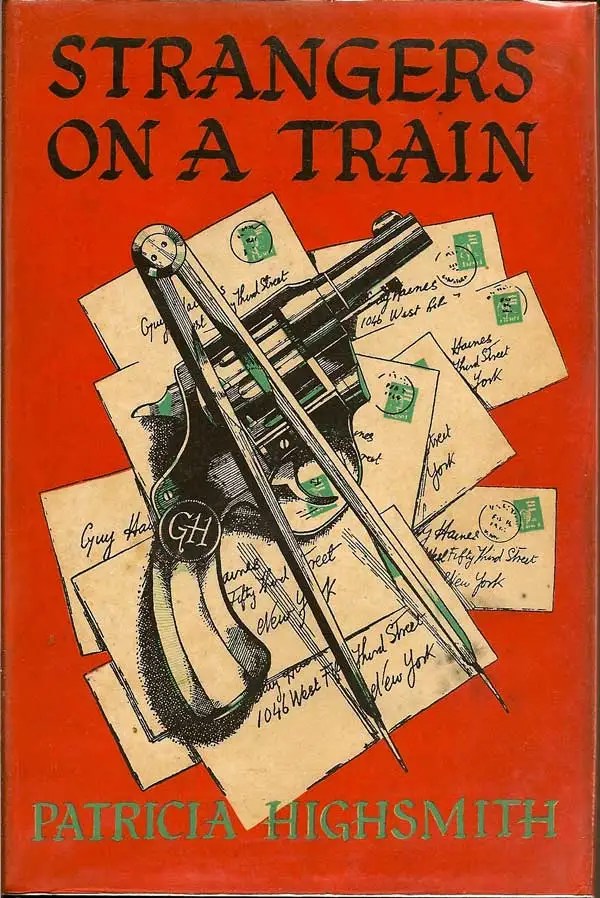
Strangers on a Train by Patricia Highsmith (1950).
Sadly, I’ve read almost no Highsmith, not even the Ripley novels. The Hitchcock film on which this novel is based is one of my favorites, but Hitchcock‘s adaptation feels like a light romantic comedy compared to the twisted tale Highsmith tells of two ill-starred young men who meet in that fateful carriage. The dark path down which the book’s Anthony Bruno leads Guy Haines makes the fun and games between the film’s Guy and Bruno Anthony feel like . . . well, like a carousel ride! Hitchcock certainly didn’t shy away from exploring the dark side of his heroes, particularly in the Golden Age of his 50’s films – and yet, for the most part, they remained heroic. But Highsmith’s novel has no heroes – both men step off the cliff! (Note: three of us had this book on our lists, making it the most selected title of the day!)

The Decagon House Murders by Yukito Ayatsuji (1987).
Granted there’s still a limited amount of Japanese honkaku mystery fiction available in English translations, but the list thankfully grows every year. Still, the more I read the older stuff, the more I think I prefer shin honkaku (translated: the newer stuff). The late John Pugmire introduced me to this modern subset with Decagon. As John Harrison, who also selected this book, said in Book Club, you have to be impressed with a first-time author who decides to take the stone-cold classic mystery And Then There Were None and create his own riff on it. Ayatsuji’s take on a deserted island murder spree is clever and fun and held great promise for a brilliant career. While I didn’t think as much of his follow-up, The Mill House Murders, I’m holding out great hope for The Labyrinth House Murders, based on a couple of reviews I’ve seen.
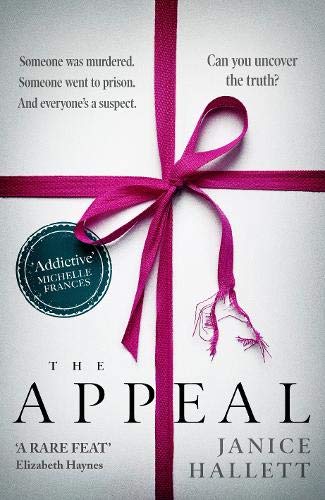
The Appeal by Janice Hallett (2022). Along with Anthony Horowitz, Hallett is one of my favorite modern authors steeped in the genre. But only her debut novel is a real whodunnit, and I have to admit I want more like this from her. Appeal is a dark, complex mystery wrapped in the glow of a sharply funny human comedy. Hallett nails the village community theater setting, which she knows well from life experience, and in the character of Isobel “Izzy” Beck she created my favorite fictional character of the last twenty years. I’ve read all her books and love Hallett’s modern epistolary style. But I humbly entreat her to please give us another real mystery soon, okay?
So there you have my list. The fact that the members of my Book Club are a varied lot of personalities with distinct tastes means that we had a wide assortment of authors and time periods represented. It might also explain why we have such a hard time picking a book we can all enjoy reading! But never fear: next month, we’re going back to doing what Book Clubs everywhere do – we’re reading a book! In fact, we found a holiday-themed mystery title in record time!
I look forward to reading below what titles you might have included in your lists!
 Ah Sweet Mystery!
A Question of Proof by Nicholas Blake. Even though Nigel Strangeways character changes greatly from the first novel, it’s a very readable book.
LikeLiked by 1 person
You’ll be happy to know that the Blake was listed by one of our members. (Sorry it wasn’t me.) Our book club read it a couple of years ago and we all enjoyed it very much.
LikeLike
Well, we all got opinions …. but THE BIG SLEEP really should have been in there somewhere! 😁
LikeLiked by 1 person
Sadly, I don’t think most of us have read Chandler.
LikeLike
That is just wrong in so many different ways … glad the Hammet got in 😁
LikeLike
Some of us have read Chandler, which is why we didn’t include him…
LikeLike
I could weep … shame Woolrich wasn’t eligible. Which reminds me JJ …
LikeLike
It’s okay, Woolrich qualified via the little-known “Because I picked him” rule.
LikeLike
What, despite all the non crime novels he published first? Tut tut …
LikeLike
None of that counted for our purposes. TBWB is too good to cavil about such trifles.
LikeLike
Well, I’ve lost all confidence in the process now 🤣
LikeLike
I look forward to a reread to confirm but I would probably include Cover Her Face on my list if we are not looking at GAD writers exclusively.
LikeLiked by 1 person
I also liked that book. I was a big fan of James for the first half of her career – through DEVICES AND DESIRES – and then her books got longer and more arid, and the mysteries themselves felt like an afterthought.
LikeLike
I agree completely Brad, first class James lasted for nearly 3 decades, which is damn impressive, but definitely only up until DEVICES AND DESIRES.
LikeLike
I think both of you gentlemen are right in that Devices and Desires serves as a point of deviation in James’ work, but it is by no means the point-of-no-return in terms of quality. In fact, her very next Dalgliesh novel, Original Sin is, in my estimation, one of her very best books and it harkens back to both Flowers For the Judge and Blake’s End of Chapter (the latter almost too much so according to some critics). There is a richness in setting and tone to the later James novels that make them particularly worthy of study: the Inner Temple of A Certain Justice; the theological college of Death in Holy Orders; and the Hampstead museum of The Murder Room. These last two books are admittedly rather light when it comes to mystery, but the evocation of place – always one of her strongest suits as a writer – has seldom been better. For quite a while now I have been going through the James oeuvre more-or-less in chronological order and I have only one Dalgliesh novel left: The Private Patient. It has been a very rewarding journey to say the least.
LikeLiked by 1 person
I totally agree with you about James’s skill with setting and atmosphere, Nick! It just started to feel, for me at least, that around Original Sin setting and character remained strong but the mystery went kaput. When James created a nursing hospital or a forensic lab or the community in and around a nuclear power plant, everything was great. After that, they felt more like novels with murder in them (which I suspect wouldn’t have bothered James one bit!)
LikeLike
I loved The Invisible Host, and A Kiss Before Dying!
LikeLike