As soon as we received our invitations to take part in the 2024 edition of Reprint of the Year over at Kate’s blog, Cross-Examining Crime, I knew that one of my books had to be Ellery Queen’s Cat of Many Tails! I’m sure most of you know that “Ellery Queen” is the alias of cousins Frederick Dannay (the plotter) and Manfred B. Lee (the writer), that they used this alias as the name for both the author and the hero of a long series of novels and short stories, and that while one could argue that they began their partnership under the sway of then leading light S.S. Van Dine, over the course of forty-three years the Queen dynasty evolved in exciting ways.
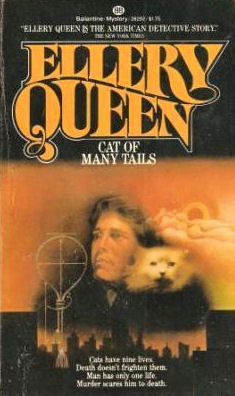
Indeed, the novels and stories can be divided into fairly distinct periods. The First Period is the most “Van Dine-ian”, comprising the nine “Nationality” novels (ten, if you agree that Halfway House could just as easily have been called The Swedish Match Mystery.) I cut my teeth on Queen with the fourth, and arguably the best, of these: The Greek Coffin Mystery. These books were complex puzzles with notable settings, light on character but heavy on clues and twists, and all of them included a formal Challenge to the Reader to underscore how Queen was attempting to “play fair” with his audience.
Then, like most of his contemporaries, Queen began to experiment in the late 1930’s, placing less emphasis on the pure puzzle form and more on character and theme. While Lee looked for a more naturalistic tone in his prose, influenced by the great American novelists of the day, Dannay’s plots emphasized the moral consequences of murder and reconceptualized their detective-hero from a Golden Age eccentric and purveyor of truth to a sensitive and flawed man.
Whereas the cousins had written seventeen novels during the 30’s, they produced only five full-length mysteries in the 40’s. (Not to say they weren’t busy: the Ellery Queen radio program began in 1939 and ran through 1948. Another set of short stories appeared, and in 1941 Fred Dannay began Ellery Queen’s Mystery Magazine, an industry that eighty-three years later is still going strong.) Three of the five titles – Calamity Town, The Murderer Is a Fox, and Ten Days Wonder – take place in Wrightsville, a Thornton Wilder-esque New England town that provided a deceptively prosaic backdrop for Ellery’s transformation. People who are partial to early puzzle-centric Queen will argue, not without reason, that these three titles work less well as mysteries than as novels with crime in them. I can’t fault these folks for their opinion, but I see this trilogy as something special: the murder mystery as American tragedy.

The other two 40’s novels are special in and of themselves: There Was an Old Woman is a hybrid, a throwback to early Queen, with its dysfunctional family straight out of Alice in Wonderland and its triple-pronged twist ending and a distinctly screwball sensibility that might remind some of Stuart Palmer or Craig Rice. And Cat of Many Tails . . . well, that’s what we’re here to discuss today.
We are all grateful to Otto Penzler and The Mysterious Press which, since the inception of the American Mystery Classics series, has regularly included the work of Ellery Queen in its catalogue. Penzler has focused on the First Period, producing six of the Nationality titles, as well as the early short story collection The Adventures of Ellery Queen. But in September, AMC released Cat of Many Tails, one of the best serial killer mysteries and New York-set mysteries of all time. This new release includes an introduction by Richard Dannay, Fred’s son, who talks about the novel’s importance in the canon (having studied law in Cambridge during the awful reign of the Boston Strangler, Richard assures us that the book gets the atmosphere of fear and panic just right) and about his father’s importance to the genre.
As for the book itself, it’s a corker! Right at the start, Queen drops us into a maelstrom of tension affecting the Five Boroughs and, especially, two of its denizens closely associated with crime-solving: “The strangling of Archibald Dudley Abernathy was the first scene in a nine-act tragedy whose locale was the City of New York. Which misbehaved. Seven and a half million persons inhabiting an area of over three hundred square miles lost their multiple heads all at once.”

It’s summer in the city, and it’s mighty hot. The residents of Manhattan are fleeing their apartments and packing the thoroughfares in an attempt to escape to the beach or merely catch a passing breeze. People are riding busses or the subway, hoping to find “a violent displacement of the tunnel, air, hellish, but a wind.” They crowd Central Park at night, as well as the movie theatres and Ebbets Field, desperate for some relief from the grinding heat. But these citizens, who have recently survived the Armageddon of World War II, have a new enemy – a serial killer whom the press has dubbed The Cat. The papers and the radio start to churn up the horror because it sells, and people are inundated with the fact that the Cat seems to be everywhere and nowhere all at once, that he strangles his victims with silk cord, and that there seems to be no rhyme or reason in terms of the killer’s choice of victims.
The papers have even crafted the titular image of the killer, “one of the great monsters of cartoonical time. The man should get the Pulitzer Prize for Satanism. ‘How Many Tails Has The Cat?’ asks the caption.” As the novel begins, five tails represent the number who have fallen victim: a reclusive mama’s boy, a prostitute, a hard-working family man, an aging debutante, and a paralyzed woman. (Even though we never meet them, Queen brings each of these poor souls to vivid life.) To all outward appearances, these people have no connections with, or resemblance to, each other, and no stand-out qualities make them more or less likely to attract the attentions of a monster like the Cat.

As is usual in times like these in the Queen-verse, responsibility for solving the case is placed on the bird-like shoulders of Inspector Richard Queen, head of Homicide. In fact, Queen has just been appointed as head of a task force addressing the threat the Cat poses to the city, although the reasons for this are manifold. You see, the canny police commissioner realizes what we fans have long known: while the Inspector is sharp, dogged and perfectly capable of taking on the stresses of a mammoth problem like a serial killer, he also possesses a secret weapon in the form of a brilliant crime-solving son who is sure to lay the Cat’s crime spress to rest.
Except, as the novel begins, the secret weapon is out of commission: Ellery is in a state of self-imposed retirement from crime-solving, due to the emotional repercussions of his last adventure in Wrightsville (Ten Days Wonder). Yet, as worried as the Inspector is over his son’s tormented soul, he worries that the reign of the Cat is “a special deal . . . a race against citywide collapse.” And so father attempts to lure son into consultation, but even as Ellery begins to make certain deductions about the Cat’s modus operandi, he remains ambivalent about getting involved – until the police commissioner himself shows up at their door with news of the latest victim.
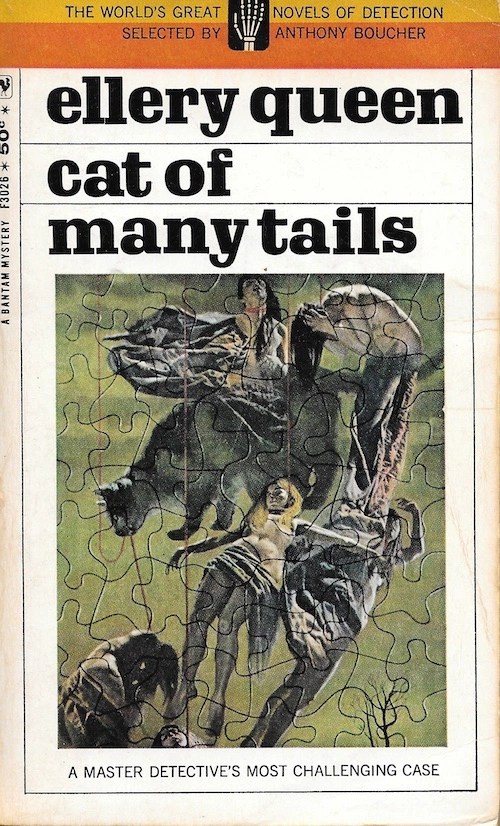
Serial killers are a favored device in modern crime fiction, and there are several examples I love. Pronzini and Malzberg’s The Running of Beasts, Stephen Dobyn’s The Church of Dead Girls, and W. Edward Blain’s Passion Play all come to mind (and will be re-read and reviewed here some day!) Still, I prefer the classic variety, sporadic though they may be in appearance, because they tend to rely less on the numbing gore that modern authors favor and focus more on the psychological effect of these butchers on a community. Agatha Christie wrote several of my favorites during the 1930’s, including The A.B.C. Murders, Murder Is Easy and And Then There Were None, and each of them tackles the concept in a wholly different way. And let’s not forget Francis Beeding’s Death Walks in Eastrepps, Philip McDonald’s Murder Gone Mad, or Knock, Murderer, Knock, the grand debut of the sadly short mystery-writing career of Harriet Rutland.

Cat of Many Tails pays its own homage to these past examples. In fact, early on Ellery refers to “the ABC theory” of serial killing (and thereby spoils the central conceit of Christie’s novel!) What sets Cat apart from the others is its epic scope and sense of realism. When a fresh victim appears and turns out to be Black, one reporter quips that the Cat seems to be “a firm believer in civil rights.” But it is Inspector Queen who puts it most strongly. As Ellery seeks patterns in an attempt to beat the Cat to the punch, his father counters with his own opinion:
“Ellery, this is killing for the sake of killing. The Cat’s enemies are the human race. Anybody on two legs will do. If you ask me, that’s what’s really cooking in New York. And unless we clamp the lid on this – this homicide, it’s going to boil over.”
With all of New York as its setting, this is no closed circle mystery; the glossary of names at the end of the book lists ninety-six characters, not including the Queens or series regular Sergeant Velie. Indeed, this is not really a puzzle mystery at all, but a full-on procedural. Ellery does some deducing at the start, but most of the breaks in the case come about as a result of dogged investigation and sheer luck. Most of those on the massive character list are merely mentioned in passing, but Queen gives life to a great number of these folks, from the beleaguered Mayor and Police Commissioner (referred to only as “Jack” and “Barney”) to various witnesses and suspects, and to the victims themselves and their kin. Similar to The A.B.C. Murders, three of these family members join an unofficial investigative group that forms around Ellery: Celeste Phillips, a model, and Jimmy McKell, a reporter, who, in both losing their sisters, find each other, and Dr. Edward Cazalis, a noted psychiatrist who in losing his niece becomes both Ellery’s helper and competitor in crime-solving.

Halfway through the novel, the case takes a sharp twist, and becomes, as you might guess, a gripping game of cat and mouse, only with the Cat becoming the Mouse. In true Queenian fashion, the grand climax comes, and the author saves the most emotional twist for last, sending Ellery on a grueling trip to Vienna to find it. The emotional maelstrom that our hero discovers there helps elevate the book from a “mere” genre exercise into a moving novel with a large dollop of murder on the side. To quote Manny Lee in a letter he wrote to his cousin: “I am convinced that this will be considered, from every standpoint – both plot and writing – the very finest Queen novel to date, by just about a million miles. I think it has a good chance of being considered a sort of classic, at least among the cognoscenti.” As Richard Dannay tells us, his father was humbler: in presenting a copy of the book to a Queen book collector, Fred added this note: “To John – This book was almost all we hoped to make it.”
Having just re-read it for a third time, I tend to side with Manny here. This early mining of what would become a common trope in crime fiction remains easily one of the best examples of its kind, both as a detective story and as a novel irrespective of genre. Those of you who haven’t read it yet are in for a treat. And I fervently hope that those of you who love Cat of Many Tails as much as I do will vote for it as 2024 Reprint of the Year!

 Ah Sweet Mystery!
I loved the Nationality books but after my unhappy experience with Calamity Town I stopped reading the Ellery Queen books.
It’s odd because it’s not like I’m a puzzle-plot purist. I enjoy hardboiled crime and noir fiction.
Looking back it’s possible that the problem was that I read Calamity Town straight after reading the Nationality novels. I was hoping for more of the same.
I should give later Queen another chance, but a serial killer story – possibly not my cup of tea.
LikeLike
A good choice. Likely to be in top 5 !
LikeLiked by 1 person
There’s a pink or blue silk cord for everyone who doesn’t vote!!!
LikeLike
The Greek Coffin Mystery was my first Queen as well. It’s an absolute corker isn’t it?
LikeLiked by 1 person
Seriously, I threw the book in the air and gasped. And I was thirteen!!!
LikeLiked by 2 people
I think this novel provides a strong illustration of the problem (perhaps impossibility) of delineating precise genre borders. For while you suggest that this is not a puzzle mystery at all, I’d say that the investigation is significantly shifted and given momentum by three clues that are very much of a formal puzzle variety— the first being the age order clue, the second the marital status distinction clue (for me the most interesting point in the book— a knowledge limitation-clue recalling the great “blunt instrument” clue of The Tragedy of Y… or, for that matter, the “V-Ger” clue of Star Trek:The Motion Picture. I always find knowledge-limitation clues more interesting than the far more common knowledge-surplus clues) and the third being a clue of chronology that exonerates the key suspect. The atmosphere is admittedly anything but purely clinical or cerebral here, and there’s certainly no challenge to the reader, but those clues are as “pure puzzle” as anything in the genre.
The one thing that doesn’t work for me is the extensive amount of time employed in preparations to “trap” the culprit— a process that begins early enough in the novel to low the reader to suspect that they are not yet truly “in” on the correct solution. If I were to adapt the novel, I would greatly tighten this section.
LikeLiked by 1 person
As you’re going to remember very shortly, Agatha Christie does a similar thing of providing an alibi for one of the “killer’s” killings, only she reveals this complication – and, hence, a warning that her game isn’t over – at the very end. And, of course, her game is to dangle the killer’s identity right in front of us without ever confirming it. But Queen is playing a different game in that Cazalis is aware of what’s going on and does what he does with a purpose. The plot needs time for that to play out. Your suggestion that the section be tightened works if we all assume this is a puzzle mystery and that timing of Cazalis’ unmasking means that the true solution is still to come. Queen is attempting to fool us here – and if I recall my long-ago first reading, it worked on me!
LikeLike
There was too much book left in my hand for me not to at least suspect (and indeed hope) there was more solution surprise in store. If there hadn’t been, I would’ve felt quite disappointed, as I was with the film version of Anthony Abbott’s “About the Mystery of the Night Club Lady” (which actually just excised the novel’s final twist).
LikeLiked by 1 person
Anthony Abbott is a mystery writer who doesn’t get enough attention.
I haven’t seen the film version of About the Mystery of the Night Club Lady.
LikeLike
I’m so glad you commented on this, because otherwise I would not have noticed the ridiculous errors I made on thr earlier comment. The film version of About the Murder of the Night Club Lady (titled The Night Club Lady) is actually excellent. It is the film version of Abbott’s About the Murder of the Circus Queen that egregiously excises its final twist.
LikeLike
I’m so glad you commented on this, because otherwise I would not have noticed the ridiculous errors I made on thr earlier comment. The film version of About the Murder of the Night Club Lady (titled The Night Club Lady) is actually excellent. It is the film version of Abbott’s About the Murder of the Circus Queen that egregiously excises its final twist.
LikeLike
One of my favourite Ellery Queen novels, definitely in my top 5 for certain, along with Tragedy of Y, There Was an Old Woman, Greek Coffin and Ten Days’ Wonder.
LikeLiked by 1 person
Mmm, I like your list! I’ve never attempted a Top 10 Ellery Queen list, but these five would be in it, along with Siamese Twin and Face to Face. The rest I’d have to think about.
LikeLike
For me, along with those five, it’d probably be Origin of Evil, Siamese Twin, Spanish Cape, And on the Eighth Day, and Tragedy of X.
LikeLike
What a wonderful review of a favourite book, Your review makes me want to read it again. It was the second Queen I read and am proud of the fact that I guessed the identity of the Cat correctly.
LikeLiked by 1 person
I was an ignorant teenaged boy when I first read this and didn’t have the sensitivity to get the answer right. I remember thinking at the time that the murderer was too minor a character for this to be “fair.” Fortunately, now I’m a grown-up! And really, this may be one of the most devastating serial killers in crime fiction.
LikeLike
A fabulous choice – I still have the IPL edition I bought in the 1980s. It’s a classic through and through.
LikeLiked by 1 person
I did my top 9 Ellery Queen titles way back when but I stand by it:
LikeLiked by 1 person
Our lists are similar, but I have little fondness for A Fine and Private Place. If I’m going to include a short story collection, it would be Calendar of Crime; maybe the fact that they’re recycled radio scripts makes them move better for me. And my “not penned by EQ” guilty pleasure is Fourth Side of the Triangle, which feels nostalgic and has great fun with a variation on the dying message.
LikeLike
I always want to push FINE AND PRIVATE PLACE because I love how the big twist is handled but no question it would have worked much, much better as a novella. I prefer the TV version by Levinson & Link of TRIANGLE, must admit.
LikeLiked by 1 person
I very much enjoyed the TV movie, but I think that the final dying message there is really silly! Maybe it’s because I already knew the killer, but the meaning of that message was so clear from the start! However, it’s a much more visual clue and works better for TV than the book’s (superior) clueing would have!
LikeLike
Honest question, what cluing is there even in the book? All the clues that I remember are only for the snyfr fbyhgvba, and the bigger clues only coming right before the culprit reveal fhpu nf gur cevagrq angher bs ABEZN
LikeLike
Oh, I didn’t call it a well-clued mystery, I just said it was a guilty pleasure amongst the titles not written by the boys together. It has been a while since I read it, but somehow Ellery finds the secret of the portfolio names and somehow he finds the truth about which portfolio to look at. It might just be luck. I thought the characters were good. It’s more like a Wrightsville mystery, but set in NYC.
LikeLike
I agree, the final clue is the weak spot. PLAYER is the better book anyway of course 🤣
LikeLiked by 1 person
I have struggled to love Queen. It has been quite a while since I have read any of their novels. I have some sitting on my TBR pile. Maybe 2025 will see me pick one and give them another go. Inevitability none of them is this one lol
LikeLiked by 1 person
Pingback: Reprint of the Year Award 2024: Nomination 2 – crossexaminingcrime
I think the fact that when we did our Top 39 Draft, Cat of Many Tails was the very first pick in the very first round. We were all scrambling to get our hands on this one!
LikeLiked by 2 people
Cat of Many Tails is truly a brilliant book, but it absolutely must be read after first reading Calamity Town, The Murderer is a Fox, and Ten Days’ Wonder, or vast chunks of it won’t quite make sense or have the proper impact.
LikeLiked by 1 person
I totally agree, David: it’s a must for anyone who really wants to dig into EQ’s oeuvre. Neophytes will be confused as to Ellery’s mindset at the start of Cats. It does make more of a mystery out of There Was an Old Woman, which doesn’t fit into this 1940’s pattern at all.
LikeLike
From what I understand, “There Was an Old Woman” was Plan B after they had to scrap their work-in-progress when they realized that it duplicated the plot device from Agatha Christie’s just-published “And Then There Were None”. (Agatha had no problem publishing hers, even though it used the same plot device from the 1933 Sherlock Holmes film “A Study in Scarlet” – which of course she didn’t “borrow”.) Decades ago, I established the internal chronology of the stories, and they don’t occur in publication order, so “There Was an Old Woman” shouldn’t be read as if it’s part of the Wrightsville era. It occurs in 1938, two years before “Calamity Town”.
LikeLiked by 1 person
Pingback: “I’ve got (another) little list . . . ” Ten Favorite Mysteries of the 1940’s | Ah Sweet Mystery!