Last week, I decided to reorganize my mystery book collection, numbering around a thousand volumes. Originally, as you might expect, everything was in alphabetical order – with certain exceptions. There is, of course, the Altar to Christie.

Plus, all the honkaku mysteries, the Dell mapbacks, and the children’s and YA mysteries have their own places of honor.. Then I got the idea that it would be pleasing to put certain books together based on their publisher! It may seem nonsensical in terms of order, but it felt aesthetically pleasing. The collection now looks something like this:
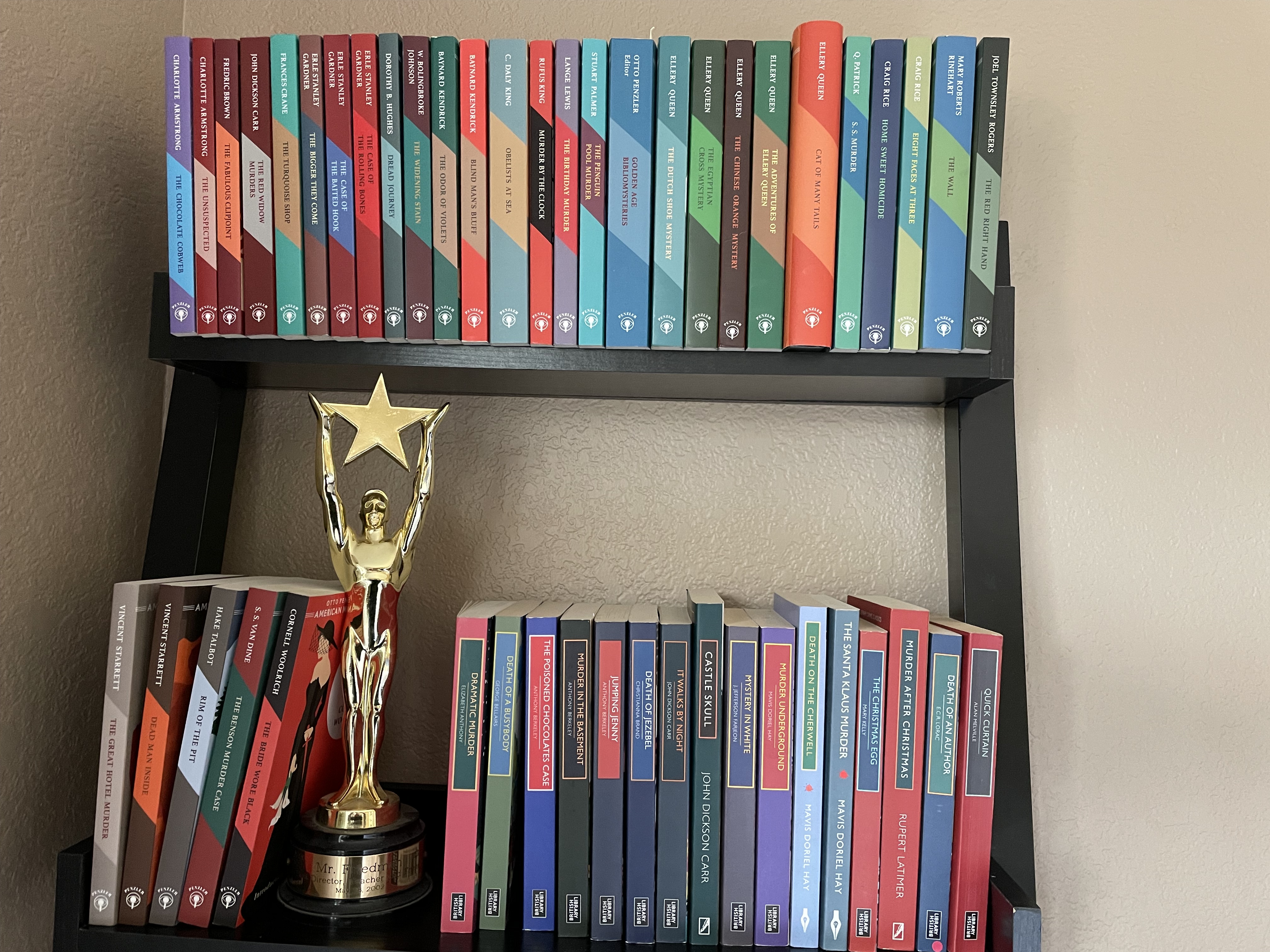
Downstairs, I have all the American Mystery Classics, the British Library mysteries, the Crippen & Landru collections, the impossible crimes from Locked Room International, ditto from Ramble House, and my ever-growing collection from the much-missed Rue Morgue Press. You can also find both my John Dickson Carr/Carter Dickson and my A.A. Fair/Erle Stanley Gardner collections.
Upstairs are the Dell Mapbacks, the YA and kid stuff, the honkakus, and my shrine to, er, special bookshelf dedicated to Agatha Christie, plus all the rest of my books – A to Z, including the entire works of Ellery Queen and Rex Stout. Plus, I’ve a pretty sizeable collection of DVDs consisting of mystery films and TV shows.
Some of you might be thinking . . . . . oy! Why?? What has he done?!? And who knows? I might agree with you . . . one of these days! In the moment, however, this shake-up has made me look at my collection in a fresh way. (It also made a great excuse to dust the shelves!) For some reason, titles and authors pop out more than they did before, and while I can already hear your argument that it’s silly to have a few authors appear on different shelves in different parts of the house (Carr, for instance, is now found in four distinct places!), it has caused my brain to shiver with newfound anticipation as I approach a shelf and truly wonder what I will find there.
I would imagine that few people purchase a used book simply because of the publishing house. You pick up something because of the title or the author or the blurb on the back. I’m the same way – with two exceptions. The first is the sadly lamented Rue Morgue Press. Founded in, I believe, 1997 by Tom and Enid Schantz, I can’t tell you how many titles RMP released before the lamented closure of its doors in 2016. But throughout these years, the Schantzes did what luminaries like Martin Edwards (British Library), Otto Penzler (AMC) and small publishers like Dean Street Press, Pushkin/Vertigo and Coachwhip are doing today: making accessible to a hungry reading public a host of mystery authors from the famous to the unknown. With colorful and often humorous covers and smart introductions, Rue Morgue re-introduced such authors as Dorothy Bowers, Glyn Carr, Clyde B. Clason, Frances Crane, and Eilis Dillon. As you can see by my shelf, they also included major players, like Nicholas Blake, Carter Dickson and Craig Rice.

The second publishing house I love and wish I collected more of is the Dell mapbacks. This is a long-retired imprint that only lasted eight years (1943 – 1951) and comprised 550 titles, of which I own a mere thirty-five. (I used to have a few more, but the books were old and not that well put together, and they eventually fell apart.) The covers on a mapback – front and back, of course – are usually smashing, although I can’t always vouch for the usefulness of the map or diagram on the back. The first few pages of most of these volumes contained several regular and delightful features: Persons This Mystery Is About, What This Mystery Is About, List of Exciting Chapters, and an often intriguing, sometimes silly list of statements/questions under the heading, Wouldn’t You Like to Know –

Mind you, none of this assured you that the book you were about to read would be any good – plenty of mapback novels were trash! – but this was a triumph of packaging. Who knows if I will ever read Death of a Bullionaire, The Corpse Came Calling, or One Angel Less – but as you can see from the picture, Dell published some great authors, as well as authors who have sadly been forgotten and who may be well worth the investigation. Authors like Zelda Popkin and Pat McGerr and the Little sisters.
Ah, the Little sisters! Both Dell and Rue Morgue published their books, and somewhere in my travels I picked up a mapback copy of Great Black Kanba. So muster together, me ankle biters, and let me tell ya a yarn about Constance and Gwenyth Little, who managed between them to write twenty-one mysteries, all but one containing the word “black” in the title. Born in Sydney, Australia, they and their three siblings were imbued early on with the traveling bug by their father, an actuary who moved them first to Western Australia and then to London. From there they bounced to Mexico City, then New York, and finally to East Orange, New Jersey. Gwenyth and Constance made three round-the-world tours before they settled down in Joisey to write together.
In process, they resembled another Northeastern pair, the cousins Frederick Dannay and Manfred B. Lee, who created Ellery Queen: Constance, like Fred, would work up a detailed synopsis of the plot, including bits of dialogue, and Gwenyth, like Manny, would write and edit the final draft. Unlike the guys, the sisters had no interest in a “Great Detective” or in any continuing characters. From what I gathered, their books fall under the category of “comic mystery” and tend to focus on the intrigues of “privileged and slightly spoiled heroines . . . bright, independent-minded and cheerful, they learned to drink and smoke and party during the 13 years of that so-called noble experiment (Prohibition).” Romance figures heavily in their novels, and I read that you can “pick out one eligible bachelor in the book able to trade barbs with the heroine and you can immediately knock one person off your list of suspects.”
The Littles’ first book debuted in 1938, and they wrote until 1953, when the public’s taste for traditional mysteries had paled and their books stopped selling. (The Schantzes suggest that the proliferation of TV sets might have been a harbinger for the death of reading. How sad!) 1944’s Great Black Kamba is the tenth of their mysteries, and, believe it or not, the third mystery I’ve read set aboard a train racing across the Australian outback. (Both of the others, M.G. Leonard and Sam Sedgman’s Sabotage on the Solar Express and Benjamin Stevenson’s Everybody on This Train Is a Suspect, were highly enjoyable reads . . . perhaps I should start shelving my Mysteries-Set-Onboard-a-Train-in-Australia together.)

The early information at the top of Dell mapbacks tended to sensationalize the contents therein, and while the blurb here promises “a series of murders,” half the book passes before an actual death occurs. The first half is dedicated to presenting a mildly screwball mystery-comedy where the “bright, independent-minded and cheerful” heroine is not quite on her game: she has awakened onboard a train bound for Melbourne, and she is suffering from amnesia.
A friendly fellow passenger informs her that her name is Cleo Ballister, that she is a film actress from America, and that she’s getting off at Melbourne to meet her Australian relations. Evidently, another young woman named Virginia Peters also suffered a mishap and was removed from the train to a sanitorium. None of this rings a bell with poor “Cleo”, and so she searches for more information by looking through her purse, where she finds love letters from two different men: the letter from “Jimmy” appears somewhat threatening, and the one from “Billy” offers Cleo protection from “Jimmy” through someone he has hired named “Clive.”

At the Melbourne station, our leading lady meets her screwball relations, including the brooding Cousin Jimmy. Soon they are joined by an attractive red-haired doctor by the name of Clive Butler, who introduces himself as Cleo’s fiancé! And then the whole group is off, transferring from one train to another, over and over, with the longest stretch of their travels taking place on board the Black Kanba, a sleek dark train hurtling across the Bullarbor Plain. As “Cleo” deals with dueling beaus, a weird new family, and an ever evolving case of amnesia, the situation starts to become more sinister.
Are Jimmy’s accusations that Cleo has committed murder true? Are Clive’s protestations starting to sound real? Is Uncle Joe, the family patriarch, going crazy, or is someone actually completing the paintings he starts every morning? Is “Cleo” herself going nuts, since she hears a dog barking right beside her, and yet there’s not a canine in sight?
It truly takes half the novel before Cleo spots tiny bloody tracks across the train floor and discovers one of her merry band gruesomely killed in the berth below hers. That “series” of murders amounts to a mere pair, but they are suitably surprising and dramatic. I wish I could heap more praise on the mystery itself, but this is feels more like a romantic comedy wrapped in sinister trappings. It’s an interesting contrast to Lily Wu and Janice Cameron, the detective team in Juanita Sheridan’s books. My friend Kate Jackson added an interesting comment about this pair to my review of The Chinese Chop:
“One of the things that I appreciated with this series was that the young women are not rushed to the altar and pushed off the page while their male counterpart does the detecting. They remain single, but that doesn’t mean they lack dates; they only accept them if they want them. I think this series presents being single in a much more positive way.”

This is not the reality for Cleo or the other female characters in Great Black Kanba. The central narrative here involves women plotting to get men, some for good, others for more venal reasons. Most of the scenes involving Cleo find her navigating amongst men, whether they be suitors, relations, or police. Most of these scenes contain a certain level of hostility, whether played for comic effect or to generate suspense. Still, even if Cleo is destined to end up with “Mr. Right,” along the way she gets in some good digs on behalf of the “battle of the sexes:
“‘I think a husband and wife should live where they please, and just go to visit each other occasionally,’ I said. They all disagreed with me violently, and Mary pointed out, ‘The children need a fathers influence.’ ‘Oh well, that’s all right,’ I conceded. ‘The children could remain with the father. That would make it easier for the wife, anyway.’”
Eventually, the killer is revealed, not through any deduction on Cleo‘s (or anyone else’s) part, and while it’s all suitably entertaining, it doesn’t have the satisfaction of a well-crafted puzzle. And there are other minor puzzles that are barely explained or, worse, simply guessed at (like the problem of Uncle Joe’s paintings.)
Still, I don’t think crafty puzzles and strong deduction were the Little’s bag. This might have made a charming 40’s comedy-mystery film: light on clueing, heavy on the action and romance. I have a feeling the same holds true for the other twenty novels in the Little’s oeuvre. Both Kate Jackson and Jim Noy have had good to mixed things to say about the Littles on their blogs. I am looking to expand my collection of Rue Morgue Press titles, so maybe if I proceed carefully . . . but that’s all shrimp on a future barbee!
 Ah Sweet Mystery!
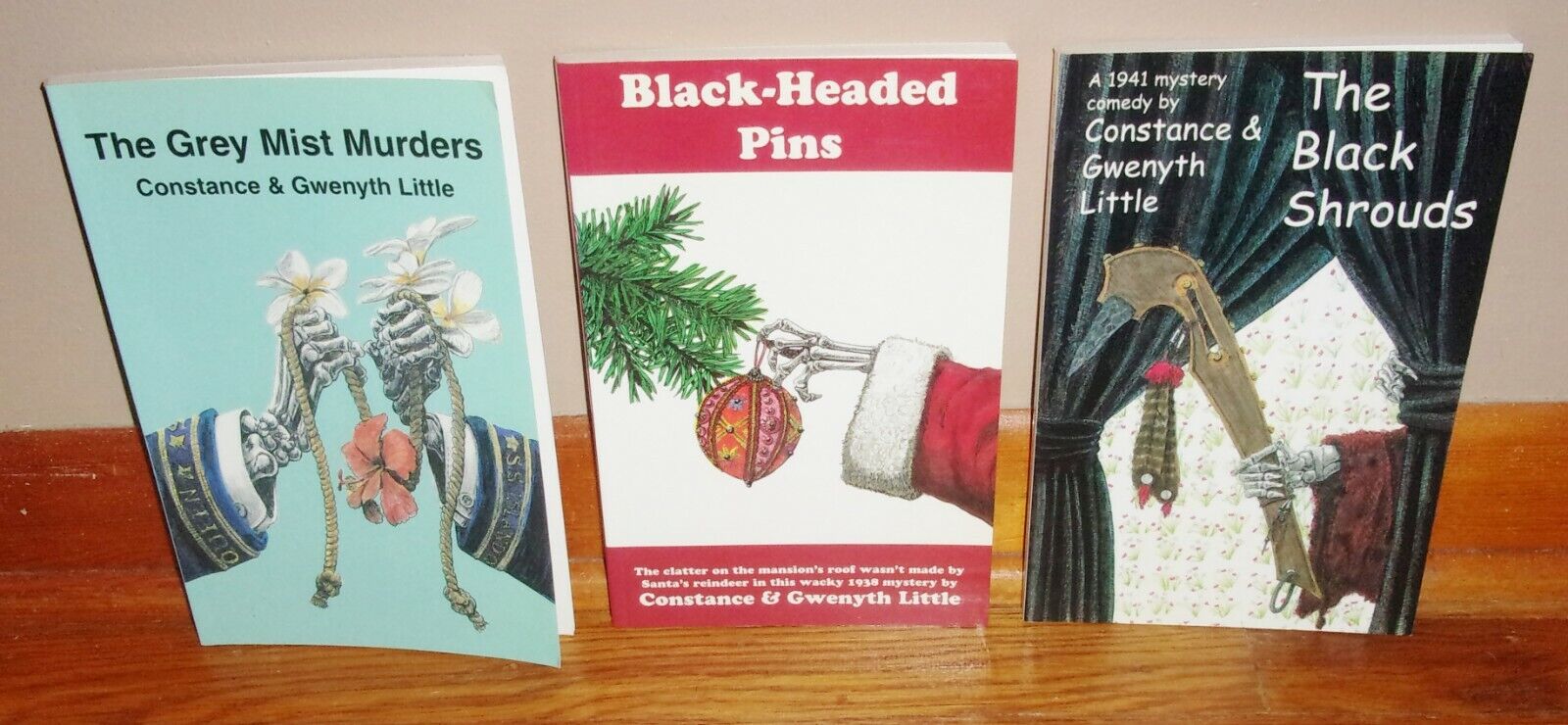
Yay I am glad you have finally tried the Littles. The Great Black Kanba is one of the few novels they wrote which is set in Australia and I think I enjoyed it more than you. The vast majority are set in America. I have not read The Grey Mist, so look forward to seeing what you make of that. I have read the other two which are winging their way to you and of those two The Black Shroud is the strongest. Having a quick scan of my Little collection (read at least 15 of them I think) they did also include divorced women (or women cited in a divorce case as a correspondent) as their protagonists, which is a little bit edgy for the time, well at least in the UK.
LikeLiked by 1 person
Great post. I always like seeing others’ GAD collections. I spent a couple afternoons organizing mine in alphabetical order by author.
I have yet to read any of the Littles books although I have several TBR after curating Kate’s highest rated titles. You trigger me to read them.
Finally, I love seeing your mapback collection as I have a bit of an addiction buying those. I wish someone with the rights would republish those or perhaps create a coffee table book showing all the front and back covers.
LikeLiked by 1 person
Rearranging the shelves is a time-honored way to freshen them up for the buying public (and clean them).
That’s why grocery stores periodically rearrange. So you, dear reader — er — customer — discover items you didn’t know existed.
As you proved, it works!
LikeLiked by 1 person
I bought a new bookcase a few weeks ago and reorganized my books in much the same way. Of course my books can’t reach the same numbers as yours. What a great collection.
I find organizing by publisher works very well. Call me shallow, but there’s something pleasing about seeing those colourful British Library spines en masse. And before getting the new case, it was very important to have books of the same height together so that more could be stacked on top…
I found one “Conyth Little” in the collection, The Black Thumb. I’ll have to see what that one’s like. The premise for Kanba sounds a little rom-com like.
LikeLiked by 1 person
No, Velleic, it’s VERY rom-com like. No clues, but the final reveal was suitably creepy. Kate and Jim have liked some of them, but they sound like a mixed bag. Still, I took a chance and bought a few more. Love those Rue Morgue covers!
LikeLiked by 1 person
Conyth Little was the publishing name in Britain, I think. I have one, too.
LikeLike
Pingback: Winding Up the Week #416 – Book Jotter