You can’t help but wonder if Chinese-American detective Charlie Chan, created in 1925 by popular author Earl Derr Biggers, would have left as lasting and, well, complicated an impression on our culture had he never made it to film. After all, there were only six novels published in a space of seven years. They were hugely popular, and I’ll bet Biggers would have written more had he not suffered a fatal heart attack in 1932 at the age of 49.

But it was a foregone conclusion that Inspector Chan would make it to the silver screen. As Ken Hanke writes in his detailed filmography, Charlie Chan at the Movies, “It probably came as no great surprise to Biggers that Hollywood quickly decided to film (his first novel) The House Without a Key. Its exoticism made it a natural and Hollywood had already found uses for Biggers’ talents.” As Biggers produced one novel after another, some studio would grab the rights and film it. But up until 1929, when Fox studios purchased the rights to Behind That Curtain, the thought of a Charlie Chan series hadn’t crossed anyone’s mind.

It would take two years for the Fox machinery to begin cranking them out producing twenty-eight films featuring the detective and barely pausing along the way to recast the leading role after star Warner Oland succumbed to an alcohol-related illness and Sidney Toler took over. And then – Fox was done. After Toler spent a year trying to finance new Chan films somewhere else, the series found a new home at the Poverty Row studio Monogram Pictures. Already Fox had made the Chan films on the cheap, averaging a $200,000 budget per picture; at Monogram, this was slashed to $75,000. And it shows. To complicate matters, Toler became quite ill and could barely walk during the making of the last few pictures. He died a few short months after his final film, The Trap, was released, and the role was recast yet again, with Roland Winters, for six final films.
And now, the moment that everyone has been waiting for: The Three Amigos – Sergio Angelini, Nick Cardillo, and yours truly – are drafting a list of the Top Thirteen Charlie Chan films. For the purposes of this draft, Nick, Sergio and I decided to forego the Monogram films, some of which are . . . okay, while others are painful to watch. Out of the 28 Fox films that were made, five are lost, although the scripts are available online somewhere, and Ken Hanke discusses each of the lost films in riveting detail. As a sixth “lost” film, Charlie Chan in Paris, was eventually recovered, we can always hold out hope that a print of one or more of the others exists somewhere.
Just in case you are playing along, here again is the list of films we are considering:
| TITLE | YEAR | STARS |
| The Black Camel | 1931 | Warner Oland, Bela Lugosi, Robert Young |
| Charlie Chan in London | 1934 | Warner Oland, Ray Milland |
| Charlie Chan in Paris | 1935 | Warner Oland, Keye Luke, Mary Brian |
| Charlie Chan in Egypt | 1935 | Warner Oland, Stepin Fetchit |
| Charlie Chan in Shanghai | 1935 | Warner Oland, Keye Luke, Charles Locher |
| Charlie Chan’s Secret | 1936 | Warner Oland, Rosina Lawrence |
| Charlie Chan at the Circus | 1936 | Warner Oland, Keye Luke, The Brasnos |
| Charlie Chan at the Race Track | 1936 | Warner Oland, Keye Luke, Helen Wood |
| Charlie Chan at the Opera | 1936 | Warner Oland, Boris Karloff, William Demarest |
| Charlie Chan at the Olympics | 1937 | Warner Oland, Keye Luke, Katherine De Mille |
| Charlie Chan on Broadway | 1937 | Warner Oland, Keye Luke, Harold Huber |
| Charlie Chan at Monte Carlo | 1937 | Warner Oland, Keye Luke, Sidney Blackmer |
| Charlie Chan in Honolulu | 1939 | Sidney Toler, Victor Sen Yung, Phyllis Brooks, Claire Dodd |
| Charlie Chan in Reno | 1939 | Sidney Toler, Sen Yung, Phyllis Brooks, Ricardo Cortez |
| Charlie Chan at Treasure Island | 1939 | Sidney Toler, Sen Yung, Cesar Romero |
| City in Darkness | 1939 | Sidney Toler, Lynn Bari, Leo G. Carroll |
| Charlie Chan in Panama | 1940 | Sidney Toler, Sen Yung, Lionel Atwill, Mary Nash |
| Charlie Chan’s Murder Cruise | 1940 | Sidney Toler, Sen Yung, Lionel Atwill, Leo G. Carroll |
| Charlie Chan at the Wax Museum | 1940 | Sidney Toler, Sen Yung, C. Harry Gordon |
| Murder Over New York | 1940 | Sidney Toler, Sen Yung, Ricardo Cortez |
| Dead Men Tell | 1941 | Sidney Toler, Sen Yung, Sheila Ryan |
| Charlie Chan in Rio | 1941 | Sidney Toler, Sen Yung, Harold Huber |
| Castle in the Desert | 1942 | Sidney Toler, Sen Yung, Henry Daniell |
As usual, we modeled our draft on our favorite film podcast, Screen Drafts, where Clay Keller and Ryan Marker host a variety of film professionals and enthusiasts in the drafting of various “Best of” lists. Rather than do a Super Draft of all twenty-three films, (which works best with four drafters), we decided to limit our list to thirteen This always makes things more emotional, as you can never be certain that one of your favorites won’t be left by the wayside.

And I have to tell you – things did get emotional during our draft, once we started to realize that certain drafters had a strong Warner Oland bent while others were Team Toler all the way!! It was tense, it was rancorous, it was – a whole lotta fun. So join us as we create this serpentile-style draft where each of us takes their turn placing films on the list and see where your favorites landed (if they landed at all!!) Perhaps you, too, have a favorite Chan portrayer; you may or may not be surprised how the ratio of Oland to Toler films turned out in the end.
In this draft:
Drafter C will place in the following slots: 13, 12, 9. 6, and 3.
Drafter B will place in slots 11, 8, 5, and 2.
Drafter A will place in slots 10, 7, 4, and 1.
Each player is also endowed with a blessing in the form of a veto. If someone plays a film that another player feels either should not be on the list or should be placed higher on the list, that player can employ his veto, which pushes the selection out and requires the original player to select another film. The vetoed film then goes back into the ether, as Clay says, to either be played again later or relegated to obscurity.
Drafter C gets the lower pics but more of them. Since Drafters A and B get fewer pics, we’re allowing them each an extra blessing: Drafter A receives a bonus veto, and Drafter B receives a veto override. The way this works is as follows: say that Sergio plays a film at the bottom of the list, but Nick thinks it should be played much higher. He employs his veto to force Sergio to play another title. But if Brad agrees with Sergio that the film belongs where he put it, Brad can use his veto override, the film stays put, and Nick’s veto becomes garbage. Snap!

We determined our positions through a round of trivia. Nick came in first, followed by Brad. After the choices were made, we ended up with this:
Drafter A – Brad
Drafter B – Sergio
Drafter C – Nick
And now . . . The Charlie Chan Draft.
* * * * *
13. Nick started us off by playing Charlie Chan at the Wax Museum. He says: I have always wanted to like this one more than I do. The atmosphere of the wax museum is stellar along with the horror movie conventions, but the plot is over complicated and muddled – especially the crime in the past. A lot of solid ideas requiring stronger execution.
Despite not making it on Sergio’s list, he found much to like: At last Victor Sen Yung is given second billing. It has a nifty noir look and zips along nicely (why did Lyn Shores have such a thin directorial career?) It’s the first to feel like a real low budget B movie (lots of talk, very limited sets). The plot is really complicated but pretty daft, too – overall, this is silly but fun.
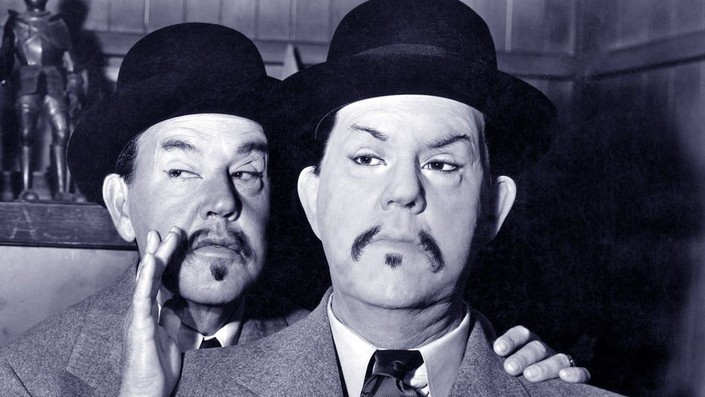
Brad had a more negative reaction: This has the reputation of being one of the worst of the Fox Chans, and I’m not going to rebut that argument for a moment. It was #22 on my list! A bunch of potentially good ideas are mashed together into something so unimaginative that it feels twice as long as its sixty-three-minute running time. The plot relies on the hackneyed idea that a man could have plastic surgery and not be recognized by his closest associates; in the end, it really doesn’t matter who the killer is, and his unmasking feels like an afterthought. But I’m not going to waste a veto on the bottom.
12. Nick played Charlie Chan’s Murder Cruise. Nick: One of the longest films in the series (76 mins), it justifies its run time with a jam-packed plot, an eccentric cast of characters, and a fun reuse of the Charlie Chan in Paris gambit.
Brad had this at the same spot on his list. It begins well enough, with old friend, Inspector Duff , getting murdered in his office, prompting Chan to board a cruise populated by interesting characters played by interesting actors. But once the killer dons an outfit that makes him look like the Gorton Fisherman it devolved into a lot of chases. Plus, the comic interludes with Jimmy Chan are looking like the same shtick from earlier films. I place this higher than several others because the cast is quite good, and the identity of the killer a bit less obvious than usual.
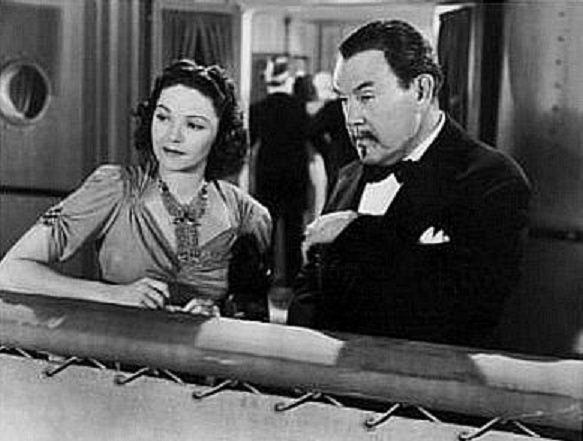
Sergio found it notable for, among other things, its cast: Lionel Atwill is good in a low-key performance, Marjorie Weaver is fab as ever, and there’s a nice part for Charles B. Middleton. It’s a really good whodunit with a complicated story, a surprise disguise (recycled from Paris) and unexpected finish. Fun acidic dialogue and nice idea to have suspects involved in shipboard manhunt. As usual, it’s a shame that Sen Yung has to be so silly.
11.For his first title on the list, Sergio played Charlie Chan at the Race Track. Brad vetoed it.
Sergio switched to Charlie Chan in London. His take: written by the great Philip MacDonald, and good fun, though admittedly a bit slow at 79 minutes (the longest Chan, though includes one minute of exit music). Not much of a whodunit perhaps (typical MacDonald), but solid enough – and there is lots of humor. Oland is great as Chan, who is unequivocally a total hero here. Nice countdown clock to execution, and MacDonald injects some neat sabotaging of British complacency among the upper crust, right from the opening scene where the Home Secretary is outraged when hanging is referred to as murder. The party sequence has a good time sending up British types and conventions – it may not amount to an actual social critique, but the build-up to the climax of the story provides, with its payoff, a fascinating dissection of the British class system. Nice early role for Ray Milland.
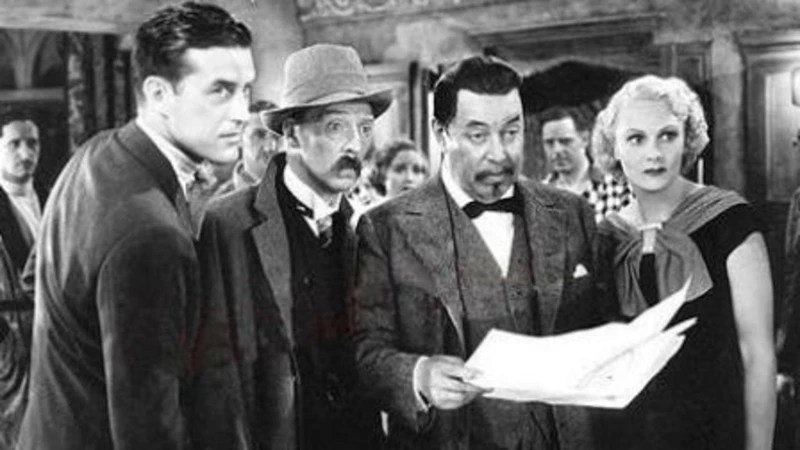
This was way down on Nick’s list, although he found stuff to like about it: Fun country house setting with surprisingly sprawling cast. Cribs from Silver Blaze – horse clue – and feels like a fresh setting to drop Chan into, but fairly standard by every measure.
Brad also failed to place this one: The film is only eight minutes longer than The Black Camel, but it feels like eighty. Part of this is due to the slowness of Oland’s speech, and the rest has to do with the least hidden “hidden killer” in all of the Chan films. No other suspects are developed or have motives. Most of the film has Chan wandering around a country estate (seriously, the film is called . . . in London, and Charlie spends a bare ten minutes there!) seeking information. Two additional murders (one unsuccessful) are welcome, but the plot plods along.
Since both GMs acknowledged the historical significance of the film, they declined to veto it.
10.Brad played City in Darkness. Sergio vetoed it.
For his replacement, Brad played Castle in the Desert. The last Charlie Chan film by Fox works hard to set up the traditions of a Golden Age closed circle mystery and includes enough twists and turns to merit consideration at the middle of this list. The plot that is jammed into sixty-two minutes is pleasantly complex and moves fast. The castle setting is atmospheric, and we have the added bonus of Douglas Dumbrille and Henry Daniell in strategic roles.
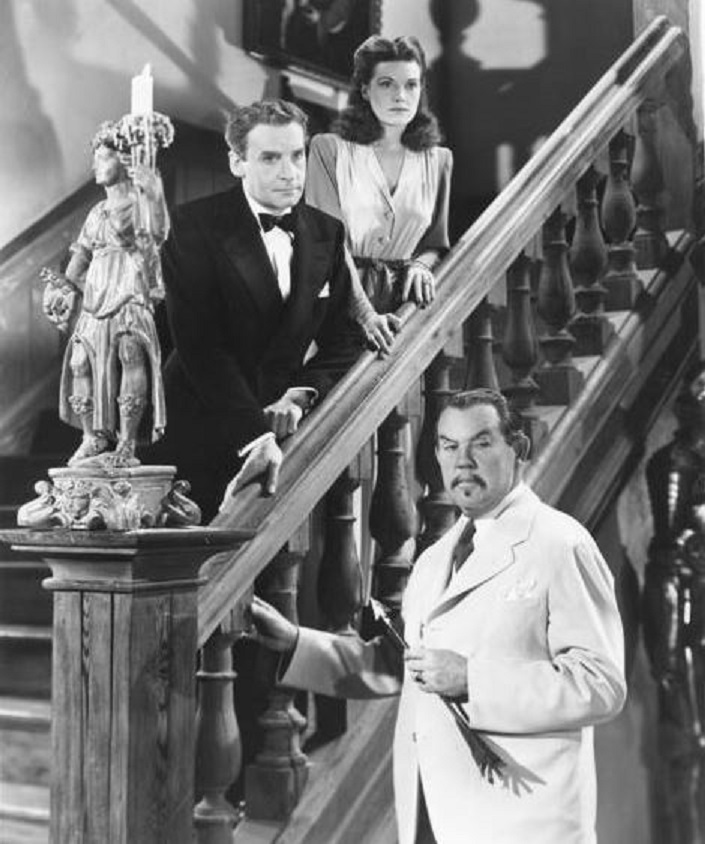
Nick agrees that this one belongs on the list: Very strong production design and a solid ensemble plus more location work than usual give this film a polished and glossy look. The return to a country house setting feels like a good way to ring down the curtain on this era of the Chan films after so much espionage hijinks.
Sergio thinks that the film looks very good, with Virgil Miller back as DP. The set was derived from the 1939 film The Hound of the Baskervilles, and also appeared in The Man Who Would Not Die. There’s a nice visual juxtaposition between the isolated gothic pile and the wary villagers of the desert town. Jimmy Chan is in the Army now but makes it back to “help” his Pop (the suit of armor bit is just silly). Still, it makes for a decent end to the Chan series at Fox.
9.Nick played Charlie Chan at the Olympics. The first in the series that feels of the current moment, but the spy machinations still feel apiece with the series so far. A complex plot. Pauline Moore remains my favorite heroine of the Chan series.
Sergio agreed that this was a worthy entry: It’s probably Oland’s last peak, though he does sadly seem a bit unfocused. One of the best overall films, with a varied adventure that successfully rings the changes (i.e. not doing the obvious thing of starting the film in Berlin. Since Lee Chan is occupied at the Olympics, we first get to meet Number Three son, and he’s very sweet. The “least likely murderer” is a bit too implausible and clearly illogical, but C. Henry Gordon and Katherine De Mille make for a smooth confident villain and a sexy femme fatale (“Our game is with the Oriental now!”) H. Bruce Humberstone’s direction is really zippy. Charlie’s reunion with Lee is very affecting, as is Charlie’s concern when Lee is kidnapped. Jesse Owens is pointedly referred to by name and cheered on by other African-American athletes.

Brad was less enamored of the mystery aspects of the plot: It ultimately boils down to two possible suspects, and it’s not surprising when the one with the perpetual smirk is unmasked. I might have not been in the right mood to see this one at the time, and I won’t veto it here because all the historical stuff – the voyage on the dirigible, the stuff at the Olympics, the mention of Jesse Owens, which goes a little way toward mitigating the awful Black stereotyping of other films – does make this one stand out.
8.Sergio played Charlie Chan in Shanghai. He loved the interplay between father and son here: Charlie is lovable and cuddly as a celebrity from now on, introduced playing with a group of children. There are a lot more Asian characters than usual due to the setting, plus an unusual plot about international drug smuggling. “Beauty of poppy conceals sting of death!” Keye Luke gets an action scene! Good noirish lighting in the villains lair; maybe there are too many villains, though.

It’s another title that failed to make either Brad’s or Nick’s lists. Brad: At least it’s a major case for Lee Chan (Keye Luke), and it’s nice to see father and son working together so much. Other than that, this isn’t really even a whodunnit. For a while, it looks like Sir Stanley’s secretary (Jon Hall) might be the bad guy, but nobody who knows the Chan formula is going to believe it for a minute. No fair play here, just lots of revelations that follow lots of kidnappings, assassination attempts, action and more action
Nick: Organized crime hijinks and a dash of action makes this feel more like a Mr. Moto prototype than Charlie Chan. The identity of the criminal mastermind feels obviously telegraphed, but it’s never boring.
Given that it isn’t dull and showcases Charlie and Lee’s relationship, neither GM was inclined to veto this.
7. Worried that some of his favorites wouldn’t land on the list, Brad played Charlie Chan at Treasure Island. Nick vetoed it, which Brad took as a good sign.
Brad’s replacement pick, Charlie Chan on Broadway, is a fast-paced crime thriller worthy of the Great White Way in which it’s set. It’s a fun cast, led by Harold Huber as the snappy Inspector who helps Charlie and Lee find a cleverly hidden surprise killer (but if you’re paying attention to the clues, or know the ways of casting in 1930’s “B” mysteries, you can figure it out.) Joan Marsh and Donald Woods entertain as rival reporters, and they’re not-quite-a-romance marks them as one of the most interesting young couples in the canon.
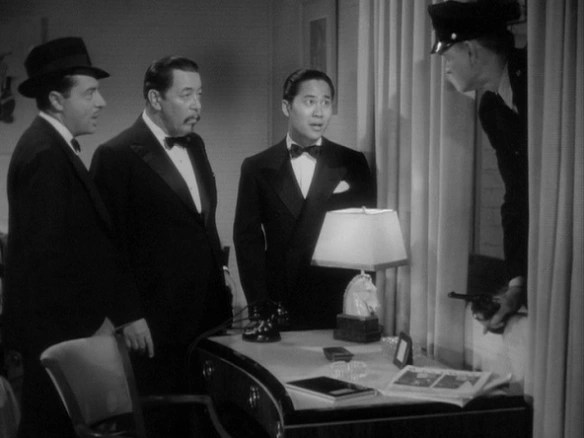
Nick’s thoughts: The gangster shenanigans and rat-a-tat dialogue is fun! The mystery is simpler than most and Charlie has surprisingly limited screen time, but this is a really fun one! Harold Huber remains one of my very favorite returning players in the series.
This did not place on Sergio’s list. “The hard-boiled, fast-talking style feels very different for this series; it’s a sign of changing times, along with lots of diegetic music in the first half. New York is presented as much more foreign, linguistically and culturally to Charlie than Europe. And Oland isn’t in it much, possibly due to his “incapacity.” Not a notable entry, IMO, but murderer reveal is big surprise.
6. Nick played The Black Camel. He feels that the location cinematography is striking. The plot stronger than the standard (due of course to the fact it’s adapted from the Biggers novel). Oland’s performance is crispier and more multi-faceted and Lugosi is, as ever, a powerhouse of charisma.
Sergio had this at #2! He admired the “really impressive production values (shooting on location in Hawaii, exteriors and many interiors) with lots of moving camera shots. There’s a sly opening sequence that turns out to be from a movie. The plot is solid and the villain a genuine surprise. We feel real sympathy for the main killer (but not the other one, a smart idea to keep audiences and censors happy.) Oland as Chan is much tougher here than in the future. I consider this the only A production Chan film and among the very best; While admittedly the central questioning sequence, at 17 minutes, is very long and theatrical, the adversarial stance of the suspects is refreshingly realistic.

This was #8 on Brad’s list: Although it creaks with age a bit and some of the performances are a little wooden, it’s really an excellent picture. It’s only Warner Oland’s second appearance as Chan, and he’s full of energy and humor. Plus, it’s great to see him on his home turf, in charge of everything and not answerable to some patronizingly kind police superintendent. He’s matched by Bela Lugosi, fresh from filming Dracula that same year, who makes a great red herring!
5. Sergio played Charlie Chan’s Secret. He says, “Though the set design is the best element, this is a very good-looking Oland era Chan, thanks in part to Rudolph Matè, among the most distinguished DPs the series ever had. His contribution is noticeable as the film gets dark and spooky with the wonky shaped Colby house from about eight minutes in, which is certainly in Expressionist style. Still using titles to identify locations. This is the last Warner Oland film that would not feature Keye Luke as Number One Son, so Charlie is more dynamic and uses his gun!
This just missed Brad’s list, but there was enough good stuff in it for him to let it stand: The suspect list is a nice assortment of greedy relatives, a pair of psychics, a vengeful servant and a desperate family lawyer. For once, the killer’s identity isn’t immediately apparent. There is a second murder – or is it really?? – and then Charlie lays a trap for the killer. Yet how Chan could have known the killer would fall for the trap is just as mysterious as how the killer could have known his mechanical gun would work on his second victim! And then there’s the comic relief in the form of a butler from the Franklin Pangborn School of Nervous Nellies. The less said about it, the better.
Nick liked it more: Charlie Chan collides with the Old Dark House thriller. Evocative, expressionistic production design and some genuinely creepy images place this a cut above the other titles in the first phase of the series. The use of the spirit world would be done better in Treasure Island.
4. Brad played Charlie Chan in Paris. After the slowness of London, things really pick up in France! Seeking to uncover a conspiracy concerning counterfeit bank bonds, Charlie is aided by his #1 son Lee (Keye Luke, in his first appearance) and friend Victor Descartes (Thomas Beck, a very appealing actor who made several appearances in Chan films). This is a tight, complex little mystery, worthy of the mind of Philip MacDonald, penning his second Chan tale after London. It’s well-filmed, with lots of suspenseful moments. The solution involves a double unmasking and feels fresh, even if it doesn’t exactly play fair in the end.
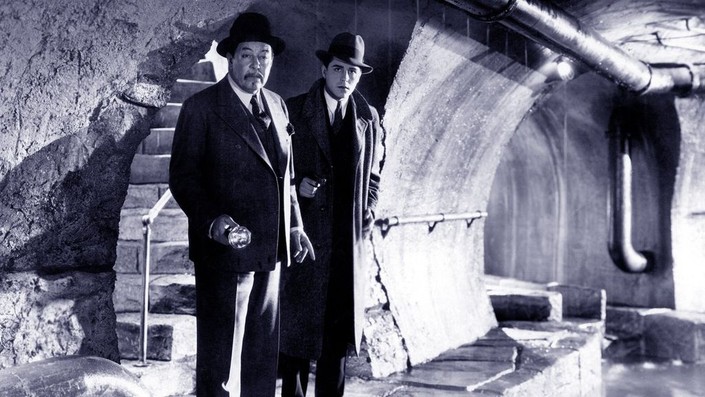
This had been Sergio’s #1 pick: Charlie is the main focus from almost the first shot. Great disguise plot, presumably by MacDonald as it is certainly reminiscent of his novel, The Rynox Case. This is one of Eric Rhodes’ best non-funny foreigner roles. Harry Cording is the French flatfoot, and Mary Brian makes for a fiery if foolish heroine, who is lucky to have Charlie there.
Unfortunately for Nick, he was far less enamored of the early Warner Oland films: Technical aspects are quite surprising for the time (short use of flashbacks) and the murderer in disguise palaver is nicely executed. But this only comes alive in the moments that really highlight Parisian atmosphere (nightclub/sewer). Rian Johnson must have been inspired by all the doughnut talk.
3. Nick played Charlie Chan at Treasure Island. He called it a minor tour-de-force with incredibly strong atmosphere and the best use of the supernatural to this point. All of the mindreading scenes are excellent and the finale at the magic show is one of the best climaxes with a genuinely surprising reveal.
Sergio called this one “a classic, probably the best Toler, thanks to its strong plot, good cast, excellent direction (by Norman Foster) and tip-top production values. Seasoned fans might spot the villain early on, but the disguise is excellent that there is bags of atmosphere!
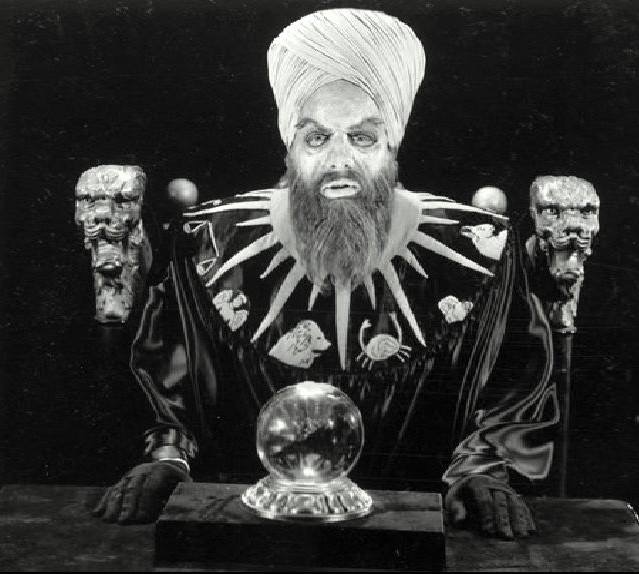
Brad loved seeing this one return as it had been his #2 pick: A delight from start to finish, and I’m not just saying that because it mostly takes place in my home town of San Francisco. In case you know nothing about our local history, Treasure Island is a man-made piece of geography in the bay between SF and Oakland that was constructed in 1937 for The Golden Gate International Exposition, our World’s Fair! We get some cool stock footage from the air of the massive exposition, but it looks like nothing for the film was actually filmed there. It’s is a grand mystery that moves like a steam engine and contains all sorts of entertaining set pieces and culminates in a lengthy containing perhaps Charlie’s most epic unmasking a killer.
2. Sergio played Charlie Chan in Panama. His thoughts: Norman Foster to the rescue again oh, for a colorful, exotic and dynamic adventure, so this is really a Moto film in disguise. There’s no sign of Charlie in the first real but instead lots of location footage, a fun setting and unlikely suspects (especially the spinster out for a good time, very Hildegarde Withers!) Victor Sen Yung, as Jimmy Chan, dominates the second reel, blows his dad’s cover, and exposes an interesting subplot involving bacteriological warfare!
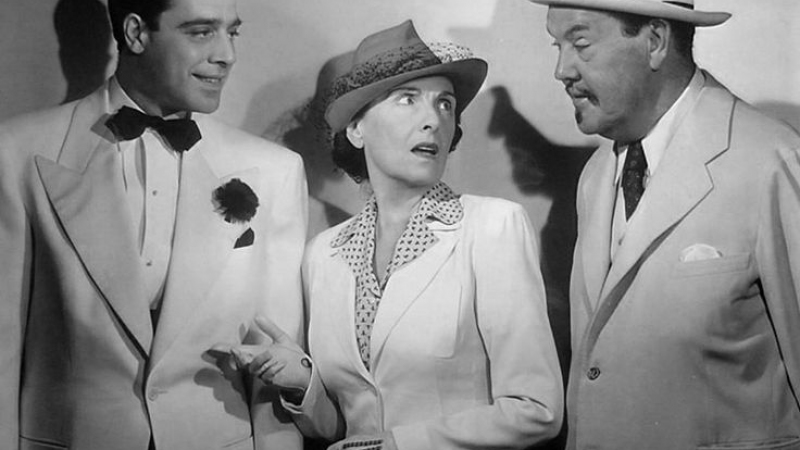
This was a delightful surprise for Brad, who had feared Panama would have to be sacrificed for other choices: I have always this film for its murderer, played by an actor I very much enjoy. They are felled in the end by what Scott Ratner calls a “surplus information” clue, a common occurrence in the Chan films. The quality of these varies a lot, but I like this one, especially since Charlie had just used the same type of clue to incriminate the killer’s confederate and so you don’t see another one coming. The middle dragged a bit for me this time, so I placed it at #7. The list of suspects is fun: Lionel Atwill plays a mystery writer and Mary Nash a schoolteacher. There’s also a cabaret owner (Jack La Rue) and his new singer, who attracts the interest of a federal engineer (Kane “The Shadow” Richmond), as well as a mad scientist and an Egyptian tobacconist. I’m thrilled that Sergio ended up playing it!
Shockingly, this did not make Nick’s list! It’s always more fun when Charlie is engaged in a regular murder mystery than an espionage scheme, and this script started out as a Mr. Moto movie. Despite this, it features one of the best twist endings of the series and an evocative sense of place.
1.Brad played Charlie Chan at the Opera. He says: This may be the classiest Chan of them all. It certainly has the best guest star in Boris Karloff, who plays a mystery mental patient with ties to the opera world. No less a personage than Oscar Levant wrote an opera for this movie! (It’s not half bad: if I were committing a murder, I’d play this during the act.) The humor this time out is far more sophisticated, as when the police threaten to postpone the performance and the stage manager says, “This opera is going on tonight even if Frankenstein walks in!” For once, son Lee is a helper rather than a hindrance to his Pop, and the comic relief is assigned to the great William Demarest as a casually racist cop. Thomas Beck appears (I think for the last time), and for once ALL the suspects behave suspiciously (at least one of them had recently been unmasked as the killer in an earlier Chan film!), and the guilty party is captured through a legitimate (and perfectly obvious if you think about it) clue. Oland is given more aphorisms to spout than usual, but he is still wonderful, and it’s hard to believe that only one more year and three Chan films remained in his career before chronic alcoholism hastened his all-too-early death in 1938.
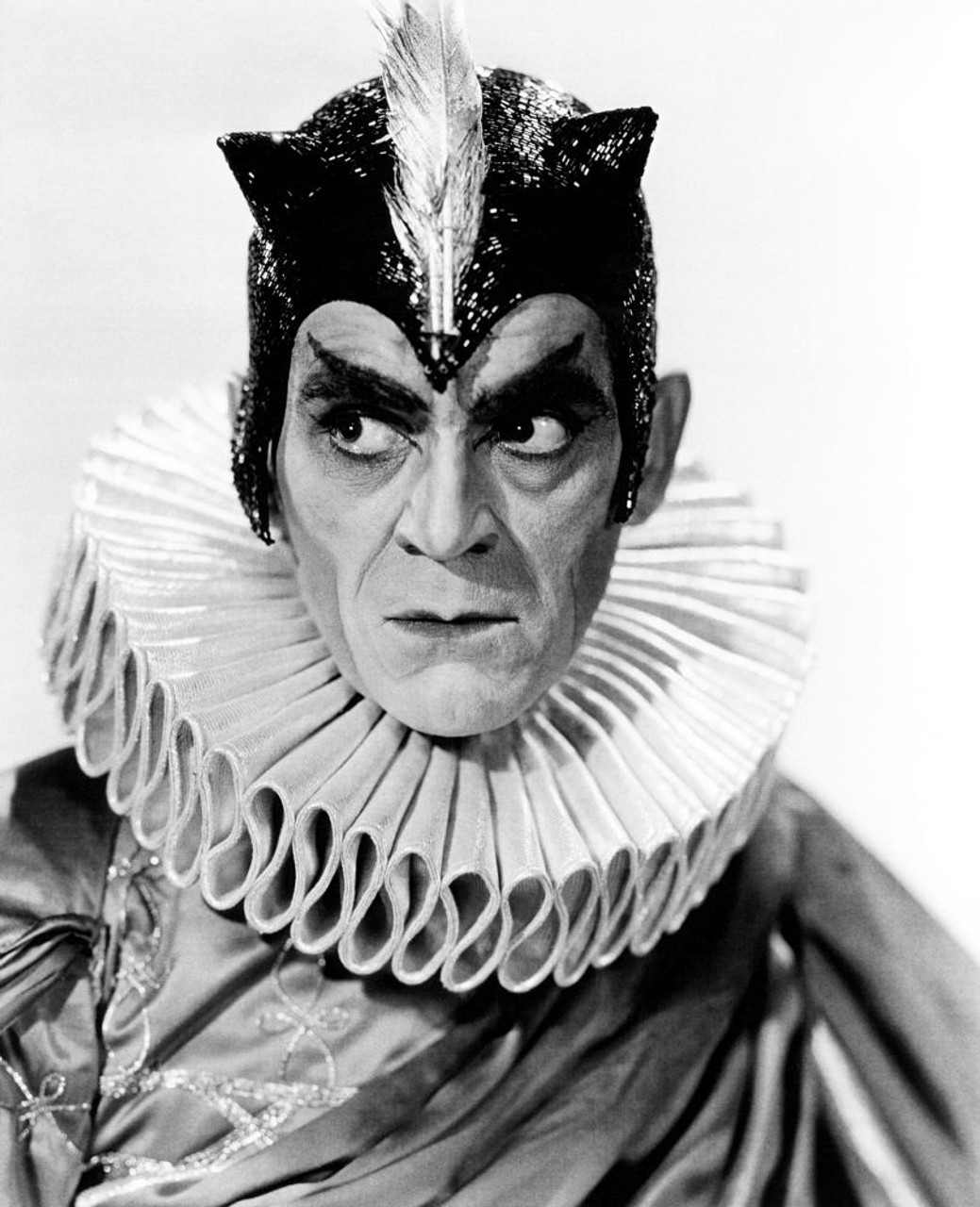
Nick concurred (this and Treasure Island also occupied the top two spots on his list, just reversed): Karloff is of course the shining star of the film, doing his usual horror movie shtick. Phantom of the Opera-lite atmosphere is exciting and lavish, the libretto for the opera memorable, and the mystery – though somewhat light – constantly engaging. One of the best!
And Sergio had this only slightly lower, at #4: Probably the most fun for new audiences, but quite anomalous due to Karloff, so not the best or most representative; Demarest fantastic detective, well, as athletic as ever; explanation of early fax is fabulous; Karloff is necessarily over the top, but all the backstage hubbub is good fun. Still, the shift in emphasis to privilege, Karloff makes the pace choppy, and the plot, somewhat meandering as it tries to cram stuff in with too little attention paid to characters other than Karloff, who is just a red herring after all.
And that’s how the list panned out. We briefly discussed discards and all agreed (rather a miracle after our draft!) that we wished three films – Charlie Chan at the Race Track, Charlie Chan in Reno, and Charlie Chan in Egypt – had made it onto the list. But, well, “the best laid plans, etc.,” as many a Screen Drafts will tell you.
To wrap up our celebration of Charlie Chan’s centennial, I’ll share with you tomorrow my rankings of the complete list of twenty-three Fox Chan films, with extended notes. I asked Sergio and Nick to share their lists as well so that you could compare.
Here once more is the final list of the Top Thirteen Fox Charlie Chan films:
13. Charlie Chan at the Wax Museum
12. Charlie Chan’s Murder Cruise
11. Charlie Chan in London
10. Castle in the Desert
9. Charlie Chan at the Olympics
8. Charlie Chan in Shanghai
7. Charlie Chan on Broadway
6. The Black Camel
5. Charlie Chan’s Secret
4. Charlie Chan in Paris
3. Charlie Chan at Treasure Island
2. Charlie Chan in Panama
. . . and the Number One Charlie Chan film of all time . . .
1. Charlie Chan at the Opera
Thank you so much.
 Ah Sweet Mystery!
The draft was great fun, always great to chat with you guys. We knew Chan might be tricky in terms of consolidating a top 13 and it sure was! Can’t wait for our next one 😁
LikeLiked by 1 person
Always a pleasure to have these conversations and it was a real delight to revisit the Chan films after so many years. I look forward to our next discussion!
LikeLiked by 2 people
Pingback: MYSTERY MOVIE TALK: Three Announcements! | Ah Sweet Mystery!
Pingback: THE “GREATEST MYSTERY FILMS OF ALL TIME” DRAFT!!! | Ah Sweet Mystery!