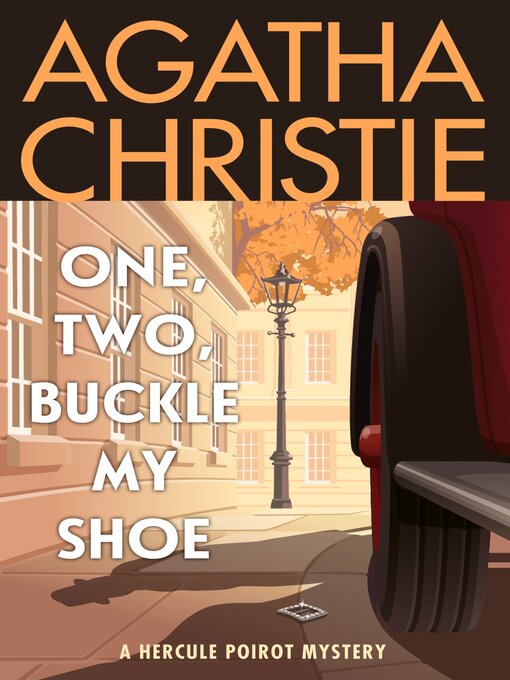
One, Two, Buckle My Shoe, Agatha Christie’s twenty-eighth mystery and the nineteenth featuring Hercule Poirot, has the disadvantage of being surrounded by better titles. Its two predecessors are And Then There Were None, the greatest mystery of all time, and Sad Cypress, a haunting and beautifully written story. And it is followed by Evil Under the Sun, perhaps Christie’s most fun mystery, and N or M, the best of the Tommy and Tuppence novels and my favorite of her spy thrillers.

Indeed, Buckle follows a string of Poirot’s greatest hits, with the Belgian sleuth tracking down a serial killer, sailing down the Nile, and celebrating Yuletide cheer slathered in blood! These books signaled a new depth to Christie’s writing: the characterization and emotional resonance of Nile, ATTWN, Cypress, and the books that followed, including Five Little Pigs, The Hollow cannot be overlooked, and the welcome return of Miss Marple (The Body in the Library, The Moving Finger) along with some of the author’s best standalone mysteries (Toward Zero, Crooked House) ensure that the 1940’s hold a special place in the hearts of Christie fans.
One, Two, Buckle My Shoe can’t help but get a bit lost in the shuffle: its plot is over-complicated, its storytelling is old-fashioned, and its characters – the Christie fan wiki lists thirty-seven of them! – are mere sketches. Still, the book possesses a few qualities that make it stand out in such a brilliant crowd. It’s one of the few Poirots that functions more as a procedural than a traditional closed circle mystery (these range from the problematic The Big Four to the brilliant The A.B.C. Murders to the, er, far-from-brilliant The Clocks.) And it’s the final appearance of Chief Inspector Japp, who debuted along with Poirot in 1920 and had a good run in the 30’s. This is one of, I believe, only two major works where Poirot and Japp work together without benefit of Hastings or another Watson figure (the other being the novella “Murder in the Mews.”)
Finally, OTBMS may be Christie’s most overtly political novel, both in the world Christie presents and in the climactic moral choice presented to Poirot – an actual moral choice, unlike the finale of Orient Express where the only real dilemma was created out of cloth by Sir David Suchet for dramatic effect. This choice is, perhaps, the most interesting aspect of the book, because it shows how far Christie is willing to go: the woman who revealed that your lover, your child, your mother, your friendly policeman, or your trusted friend could be a killer here asks us to sacrifice the stability of a nation for the sake of justice.
My re-read of the novel this time around was more enjoyable than I thought it would be. Japp has never been a favorite of mine, but he and Poirot play off each other well here, and the pace never lags. My issues with Buckle are probably more a matter of personal taste: while it concerns itself with many things, it doesn’t have the linchpin of a family or even strong individual characters, and it lacks the warmth of the late 30’s titles and the depth of those that followed throughout the rest of the 40’s. It is a whodunit, but due to the nature of its big twist, it doesn’t necessarily read like one; rather, it is structured more like Hammett or Chandler, with one bizarre event bouncing off the next.
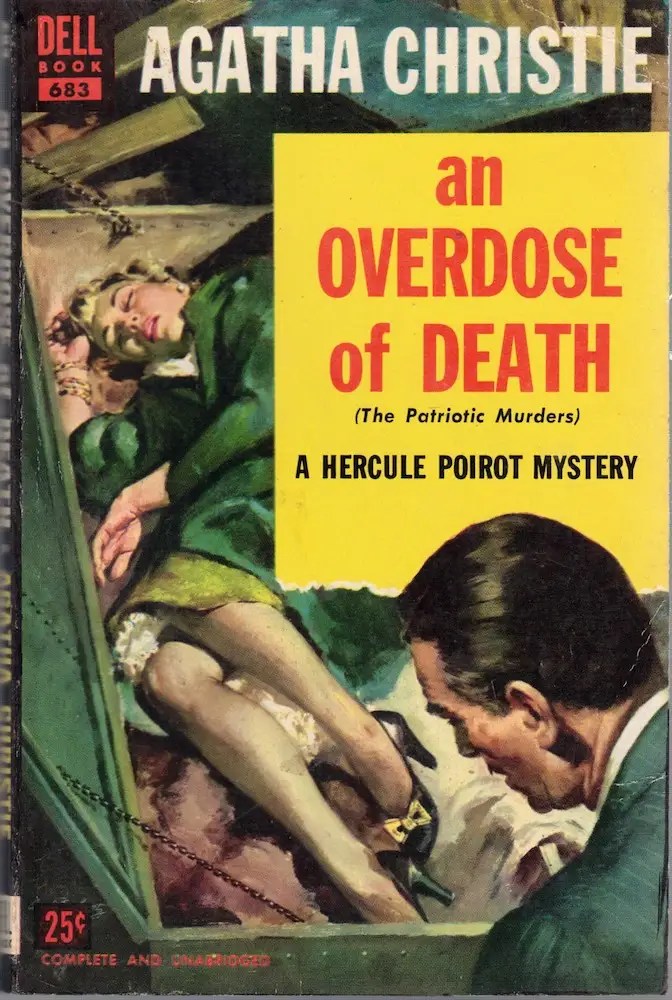
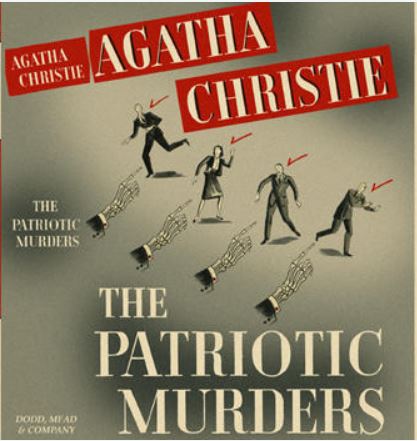
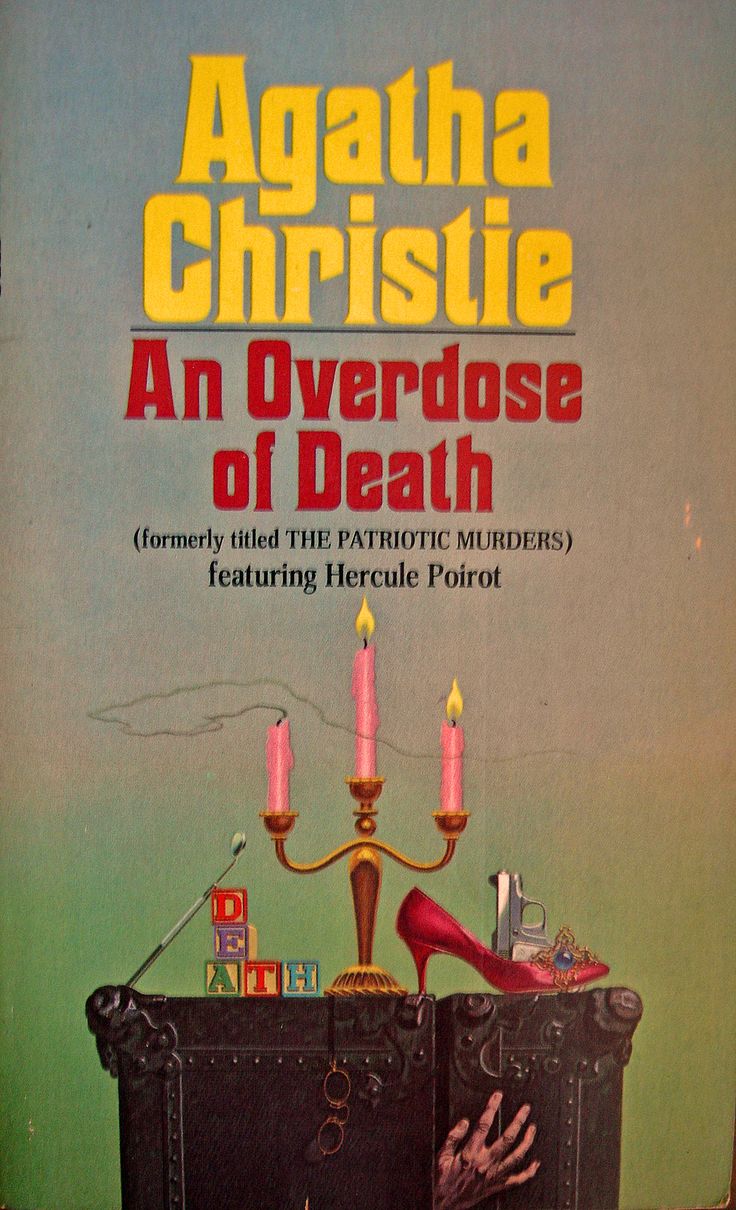
One final note before we start ranking, and that concerns the title. There are three distinct ones for this book, and none of them is perfect. I grew up with the second American title, An Overdose of Death, which Mark Aldridge calls “schlocky.” This is a word that means “cheap or inferior,” and while I wouldn’t go quite as far as that, it is distinctly unimaginative. But it is a masterpiece compared to the first U.S. title, The Patriotic Murders, which is boring and un-Christie-like, not to mention arguably misleading.
The original title, One, Two, Buckle My Shoe, gets some flak for its tenuous relationship to the nursery rhyme, frankly a problem with several of Christie’s titles. It’s fascinating to open up John Curran’s Agatha Christie’s Notebooks and peruse the author’s brainstorming of plot ideas that might be relevant to particular verses of the rhyme – and what a different book that would have been! She considered making the murder victim a “fat hen” of a rich old lady, burying a second body in the garden where “men must delve” and giving the “hen” two young female relations who stand to inherit her fortune (the “maids a’courting.”)
In the end, the rhyme is merely a literary device, but Christie finds some clever allusions to keep it going. At one point, a murder prompts a feeling of “shutting the door;” once certain clues are collected (“picking up sticks”) it is up to the Poirot to use his powers of order and method to “lay them straight.” He comes upon Howard Raikes “a’courting” Jane Olivera at an appropriate point, and visits an actual maid, Agnes Fletcher, in her kitchen to receive important information. And, of course, prominent on the clue list is that all-important buckle. So . . . not brilliant, but not half-bad, either.
* * * * *
The Hook
“There are certain humiliating moments in the lives of the greatest of men. It has been said that no man is a hero to his valet. To that may be added that few men are heroes to themselves at the moment of visiting their dentist.”
With 1937’s Death on the Nile, a shift occurred in the narrative structure of Christie’s whodunnits. Up till then, the story would be told from the point of view of the sleuth and/or his Watson. Maybe this was considered the most trustworthy POV for a detective story, a fact that Christie played with to excellent effect in novels from 1920 through 1935. Maybe Christie felt something open up for her when, in Cards on the Table, she included four sleuths and alternated point of view between them. (She also gave us moments with no sleuth whatsoever, mostly involving the emerging triangle between Anne Meredith, Rhoda Dawes and Major Despard.)
Whatever the process that led to it, we see a distinct change in Nile, as nearly every character gets to share his or her perspective with the reader. It is the narrative style that I prefer, and while Christie didn’t absolutely stick to it, a majority of her novels through the rest of her career employ this device. And so, after Nile and Appointment with Death andHercule Poirot’s Christmas and And Then There Were None and Sad Cypress, it looks like we’re going to be treated to the same device in this novel. Sadly, the multiple viewpoints only extend through the first chapter that comprises the hook, but it makes the opening one of the stronger sections of the book and the only one to contain a significant amount of humor.
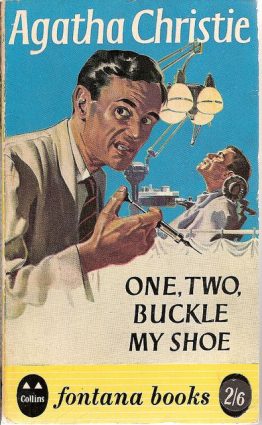
They say that the great levelers between people of every station in life are death and taxes. To this, Christie amusingly adds the ordeal of going to the dentist – specifically Mr. Morley, a prosperous London dentist who, as it will turn out, seems to specialize in suspects as his clientele. This morning, Morley is upset: his nurse/receptionist has called in sick with a family emergency on a day that is shaping up to be hellishly busy; his new porter is an idiot, his new partner drinks, and a perusal of the newspaper reveals that the policies held by the current government are “inconclusive, chaotic, imbecilic, and frankly, suicidal!”
We also get to briefly meet several of the patients due to be seen that morning. They are, in ascending order of importance: a portly Greek named Amberiotis, a talkative and silly woman named Miss Mabelle Sainsbury Seale, a banker named Alistair Blunt, who is one of the most important men in England, and a Belgian detective named “Mr. Peerer.” (Yes, the porter is rather stupid.)
The bulk of the chapter is taken up with Poirot’s appointment, and it’s fun to watch him squirm in the chair. Christie is aware of a dentist’s propensity for engaging his patients in conversation when their mouths are stuffed with cotton – and of his ability to understand exactly what Poirot means when he says, “I ah nah a Frahah – I ah – ha a Benyon.” Still, the rest of the chapter appears to stick to ordinary matters, and it is up to the practiced reader to store certain moments in his memory. Some of these will be red herrings and some will be significant: Who was in the waiting room at certain times? What happened to Miss Sainsbury Seale’s shoe buckle in Poirot’s presence? And what is the significance of the little story Mr. Morley told Poirot?
“I, myself, for instance. I don’t remember names, but it’s remarkable the way I never forget a face. One of my patients the other day, for instance, – I’ve seen that patient before. The name meant nothing to me – but I said to myself at once, ‘now, where have I met you before?’ I have not remembered yet – but it will come back to me – I’m sure of it.”
Hearing this story a couple of pages before Morley is found dead heightens its potential to carry some import later. It’s not a lot to go on, but it’s something.
Score: 7/10
The Closed Circle: Who, What, When, Where, Why?
Who?
As I mentioned, the Christie fan wiki lists thirty-seven characters appearing in this novel. I haven’t made a vast study of cast size, but I imagine this sort of number is mostly found in her thrillers. The wiki also lists thirty-six characters in Death on the Nile, although a number of these are dead people or extras. Some criticize the cast list of Nile as being too unwieldy, a comment I understand and immediately dismiss. (I love that cast.) A major difference between the two books is that Nile is a traditional closed-circle mystery, the structure of which tends to best accommodate between seven and twelve persons, while Buckle is a procedural, a form that tends to work better with a large cast. It is telling, then, that I think the large cast works far better in Nile.
The people found in OTBMS are a more realistically depicted bunch than we find in earlier “politically” minded texts, like The Secret Adversary or the Secret of Chimneys. However, in terms of holding our interest, the results are varied. Some of my favorites, like the staff of Mr. Morley’s dental office, appear only briefly. Miss Mabelle Sainsbury Seale is a small comic gem – but then we never actually meet her, do we?
Ultimately, the significant characters are those most closely connected to the banker Alistair Blunt, who is himself described as “a very quiet and retiring man.” His niece Jane Olivera cuts a lively figure, as does her peevish mother, but neither is a serious suspect. Then there are the two young men who represent both extremes of the political spectrum. Frank Carter, fiancé to nurse Gladys Nevill, is a Fascist, while Howard Raikes, beloved of Jane, is a Communist. Both are unpleasant to be around and to read about – but then that’s precisely the point about them. While we’re distracted wondering whether Blunt is going to be hit from the radical right or the extreme left, we give little heed to suspicions about the man himself, even though Christie supplies us early on with an extensive biography concerning his marriage at the age of twenty-five to a fabulously wealthy businesswoman two decades his senior, who died ten years later and made Blunt one of the richest and most powerful men in England. Pay attention, people!!
The most problematic character is one of the most important: Helen Montressor, Alistair Blunt’s cousin, doesn’t appear until Chapter Six, two-thirds of the way through the novel. Of course, this isn’t quite true: we have seen her impersonating Mabelle Sainsbury Seale, we come to know her to be the mysterious Mrs. Albert Chapman, and we are dealt the surprise that she is actually Gerda Blunt, Alistair’s actual wife. She is all these things – in fact, she is too many things! It reminds me of how uncomfortable I was with the duplicity of the female murderer in Third Girl, a book that latches onto a few plot points from Buckle and then scrambles them, but then Christie’s fondness for disguise and impersonation is one of the most problematic aspects of her writing. In my first reading of the novel, I remember feeling cheated that one of the murderers was such a “minor” character; in hindsight, I realize that the woman has been in the book from the start, and the fact that her true nature remains closed to us until the end is necessitated by the plot. However, in thinking about the richly drawn characters who kill from Death on the Nile through Sad Cypress, I can’t help but be disappointed with what we’re presented here.
What?
- “Poirot shrugged his shoulders. He said, ‘It would seem that death selected, most inartistically, the wrong man. The Mysterious Greek, the Rich Banker, the Famous Detective – how natural that one of them should be shot! For mysterious foreigners may be mixed up in espionage and rich bankers have connections who will benefit by their deaths and famous detectives may be dangerous to criminals.’
- “Whereas poor old Morley wasn’t dangerous to anybody,’ observed Japp gloomily.
- “’I wonder.’”
The death of Mr. Morley by gunshot in his office is suggested to be a case of suicide after Morley realized that he had accidentally injected a fatal dose of anesthetic into Mr. Amberiotis, one of his patients. But Poirot rejects this idea, for several reasons. Morley was too good a dentist to make such careless mistakes and too ordinary a man to have a motive to murder Amberiotis. And what of the disappearance of Miss Sainsbury Seale? And what of the presence of the Fascist Frank Carter and the leftist Howard Raikes on the premises? And what does all this have to do with the mysterious government agent Albert Chapman and his wife, who seems to have been murdered by the missing Miss Sainsbury Seale!
As Poirot puts the pieces together, he seems to have uncovered a massive conspiracy to do away with Alistair Blunt, whose solid conservative banking practices have kept England solvent for years. The inclusion of government agents, political radicals, and at least two instances of someone shooting at Blunt appear to support this theory.

I’m willing to swallow artifice by the bucketful when I read a Golden Age mystery. But the convergence of so many characters upon a single dental office is a pretty hard nut to swallow. How lucky that everyone involved in the case had a tooth problem that day! How fortuitous that we have radicals from both sides of the political fence on the scene and out for blood! How super lucky that the only young women in the case have such poor taste in beaux. If the killers are savvy enough about the staff and workings at Mr. Morley’s office to create this complex plan and manipulate all these people into their place in order to eliminate two people who threaten their security, why did nobody take a moment to see that the world’s best detective also had an appointment that same day? How easy would it have been to delay the whole plot for twenty-four hours!
I know what you’ll say: the British make a habit of underestimating foreigners and, in particular, Hercule Poirot. I agree, but for once I also think that the killers could have come up with a much easier plot to do away with Miss Sainsbury Seale. They could have probably accomplished it with a careful dinner party and eliminated the need for shedding blood.
When and where?
By and large, this is a London mystery, which is always fun. But nothing much stands out here. The setting – the dental office, Blunt’s London and country homes, Mrs. Chapman’s flat – are purely functional. The procedural structure of the plot doesn’t allow for much reflection on where we find ourselves, but the constant movement does help the pace.
Score: 6/10
The Solution and How He Gets There (10 points)
“The proud have laid a snare for me and spread a net with cords: yea, and set traps in my way . . . “
The book contains perhaps the strongest evidence in the canon not of a murderer’s guilt but of Poirot’s Catholic faith. He gets his first glimmer of the truth while attending church while staying in the country at Alistair Blunt’s behest. Indeed, understanding how Poirot pieces together the entire solution requires faith on our part, but a series of clues and fortuitous events at least push him in the right direction.
What Poirot reveals to Alistair Blunt at the end is that he had been manipulated into considering Morley’s death to be part of a “public” crime directed against Blunt by his political enemies when, in fact, the murders were committed for “private” reasons. There are no specific clues that support this, just feelings – as when Poirot receives a phone call warning him off the case and immediately gets a whiff of an E. Phillips Oppenheim thriller. There’s a similar moment when Japp and Poirot are discussing the case and Japp says events remind him of “a certain lady novelist” – as in Mrs. Oliver, whose early work for Mr. Parker Pyne was redolent of pre-Golden Age thrillers.
The incident of Miss Sainsbury-Seale is meeting Blunt and identifying herself as a friend of his wife is intriguing, even as it gets glossed over. From all we know about the real Mabelle, it seems inconceivable that she could have been friends with the elite Rebecca Arnholdt. There are no clues, however, to suggest that Blunt had another wife, that he was a bigamist, or that he had in his quiet, conservative nature a kinky side that enjoyed the secret meetings with Gerda, an actress who liked dressing up as different characters, for their assignations.
The best clues are the shoe buckle and the state of the dead woman’s body found in Mrs. Chapman’s apartment. If we’re astute, we’ll notice that a shoe that appeared brand-new at the book’s beginning has become scuffed and well-worn in a matter of hours. The killers effectively arrange the body to force the police to question the identity of the corpse and switch the dental records to lead them to the wrong conclusion. Poirot’s reasoning at the end as to the true nature of Miss Sainsbury-Seale’s personality is sound – but it isn’t clued. And while it makes sense to conclude that Mrs. Chapman (alias Gerda Blunt) pretended to be Mabelle on the fatal day, Poirot’s assertion that the same woman is also Helen Montressor is a total guess.
The sleuth’s progress toward the truth takes a giant leap after he talks to Morley’s maid Agnes, whose testimony leads him to interview Frank Carter in prison. This is one of the best scenes in the novel: Carter is so awful, a rude, foreigner-hating Nazi sympathizer, that Poirot can’t help but hope that he doesn’t clear himself. But Carter clears up the real time of death and actually sees the murderer make his exit (although he can’t identify him). However, all of this happens after Poirot receives enlightenment in church, leading me to score his success here as: divine intervention-8, solid evidence-2.
One more point: classic mystery authors were fond of occasionally inserting a final stinging twist on the very last page. (See Paul Halter, the master emulator of this phenomenon.) Christie does this here, and it stinks. All Mr. Barnes had to do was tell Poirot that he was Albert Chapman, an unmarried spy, as soon as the name first appeared in the case, and the whole thing would have ended much quicker. As it is, he withholds this vital fact as a fanciful whim – and gets away with it! Boo!
Score: 5/10
The Poirot Factor
“He was a man who was accustomed to have a good opinion of himself. He was Hercule Poirot, superior in most ways to other men. But in this moment he was unable to feel superior in any way whatever. His morale was down to zero. He was just that ordinary, that craven figure, a man afraid of the dentist’s chair.”
Inspector Japp is far from my favorite policeman in Christie, but he and Poirot work really well together, due to Poirot’s deference to Japp’s position and the Scotland Yard man’s respect for Poirot’s abilities. They waste no time taking jabs at each other, like Poirot and Hastings do; they just get to work.
What that allows the reader to do here is focus on Poirot, and he’s great throughout. From the opening moments of craven fear of the dentist, to the relief when it’s over and his supreme egoism can come flooding back, to his hesitant regard of the evidence before him, his near fall into the murderers’ trap, and his divinely inspired reversal onto the right track, Poirot is a man at the height of his fame and powers. We also get to see a wide range of interesting reactions from other characters: the insolence based on fear of Jane Olivera, the contempt felt by her mother and Mr. Raikes, the rancor from Frank Carter, the excitement of meeting a celebrity from Mr. Barnes and others.
I should bite my tongue, but I can’t help wishing that we had gotten less of Poirot and more of the Blunt household. Yes, it’s wrong of me to try and “correct” Agatha, but if we could have had a few scenes expanding the roles of the Oliveras, Howard Raikes, and especially “Helen Montressor,” I think the final unmasking would have been more effective and emotionally resonant.
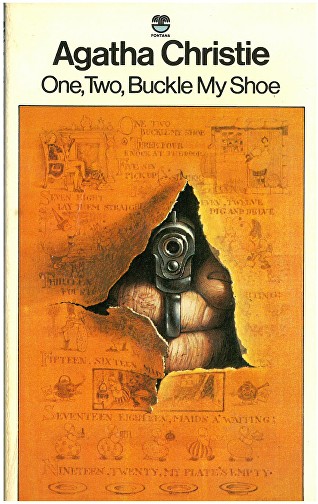
In the end, I don’t buy for a minute that Poirot is given enough information to formulate the whole story, but the power of his personality is enough that I’m willing to travel the distance with him. I do find it interesting that Christie gives Mr. Barnes (alias Albert Chapman) the last laugh over Poirot in the end, as I would have liked to see the detective either have the man arrested for withholding vital information, or give him a sound Gallic smack across the cheek, or . . . something, anything! Instead, after the labyrinthine journey through this case, all Poirot can summon up is the phrase . . . “Nineteen, twenty, my plate’s empty.” It’s more belabored than satisfying, but it doesn’t really upset my score here.
Score: 9/10
The Wow Factor
It takes a long time to get to the “wow” of this novel. After being exposed as a triple murderer, Alistair Blunt attempts to seduce into doing what is best for England and let Frank Carter take the rap. It might be a little hard for a modern reader to listen to Blunt recount why he is better for England than Carter, who is barely developed as a character in the book beyond being a jerk. Still, we get a sense of his tragic life when his girlfriend, Gladys Nevill, pleads to Poirot on his behalf, no matter how strong the evidence against Frank may be:
“But even if Frank did – did do a foolish thing like that – and he’s one of those Imperial Shirts, you know – they march with banners, and have a ridiculous salute, and, of course, I suppose Mr. Blunt’s wife was a very prominent Jewess,, and they just work up these poor young men – quite harmless ones like Frank – until they think they are doing something wonderful and patriotic.”
I know it’s dangerous to compare the past to today’s political climate, but I imagine that Frank Carter is a very good representation of many of the people who showed up at the U.S. Congress on January 6, 2021. We find their actions and beliefs reprehensible, perhaps, but if we examine them closely, we might find empathy for the situations in life that brought some of them to that moment.
Poirot openly agrees that the work Alistair Blunt does is essential for maintaining the stability of the nation in these unstable times. And he certainly does not like Frank Carter. But then he gives a remarkable speech that should endear all of us to this magnificent immigrant:
“. . . to me the lives of those four people (Carter and the three victims) were just as important as your life . . . You are a man of great natural honesty and rectitude. You took one step aside – and outwardly it has not affected you. Publicly you have continued the same – upright, trustworthy, honest. But within you the love of power grew to overwhelming heights. So you sacrificed four human lives and thought them of no account . . . I am not concerned with nations, monsieur. I am concerned with the lives of private individuals who have the right not to have their lives taken from them.”
Thank God for this way of thinking! Thank goodness for Poirot!
Score: 7/10
FINAL SCORE FOR ONE, TWO, BUCKLE MY SHOE: 34/50
THE POIROT PROJECT RANKINGS SO FAR . . .
- The A.B.C. Murders (46 points)
- Three-Act Tragedy (42 points)
- Cards on the Table (36 points)
- One, Two, Buckle My Shoe (34 points)
- Dead Man’s Folly (28 points)
- The Mystery of the Blue Train (26 points)
Next time . . .

Get ready for take-off . . . along with a controversial discussion about blowpipes!
 Ah Sweet Mystery!
Pingback: MY AGATHA CHRISTIE INDEX (The Blog-iography!) | Ah Sweet Mystery!
I was left thinking about that quote of Dorothy L. Sayers’ that you highlighted in your Three Act Tragedy review regarding this novel. It is the one time that Christie’s plot seems to have gotten away from her. Overly-complicated murder plots is a charge that you could level at most GAD fiction, but that is part of the fun. And while the double bluff in OTBMS is fun, as is the substitution of dental records, is feels a little too clever by half. You don’t feel that any self-respecting murderer would attempt to pull off this plot and Christie doesn’t convince on that score either. Ultimately, I do like this book, but it does not impress in the same way that Christie’s Crown Jewels or even some of the better second-tier titles do.
LikeLiked by 1 person
I wonder what the killers would have done, if Morley had taken his patients even in a slightly different order. 😉
LikeLiked by 1 person
Great point! He was “fitting in” MSS – had he chosen an earlier or later slot, either everything would have gone awry, or Hercule Poirot himself might be dead!!
LikeLike
I had not realised this was Japp’s final appearance – that would make for a great quiz question!
LikeLike
He appears in one of the short stories in the Labours of Hercules. The one with Countess Rosakoff in the night club.
LikeLike
I still think you are way too harsh on FOLLY, especially compared with this one … 😁
LikeLiked by 1 person
Sergio, stop living in the past! This ranked higher than FOLLY because it has some stronger ideas at the foundation, plus a much stronger opening. Now, let’s move along . . .
LikeLike
🤣
LikeLike
The attempt to make Blunt look like the victim of an attempted murder, Christie’s second favorite trick after impersonation, is particularly weak in this one.
And the politics are odd. You might think that Britain being ruled by bankers, not politicians, would be something the Fascist and Communist would say, but its the view of Poirot as well, only he thinks its a good thing!
LikeLike
I’ve been away (Ocean City writing retreat in the off-season!) so I’m late commenting.
There are two filmed versions. The David Suchet is pretty good!
The more interesting one is the Chinese Checkmate arc, complete with major-league police brutality, poisoned meat sauce noodles (the dentist becomes a chef), and its beating heart is the motive and method stolen from Mysterious Affair at Styles. It’s complicated and requires watching twice to figure it all out.
LikeLiked by 1 person
Pingback: THE POIROT PROJECT #7: Death in the Clouds | Ah Sweet Mystery!
Pingback: THE POIROT PROJECT #8: The Big Four | Ah Sweet Mystery!
Pingback: THE POIROT PROJECT #9: The Murder of Roger Ackroyd | Ah Sweet Mystery!
Pingback: THE POIROT PROJECT #10: Murder in Mesopotamia | Ah Sweet Mystery!
Pingback: THE POIROT PROJECT #11: Hickory Dickory Dock | Ah Sweet Mystery!
Pingback: THE POIROT PROJECT #12: Elephants Can Remember | Ah Sweet Mystery!
Pingback: THE POIROT PROJECT #13: Hallowe’en Party | Ah Sweet Mystery!
Pingback: THE POIROT PROJECT #14: Death on the Nile | Ah Sweet Mystery!
Pingback: THE POIROT PROJECT #15: Peril at End House | Ah Sweet Mystery!
Pingback: One, Two, Buckle My Shoe by Agatha Christie – Mysteries Ahoy!