My Book Club has come up with a wonderful idea to spice up our monthly meetings. We’ve determined that it isn’t necessary to read a classic mystery each time (especially since we have a spotty track record when it comes to finding titles we can all enjoy); what matters is that we have a grand time talking about classic mysteries.
That’s why back in October we all met and shared our lists of Ten Favorite 1930’s Mysteries. The rules were deceptively simple: pick whatever you like, but each author can be represented only once on your list. How on earth do you do that with someone like Agatha Christie, or John Dickson Carr, or any of the prolific geniuses who wrote crime novels during the Golden Age?
For the 1930’s list, I decided to impose a further challenge upon myself by finding one title for each year, from 1930 to 1939. In a way, I think this helped me out a lot: after choosing And Then There Were None as my favorite Christie, that meant that I could bite the bullet over other favorite Christies of the decade and, at the same time, cross off a whole year of titles by other authors from that same year. Still, this led to unavoidably painful moments, like when I had to cross Carr’s The Black Spectacles off my list, despite my intense love of it, and had to find another Carr that fit somewhere else.
I must say that we came up with some pretty nifty lists. Of course there was overlap, but there was also variety, as our wide reading experiences and varied tastes converged together. At any rate, we had such fun doing it that we swore to come back and try again. It took until March for us to gather and share our lists from the 1940’s. This time out, I have to say that it was impossible to include certain favorite titles and still maintain that “one-per-year” aspect of the challenge. It was a good idea while it lasted!
Below you will find, in chronological order, my list of ten favorites. Are they all my favorite titles? Nah, that would be impossible. The 40’s might be my favorite decade for Christie and Ellery Queen. It was also a productive decade for Carr, Christianna Brand, Erle Stanley Gardner and Rex Stout – although I will say that, for all but Stout, a certain extra favorite emerged. Anyway, here you go. (Watch out for lists from my fellow blogger/Book Club members on their own sites.) (Here’s Kate’s. And here’s John’s.)

1940 – The Bride Wore Black by Cornell Woolrich
This is the only book that I read especially for this list. It’s the only Woolrich novel that I have read thus far, and if it’s any indication, “Corny” and I are going to get along just fine.
Woolrich takes a simple idea – a young widow exacts murderous revenge against the group of men whom she believes caused the death of her beloved husband – and creates something rich and dark and amusing and sad. The author quickly establishes the pattern that Killeen will follow: stalk her prey, ingratiate herself into his life, dispatch him (in some pretty interesting ways), and disappear, leaving the police, embodied by the humane Detective Wanger, increasingly frustrated. Along the way, we are treated to an in-depth, sexually frank depiction of New York society on the cusp of World War II.
Despite the inevitability of the pattern he presents, Woolrich evokes suspense in such a pleasing variety of ways that even if you think you can second guess what will ultimately happen, you are gripped by the path Julie takes to get there. Knowing what we know about Woolrich – his loneliness, the self-imposed wretchedness of his existence – it’s even more impressive to see his understanding of the humanity that existed all around him . . . and never let him in. This is embodied by the grim, “nobody wins” aspect of the twist ending.
Runner-up: There’s not a lot of noir on this list because mid-century noir is not usually my thing. But I had a ridiculously fun time with Joel Townsley Rogers’ The Red Right Hand (1945). It has been a few years, so I barely remember the denouement, but I can recall what a singular ride it was, both literally and stylistically! Highly recommended!
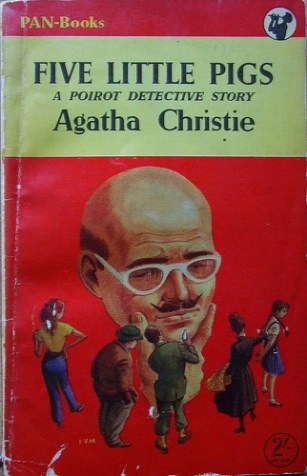
1942 – Five Little Pigs by Agatha Christie
With a baker’s dozen of mysteries to choose from, I had to narrow this down from my top three to one. Both The Hollow (1946) and Crooked House (1949) can be found on my own Top Ten Christie list, and I adore them both. But it had to be this one, which I first read as Murder in Retrospect (possibly a better title?) many years ago, and have revisited over and over again, each time finding something new.
In many ways, I see Pigs and Hollow as a matched set: a beautifully rendered group of people meet at a country mansion, with a tense romantic triangle involving an artist and an unhappy wife at the center. Both novels present a difficult challenge for Hercule Poirot: in one a group of suspects open up about events that occurred long ago, and the detective must sift through their contrasting – and not always honest – memories. In the other, the circle closes its ranks against Poirot in order to protect one of their own.
Ultimately, I had to go with Five Little Pigs because not only is it a beautiful novel of character, it contains a brilliantly clued puzzle, the best of this lot. Poirot fits best into Pigs, although I must say that while many fans think the detective does not belong in The Hollow, I say that they couldn’t be more wrong. And although The Hollow has a similarly devastating ending, the final image of the murderer of Amyas Crale leaving his home as a shell of a human being perhaps constitutes the greatest punishment Christie ever inflicted upon one of her killers.
Runner-up: Can you doubt which Christie title I chose???
Non-Christie Runner-up: I have to go with Harriet Rutland’s Blue Murder – proof that the village mystery doesn’t need to be in the least bit cozy and that the mystery need not be an antidote to the horrors of war but face them (nearly) straight on with mordant humor.
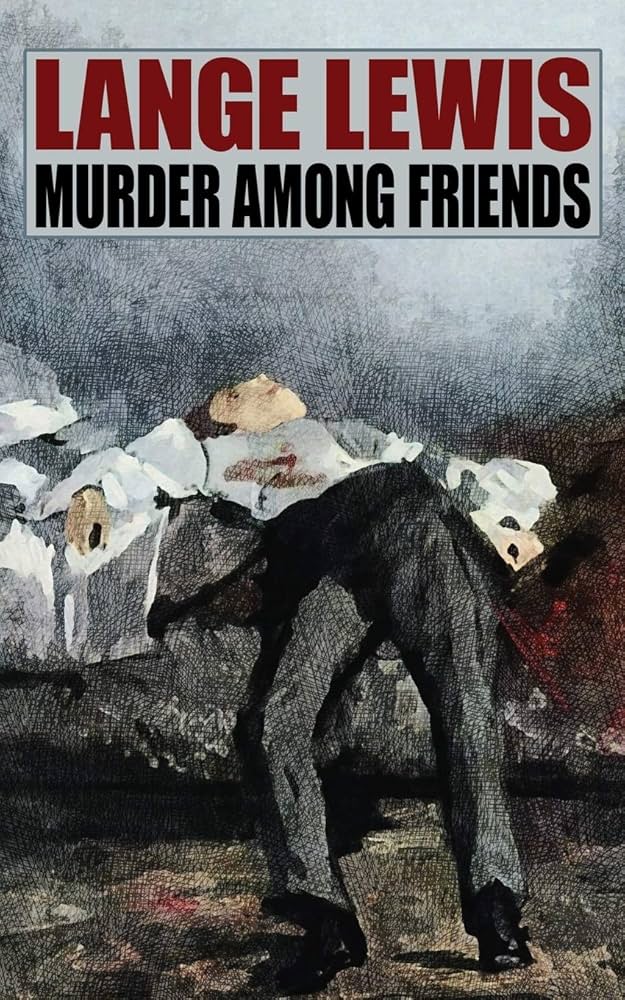
1942 – Murder Among Friends by Lange Lewis
Does Lange Lewis, who wrote five novels, deserve to be in the esteemed company of the other authors on this list? Well, thankfully, I’m not creating a Ten BEST list here, only a list of my favorites. And Lewis blew me away with her debut novel about a group of medical students, whose circle of friendship explodes after the death of a young woman.
Was Garnet Dillon one of the many victims of the serial killer known as the Black Overcoat, who has been tormenting the population of a crowded Southern California university? If so, does that mean that one of Garnet’s own friends is the monster? Or was there another reason that she died?
The solution, when it comes at the end, is surprising and heart-wrenching. It also reminds you that 1942 was not some long-ago antique era to which our modern generation can barely relate. The things that drive people to desperate measures change very little with the passage of time.
Runner-up: 1945’s The Birthday Murder is another remarkable Lewis title. Is it just as good as – Nearly as good as- a touch better than – Murder Among Friends? Why quibble? I urge you to read the pair!
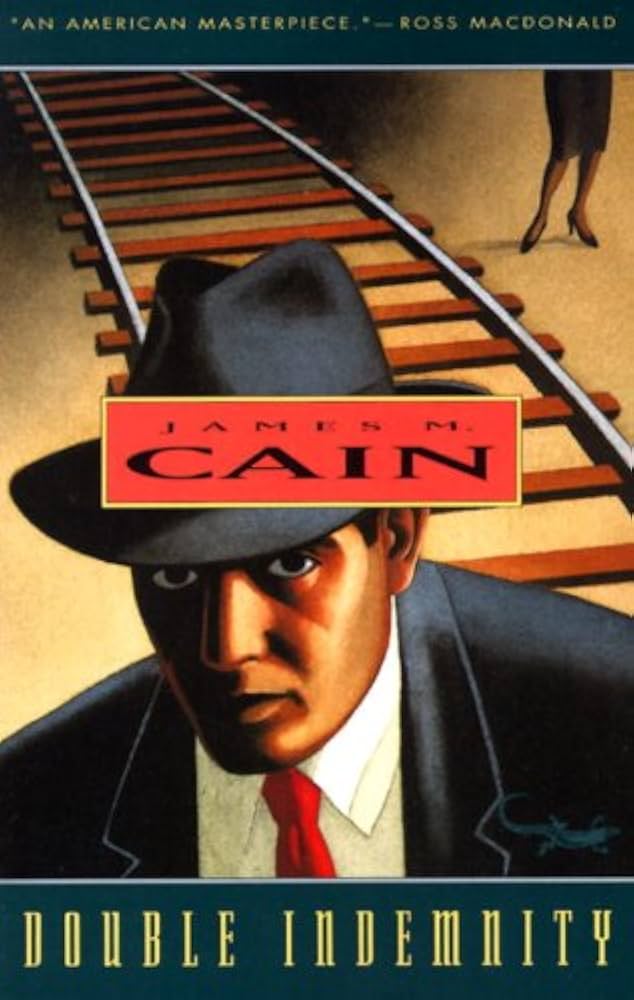
1943 – Double Indemnity by James M. Cain
We had a long conversation about this choice because it was first serialized in Liberty Magazine in 1936. Its first actual appearance as a whole book was in 1943, so my selection was given the official Book Club Seal of Approval.
Lovers Walter Huff and Phyllis Nirdlinger plot the murder of her husband in such a way that the insurance payoff will be big. Their perfect plan cannot allay the suspicions of the insurance company for which Walter works, and his own inherent decency, exacerbated by his friendship with Barton Keyes, the company’s claims manager, eats at Walter until the conspirators turn on each other.
In fairness, I name this one partly out of my undying love for the 1944 film, one of the seminal films noirs of all time. I personally think the film improves upon the book, the names alone are better!), but there are touches that Cain includes in his spare, lean prose that make this a special story. The book’s ending is truly bonkers, and while I can understand the film not including it (and that final tender moment between Walter and Keyes is one of the film’s high points), it would have been fun to see Barbara Stanwyck and Fred MacMurray leap off a boat into shark-infested waters together as a token of their . . . undying (?) love.
Runner-up: As I mentioned, I’m not a huge hard-boiled fan. And finding a relationship between Cain’s book and this is like finding a soused heiress in a haystack. But C.W. Grafton’s 1943 debut The Rat Began to Gnaw the Rope delighted me when I read it and should amuse you as well if you have not yet heeded my past review and read it already!
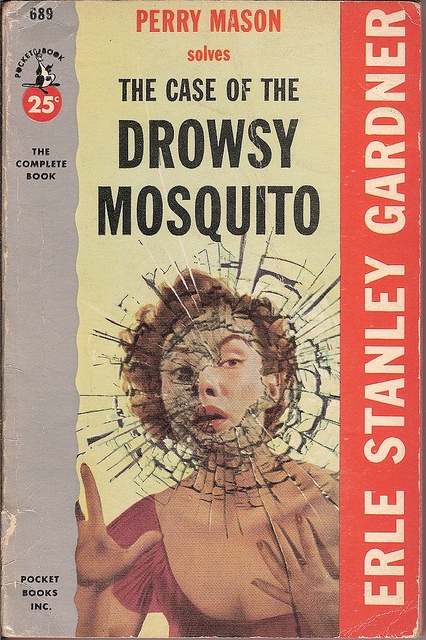
1943 – The Case of the Drowsy Mosquito by Erle Stanley Gardner
Gardner published nineteen Perry Mason mysteries during the 1940’s, and this one may be the best of this or any decade. I haven’t posted my review of it yet – that comes in July – but there’s something very special about this one, both as a mystery (Perry and Della come this close to death!) and as a treatise by the author on the best path to a good life. To that end, the book eschews Mason’s office and the dangerous streets of Los Angeles in favor of the Southern California desert. This is not the way I would choose to live, but Gardner makes it so appealing that even this city slicker had to pause a moment.
Runner-up: One of my favorite of the matrimonial titles, 1941’s The Case of the Haunted Husband is a zany joyride that showcases Perry Mason at his most gallant.

1944 – Green for Danger by Christianna Brand
Brand is one of the few authors in my top tier of favorites who debuted in the 40’s. She also is the least prolific, at least as far as mysteries go, so people tend to have their very favorite titles. I have two, and this is one of them. Others can argue for Death of Jezebel or Suddenly at His Residence, but I will not be swayed.
A gripping and clever closed circle mystery set against the background of war, specifically a military hospital in the countryside dealing with the incessant enemy bombings from overhead. A group of doctors and nurses operate on a kindly mailman who was hit by a bomb, and he dies. Enter Inspector Cockrill, who exposes the tragedy for the murder it was and exposes one of the most tragic killers of the Golden Age. Brand was not one to gather all the suspects together at the end and let things conclude gracefully. Once the killer is unmasked here, all hell breaks loose in a stunning climax.
Bonus points to director Sidney Gilliat for getting the book so right on film.
Runner-up: My prediction was that Book Club would divide between Green for Danger and 1948’s Death of Jezebel. (Yup!)There is no denying the cleverness from start to finish of this later title, made juicier by how hard it was to find until the British Library republished it! The impossibility hinges on perhaps the most macabre trick in the history of impossibilities (but hey! I’m no expert!) and I loved this one – except the characters and setting simply do not sing for me the way they do in Green.
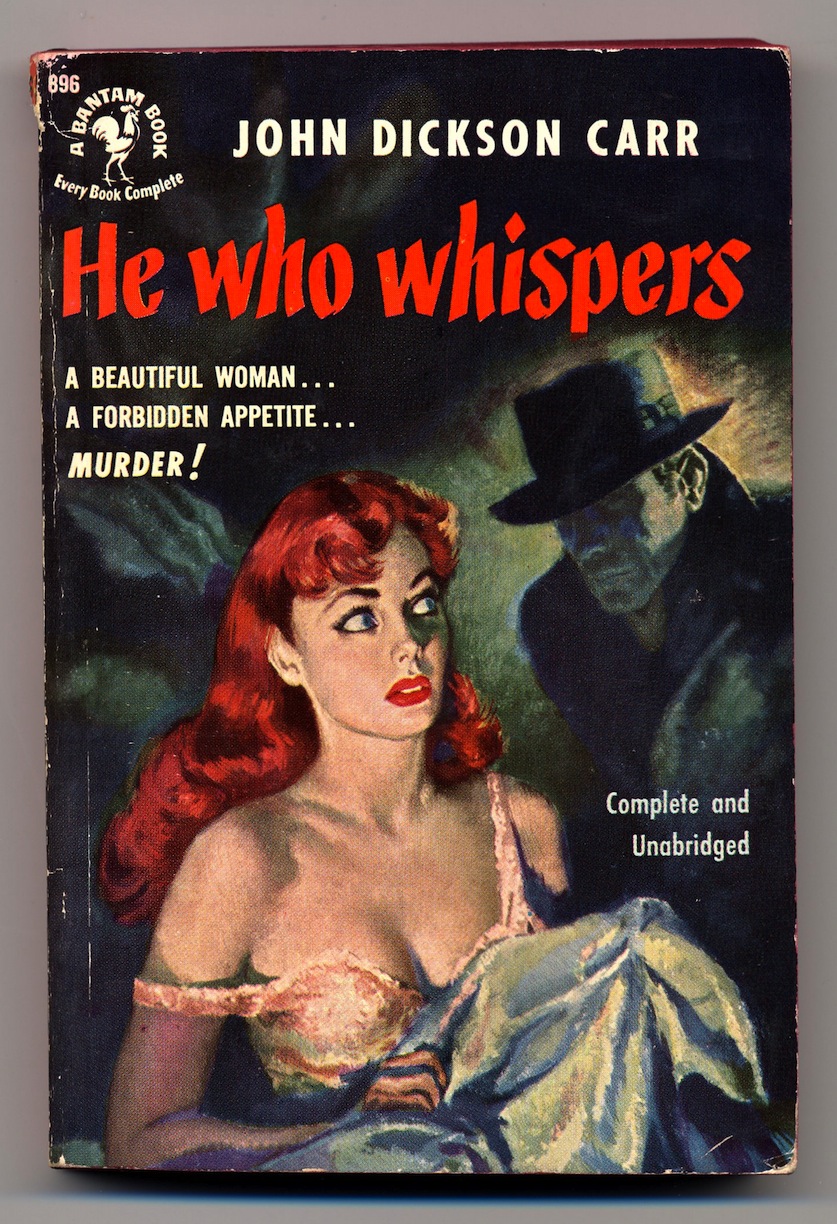
1946 – He Who Whispers by John Dickson Carr
How do you even pick your favorite Carr/Carter Dickson of the 40’s?!? The list of possible suspects is way too long, from the crack-up humor of The Case of the Constant Suicides to the perfection of the set-up in Till Death Do Us Part, from the wartime perfection of Nine – and Death Makes Ten to the tragic shocker of an ending in She Died a Lady.
Ultimately, for me, it’s no contest. From the starting moments, set at a sort of Detection Club knock-off, to the final page that manages to utterly surprise you even though the mystery is completely over, He Who Whispers has a haunting quality that grows and grows. In Fay Seton, Carr has created perhaps his most fascinating woman, who may or may not be an actual vampire! Once Carr reveals her true nature, he dares his 1940’s audience (and all who follow) to judge her.
As sometimes happens to me with Carr, I spotted the killer in the early moments – but had no idea what the heck was going on! For atmosphere, for character, and for an emotional gut punch, you can’t do much better than this.
Runner-up: Like Christie, Carr had an amazing run during the 1940’s. I’m not fully read up on all the titles, but I have a soft spot for 1943’s She Died a Lady. Yes, it’s set in the latter half of Sir Henry Merrivale’s career, making it necessary to put quotes around the term “hilarious” hijinks. But it contains a denouement at least as devastating as He Who Whispers, making it another of the few Carr/Dickson titles where the story resonates long after you close the book for the last time.
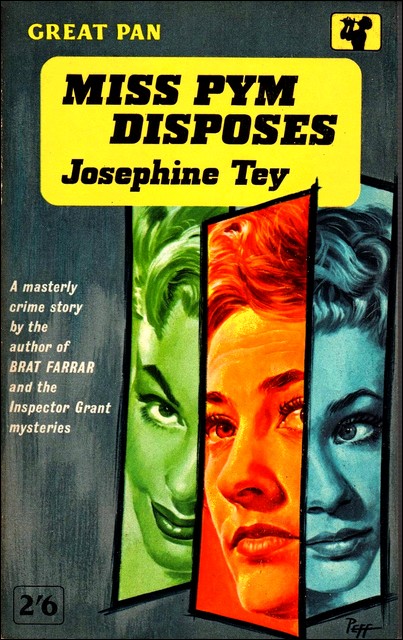
1946 – Miss Pym Disposes by Josephine Tey
Continuing the theme of mysteries that shake you to the core, this was my first taste of Josephine Tey. It is a book that divides mystery fans strongly, based on their reactions to the title character, a private investigator of dubious skill, and to the nature of the mysteries she attempts to solve. Miss Pym’s snooping around a prestigious girl’s school yields all sorts of dramatic pay dirt, along with an ending that leaves you a little bruised.
Next year will mark ten years since I read this, and it still haunts me. I honestly cannot wait to tackle it again!
Runner-up: What is so cool about Tey is how different one book is from another. (I say this after having read two of them!!) The other Tey I’ve read is easy to recommend: 1948’s The Franchise Affair is as much about the vacillating sympathies of an easily swayed community as it is about an intriguing crime and court case. If you only read one Tey, read Miss Pym. But why stop there???
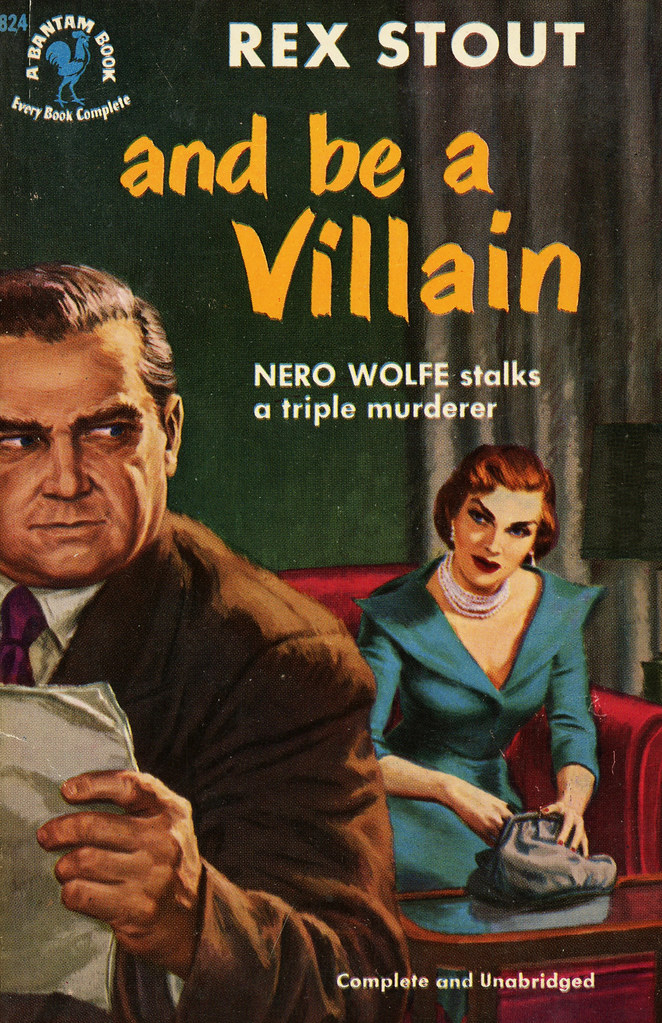
1948 – And Be a Villain by Rex Stout
Stout got so involved in the wartime effort that his novel production waned during the 40’s. He wrote only nine books, of which I have only read a few. So don’t take my word here as gospel for what was the best Nero Wolfe novel of the 40’s. Instead, look at And Be a Villain for its extra importance to the Wolfe canon.
Stout’s detective has strong ties with Sherlock Holmes. (Haven’t I read somewhere the theory that Nero was Sherlock’s son or some other sort of descendant?) One thing the two famous sleuths share is an arch-villain. For Holmes it was Professor Moriarty, while Nero Wolfe has faceoff with gangster Arnold Zeck that begins here, picks up steam in 1949’s The Second Confession and reaches its dramatic climax in 1950’s In the Best Families.
This first case has the added bonus of its setting: a murder committed during a popular radio show. And yes, Arnold Zeck had a short career for a super-villain, but Moriarty didn’t last long either. Consider this trilogy a pivotal moment in the Wolfe biography, and And Be a Villain might just be the most charming novel of the three. (I confess to reading the Zeck trilogy long before I started blogging. One of these days, a re-read will be in order . . .)
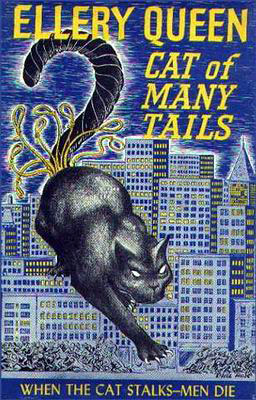
1949 – Cat of Many Tails by Ellery Queen
I recently reread this one for the third or fourth time for last year’s the Reprint of the Year contest (I’m happy to say it placed second, only losing out to my favorite Christianna Brand novel – so who can complain?) Not only is it one of the best serial killer mysteries of all time, but it is a pivotal moment of crisis in Ellery Queen’s career, one that began seven years earlier with the author/detective’s first visit to Wrightsville (Calamity Town) and which left Ellery an emotional wreck at the end of the previous book, the shocking Ten Days Wonder. Ellery begins this novel convinced he will never detect again, and by the end of the Cat’s reign of terror during a blistering New York summer, he has fled America in search of psychiatric help. (Something a lot of us are pondering these days!!!)
I think I have had my say about this one, but if it hasn’t moved you to pick up the book and read it, you might want to look for a little therapy yourself!
Runner-up: This is hard! I’m definitely a 1940’s EQ fan, and Cat is actually the culmination of a decade-long arc of great emotional stress and growth for the protagonist, his creators, and the mystery genre at large. It begins in 1942 with Calamity Town, Ellery’s first sojourn to Wrightsville, and as heartbreaking a story as you’re going to find. It continues through two more novels set in that less-than-idyllic village paradise, culminating in Ten Days Wonder, the solution of which charts a new course for the brand. But there is also a break: There Was an Old Woman (1943) is a screwball throwback to the Golden Age it is leaving behind, and it is a delight. You’ll have to make your own choice; sorry I couldn’t be of more help!
And those are my picks for the 1940’s. The discussion we had about our lists over at Book Club was a pure delight. (Keep your eye out for some other lists on other blogs – Kate’s is a five-parter!!!!!.) And while we’re moving back to a book a month in April – Rufus King is next up on the list (as you may remember, I jumped the gun and read Murder by the Clock last month!) – I hope we get to have some more general discussions like this one. It’s the perfect setting for it.
 Ah Sweet Mystery!
My top ten from the 1940s:
He Who Whispers – JDC (1946)
5 Little Pigs – Christie (1942)
10 Days Wonder – EQ (1948)
30 Days to Live (aka The Mouse who Wouldn’t Play Ball) – Anthony Gilbert (1943)
Suddenly at His Residence – Christianna Brand (1946)
Swan Song – Edmund Crispin (1947)
Rim of the Pit – Hake Talbot (1944)
Red Right Hand – Joel Townsley Rogers (1945)
Home Sweet Homicide – Craig Rice (1944)
Wilders Walk Away – Herbert Brean (1948)
I like all of your choices as well, although I admit I haven’t read that Tey novel. Might need to check that one out.
LikeLiked by 2 people
I’ve read and enjoyed so many of the books on your list. I’ve got the Rice, Brean and Stagge on my shelves waiting to be read!!
LikeLike
I can’t argue with any of your choices. You have picked some excellent books. The quality of your runner-ups demonstrate that as well.
Here is my list of some favorites trying to limit to one book per year and one author per that decade. I wasn’t wholly successful leading to two choices for 1943 and two for Carr:
1940 – Nine Times Nine – Anthony Boucher
1941 – The Case of the Abominable Snowman – Nicholas Blake
1942 – Diabolic Candelabra – E.R. Punshon
1943 – The Scarlet Circle – Jonathan Stagge, She Died a Lady – Carter Dickson
1944 – Rim of the Pit – Hake Talbot
1945 – The Birthday Murder – Lange Lewis
1946 – He Who Whispers – John Dickson Carr
1947 – Waltz into Darkness – Cornell Woolrich
1948 – The Death of Jezebel – Christianna Brand
1949 – Crooked House – Agatha Christie
LikeLiked by 1 person
Another great list, Scott. The task of limiting these lists to ten is impossible, of course, but it leads to great discussions and great recommendations! It was fantastic to realize that many of the books on there’ lists have been on my TBR so long that I had forgotten I own them!!!!!
LikeLike
some great authors here!
This is also how I discovered the amazing Woolrich!
LikeLiked by 1 person
Pingback: CHARLOTTE’S WEB: An Object Lesson in Domestic Suspense | Ah Sweet Mystery!
Pingback: SIX SKIDOO: My Favorite Mysteries of the 1920’s | Ah Sweet Mystery!